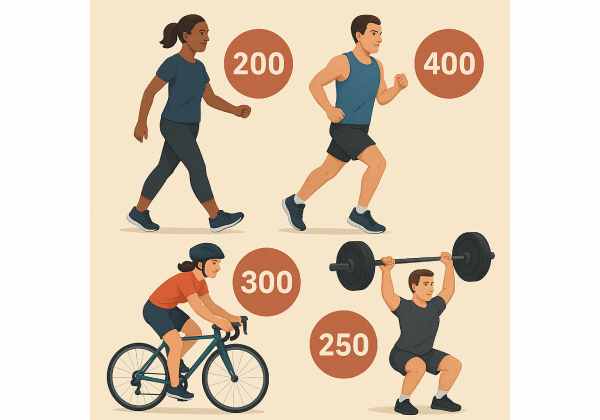
Calories burned during exercise can vary a lot, even when two people do the same workout. Body weight, pace, incline, resistance, fitness level, and how hard you are really working all change the number. That is why calorie estimates are useful, but they are still estimates.
This guide explains how calorie burn is typically calculated, what common exercises burn in realistic ranges, and how to use those numbers without overestimating what a workout “earned.” You will also see why higher calorie burn per minute does not automatically make an exercise better for fat loss, and how to combine activity, nutrition, and recovery in a way that actually works.
Table of Contents
- How calorie-burn estimates actually work
- Estimated calories burned in 30 minutes
- Which exercises burn the most calories
- Why the same workout burns different calories
- How to use calorie-burn numbers for weight loss
- Best choices for beginners, busy people and bad knees
- Building a weekly plan that actually works
How calorie-burn estimates actually work
Most exercise calorie estimates are based on METs, short for metabolic equivalents. In simple terms, a MET value describes how much energy an activity uses compared with resting quietly. A higher MET means higher energy demand.
A practical formula looks like this:
Calories burned ≈ MET × body weight in kilograms × hours performed
That sounds technical, but the idea is straightforward. If an activity is more intense, done longer, or done by a heavier person, calorie burn tends to be higher.
Here is why estimates differ so much in real life:
- Body weight matters. A heavier person usually burns more calories doing the same task at the same pace because moving more mass costs more energy.
- Intensity matters. A casual bike ride and a hard cycling session are not remotely the same.
- Terrain and resistance matter. Walking uphill, using treadmill incline, rowing harder, or cycling against more resistance all raise energy cost.
- Technique matters. Efficient runners or cyclists may burn slightly less than less efficient movers at the same pace.
- Devices are not perfect. Watches, cardio machines, and apps often use formulas that may not match your actual effort.
This is why calorie-burn tables should be read as rough guides, not precise measurements. They are good for comparing one activity to another and for planning workouts. They are not good for deciding that you “earned” exactly 427 calories.
Another important point is that calorie burn during exercise is only part of the weight-loss picture. Formal workouts help, but they work best when paired with daily movement and a reasonable calorie deficit. A session that burns 250 to 400 calories can absolutely help, but it does not override consistently high food intake.
It also helps to separate calories burned per minute from calories burned per week. Running may burn more per minute than walking, but walking is easier to do more often and for longer. That means someone who walks daily may burn more total calories over a week than someone who runs once or twice and then skips the rest.
That is the mindset to use throughout this article. The best calorie-burning exercise is not just the one with the biggest number on paper. It is the one you can perform safely, repeat often, and recover from well enough to keep doing over time.
Estimated calories burned in 30 minutes
The table below gives approximate calorie-burn estimates for common exercises performed for 30 minutes at a steady effort. These are rounded figures based on standard MET-style estimates, so think of them as planning numbers rather than exact measurements.
| Exercise | 125 lb | 155 lb | 185 lb |
|---|---|---|---|
| Walking, moderate pace | 110 | 135 | 160 |
| Walking, brisk pace | 135 | 170 | 200 |
| Running, about 6 mph | 265 | 325 | 390 |
| Cycling, 10 to 12 mph | 195 | 240 | 285 |
| Cycling, 12 to 14 mph | 225 | 280 | 335 |
| Elliptical, moderate effort | 140 | 175 | 210 |
| Swimming laps, moderate effort | 165 | 205 | 245 |
| Rowing machine, vigorous effort | 205 | 255 | 305 |
| Strength training, general session | 100 | 125 | 145 |
| Circuit-style resistance training | 165 | 205 | 245 |
A few practical takeaways jump out immediately.
First, pace and effort change the number fast. Brisk walking burns much more than strolling. Faster cycling burns much more than easy spinning. A hard rowing session can rival or beat many other cardio options.
Second, body weight changes the estimate more than many people realize. Someone at 185 pounds may burn roughly 40 to 80 more calories than someone at 125 pounds in the same 30-minute session, depending on the activity.
Third, strength training often burns fewer calories during the workout than running, rowing, or harder cycling. That does not make it a poor choice. It just means its main value is different. Resistance training helps you hold onto muscle, improve body composition, and stay stronger while dieting. If you want a simple starting point, a 3-day strength training plan is often enough to make a real difference.
If you want to turn the table into longer-session estimates, a simple shortcut works: if pace and effort stay similar, 60 minutes usually burns about double the 30-minute number. That is not exact, because fatigue and pacing can drift, but it is a reasonable planning method.
For example:
- brisk walking for 60 minutes at 155 pounds would be about 340 calories
- running at about 6 mph for 60 minutes at 155 pounds would be about 650 calories
- moderate cycling for 60 minutes at 155 pounds would be about 480 calories
These numbers are useful for comparison, but they are still only one piece of the picture. A lower-burning activity you do five times per week often beats a higher-burning activity you only do when motivation is perfect.
Which exercises burn the most calories
If the only goal is calories burned per minute, vigorous activities usually rise to the top. Running, hard rowing, fast cycling, jump rope, steep stair work, and high-effort circuits all tend to produce high numbers.
But there is an important distinction between highest calorie burn per minute and best overall fat-loss tool.
Here is a simple way to think about common options.
High calorie burn per minute
These usually rank near the top:
- running
- vigorous rowing
- hard cycling
- jump rope
- steep stair climbing or stair machine work
- hard interval sessions
These are powerful tools, but they also demand more from your joints, lungs, and recovery. They can be great if you tolerate them well.
Moderate calorie burn with better sustainability
These often work better for the average person:
- brisk walking
- incline treadmill walking
- moderate cycling
- elliptical training
- swimming
- circuit training
This middle category is where many strong weight-loss plans live. The calorie burn is meaningful, the fatigue is usually manageable, and consistency tends to be better.
Lower calorie burn per minute but still valuable
These should not be dismissed:
- easy walking
- standard strength sessions
- gentle mobility work
- light home cardio
- daily step accumulation
This is where people often make a mistake. They ignore activities that do not look dramatic enough, even though those activities may be the easiest to repeat week after week. That is one reason walking for weight loss works so well for many people. It does not win the “most calories per minute” contest, but it is accessible, low-impact, and easy to do often.
The same logic applies when comparing cardio styles. High-intensity intervals may burn more in a short session, but they are not automatically better than steady work. The smarter question is whether the extra intensity improves your weekly output or just leaves you wiped out. That is why comparing HIIT and steady-state cardio is more useful than asking which one sounds tougher.
Running deserves special mention because it usually burns calories quickly. For many people, it is one of the most efficient cardio tools available. But the efficiency only matters if your body can handle it and you keep doing it. If running causes shin pain, knee pain, or dread, a beginner running plan may help you build tolerance gradually instead of forcing too much too soon.
The real answer is that the “best” calorie-burning exercise is usually the hardest one that you can recover from consistently, not the hardest one in the abstract.
Why the same workout burns different calories
People often get confused when one app says they burned 280 calories, a treadmill says 410, and a watch says 330. This happens because calorie burn is highly sensitive to variables that many tools estimate imperfectly.
Here are the biggest reasons numbers change.
Body weight and body size
This is the easiest factor to understand. More body mass generally means more energy required to move. That is why calorie tables are often shown at different body weights.
Actual effort
Two people can “cycle for 30 minutes,” but one may coast comfortably while the other pushes a demanding pace. Those are not the same workout.
Speed and incline
Walking at 3 mph on level ground is very different from walking at 3.5 mph on incline. A treadmill session can become much more demanding without becoming a run.
Resistance and terrain
Cycling outdoors against wind or hills often burns more than casual indoor pedaling. Rowing harder dramatically changes calorie cost. So does hiking with elevation.
Efficiency
More trained exercisers can become more economical at certain movements. That is usually a good thing for performance, but it can mean they do not always burn as much as a less efficient person at the same absolute pace.
Machine and wearable formulas
Some devices use general equations based on age, sex, body size, heart rate, and activity type. Those formulas can be directionally useful, but they are not individualized enough to be exact.
This is one reason many people overestimate how much their workouts contribute to fat loss. It is also why you should avoid eating back every machine-displayed calorie. Even if the estimate is not wildly wrong, it is rarely precise enough to use like a bank statement.
The better use of calorie-burn numbers is comparative:
- running usually burns more per minute than walking
- brisk walking usually burns more than easy walking
- harder cycling usually burns more than casual cycling
- a hilly hike usually burns more than a flat stroll
That kind of comparison is useful. It helps you choose how hard to train and how long to go.
It also helps explain why low-impact options can be so effective. If your knees do not love running, you may be able to do more total work with cycling, elliptical sessions, or other joint-friendly cardio options. A lower-impact mode that lets you train four times per week can outperform a higher-impact mode that keeps getting interrupted.
The biggest lesson is simple: calorie burn is not fake, but it is noisy. Treat it like a helpful estimate, not a precise score.
How to use calorie-burn numbers for weight loss
Calorie-burn estimates are useful when they help you make better decisions. They become harmful when they create false confidence, compensation eating, or an obsession with “earning” food.
The best ways to use them are practical.
Use them to compare options
If you are deciding between a 30-minute easy walk and a 30-minute brisk walk, calorie estimates can show that pace matters. If you are choosing between moderate cycling and harder intervals, the comparison helps you understand the tradeoff.
Use them to plan volume
A person doing 150 minutes of brisk walking per week may burn far less than someone doing 300 minutes. That sounds obvious, but it matters. Weekly totals often matter more than any single session. A guide on how much cardio per week for weight loss is often more helpful than chasing the most intense workout once in a while.
Do not use them as permission slips
This is one of the biggest fat-loss traps. A workout burns a few hundred calories, then the post-workout coffee drink, snack, or “treat meal” quietly wipes out most or all of the deficit. This is not a reason to avoid exercise. It is a reason to avoid over-crediting it.
Remember that appetite response varies
Some people feel normal after exercise. Others get hungrier, especially after long or intense sessions. That is why it helps to have a plan for meals and recovery instead of relying on post-workout impulse decisions.
Pair exercise with protein and reasonable meals
If you train regularly while trying to lose fat, protein becomes even more important. It helps with fullness and helps preserve lean mass, especially if you are also resistance training. A useful starting point is to review protein intake for weight loss so your training supports your body composition instead of just creating extra hunger.
The most effective mindset is this: exercise helps create and support a calorie deficit, but it usually does not carry the whole job by itself. For most people, exercise makes fat loss easier, healthier, and more sustainable. It does not excuse everything else.
That may sound less exciting than huge calorie-burn claims, but it is more honest and much more useful.
Best choices for beginners, busy people and bad knees
The highest calorie-burn activity is not always the smartest first choice. The best option depends on your body, schedule, and tolerance for impact.
Best for beginners
Beginners usually do best with:
- walking
- incline treadmill walking
- stationary cycling
- elliptical sessions
- simple full-body strength work
These options are easier to recover from and much easier to repeat consistently. They also let you build fitness without feeling crushed.
Best for busy people
When time is tight, efficiency matters. Good options include:
- brisk 20- to 30-minute walks
- short bike intervals
- rowing intervals
- circuit-style resistance training
- lunch-break treadmill sessions
Busy people often get more results from simple routines repeated often than from elaborate plans they cannot follow. A short walk before work, another after lunch, and a couple of gym sessions per week can add up quickly.
Best for joint concerns
If you have knee pain, ankle issues, or just do not tolerate impact well, lower-impact modes are often the best path:
- cycling
- elliptical training
- swimming
- rowing with good technique
- incline walking if tolerated
These can still burn a meaningful number of calories without the pounding of running or jumping.
Best for people who get bored easily
Some people do better rotating modes:
- walking outdoors some days
- cycling or rowing on others
- one interval session
- one longer steady session
- two strength workouts
Variety can help adherence without turning the plan into chaos.
It also helps to think beyond formal workouts. If you work at a desk, small activity bursts during the day can matter a lot. That is why a desk-job movement plan can complement structured exercise so well. Standing up, walking briefly, and avoiding long inactive stretches can improve your daily energy expenditure without feeling like another full workout.
The right exercise is the one that matches your present situation. That matters more than what the fittest person in the room happens to be doing.
Building a weekly plan that actually works
A good weight-loss routine does not need the maximum-calorie activity every day. It needs a balance of calorie burn, recovery, muscle retention, and consistency.
For most people, a strong weekly setup looks like this:
| Day | Main focus | Why it helps |
|---|---|---|
| Monday | Full-body strength training | Supports muscle retention and body composition |
| Tuesday | Brisk walk or moderate cycling | Adds calorie burn with manageable fatigue |
| Wednesday | Full-body strength training | Builds consistency and preserves strength |
| Thursday | Longer steady cardio session | Increases weekly expenditure |
| Friday | Optional intervals or easier cardio | Adds intensity if recovery is good |
| Saturday | Long walk, hike, bike ride, or active hobby | Helps weekly totals without feeling overly formal |
| Sunday | Rest or light recovery walk | Improves recovery and keeps movement habits going |
This kind of plan works because it does not rely on one single tool.
- Strength training helps you keep muscle while dieting.
- Cardio increases calorie expenditure and fitness.
- Walking and general movement raise activity without wrecking recovery.
A few final rules make the plan better:
- Start lower than you think you need.
It is better to begin with a plan you can nail than one you abandon in ten days. - Progress gradually.
Add time, pace, incline, or frequency bit by bit rather than jumping straight to a high-volume schedule. - Protect recovery.
Hard sessions work better when sleep, food quality, and rest are decent. A basic warm-up and recovery routine also helps you stay more consistent. - Track trends, not perfect numbers.
Calories burned, steps, workout minutes, and body weight all have noise. What matters is the trend over several weeks. - Pick exercises you can imagine doing next month.
That is often a better filter than asking which exercise burns the absolute most calories right now.
The bottom line is straightforward. Calorie-burn estimates are useful for comparing activities and building a realistic plan. But the winning strategy is rarely just “pick the hardest workout.” It is choosing a mix of movement you can sustain long enough for those calories to add up.
References
- WHO guidelines on physical activity and sedentary behaviour 2020 (Guideline)
- 2024 Adult Compendium of Physical Activities: A third update of the energy costs of human activities 2024 (Reference Update)
- Physical activity and exercise for weight loss and maintenance in people living with obesity 2023 (Review)
- Effect of exercise training on weight loss, body composition changes, and weight maintenance in adults with overweight or obesity: An overview of 12 systematic reviews and 149 studies 2021 (Systematic Review)
- Effect of resistance exercise on body composition, muscle strength and cardiometabolic health during dietary weight loss in people living with overweight or obesity: a systematic review and meta-analysis 2025 (Systematic Review)
Disclaimer
This article is for general educational purposes only and is not a substitute for medical advice, diagnosis, or treatment. If you have heart disease, major joint pain, balance problems, or a medical condition that affects exercise tolerance, speak with a qualified healthcare professional before starting or changing an exercise program.
If this article was useful, please share it on Facebook, X, or your preferred platform to help someone else build a smarter weight-loss routine.