When your knees hurt, even basic cardio can start to feel like a bad trade. You want the calorie burn, the fitness boost, and the routine that helps with weight loss, but you do not want every session to end with more soreness, stiffness, or swelling. That tension is why so many people either stop moving altogether or keep forcing workouts that clearly are not working.
The better approach is not to avoid cardio. It is to choose forms of cardio that match how your knees actually respond to load. Low-impact exercise can help you stay active, improve fitness, and support fat loss without the repeated pounding that often comes with running, jumping, or high-volume stairs. The key is knowing which options are truly joint-friendlier, how to scale them, and how to tell the difference between a normal training response and a workout your knees are rejecting. This guide walks through the best low-impact cardio choices, how to pick the right one, and how to build a plan you can keep doing.
Table of Contents
- Why knee-friendly cardio still matters
- Best joint-friendly cardio options
- How to pick the right option
- How to start without a flare
- Strength and mobility that help
- When knee pain needs medical review
Why knee-friendly cardio still matters
Knee pain has a way of shrinking your world. At first it changes your workouts. Then it changes your daily movement. You stop taking the long route, avoid stairs, skip walks, and think twice before committing to exercise because you are already calculating how your knees will feel afterward. Over time, that reduction in movement can make weight loss harder, lower your fitness, and leave the joint feeling even stiffer.
That is why low-impact cardio matters so much. It gives you a way to keep the “cardio” part of your plan without constantly provoking the joint. For weight loss, that is important. Cardio does not have to be brutal to be useful. It needs to be repeatable. A joint-friendly session you can do four times a week is far more valuable than a high-impact workout you attempt once, limp away from, and avoid for the next ten days.
It also helps to define what “bad knees” usually means in real life. For one person, it is knee osteoarthritis with morning stiffness and pain on longer walks. For another, it is pain around the kneecap when using stairs, a previous sports injury, extra body weight that makes impact less comfortable, or a general feeling that their knees do not tolerate pounding well anymore. Those situations are not identical, but they share a common principle: load management matters.
Low-impact does not mean zero load. Your knees still work during cycling, pool exercise, or walking. The difference is that the loading is usually smoother, less jarring, and easier to control. That makes it easier to stay active while also building tolerance. In other words, the goal is not to protect the knees by doing nothing. The goal is to find the type and amount of loading they can handle and adapt to.
This is especially relevant in a weight-loss phase. Many people think only of calories burned during the session, but the larger benefit is often that knee-friendly cardio helps you stay active enough to support the rest of your plan. It fits better with daily movement, lets you keep a more stable routine, and often leaves enough energy for strength work and meal consistency. A broader look at the best exercises for weight loss makes this clear: the most effective choice is usually the one that balances calorie burn, recovery, and adherence.
Cardio timing and type can matter, but the basics still come first. Your results will depend more on how consistently you move, eat, sleep, and recover than on any single machine or workout style. That is also why a sustainable calorie deficit usually matters more than chasing the hardest session your knees will tolerate.
Best joint-friendly cardio options
Not every low-impact workout feels the same on the knees. Some reduce impact but still involve a lot of knee bending. Others keep forces smoother but can irritate people who are sensitive in certain positions. The best option depends on how your knees react, but several choices consistently work well for many people.
A useful way to think about the options is by how easy they are to control.
- Recumbent bike
This is often the easiest entry point for people with knee pain, especially during a flare or after time off. The seat supports your body, balance is not an issue, and resistance can be adjusted in small steps. For many people, it feels less threatening than walking because you remove body-weight impact and can keep the range of motion controlled. - Upright stationary bike
Also a strong option, especially if a recumbent bike feels awkward or unavailable. Seat height matters. A seat that is too low increases knee bend and can aggravate symptoms. Many people do better when the seat is high enough that the knee remains slightly bent, not sharply folded, at the bottom of the pedal stroke. - Pool walking, water aerobics, and swimming
Water is one of the best environments for irritated knees because buoyancy reduces joint loading while still letting you move meaningfully. Pool walking and shallow-water aerobics are especially useful for people who are not confident swimmers. Swimming can work well too, although some people find certain kicks less comfortable than others. - Elliptical training
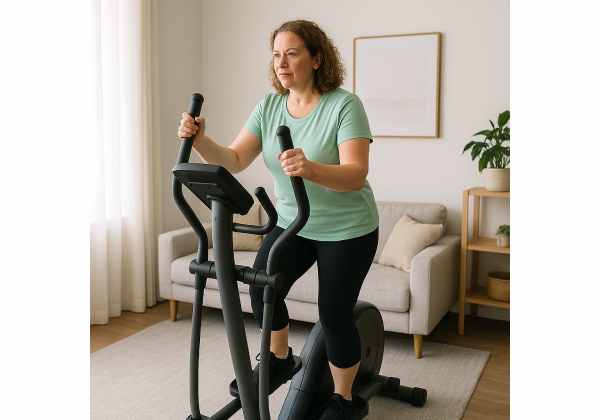
The elliptical is a good middle-ground option for people who want a more continuous cardio feel without the impact of jogging. It can be excellent when tolerated, but it is not automatically comfortable for every knee. Some people find the repeated knee bend bothersome, especially at longer stride lengths or higher resistance. - Flat walking
Walking is accessible, cheap, and easy to repeat, which makes it powerful. It is also often more tolerable than people expect when the route is flat, the pace is moderate, and the duration is built gradually. A structured walking plan for weight loss can be a better fit than random long walks that spike pain. - Outdoor or indoor cycling
Once your knees tolerate the pattern well, regular cycling can be a strong long-term option. If you want more variety than a bike in the corner of a gym, a progressive cycling plan often gives enough structure without impact.
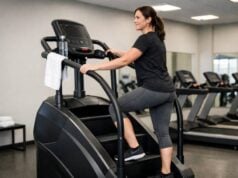
A few options deserve more caution. Rowing is low-impact, but the deep knee bend can bother some people. Stair climbers are technically not impact-heavy, yet they load the knee in a way many painful knees dislike. Jump-rope, plyometrics, and aggressive boot-camp circuits are usually poor starting points.
The best choice is not the fanciest machine. It is the one that lets you finish the session feeling worked, not punished.
How to pick the right option
The smartest low-impact cardio choice depends less on trends and more on your specific pain pattern. Two people can both say they have “bad knees” and need completely different starting points. One gets pain from impact. Another gets pain from deep knee bending. Another feels fine during exercise but swells later that night. Those details matter.
Start with one practical question: What seems to aggravate your knee most?
- If impact is the biggest issue, walking on flat ground, cycling, elliptical training, and pool work are usually more promising than jogging or step classes.
- If the knee dislikes being bent under load, a recumbent bike or flat walking may feel better than rowing, deep squats, or steep hills.
- If balance is poor or confidence is low, the bike and pool are often more comfortable starting points than outdoor walking on uneven surfaces.
- If symptoms are unpredictable, choose the mode that is easiest to adjust in real time. Machines usually win here because speed, resistance, and duration are easier to control.
It also helps to match the exercise to the goal of the day. A short cardio session for circulation and calorie burn does not need to feel like athletic training. That is why people with sore knees often do best with steady, conversational work instead of hard intervals. A zone that feels sustainable and smooth is usually the safest place to begin, which is one reason zone 2 cardio is often a practical framework.
Pain response is another major filter. Many people assume a good workout must be pain-free from start to finish, but that is not always realistic with sensitive joints. A small amount of discomfort can be acceptable if it stays mild, does not change your movement pattern, and settles back to baseline by the next day. Sharp pain, limping, a clear increase in swelling, or symptoms that linger and build from session to session are stronger signs that the current option is not the right fit or that the dose is too high.
A simple selection test can help:
- Try one low-impact option for 10 to 15 minutes.
- Keep the effort easy to moderate.
- Note how the knee feels during the session.
- Recheck later that day and the next morning.
- Repeat twice before deciding whether it is a keeper.
If the knee feels stable or slightly better after warming up, you may have found a good direction. If it feels progressively worse each time, switch options rather than forcing adaptation through stubbornness.
Warm-up quality matters too. Knees that feel stiff or unreliable at minute one often feel better at minute eight. An intentional start can change the session. A short routine focused on easy movement, gentle range of motion, and a gradual buildup of effort works much better than launching straight into working pace. That is where a solid approach to warm-up, mobility, and recovery earns its place.
Choose the option your knee can accept now, not the one you hope it should accept.
How to start without a flare
The biggest mistake people make with knee-friendly cardio is assuming “low impact” means they can start with long sessions right away. They pick the bike or treadmill, feel encouraged because the first few minutes are tolerable, and then push past the joint’s current capacity. The flare does not always happen on the spot. Sometimes it shows up six hours later, or the next morning when stairs suddenly feel worse.
A safer start is boring on purpose.
Begin with these guardrails:
- Duration: 10 to 20 minutes
- Effort: easy to moderate, roughly a pace where you could still speak in short sentences
- Frequency: 3 to 5 sessions per week
- Progression: add time before adding intensity
For many knees, the first win is simply proving you can finish a session and recover well. A 12-minute bike ride that leaves the joint calm is a better signal than a 30-minute session that leads to three days of irritation.
Intervals are often helpful early on. That might look like:
- 3 minutes easy
- 1 minute slightly brisker
- Repeat 4 to 6 times
That structure works well on a bike, treadmill, elliptical, or in the pool because it breaks the workload into manageable chunks. It also gives you repeated chances to check symptoms instead of committing to one uninterrupted block.
A few setup details make a big difference:
- On a bike, keep the seat high enough to avoid excessive knee bend.
- On a treadmill, start flat or with only a slight incline.
- In the pool, begin with walking or simple drills before more vigorous classes.
- On the elliptical, use lower resistance and shorter sessions first.
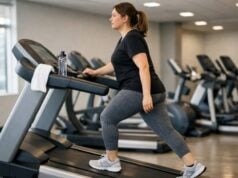
Walking deserves special mention because it is both helpful and easy to overdo. Many people do well with 10 to 15 minutes on flat ground, then build by 2 to 5 minutes every few sessions if the knee stays stable. Structured treadmill sessions can also help because speed and environment are easier to control than on streets or hills. A thoughtful treadmill walking setup is often kinder than an outdoor route with curbs, slopes, and uneven pavement.
A good weekly progression might be:
- Week 1: 12 to 15 minutes, 4 sessions
- Week 2: 15 to 18 minutes, 4 sessions
- Week 3: 18 to 22 minutes, 4 sessions
- Week 4: keep duration similar and increase pace slightly only if symptoms are calm
Do not increase duration, intensity, and frequency at the same time. That is how a manageable plan turns into a flare cycle.
Finally, judge the session by the next day, not just by the end of the workout. If your knee is notably stiffer, more swollen, or more painful the following morning, the dose was probably too high. Reduce the session length, flatten the route, lower the resistance, or choose a different option. Smart progression beats heroic progression nearly every time.
Strength and mobility that help
Cardio is only part of the solution for painful knees. If the muscles around the hips, thighs, calves, and trunk are weak or poorly coordinated, even low-impact exercise can feel less stable than it should. That does not mean you need a bodybuilding program. It means your knee usually tolerates cardio better when the rest of the chain does more of its share.
The most helpful areas to train are often:
- Glutes, which help control hip position and reduce collapse inward at the knee
- Quadriceps, which support knee control during walking, stairs, and sit-to-stand movements
- Calves, which help absorb force and improve walking mechanics
- Hamstrings and core, which contribute to overall lower-body control
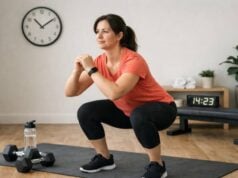
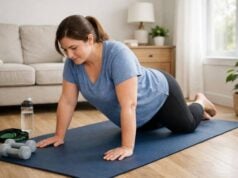
A simple twice-weekly routine can make a real difference. Good starting exercises include chair squats or sit-to-stands, glute bridges, step-ups to a low step, calf raises, and gentle banded hip work if available. You do not need a huge menu. You need a few movements you can do consistently with good form.
This matters during weight loss because knee pain can trick people into doing only cardio and skipping resistance training. That is often the wrong move. A better combination is joint-friendly cardio plus enough strength work to support the joint and preserve muscle mass. If you want ideas, glute and leg training for fat loss is often more relevant to knee comfort than another random cardio class.
Mobility also matters, but it should be targeted rather than excessive. Ankles that do not move well can push extra stress up the chain. Tight hips can make gait and step mechanics less efficient. A short routine focusing on ankle mobility, gentle calf stretching, hip flexor mobility, and controlled knee range of motion can help many people feel looser before cardio. More is not always better, though. Endless stretching rarely fixes a knee that mainly needs stronger movement patterns and better load management.
A useful weekly structure looks like this:
- Two strength sessions on nonconsecutive days
- Three to five low-impact cardio sessions
- Brief mobility work before or after workouts
- At least one easier day if your knees feel irritated
This is also why a balanced strength training plan for weight loss often improves cardio tolerance instead of competing with it. Stronger muscles do not just change how you look. They change how the knee experiences movement.
Think of strength work as the support system that makes cardio more sustainable. When the legs and hips do their job better, “joint-friendly” cardio usually becomes easier to find and easier to progress.
When knee pain needs medical review
Most people searching for low-impact cardio for bad knees do not need emergency care. They need a smarter exercise plan. But there is an important line between a manageable training problem and a knee that deserves proper assessment.
You should get the knee evaluated sooner rather than later if you have any of these:
- A recent twist, fall, or direct injury
- Significant swelling that appears quickly
- Locking, catching, or inability to fully straighten the knee
- Buckling or repeated giving way
- Pain that wakes you at night or occurs at rest
- Redness, heat, fever, or a generally unwell feeling
- Inability to bear weight normally
- Symptoms that keep worsening despite reducing training load
There is also a middle category that is not urgent but still worth addressing. If you have modified your workouts for several weeks, chosen low-impact options, progressed conservatively, and still cannot find a tolerable baseline, a sports medicine clinician or physiotherapist can usually help much faster than trial and error. They can identify whether the main issue looks more like osteoarthritis, kneecap pain, tendon irritation, mobility restriction, post-injury weakness, or something else entirely.
That matters because the “best” cardio mode can change once the underlying pattern is clearer. A knee that hates downhill walking may still love the bike. A knee that dislikes deeper flexion may prefer flat walking or pool work. A knee recovering from a recent flare may need a short-term reduction in volume before building back up. General advice gets you started. Individual assessment helps when progress stalls.
Older adults, people with multiple joint issues, and anyone with a long history of inactivity may especially benefit from a more tailored plan. In that case, it can help to combine this article’s ideas with guidance on when to talk to a doctor before a weight-loss plan, especially if pain, medications, or other health conditions are complicating exercise choices.
The encouraging part is that “bad knees” do not automatically mean the end of cardio. In many cases, it just means the end of careless cardio. With the right mode, the right dose, and the patience to build gradually, many people can get fitter, move more, and lose weight without turning every session into a test of joint tolerance.
The goal is not to prove toughness. The goal is to find the version of cardio your knees will let you keep doing.
References
- Physical Activity and Excess Body Weight and Adiposity for Adults. American College of Sports Medicine Consensus Statement 2024 (Consensus Statement)
- EULAR recommendations for the non-pharmacological core management of hip and knee osteoarthritis: 2023 update 2024 (Guideline)
- Recommendations for the management of hip and knee osteoarthritis: A systematic review of clinical practice guidelines 2023 (Systematic Review)
- The Critical Role of Physical Activity and Weight Management in Knee and Hip Osteoarthritis: A Narrative Review 2024 (Review)
- Effects of Aquatic Exercise in Older People with Osteoarthritis: Systematic Review of Randomized Controlled Trials 2025 (Systematic Review)
Disclaimer
This article is for general educational purposes only and is not a substitute for medical advice, diagnosis, or treatment. If knee pain is severe, follows an injury, causes swelling or instability, or keeps limiting your activity despite program changes, seek individualized guidance from a qualified clinician.
If this article helped you, please share it on Facebook, X, or any other platform where it may help someone find a more sustainable, joint-friendly way to stay active.