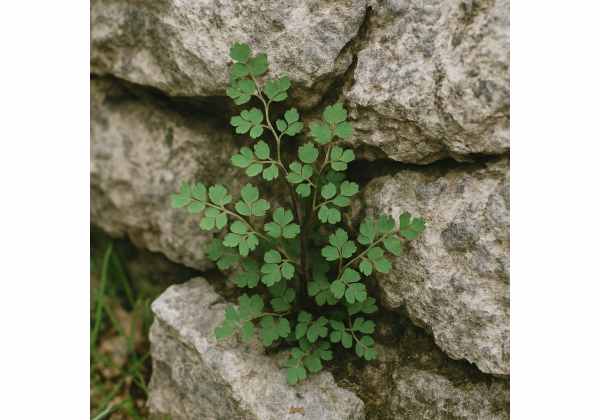
Wall Rue, or Asplenium ruta-muraria, is a small evergreen fern that grows in limestone crevices, stone walls, and rocky ledges. It is not one of the best-known medicinal herbs, yet it has a long history in European folk practice and a surprisingly interesting chemical profile. Traditional healers used it for coughs, mild urinary complaints, and “opening” stagnant conditions, while modern lab research has focused more on its flavonoids, phenolic acids, and other antioxidant compounds.
What makes Wall Rue worth a closer look is not strong clinical proof, but the combination of traditional use and early phytochemical evidence. It appears to contain bioactive compounds that may help explain its astringent, antioxidant, and mild antimicrobial reputation. At the same time, it is important to be realistic: human studies on Wall Rue itself are extremely limited, and there is no well-established modern therapeutic dose. This guide explains what Wall Rue is, what may be in it, what it might help with, how it is traditionally prepared, and where caution matters most.
Key Insights
- Wall Rue is mainly valued for traditional urinary support and old-fashioned use for cough and chest irritation.
- Its strongest modern interest comes from lab findings on antioxidant and antimicrobial activity, not from human clinical trials.
- No standardized clinical dose exists; historical preparations were often used in small servings of about 30 to 120 mL per dose.
- Avoid Wall Rue during pregnancy, breastfeeding, and with kidney disease or prescription diuretics unless a clinician advises otherwise.
Table of Contents
- What Wall Rue Is and Why It Stands Out
- Wall Rue Key Compounds and Medicinal Properties
- Wall Rue Health Benefits and What the Evidence Really Suggests
- Traditional Uses and Practical Ways to Prepare It
- Wall Rue Dosage Timing and Duration
- Safety Side Effects and Who Should Avoid It
- Interactions Quality Tips and When Medical Care Matters
What Wall Rue Is and Why It Stands Out
Wall Rue is a compact fern in the Aspleniaceae family. Unlike leafy culinary herbs or flowering medicinal plants, it is a rock-loving fern with small divided fronds and a tough, wiry habit. It often grows where other plants struggle: in dry mortar joints, old stonework, limestone crevices, cliffs, and shaded rocky pockets. That habitat helps explain part of its appeal in traditional herbalism. Plants that survive exposed, mineral-rich, low-soil environments often develop dense protective chemistry, and Wall Rue appears to fit that pattern.
Botanically, Asplenium ruta-muraria is best known as an ornamental wild fern rather than a mainstream remedy. Even so, older European herbals gave it a place among “opening,” astringent, or respiratory-support herbs. It was described as useful for cough, shortness of breath, certain urinary complaints, and children’s frailty in older language that does not translate neatly into modern diagnosis. Some traditional writers also associated it with hair support and topical use for minor skin complaints.
That history should be read carefully. Traditional use does not prove effectiveness, and older herbal language often grouped many symptoms together in broad categories such as “stitches,” “obstructions,” or “gravel.” Still, those descriptions give useful context for why Wall Rue keeps appearing in historical materia medica.
Part of what sets Wall Rue apart is that it is better understood as a niche heritage herb than as a modern first-line supplement. It is not widely standardized. It is rarely sold in large commercial volumes. It does not have the research base of herbs such as echinacea, peppermint, or valerian. Instead, it sits in a smaller category of plants that are interesting because they combine folk use, distinctive habitat, and promising chemical constituents.
That also means sourcing matters. Wild populations may be sparse in some regions, and harvesting from walls, ruins, or wild rocky habitats is not a good default choice. Accurate identification can be tricky for non-specialists because several small ferns can resemble one another. For most readers, Wall Rue is best approached through properly identified, ethically sourced dried material rather than casual foraging.
In practical terms, Wall Rue stands out for three reasons:
- It has a long, if modest, traditional record in European herbal practice.
- Its chemistry suggests genuine biological activity, especially in the polyphenol-rich category.
- Its evidence base remains preliminary, so cautious use is more appropriate than confident self-prescribing.
If you want a useful mindset, think of Wall Rue as an herb of historical interest and measured potential, not as a proven all-purpose remedy. That balanced view helps you appreciate what it may offer without asking it to do more than the evidence supports.
Wall Rue Key Compounds and Medicinal Properties
The most important modern reason Wall Rue attracts attention is its chemistry. Research on Asplenium ruta-muraria and related Asplenium species points to a mix of flavonoids, phenolic acids, xanthones, sterol-like compounds, and other plant metabolites that may help explain its traditional reputation.
Among the most discussed constituents are caffeic-acid-related compounds and flavonoid glycosides. Studies have identified caffeic acid derivatives and kaempferol-linked compounds in Wall Rue, along with beta-sitosterol and other minor constituents. More recent summaries of Bulgarian work on Asplenium species also highlight rutin, epigallocatechin, epicatechin, gallic acid, caffeic acid, ferulic acid, mangiferin, and mangiferin glucoside in Asplenium ruta-muraria or closely studied paired species. That is a chemically interesting profile because these classes of compounds often show antioxidant, membrane-protective, and mild antimicrobial behavior in lab models.
From a practical herbal perspective, the plant’s medicinal properties are usually described in four broad ways.
First, Wall Rue appears to have antioxidant potential. In plain language, that means its phenolic compounds may help neutralize unstable molecules and reduce oxidative stress in laboratory systems. This does not automatically translate into a dramatic effect in the human body, but it does support the idea that the plant is more than a folkloric curiosity.
Second, it may have astringent action. Astringent plants are often rich in polyphenolic substances and are traditionally used when tissues feel too loose, overly moist, or mildly irritated. That old framework partly explains why Wall Rue was used for some respiratory complaints and some external applications. Astringency is not a cure-all, but it can be relevant for soothing and tightening irritated surfaces.
Third, there is preliminary antimicrobial interest. Lab studies on Asplenium extracts have shown activity against certain microbes and biofilms. These results are encouraging, but they are still preclinical. They suggest potential rather than a ready-made herbal antibiotic.
Fourth, some sources describe mild diuretic or deobstruent properties. In traditional terms, that means helping fluid movement and easing the sense of urinary sluggishness. Modern language should keep this claim modest. Wall Rue is not a prescription diuretic, and it should not be used to self-treat serious swelling, infection, or stones.
A helpful way to interpret Wall Rue’s chemistry is to avoid the “one herb, one miracle ingredient” trap. Wall Rue is probably best understood as a multi-compound plant whose effects come from the combined influence of several phytochemical groups rather than one star molecule. That is common in herbal medicine, but it also makes standardization harder.
What these compounds do not prove is equally important. They do not prove that Wall Rue treats asthma, clears kidney stones, reverses hair loss, or replaces evidence-based treatment for infections. They simply show that the fern contains substances that make those old uses plausible enough to study further.
So when people talk about Wall Rue’s medicinal properties, the most accurate summary is this: it is a polyphenol-rich fern with credible antioxidant chemistry, possible astringent and antimicrobial actions, and traditional use that deserves cautious respect rather than inflated claims.
Wall Rue Health Benefits and What the Evidence Really Suggests
When readers search for Wall Rue health benefits, they usually want a clear answer: what does it actually help with? The honest answer is that Wall Rue has several traditionally claimed benefits and a few laboratory-supported directions, but very little direct human clinical evidence. That means the best way to discuss benefits is to separate traditional use, preclinical evidence, and realistic expectations.
One likely benefit area is antioxidant support. Extracts from Asplenium species, including Wall Rue in comparative work, have shown meaningful free-radical-scavenging activity in laboratory testing. This makes Wall Rue relevant as a source of phenolic compounds, but it does not mean drinking it will produce a dramatic or measurable day-to-day wellness effect. Antioxidant findings are a signal of biological promise, not a guarantee of clinical benefit.
A second area is mild urinary support. Historical herbal texts often describe Wall Rue as helping urinary discomfort, sluggish urine flow, or “gravel,” an older term often used for small stones or sediment. The safest modern interpretation is that Wall Rue may have been valued as a mild, short-term supportive herb when people wanted gentler fluid movement. That is very different from saying it dissolves stones or treats urinary tract disease. For readers seeking a milder and more familiar herb in this category, corn silk for urinary comfort is usually easier to source and dose.
A third area is respiratory tradition. Older herbals describe Wall Rue for cough, chest tightness, or short-windedness. This may reflect its mild astringent and soothing qualities more than any powerful bronchodilating action. In other words, it may have served as a simple support herb rather than a strong remedy. That distinction matters. A plant can be useful in a traditional tea blend without being an effective treatment for asthma, pneumonia, or persistent bronchitis.
A fourth possible benefit is topical or tissue-toning support. Historical references mention Wall Rue for minor outward complaints and sometimes for hair-related use. These uses are intriguing but very weakly supported by modern evidence. They belong in the category of traditional lore rather than dependable guidance.
The most scientifically grounded benefit statement would be something like this:
- Wall Rue contains compounds with antioxidant potential.
- Wall Rue extracts have shown antimicrobial and antibiofilm activity in lab settings.
- Traditional practice used it for mild urinary and respiratory complaints.
- Human outcome data are too limited to confirm strong therapeutic claims.
That final point is the most important one. There is a real difference between “promising herb” and “proven treatment.” Wall Rue falls clearly on the promising side. It may deserve more study, especially because its chemistry is richer than many people assume. But for actual illness, it should not replace evaluation or established care.
This is especially true for conditions that commonly attract herbal self-treatment: cough with fever, painful urination, swelling, flank pain, blood in the urine, or unexplained fatigue. Those symptoms need diagnosis, not experimentation.
So the practical takeaway is simple. Wall Rue may be worth considering for short-term, traditional-style support when expectations are modest. Its most credible modern story is not that it cures major disease, but that it is a small fern with real phytochemical interest and several plausible supportive roles that still await better human research.
Traditional Uses and Practical Ways to Prepare It
Traditional Wall Rue use was usually simple. It was not treated like an exotic extract or a heavily engineered supplement. Instead, it was more often prepared as an infusion, decoction, powder, or fresh-plant application, depending on the problem being addressed and the local herbal tradition.
For internal use, the most common traditional approach was a water preparation. Some historical sources describe Wall Rue as an infusion, while others imply a stronger decoction or concentrated herbal liquid taken in small servings rather than full mugs. This is typical of older European herb practice: many remedies were made stronger than a casual tea and then taken in measured amounts.
In modern practical terms, there are four main ways people might approach Wall Rue:
- Infusion
This is the gentlest option. Dried fronds are steeped in hot water and taken as a light herbal tea. This format makes sense when the goal is mild support rather than a forceful effect. - Decoction
A decoction is stronger and usually involves simmering the plant material. For a delicate fern, that can also pull out more bitterness and astringency. This is closer to the style suggested by some traditional preparations. - Powder
Older herbal writing sometimes mentions the herb as powder taken in drink for repeated use. This is less common today because taste, quality control, and identity are harder to manage. - Topical use
Crushed herb, poultice-like preparations, or rinse-style use show up in traditional literature. Modern use here is limited and should be approached carefully because skin irritation and contamination are both possible.
The biggest practical issue is that Wall Rue is not a mainstream commercial herb. You may find it only from specialist herb sellers or niche botanical suppliers. That makes product quality uneven. Choose material that is clearly labeled with the Latin name, plant part, and country of origin if possible. Avoid products that look old, dusty, overly fragmented, or poorly identified.
It is also wise to favor frond-based preparations over destructive harvesting of the whole plant. Because Wall Rue often grows in small or scattered wild colonies, responsible sourcing matters. Harvesting wild wall populations for casual use is a poor practice both ethically and botanically.
As for how it fits into modern herbal routines, Wall Rue is usually better thought of as a single-herb trial than as part of a large blend. That way, you can observe how you respond. If your interest is respiratory support, many people will find mullein for dry cough support more practical and better matched to modern herbal use, while Wall Rue remains more of a specialist traditional plant.
A final practical point: preparation should match the goal. If you are exploring Wall Rue for gentle support, use a mild infusion. If a historical text suggests a stronger preparation, remember that those traditions arose in very different clinical settings and without modern toxicology standards. Simpler and milder is the safer default.
That approach preserves the value of traditional herbal knowledge without copying older methods too literally.
Wall Rue Dosage Timing and Duration
Wall Rue dosage is the most important place to slow down. There is no standardized modern clinical dose for Asplenium ruta-muraria. No large human trials define an evidence-based amount, no major modern monograph sets a universal range, and commercial products are not consistent enough to treat their labels as a scientific standard.
Because of that, the best dosing approach is conservative and based on two ideas: traditional preparations were often taken in small measured servings, and modern self-use should stay short term and low intensity.
Historical herbals suggest that Wall Rue preparations were not always consumed as a full cup of tea. Instead, they were often taken in modest portions after preparing a more concentrated liquid. A practical way to translate that into safe modern language is:
- Small traditional servings often fall in the rough range of 30 to 120 mL per dose, depending on how concentrated the preparation is.
- If using a lighter modern infusion instead of a concentrated decoction, one modest cup of 150 to 250 mL is a more sensible upper everyday format.
- Start with the lowest practical amount and assess tolerance before repeating it.
For most adults who still want to experiment cautiously, a reasonable framework is:
- Begin with one small serving once daily.
- Prefer morning or early afternoon use rather than late evening.
- Use it for a short trial of a few days, not as an indefinite daily tonic.
- Stop if you notice nausea, bowel irritation, unusual thirst, dizziness, rash, or worsening symptoms.
Timing matters because even a mild herb that nudges fluid movement can become annoying or dehydrating if taken late in the day or combined with other diuretic-leaning products. Morning use also makes it easier to observe how your body reacts.
Duration matters even more. Because long-term safety data are limited, Wall Rue is better treated as a short-course traditional herb than as a continuous supplement. A practical rule is to reassess after 3 to 7 days and avoid stretching self-directed use past 2 weeks without professional guidance.
Also pay attention to the form:
- Concentrated decoctions should be taken in smaller amounts.
- Mild infusions can be larger in volume but weaker in intensity.
- Powdered herb is the least predictable unless you know the source well.
- Tinctures or extracts are hard to generalize because potency varies too widely.
One common mistake is to assume that a rare herb should be used at a high dose to “make it work.” With Wall Rue, that thinking is backward. The lack of standardized research is exactly why lower, measured use is the wiser option.
If you already use herbs such as dandelion tea for gentle fluid support, avoid stacking Wall Rue on top of them at full strength. Combining several fluid-moving herbs makes it harder to know what is helping and increases the chance of dehydration, lightheadedness, or stomach upset.
In short, Wall Rue dosing should be guided by restraint. Low dose, short duration, careful observation, and a willingness to stop are far more appropriate than aggressive experimentation.
Safety Side Effects and Who Should Avoid It
Wall Rue is often described as a mild traditional herb, but “mild” does not mean risk-free. In fact, one of the biggest safety issues is not that Wall Rue is known to be highly toxic, but that modern safety data are limited. When an herb lacks strong toxicology and human trial data, careful use becomes more important, not less.
Possible side effects are mostly the ones you would expect from a mildly astringent, polyphenol-rich plant taken internally:
- stomach upset
- nausea
- bitter-taste intolerance
- loose stool or, less commonly, digestive irritation
- lightheadedness if fluid loss becomes too high
- allergic reaction in sensitive individuals
These effects are not guaranteed, but they are plausible enough that first use should always be small and measured.
Some groups should avoid Wall Rue altogether unless a qualified clinician specifically approves it.
Pregnant people and those trying to conceive should avoid it. Historical herbals sometimes describe Wall Rue in ways that overlap with older “opening” or emmenagogue traditions, and there is no modern pregnancy safety evidence strong enough to override that caution.
Breastfeeding people should also avoid it because transfer into milk and infant safety have not been established.
Children are another group for caution. Older texts mention Wall Rue for children’s complaints, but that is not a reason to use it today without professional oversight. Historical pediatric use is not the same as modern pediatric safety.
People with kidney disease should avoid self-treating with Wall Rue. Any herb with even mild diuretic or mineral-handling effects can complicate an already fragile situation. The same goes for people with significant liver disease or chronic dehydration.
Anyone with active urinary symptoms that could signal infection or stones should not rely on Wall Rue. Fever, flank pain, blood in urine, vomiting, or severe pain call for medical assessment.
People with significant respiratory symptoms also need caution. If you are wheezing, struggling to breathe, coughing blood, or dealing with fever and chest pain, Wall Rue is not an appropriate first response.
Another important safety point is species confusion. “Rue” in a common name can mislead people into confusing Wall Rue with true rue, Ruta graveolens, which is a very different plant with a different risk profile. Always check the full Latin name: Asplenium ruta-muraria.
Finally, remember the broader fern issue. Ferns are a diverse group, and safety findings from one species do not automatically carry over to another. Some ferns contain problematic compounds, while others appear relatively mild. That is another reason not to generalize too freely or assume that “fern” is enough identification.
For readers comparing urinary-support herbs, golden rod for urinary support or other better-known plants often come with clearer modern usage patterns. Wall Rue remains more of a specialist herb, and that specialty status should push you toward caution, not romantic enthusiasm.
The safest summary is this: short-term, low-dose use may be tolerated by some healthy adults, but Wall Rue is not well studied enough for casual long-term use, pregnancy use, pediatric use, or self-treatment of significant symptoms.
Interactions Quality Tips and When Medical Care Matters
Because Wall Rue is not heavily researched, drug-interaction data are incomplete. That does not mean interactions are impossible. It means you should think in terms of plausible risk categories rather than waiting for perfect published proof.
The first category is diuretics and fluid-balance medications. If Wall Rue has even mild fluid-moving effects in your body, it could add to prescription diuretics and increase the chance of dehydration, dizziness, or electrolyte imbalance.
The second category is lithium. Many herbs that alter fluid handling can affect lithium levels indirectly. Even if Wall Rue’s effect is modest, lithium has a narrow safety window, so mixing the two without supervision is unwise.
The third category is blood pressure and blood sugar medications. Wall Rue is not established as a strong antihypertensive or glucose-lowering herb, but polyphenol-rich plants sometimes produce small physiologic effects that matter more once medications are involved. The risk here is not necessarily dramatic interaction but unwanted unpredictability.
The fourth category is multi-herb stacking. If you combine Wall Rue with several other urinary or cleansing herbs, you may create a stronger overall effect than intended. This is one reason simple one-herb trials are better than complicated blends.
Quality is just as important as interactions. Since Wall Rue is niche, buy it only from suppliers that clearly identify the product as Asplenium ruta-muraria. Good labeling should include:
- the Latin binomial
- the plant part used
- whether the material is dried whole frond, cut herb, or extract
- storage guidance or batch information
Avoid material that looks stale, moldy, excessively dusty, or suspiciously cheap. Rare or specialist herbs are exactly where adulteration and misidentification become more likely.
Storage should be ordinary but careful: sealed container, cool dry place, away from strong light and kitchen moisture. If the herb loses its normal color, takes on a sour smell, or clumps from humidity, replace it.
Most importantly, know when not to keep experimenting. Seek medical care rather than continuing self-treatment if you have:
- fever with cough or urinary symptoms
- chest pain or shortness of breath
- blood in urine
- severe flank or abdominal pain
- persistent swelling
- worsening fatigue
- symptoms lasting more than a short trial period
Wall Rue may have a place as a measured traditional herb, but it should never be used to delay diagnosis. That is especially true because the complaints historically linked to it, such as cough, urinary discomfort, and “gravel,” overlap with conditions that range from mild irritation to urgent illness.
In the end, Wall Rue is best used with three filters: identity, moderation, and context. Make sure it is the right plant, use it lightly, and never let a heritage remedy stand in the way of care when symptoms point to something more serious.
References
- Chemical constituents of Asplenium ruta-muraria L 2012.
- Antioxidant and antimicrobial activity of two Asplenium species 2020 (Experimental Study).
- Systematic Review: Antioxidant and Neuroprotective Capacity of Species of the Genus Asplenium (Monilophyta: Aspleniaceae) 2021 (Systematic Review).
- Exploring wild Aspleniaceae ferns as safety sources of polyphenols: The case of Asplenium trichomanes L. and Ceterach officinarum Willd 2022.
- Plants from Bulgarian Botanical Gardens: Some Selected Species with Potential for Health Food and Medical Applications 2025 (Review).
Disclaimer
This article is for educational purposes only and is not medical advice. Wall Rue is a traditionally used fern with limited modern human research, so its benefits, dosage, and safety are not as well established as those of better-studied herbs. Do not use it to diagnose, treat, or delay care for urinary symptoms, breathing problems, infection, pregnancy-related concerns, or any serious medical condition. Speak with a qualified healthcare professional before using Wall Rue if you are pregnant, breastfeeding, taking prescription medicines, managing a chronic illness, or considering giving it to a child.
If you found this article helpful, please share it on Facebook, X, or your preferred platform.