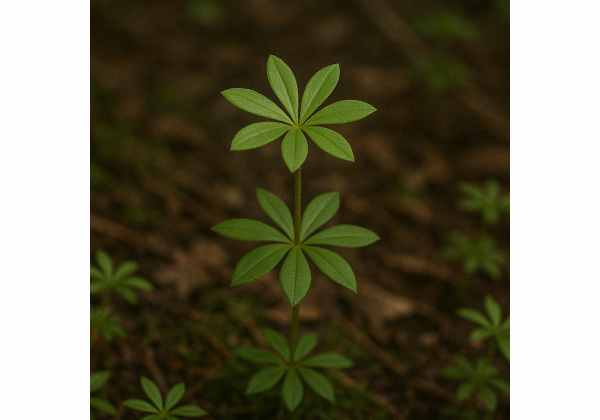
Woodruff, Galium odoratum, is a shade-loving woodland herb best known for its sweet hay-like fragrance, which becomes more noticeable after the plant wilts or dries. In older herb books it is often called sweet woodruff, and in some references it still appears under the earlier botanical name Asperula odorata. Traditionally, it has been used as a gentle calming herb, a digestive bitter-aromatic, a mild urinary support plant, and an external herb for swelling, irritated skin, and slow-healing tissues.
What makes woodruff especially interesting is the way its aroma, chemistry, and traditional use fit together. The plant contains coumarin and related precursors, along with flavonoids, phenolic acids, tannins, and other compounds that help explain its antioxidant, antimicrobial, and anti-inflammatory reputation. At the same time, this is not a herb that should be romanticized simply because it smells pleasant. Coumarin content matters, dosage matters, and prolonged or heavy use is not a good idea. This article looks at what woodruff may offer, what modern research actually supports, how it has been prepared, and where sensible safety limits should stay in place.
Brief Summary
- Woodruff is most plausibly useful as a mild traditional herb for nervous tension, gentle digestive discomfort, and topical soothing use.
- Its key compounds include coumarin, chlorogenic acid, rutin, tannins, and related phenolic constituents.
- A cautious tea-style range is about 1 to 2 g dried herb in 200 to 250 mL water, once or twice daily for short-term use.
- Avoid woodruff during pregnancy, breastfeeding, in children, and in anyone with liver disease or sensitivity to coumarin-rich herbs.
Table of Contents
- What Woodruff Is and Why Its Aroma Matters
- Woodruff Key Ingredients and Medicinal Properties
- Woodruff Health Benefits and What the Evidence Supports
- Traditional Uses and Practical Ways to Prepare It
- Woodruff Dosage Timing and Duration
- Safety Side Effects and Who Should Avoid It
- Interactions Quality and When Medical Care Matters
What Woodruff Is and Why Its Aroma Matters
Woodruff is a low perennial herb in the Rubiaceae family, with whorled narrow leaves, slender stems, and small white star-shaped flowers. It naturally prefers moist, humus-rich woodland soils and partial to full shade, which is why it is so often found beneath deciduous trees or in garden shade borders. On first glance it looks delicate, but it has a strong cultural identity in European herbalism and food traditions.
Its most distinctive feature is its scent. Fresh woodruff smells only mildly green, but when the plant wilts the aroma deepens into something sweet, warm, and hay-like. That fragrance comes largely from coumarin, a naturally occurring aromatic compound that has shaped both the herb’s culinary use and its safety reputation. This is the reason woodruff has long been added to spring wines, punches, syrups, desserts, sachets, and room-scenting blends. It is also the reason the herb should be used with more care than its floral sweetness suggests.
The name can cause some confusion. Many modern herbal references use Galium odoratum, while older texts may say Asperula odorata. The plant is the same herb. The common name “sweet woodruff” is often more helpful than the Latin for non-specialists, yet species identity still matters because coumarin-rich aromatic herbs are not all interchangeable.
Historically, woodruff was considered a plant for nervous agitation, digestive unease, mild urinary sluggishness, headaches, and externally for swelling and minor skin complaints. It was never primarily a high-intensity herb. Its traditional role was gentler and more refined: a supporting herb for people who felt tense, heavy, bloated, restless, or “stagnant” in the old herbal sense.
That does not mean every traditional claim holds equal weight today. Some old books stretch woodruff into a remedy for jaundice, venous problems, hemorrhoids, insomnia, and other complaints. Modern readers should be selective. The plant’s best-supported identity remains that of a mild aromatic herb with coumarin-rich chemistry and some topical and calming tradition.
Its fragrance also helps explain how people have used it. Herbs that smell this distinctive rarely stay confined to one category. Woodruff has lived in kitchens, herbal cupboards, linen drawers, and seasonal celebrations. That broad cultural life matters because it places the plant in a different category from harsh medicinal roots or strongly purgative herbs. It behaves more like a fragrant support herb than a forceful therapeutic intervention.
If readers are mainly looking for a softer, more familiar calming herb, lemon balm for gentle calming support is usually easier to dose and understand. Woodruff, by contrast, asks for a little more respect. Its charm is real, but so are its limits.
Woodruff Key Ingredients and Medicinal Properties
The chemistry of woodruff is more interesting than its delicate appearance suggests. The plant is most famously associated with coumarin, but coumarin is only part of the story. Modern analyses of Galium odoratum show a broader phytochemical profile that includes phenolic acids, flavonoids, tannins, and volatile compounds. Recent work has identified chlorogenic acid and rutin as major contributors to antioxidant behavior, while other studies and older phytochemical summaries point to umbelliferone, scopoletin-type coumarins, tannins, and additional phenolic constituents.
Coumarin deserves first attention because it defines the herb’s aroma and much of its public reputation. It is responsible for the sweet hay scent that becomes stronger after wilting or drying. It also explains why woodruff is often discussed in the same breath as caution about liver effects and dose. One important nuance is that coumarin itself is not the same thing as warfarin. People often hear “coumarin” and assume the herb acts like a prescription anticoagulant. That is inaccurate. The better way to think about coumarin in woodruff is as an aromatic natural compound with biologic activity and dose-related safety considerations.
Chlorogenic acid and rutin are especially relevant to the plant’s medicinal profile because they help explain its antioxidant and anti-inflammatory interest. These compounds are common in many medicinal herbs, but in woodruff they appear alongside coumarin rather than instead of it. That combination helps the plant make sense as both a fragrant herb and a modest medicinal one.
Tannins contribute astringency, which supports the logic of some traditional topical uses. When woodruff was used for minor swelling, compresses, or skin support, tannin content may have played a role. Flavonoids and broader phenolics add another layer of antioxidant and tissue-supportive action.
Its medicinal properties can be grouped into several main themes:
- mild calming or tension-easing potential
- antioxidant support
- modest anti-inflammatory activity
- mild antimicrobial relevance in laboratory settings
- topical soothing and astringent value
- gentle digestive and aromatic support
The recent anti-inflammatory work on cultivated and wild-type extracts is especially helpful because it shows that woodruff’s medicinal image is not based on scent alone. Extracts demonstrated phenolic-rich profiles and measurable anti-inflammatory effects in a macrophage model. Earlier experimental work also suggested antioxidant, antimicrobial, edema-reducing, and wound-supportive potential.
This does not make woodruff a clinical anti-inflammatory drug. It means the plant’s traditional uses are chemically plausible. The fit between chemistry and herbal use is one of the most attractive features of the herb. A fragrant woodland plant that smells sweet, supports light digestive or calming formulations, and shows antioxidant and anti-inflammatory activity in the lab is easier to take seriously than a folklore-only remedy.
At the same time, medicinal plausibility is not the same as proven clinical benefit. Woodruff remains a mild herb with more experimental and traditional support than strong human trial evidence. If someone mainly wants a more established aromatic digestive herb, peppermint for digestive and aromatic support is generally the easier first choice.
Woodruff Health Benefits and What the Evidence Supports
The strongest health claims for woodruff need to be phrased with moderation. This is not a herb with a large body of modern clinical trials. Its real value comes from the meeting point of tradition, chemistry, and preclinical evidence. When those three lines overlap, the plant becomes useful to understand even if it is not a front-line modern remedy.
The first likely benefit area is mild calming support. Traditional sources repeatedly mention nervous agitation, restlessness, and tension-like states. Woodruff’s aroma and coumarin content have made it a natural fit for evening drinks, spring tonics, and mild relaxing teas. Still, the evidence here is mostly traditional rather than clinical. It is better described as a gently settling herb than a true sleep medicine.
The second plausible area is digestive support. Aromatic and slightly bitter herbs often help when digestion feels slow, heavy, or mildly crampy. Woodruff has old use for stomach unease and seasonal cleansing-type formulas. In practice, that may make it helpful in a light tea when the goal is mild digestive ease rather than aggressive treatment. For a gentler and better-known comparison herb, chamomile for calm digestion and relaxation is still easier to recommend to most people.
A third area is topical tissue support. Earlier studies and traditional use both point toward external applications for swelling, irritated skin, and minor wounds. Experimental burn-healing work in rats found that woodruff extracts showed antioxidant, anti-inflammatory, and wound-supportive potential. That is meaningful, but still not enough to treat the herb like a modern wound-care product.
The fourth likely benefit is antioxidant support. This is probably the clearest modern evidence category. Recent studies show that extracts rich in phenolics such as chlorogenic acid and rutin can meaningfully influence antioxidant activity. This does not prove that a cup of tea will transform health outcomes, but it supports the plant’s broader reputation as a protective herbal ingredient.
A fifth possible benefit is mild urinary support. Folk medicine has sometimes used woodruff as a gentle diuretic or cleansing herb. This theme appears often enough to mention, though it remains weaker than the herb’s calming and aromatic identity. It should not be used to self-treat urinary pain, infection, or edema.
What the evidence does not support is equally important:
- it does not prove woodruff is an effective insomnia treatment
- it does not prove it treats liver or venous disease
- it does not justify high intake because the herb feels “natural”
- it does not support replacing proper care for wounds, urinary symptoms, or chronic inflammation
So what is the most accurate summary? Woodruff may be helpful as a lightly calming, aromatic, antioxidant-rich traditional herb with some topical and digestive relevance. It makes sense in small, careful amounts and in properly matched situations. It makes much less sense when used as a cure-all. That middle path is where woodruff remains most credible.
Traditional Uses and Practical Ways to Prepare It
Woodruff has been used in both medicine and food, and that dual identity is one of its defining features. Unlike harsher medicinal herbs that stay mostly in tinctures or decoctions, woodruff has a long life in spring beverages, herbal wines, syrups, perfumed desserts, and household sachets. In traditional European culture, this made the herb feel festive as well as medicinal.
The best-known preparation is probably woodruff wine or May wine, especially in German-speaking regions. Shoots are often lightly wilted before use because the characteristic coumarin aroma becomes more noticeable after the plant loses some freshness. Recent phytochemical work has complicated the old assumption that more drying always means more coumarin availability. Short wilting may support aroma development, but prolonged drying can also reduce coumarin through sublimation. That makes the traditional practice of brief wilting more understandable than either fully fresh use or extended drying.
Beyond flavored wine, woodruff has traditionally been prepared as:
- Infusion or tea
A mild tea is the most practical medicinal-style preparation. It suits nervous tension, light digestive use, and short-term traditional use. - Herbal wine or punch
More culinary than medicinal in modern use, though historically tied to mild relaxation and spring tonics. - Syrup
A fragrant way to carry the herb’s aroma into drinks and desserts. - Topical wash or compress
Used historically for swelling, skin irritation, and slow-healing tissue, though not ideal for everyone. - Sachets and household fragrance use
Not a medicinal preparation in the strict sense, but one of the herb’s oldest practical roles.
A practical rule is to keep the herb light. Woodruff works best when treated as a modest aromatic botanical, not a plant to concentrate aggressively. A tea made from dried herb is more appropriate than a powerful homemade extract. The same principle applies to culinary use. A little goes a long way, and heavy-handed preparation usually makes the herb less elegant and potentially less safe.
Topical use deserves separate attention. Woodruff has a genuine tradition in external care, but traditional use is not a guarantee of universal tolerance. Patch testing makes sense before broader application, especially because coumarin-rich herbs can irritate or sensitize some users. If the real goal is a simple external herbal wash, calendula for topical herbal support is often the more straightforward choice.
The most sensible modern preparation approach is therefore selective:
- tea for mild internal use
- culinary use in modest amounts
- brief wilting rather than heavy drying for aroma-driven recipes
- caution with strong extracts
- extra care with topical experiments
That framework keeps woodruff close to its traditional strengths. It remains a beautiful herb when its uses stay proportionate to its chemistry.
Woodruff Dosage Timing and Duration
Woodruff dosage should stay conservative because the plant’s coumarin content makes it less suitable for careless daily use than many other tea herbs. There is no modern universally accepted medicinal dose with strong clinical backing, so practical guidance has to stay close to traditional tea-style use and modest culinary exposure.
A cautious tea range is about 1 to 2 g of dried herb in 200 to 250 mL of hot water, taken once or twice daily for a short period. This is not a formally standardized therapeutic dose. It is a careful range that respects the herb’s mild traditional role and its coumarin content. Some historical sources and culinary practices use larger amounts in wines, syrups, and punches, but those uses should not be treated as medicinal dosing models.
Timing matters as well. If the goal is mild calming support, evening use makes sense. If the goal is light digestive support, tea may fit better after food or between meals. Topical use does not depend on timing in the same way, but skin tolerance should always be checked first.
Duration is where caution becomes especially important. Woodruff is better suited to brief use than to becoming a daily all-season tonic. A reasonable self-care structure is:
- try a low amount first
- keep use limited to a few days or up to about 1 week
- reassess before continuing
- avoid prolonged daily use without guidance
There are several reasons for this. First, coumarin-rich herbs are not ideal for habitual high intake. Second, woodruff’s best role is as a modest support herb, not a long-term foundational supplement. Third, prolonged use blurs the line between pleasant tradition and avoidable exposure.
Culinary use needs its own distinction. A light seasonal preparation, such as a flavored syrup or occasional woodruff wine, is not the same as repeated concentrated medicinal dosing. The problem comes when people combine both and assume the herb remains harmless because it is “just culinary.”
Another important dosage issue is drying. The plant’s aroma and coumarin chemistry change after harvest. Traditional brief wilting is not identical to extended drying, and recent analysis suggests prolonged drying can reduce measurable coumarin through sublimation. That means very old dried material may not behave like freshly wilted herb, either in aroma or in intensity.
If someone mainly wants a gentle daily spring herb rather than a coumarin-rich aromatic, dandelion for gentle everyday herbal use is often easier to fit into routine life. Woodruff is better approached as an occasional herb with a clear purpose.
The best dosing message is simple: keep the amount small, the duration short, and the reason specific. Woodruff is at its best when it remains subtle.
Safety Side Effects and Who Should Avoid It
Safety is the section where woodruff stops being merely charming. The same coumarin content that gives the herb its signature fragrance also creates the main reason for caution. Coumarin does not make woodruff automatically dangerous in culinary or small tea amounts, but it does mean large doses, repeated use, or concentrated preparations deserve more respect than people often give them.
Possible side effects include headache, dizziness, nausea, stomach discomfort, or a feeling of heaviness if the herb is taken too strongly. Traditional herbal warnings often mention that overuse can produce an unpleasant, throbbing sort of discomfort rather than a dramatic poisoning picture. That matches the idea that woodruff is not a violently toxic herb, but one that punishes excess.
The most important longer-range concern involves coumarin exposure and liver sensitivity. Modern toxicology reviews on natural coumarins note that the main adverse effect concern is hepatotoxicity in susceptible people or at excessive intake. Human handling of coumarin differs significantly from rodent metabolism, which is why simplistic statements about universal liver danger are not helpful. Still, moderation is the correct lesson, not dismissal.
Certain groups should avoid woodruff or use it only with professional advice:
- pregnant people
- breastfeeding people
- children
- people with liver disease
- people with a history of strong sensitivity to coumarin-rich herbs
- people already taking multiple herbal sedatives or liver-active supplements
Topical safety matters too. Although woodruff has traditional use on skin, coumarin-related compounds and plant sensitizers can still cause irritation. Patch testing is sensible, and broken or inflamed skin should not be treated casually with strong homemade preparations.
A useful misconception to correct here is the anticoagulant question. Natural coumarin is often confused with warfarin-like drug effects. Woodruff should still be used cautiously, but it should not be described as a natural blood thinner in the same way prescription anticoagulants work. The real safety emphasis belongs more on excess intake, liver sensitivity, and general intolerance than on dramatic anticoagulant fear.
For people mainly interested in a mild external astringent or soothing botanical rather than a fragrant coumarin herb, witch hazel for topical astringent support is often a more predictable option.
The safest overall summary is this: woodruff is acceptable for modest, short-term, well-prepared use in healthy adults, but it is not a carefree daily herb. Aroma is not the same thing as harmlessness, and the safest users are the ones who remember that.
Interactions Quality and When Medical Care Matters
Woodruff is not famous for a long list of documented herb-drug interactions, but that should not be mistaken for proof of no risk. Because it contains coumarin and other bioactive plant compounds, the most sensible strategy is to think in terms of plausible caution rather than waiting for a long formal interaction list.
The first concern is product quality. Good woodruff material should be clearly labeled as Galium odoratum and should indicate whether the herb is fresh, dried, loose, or extracted. Poor-quality products may be old, over-dried, or vaguely labeled in ways that make intensity hard to judge. Since aroma and coumarin profile shift after harvest, stale material is not just less pleasant. It is also less reliable.
The second concern is concentration. A modest infusion is one thing. A strong tincture, extract, or heavily reduced syrup is another. When a mild traditional herb becomes concentrated, uncertainty rises faster than benefit. That is why the most trustworthy use remains tea or light culinary preparation rather than aggressive extract use.
The third concern is overlap with other sedating, liver-active, or coumarin-rich products. Even if woodruff is not behaving like a prescription anticoagulant, it still makes sense to be careful when combining it with multiple herbs or supplements that affect the liver or are used for calming. The risk is not necessarily dramatic, but stacking uncertainties is rarely wise.
When it comes to medical care, woodruff is a support herb, not a substitute for evaluation. Seek proper care instead of extending self-treatment if you have:
- persistent insomnia
- ongoing abdominal pain
- jaundice or right upper abdominal discomfort
- recurrent severe headaches after herb use
- a rash or worsening skin irritation after topical application
- unexplained swelling
- urinary pain or fever
- symptoms that continue despite stopping the herb
This final point is especially important because woodruff’s traditional uses are broad enough to tempt people into overextending it. A herb once used for nervous agitation, digestive unease, swelling, and skin complaints can start to sound like an all-purpose botanical. It is not. Its best use is narrow, moderate, and short.
If someone wants a more clearly urinary-oriented herb than woodruff, corn silk for mild urinary support usually fits modern self-care more cleanly. If the need is stronger than mild self-care, medical care matters more than any woodland herb.
In the end, woodruff remains most helpful when it is treated as a refined traditional plant, not as a high-dose health hack. Good sourcing, small amounts, short use, and clear reasons are what keep it useful.
References
- Phenolic Content and Anti-Inflammatory Activity of Cultivated and Wild-Type Galium odoratum Extracts in Murine Bone Marrow-Derived Macrophages 2024.
- Comprehensive analysis of natural products of Galium odoratum (Rubiaceae), focusing on the formation of coumarin during the drying process 2025.
- Safety Profile of Nutraceuticals Rich in Coumarins: An Update 2022 (Review).
- A safety assessment of coumarin taking into account species-specificity of toxicokinetics 2006.
- Antioxidant and burn healing potential of Galium odoratum extracts 2013.
Disclaimer
This article is for educational purposes only and is not medical advice. Woodruff is a traditional aromatic herb with limited modern human clinical evidence, and its coumarin content means it should be used in moderation. It should not be used to self-treat liver problems, persistent insomnia, urinary disease, chronic inflammation, or serious skin conditions. Speak with a qualified healthcare professional before using woodruff medicinally if you are pregnant, breastfeeding, taking prescription medicines, living with liver disease, or planning to use it for a child.
If this article helped you, please share it on Facebook, X, or any platform your readers prefer.