Woad, Isatis tinctoria, is one of the rare herbs whose identity spans both medicine and material culture. For centuries it was famous as a source of blue dye, yet the same plant also built a strong medicinal reputation in Europe and later in broader herbal traditions for wounds, inflammatory skin problems, feverish illnesses, and infection-related complaints. Modern research has revived interest in woad not because it is fashionable, but because its chemistry is genuinely intriguing. Different parts of the plant contain alkaloids such as tryptanthrin and indirubin, indole-related compounds, phenolic acids, flavonoids, fatty acids, and glucosinolate-derived molecules that may help explain its anti-inflammatory, antioxidant, antimicrobial, and skin-supporting effects.
At the same time, woad is not a simple kitchen herb and it is not a fully standardized modern botanical medicine. Much of the evidence remains preclinical, and the most defensible oral dose guidance is still historical rather than clinical. The best way to approach woad is with interest, restraint, and clarity about which claims belong to tradition, which belong to laboratory research, and which are strong enough to guide practical use today.
Key Facts
- Woad shows promising anti-inflammatory and skin-soothing activity, especially in topical research.
- Its most credible modern strengths are antioxidant, anti-inflammatory, and antimicrobial potential.
- Older monographs cite 1 to 2 g dried root daily in divided doses, but this is historical rather than clinically standardized.
- Pregnant people and anyone planning self-treatment with concentrated extracts should avoid unsupervised use.
Table of Contents
- What woad is and why species identity matters
- Key ingredients and medicinal properties of woad
- Potential health benefits and what the evidence actually supports
- Traditional and modern uses of woad
- Dosage forms, timing, and practical use limits
- Safety, side effects, interactions, and who should avoid it
- How to choose, prepare, and use woad wisely
What woad is and why species identity matters
Woad is the common name for Isatis tinctoria, a biennial plant in the mustard family, Brassicaceae. It is best known historically as dyer’s woad because its leaves were processed to make blue pigment long before imported indigo and synthetic dyes became dominant. But the plant also built a long medicinal reputation, especially in Europe, where classical and later herbal writers described it for wounds, ulcers, hemorrhoids, inflammatory ailments, and several feverish or eruptive illnesses. That double identity is part of its fascination: woad is both a dye plant and a medicinal herb, and neither history should be ignored.
Species identity matters here because the name “isatis” is often used loosely. Some medicinal traditions and commercial products refer to Isatis roots or leaves without clearly separating Isatis tinctoria from related Isatis species, especially Isatis indigotica. The two are related and share some chemistry, but they are not interchangeable in a strict herbal sense. A careful article on woad should stay anchored to Isatis tinctoria rather than borrowing every dose, formula, or therapeutic claim from other Isatis materials.
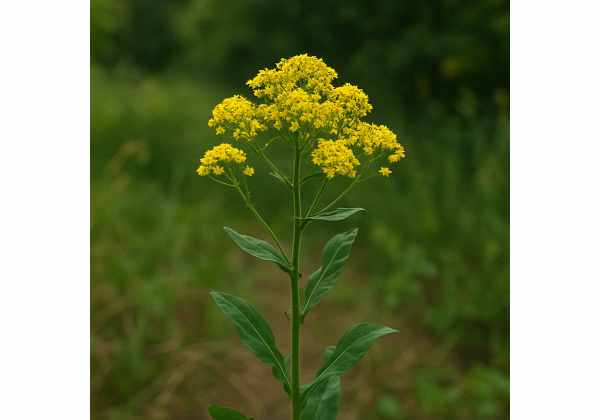
The plant itself is striking but not dramatic. In its first year, it forms a rosette of leaves; in its second, it sends up flowering stalks with clusters of small yellow flowers and later seed pods. The leaves are bluish green, slightly waxy, and often broader than people expect from a medicinal plant. Different plant parts have different strengths. Leaves are the most famous for dye production and much of the topical anti-inflammatory research. Roots have a stronger place in traditional internal use. Seeds, once less discussed, are now being studied for fatty acids, glucosinolates, and other compounds with possible cosmetic and pharmaceutical value.
Woad also belongs to a family with a very recognizable chemical logic. Like other glucosinolate-rich Brassicaceae plants, it produces defense compounds that can become biologically active when plant tissues are damaged and enzymes begin to break larger molecules apart. That family relationship helps explain why woad has attracted modern interest in inflammation, microbes, oxidative stress, and skin biology.
Another reason identity matters is that woad’s old medicinal fame can make it sound more settled than it really is. It has real history, but it is not a thoroughly standardized modern herbal product. Its traditional uses are broad, its phytochemistry is complex, and its modern evidence is uneven. Some of the most promising findings involve topical skin inflammation, anti-allergic signaling, and laboratory antimicrobial activity. Other claims remain mostly historical or preclinical.
That is why the best starting point is simple: woad is a historically important European medicinal herb with notable modern phytochemical interest, but it should be judged as Isatis tinctoria specifically, not as a generic “isatis” or an interchangeable proxy for every related species. Once that identity is fixed, the rest of the discussion becomes much more reliable.
Key ingredients and medicinal properties of woad
Woad’s medicinal profile is chemically diverse, and that diversity is one reason the plant keeps returning to scientific discussion. It does not depend on one famous compound alone. Instead, it combines alkaloids, indole-related molecules, phenolic acids, flavonoids, glucosinolate derivatives, and, in the seeds, fatty acids and phytosterols.
The most widely discussed constituents include tryptanthrin and indirubin. Tryptanthrin is especially important for woad’s modern anti-inflammatory reputation. It has been linked to inhibition of inflammatory pathways such as COX and 5-LOX and is often treated as one of the plant’s signature bioactive compounds. Indirubin is historically important because it became associated with research into leukemia and other proliferative disorders, though that area belongs much more to specialized pharmacologic research than to ordinary self-care herbalism.
Woad also contains indole acetonitrile derivatives and other molecules generated from indole glucosinolate breakdown. These are important because they help explain why woad behaves like a medicinal mustard-family plant rather than merely like a pigment source. In practical terms, they contribute to anti-inflammatory, anti-allergic, and possibly antimicrobial effects. The plant’s seeds also contain multiple glucosinolates, which, when hydrolyzed by myrosinase after tissue damage, can form isothiocyanates, nitriles, and related breakdown products with antioxidant and antimicrobial relevance.
The phenolic side of woad matters as well. Studies on leaf extracts describe a substantial profile of flavones, flavonols, and phenolic acids, including vicenin-2, isovitexin, apigenin glucosides, chlorogenic acid, caffeic acid, ferulic acid, sinapic acid, and p-coumaric-related compounds. These constituents likely contribute to antioxidant activity and to some of the plant’s broader tissue-protective effects. In some extracts, phenolics are major compounds rather than minor accessories.
The seeds add another layer. More recent work has highlighted fatty acids, amino acids, phytosterols, and glucosinolates in woad seeds, suggesting that the plant’s wellness potential is broader than the older leaf-and-root-centered picture. This does not mean the seed is suddenly the most important medicinal part, but it does show that woad is chemically richer than many older monographs implied.
Compared with other medicinal plants in the mustard family, woad stands out because it combines glucosinolate-type defense chemistry with a distinctive alkaloid and phenolic profile. That blend helps explain why it has been studied for irritated skin, allergic responses, oxidative stress, and even experimental oncology models.
From a practical perspective, woad’s medicinal properties can be summarized as:
- anti-inflammatory
- anti-allergic
- antioxidant
- antimicrobial
- potentially skin-protective
Some research also suggests antiviral, analgesic, and anti-tumor potential, but these areas remain much less ready for consumer-style claims. The underlying point is that woad’s chemistry is both deep and variable. Leaves, roots, and seeds do not deliver the same balance of active compounds, and extraction method changes the result again. A water infusion, a tincture, and a lipophilic topical extract are not simply different containers for the same herb. They are different chemical presentations of the plant.
That variability makes woad interesting, but it also explains why standardized dosing is difficult. The plant clearly contains pharmacologically meaningful molecules. The challenge is that it expresses them in shifting patterns depending on the part used and the way it is processed.
Potential health benefits and what the evidence actually supports
Woad has several plausible medicinal benefits, but they do not all rest on the same kind of evidence. The strongest modern discussion should separate historical reputation, preclinical research, and human-relevant practical use.
The most credible modern benefit is anti-inflammatory and skin-calming potential, especially from leaf-derived topical extracts. Experimental work has shown that well-characterized lipophilic or petroleum ether extracts can reduce inflammatory signaling, help inhibit cytokines such as interleukin-6 and interleukin-33, and dampen mast cell degranulation. That matters because these mechanisms map directly onto irritated, reactive, or allergy-prone skin rather than vague whole-body “detox” language. A smaller human-facing evidence base also points in the same general direction: woad seems most convincing as a topical anti-irritant herb rather than as a broad oral panacea.
A second strong area is antioxidant support. Hydroalcoholic leaf extracts and seed-related compounds show antioxidant activity that may help explain some of the plant’s tissue-protective reputation. Antioxidant claims are often overused in herbal writing, but in woad they are not empty decoration. The combination of phenolic acids, flavonoids, and glucosinolate-derived chemistry makes oxidative-stress relevance quite plausible.
A third meaningful area is anti-allergic and anti-atopic potential. Research models involving dermatitis-like inflammation suggest that water or lipophilic extracts can reduce swelling, abnormal skin thickening, and inflammatory signaling. This does not mean woad is a proven home treatment for eczema, but it does mean that its traditional use for inflamed skin now has a more persuasive mechanistic background than many other folklore claims.
Antimicrobial and antiviral potential also deserves mention, though with restraint. Historical texts used woad for infectious conditions, and modern studies support antimicrobial activity in vitro. That makes the traditional reputation understandable. But laboratory inhibition of microbes is not the same thing as proven effectiveness in treating infections in real people. Woad should not be presented as a substitute for evidence-based care in flu, serious skin infection, or respiratory disease.
There is also longstanding interest in anti-tumor compounds, especially indirubin and tryptanthrin. These compounds have shown important biological activity in experimental cancer models and older oncology research. Still, this is the area most likely to be overstated. The fact that woad contains compounds with anti-proliferative potential does not justify self-treatment for cancer, and it should never be framed that way.
A practical comparison helps. In the topical realm, woad’s modern promise resembles the kind of targeted anti-irritant interest seen with traditional skin-support herbs such as calendula, except that woad’s chemistry leans more toward alkaloids, glucosinolate derivatives, and inflammatory signal modulation than toward soothing resins or mucilage.
So the best ranking of woad’s benefits is:
Most plausible
- topical anti-inflammatory support
- skin-calming and anti-irritant potential
- antioxidant activity
Reasonably promising but still preclinical-heavy
- anti-allergic and anti-atopic effects
- antimicrobial activity
- respiratory and immune-related support
Interesting but not appropriate for self-treatment claims
- anti-tumor or leukemia-related relevance
- broad antiviral promises
- generalized “detoxification” beyond traditional language
That ranking keeps the plant in proportion. Woad is neither a forgotten miracle herb nor an empty relic. It appears genuinely useful, especially in skin-related contexts, but most of its strongest modern claims still belong to careful, limited interpretation rather than sweeping wellness marketing.
Traditional and modern uses of woad
Woad’s traditional uses are unusually broad, partly because the plant lived in daily life for so long. In classical Europe, it was recommended for wounds, ulcers, hemorrhoids, and inflammatory disorders. Later herbal traditions described it for snake bites, eruptive illnesses, skin inflammation, feverish conditions, and even tumor-related problems. Leaves and roots were both used, but not always for the same purposes. Leaves had a stronger association with skin and infectious conditions, while roots gained a more inward, bitter, and system-level reputation.
Some of the old uses sound strange to modern readers only because the language has changed. Historical descriptions of “heat,” “toxins,” “corrupted blood,” or “ulcerous inflammations” often reflected what we would now separate into skin inflammation, infection, fever, or tissue irritation. The language was imprecise, but the patterns were not necessarily irrational. Woad repeatedly appears where redness, irritation, fever, and tissue stress overlap.
Its long use as a dye plant also shaped its medicinal story. People cultivated it widely, handled it often, and learned its effects in multiple contexts. That is different from herbs known only through rare medicinal trade. Woad was available, visible, and familiar. Because of that, it entered both domestic practice and scholarly herbals.
Modern uses are narrower. Today, the most defensible use of woad is in topical skin-focused formulations or as a research-driven botanical for irritated or inflamed skin. That does not mean the root has lost all relevance, but it does mean that modern evidence aligns most clearly with dermatologic and inflammatory pathways. In that sense, woad has shifted from a broad historical medicinal plant to a more focused modern phytotherapeutic candidate.
Woad has also been studied in anti-allergic and airway-inflammation contexts, with some interesting animal data. Yet this remains an experimental area, not a mainstream herbal indication. The same applies to oral support for immune balance or oxidative stress. These uses are plausible, but they are not standardized and they are not the strongest practical entry point for most people.
One useful comparison is with older European medicinal plants that straddle food, tradition, and modern biological relevance. Like garlic, woad carries a rich historical reputation and real bioactivity. Unlike garlic, however, it is not normalized as a daily food herb, which means its forms, dosing, and use context need more care.
Modern use can be grouped into four practical categories:
- Historical herbal use
Root or leaf preparations in older Western or broader traditional practice. - Topical botanical use
Experimental or semi-specialized skin products aimed at irritated or inflamed skin. - Phytochemical and dermatologic research
Extract studies focused on cytokines, mast cells, oxidative stress, and inflammatory pathways. - Cosmetic and cosmeceutical interest
Especially around seeds, antioxidants, and skin-related formulations.
What woad is not, at least for now, is a general-purpose modern supplement with clear goals, clear doses, and strong clinical consumer evidence. That distinction matters. A plant can have impressive tradition and promising research without being ready for casual, broad oral self-medication.
So the best modern reading of its traditional uses is respectful but selective. Woad was historically used for many things, but the uses that translate most convincingly today are the ones closest to inflammation, irritated skin, and biologically plausible plant chemistry. That is where old practice and modern evidence meet most clearly.
Dosage forms, timing, and practical use limits
Woad’s dosage is one of the clearest places where honesty matters. There is no well-established modern clinical dose for Isatis tinctoria as a general medicinal herb. Most practical dose information comes either from older monographs, traditional practice, or experimental extracts that are not directly comparable to consumer products.
The most defensible oral guidance comes from an older monograph that cites 1 to 2 g of dried root daily in divided doses for adults. This is useful, but it needs context. It is a historical adult range, not a contemporary clinically validated standard. It tells us where traditional oral use roughly sat, but it does not solve questions about extract strength, bioavailability, duration, or which plant part is most appropriate for which condition.
That uncertainty becomes more important when people talk about “woad extract” without specifying whether the extract is:
- from leaf, root, or seed
- water-based, alcohol-based, or lipophilic
- standardized to any active constituent
- intended for oral or topical use
Those distinctions are not technical trivia. A topical petroleum ether extract developed for skin inflammation is not equivalent to a dried root powder or a leaf infusion. Likewise, a water extract studied in an animal dermatitis model does not automatically tell us how to dose a tincture. Woad’s chemistry changes dramatically with plant part and extraction method.
For practical use, the main forms are:
- dried root in traditional formulas
- leaf or root tinctures
- teas or decoctions in historical herbal practice
- topical extracts for skin-directed use
- research extracts not intended as ordinary over-the-counter products
Timing matters less than form and purpose. For older oral use, divided daily doses make sense because they reflect tonic or steady exposure rather than one large dose. For topical use, timing depends on the product and the goal, but woad research suggests it behaves better as a preventive or early anti-irritant approach than as a dramatic rescue treatment after inflammation is fully established.
This is where comparison helps. Traditional roots such as burdock and other slow-acting herbal preparations often work within a framework of repeated modest use rather than high, one-off dosing. Woad fits that style better than it fits the “mega-dose botanical extract” model.
A realistic dosing framework looks like this:
- Oral root use: historical range only, roughly 1 to 2 g dried root daily in divided doses
- Topical use: product-specific and not easily generalized from the published studies
- Leaf preparations: variable and less standardized than the root
- Concentrated extracts: should not be treated as interchangeable unless clearly characterized
Because of this uncertainty, the safest dosage conclusion is not a neat number. It is a principle: use the plant modestly, match the form to the intended use, and do not pretend that all extracts are comparable. Woad is a plant where chemistry, not just species name, determines the experience.
That is also why the article should not overpromise. It is better to admit that woad lacks modern dose precision than to give a false impression of certainty. In herbal medicine, trustworthy ambiguity is safer than polished guesswork.
Safety, side effects, interactions, and who should avoid it
Woad’s safety profile is mixed in an important way: the plant has a long tradition of use, but modern clinical safety data remain limited. That means it should not be treated as highly dangerous, yet it also should not be treated as casually safe in concentrated medicinal forms.
The first major point is that clinical safety studies on leaf and root preparations are limited. Older texts do not emphasize major adverse effects from ordinary herbal use, but that is not the same thing as modern safety validation. Traditional warnings also caution against use in people described as having a “weak constitution,” which in modern terms may roughly suggest frailty, poor digestive tolerance, or low resilience to cooling and draining herbs.
The second major point concerns isolated compounds, especially indirubin. Purified indirubin has been linked with adverse effects such as abdominal pain, diarrhea, nausea, vomiting, thrombocytopenia, and, in rare cases, significant marrow suppression. That does not mean every cup of woad tea produces those effects. It does mean that people should not assume concentrated woad-derived preparations are harmless simply because the whole plant has a long history.
Topical use appears more favorable than internal self-experimentation, but it is still not free from caution. Any herb used on irritated skin can potentially sting, sensitize, or behave unpredictably in a person with barrier-damaged skin. Patch testing and conservative first use make sense, especially with lipophilic or strongly active plant extracts.
Likely safety concerns include:
- digestive upset with oral use
- poor tolerance in frail or depleted individuals
- possible skin irritation with some topical preparations
- increased uncertainty with concentrated or purified compound products
- confusion between traditional woad use and high-potency indirubin-style products
Pregnancy, breastfeeding, and childhood deserve extra caution. There is not enough modern safety evidence to support self-prescribed medicinal use in these groups. The same goes for people with blood cell disorders, active gastrointestinal sensitivity, or those receiving oncology treatment. Since indirubin-related compounds are part of woad’s medicinal story, it is especially unwise to improvise high-dose use alongside complex medical therapy.
A comparison with other herbs that carry strong traditional reputations but uneven modern standardization is useful. Tradition can point us toward interesting plants, but it does not automatically define safe modern use across all concentrated products.
Who should avoid unsupervised medicinal use?
- pregnant or breastfeeding people
- children
- people with significant digestive sensitivity
- people with blood disorders or platelet concerns
- anyone on complex drug regimens, especially cancer-related therapy
- anyone considering concentrated extracts instead of mild traditional forms
Another practical caution is simple substitution. Because “isatis” and “woad” can be used loosely, people may buy products without knowing which species, plant part, or extraction style they are actually getting. That alone is a safety issue. Good herbal safety starts with correct identity and transparent labeling.
So the best safety summary is neither alarmist nor casual. Woad appears promising and sometimes relatively gentle in traditional or topical contexts, but the evidence does not support broad unsupervised use of strong extracts. The plant deserves caution precisely because it is active, not because it is useless.
How to choose, prepare, and use woad wisely
Using woad wisely begins with accepting what kind of herb it is. This is not a culinary everyday plant like parsley, and it is not a mainstream supplement with easy product standardization. It is a historically important medicinal plant whose modern value lies in selective, informed use.
The first rule is to choose products that clearly state Isatis tinctoria, the plant part used, and the preparation type. If a product simply says “isatis” or “woad extract” without clarifying whether it is leaf, root, or seed, that is not enough. Different parts emphasize different chemistry. Leaf-focused products make more sense for topical anti-inflammatory interest. Root-focused products fit historical internal use more closely. Seed-derived products belong more to the cosmetic and emerging phytochemical space.
The second rule is to separate dye tradition from medicinal use. A plant famous for indigo production can tempt people into assuming that any indigo-rich or blue-derived preparation is medicinally appropriate. That is not a safe assumption. Dye processing, pigment extracts, and herbal therapeutic extracts are not interchangeable.
The third rule is to respect extraction. Woad’s active profile changes dramatically depending on whether the preparation is aqueous, hydroalcoholic, or lipophilic. This is one reason standardized topical products can make more sense than homemade improvisation, especially for skin use. A well-characterized extract is far easier to understand than a vaguely made home preparation from harvested leaves.
For readers comparing herbs, woad is less straightforward than more familiar botanicals such as better-standardized medicinal herbs with clearer modern usage patterns. That does not make woad inferior. It simply means the user must be more disciplined.
A wise practical approach looks like this:
- Start with the intended goal
Skin irritation, experimental anti-inflammatory support, or historically informed tonic use are very different aims. - Match the form to the goal
Topical leaf-derived preparations make more sense for skin-focused use than root decoctions. Traditional internal use belongs more to the root than to casual leaf experimentation. - Keep doses conservative
Historical root ranges are more defensible than self-created “stronger must be better” approaches. - Do not transfer claims from unrelated products
Dye, cosmetic seed oil, TCM formulas, and traditional Western root use should not be merged into one vague category. - Use professional guidance when the use is medicinal rather than exploratory
This matters especially if the goal is more than minor skin support or historical interest.
There is also a practical ethical point. Woad has ecological and agricultural histories that vary by region, including invasive status in some places. That means wild harvesting is not automatically a virtue. Sometimes cultivated, clearly identified material is the better option both for consistency and for ecological judgment.
In the end, woad works best when it is treated with proportion. It is not a miracle cure, but it is not merely an old dye weed either. It is a serious medicinal plant with historical depth, modern anti-inflammatory promise, and enough active chemistry to deserve careful, well-labeled, form-specific use. That is the middle path where the plant makes the most sense.
References
- Isatis tinctoria L.—From Botanical Description to Seed-Extracted Compounds and Their Applications: An Overview 2025 (Review)
- Hydroalcoholic Leaf Extract of Isatis tinctoria L. via Antioxidative and Anti-Inflammatory Effects Reduces Stress-Induced Behavioral and Cellular Disorders in Mice 2022 (Research Article)
- Anti-Atopic Effect of Isatidis Folium Water Extract in TNF-α/IFN-γ-Induced HaCaT Cells and DNCB-Induced Atopic Dermatitis Mouse Model 2023 (Research Article)
- Isatis tinctoria L.-derived Petroleum Ether Extract Mediates Anti-inflammatory Effects via Inhibition of Interleukin-6, Interleukin-33 and Mast Cell Degranulation 2020 (Research Article)
- Isatis tinctoria Monograph 2002 (Monograph)
Disclaimer
This article is for educational purposes only and does not replace medical advice, diagnosis, or treatment. Woad is a biologically active medicinal plant with promising anti-inflammatory and skin-supporting potential, but much of the evidence remains preclinical and modern clinical dosing is not well standardized. Do not use woad to self-treat serious skin disease, infection, cancer, or inflammatory illness, and do not assume that all Isatis products are interchangeable. Extra caution is warranted during pregnancy, breastfeeding, childhood, and when using concentrated extracts or complex medical therapies.
If you found this article useful, please consider sharing it on Facebook, X, or another platform you prefer.