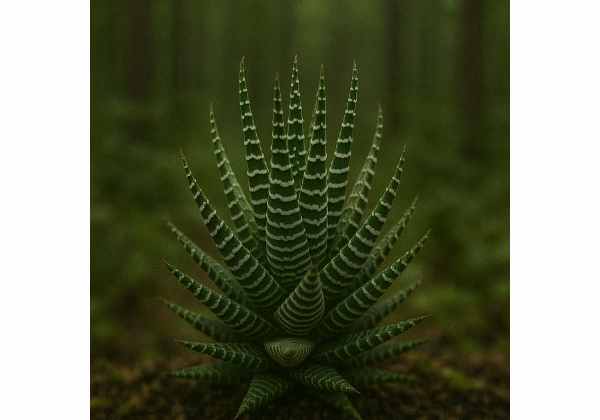
Zebra plant, better known botanically today as Haworthiopsis fasciata and still widely sold under the older name Haworthia fasciata, is a striking South African succulent recognized for its white-banded leaves and compact rosette form. It is often grouped with medicinal succulents because of its family resemblance to aloe, but that connection can be misleading. Unlike aloe vera, zebra plant is prized mainly as an ornamental houseplant, and the evidence for meaningful therapeutic use is thin.
That does not make the plant uninteresting. A few authoritative plant databases note that it has been recorded in medicinal or useful-plant contexts, and South African conservation literature shows that it has appeared in trade connected to traditional medicine. Still, published details on actual therapeutic applications, active compounds, safe preparations, and effective doses remain sparse. For most readers, the most helpful way to approach zebra plant is with clear expectations: understand what the plant is, what is and is not known about its medicinal profile, why it is commonly confused with other succulents, and why “natural” does not automatically mean evidence-based or safe for self-treatment.
Key Facts
- Zebra plant is mainly an ornamental succulent, not a well-established medicinal herb.
- No strong clinical evidence supports oral or topical health benefits for Haworthia fasciata.
- No validated therapeutic dose exists for self-treatment by mouth or on the skin.
- Children, pregnant or breastfeeding people, and anyone delaying care for burns, wounds, or infections should avoid experimental medicinal use.
Table of Contents
- What Zebra Plant Is and Why the Name Matters
- Key Ingredients and What Is Actually Known
- Does Zebra Plant Have Proven Health Benefits
- Traditional Mentions and Why Aloe Comparisons Fall Short
- How Zebra Plant Is Used Today
- Dosage and Why No Therapeutic Range Is Established
- Zebra Plant Safety and Who Should Avoid It
What Zebra Plant Is and Why the Name Matters
Zebra plant is a compact succulent native to South Africa, especially the Cape region, where it grows in harsh, dry conditions and stores water in thick fleshy leaves. Its distinctive white ridges make it one of the most recognizable house succulents in cultivation. The plant stays small, tolerates indoor life well, and is often recommended to beginners because it handles bright indirect light and infrequent watering better than many leafy houseplants.
The first important point for any article about “health benefits” is that the plant’s name is already part of the confusion. The accepted botanical name is now Haworthiopsis fasciata, while Haworthia fasciata remains a familiar synonym in commerce. Even more confusing, many plants sold under that name are actually Haworthiopsis attenuata, a close relative with similar striping. This matters more than it may seem. When people repeat medicinal claims online, they often do so without being certain which species they are discussing. With a plant that already lacks strong clinical evidence, misidentification makes the evidence weaker still.
There is another layer of confusion. Because zebra plant is a succulent in the same broad family group as aloe-type plants, people sometimes assume it must have a similar soothing gel or comparable medicinal value. That leap is not justified. Similar appearance or family placement does not prove comparable chemistry, effectiveness, or safety. This is one of the most useful things to understand from the start: zebra plant looks like a cousin of better-known medicinal succulents, but it does not have the same level of documentation.
In practical terms, zebra plant belongs first to the world of ornamental horticulture, not clinical herbalism. Its best-established uses are decorative and educational. It is admired for:
- compact size
- drought tolerance
- long lifespan
- unusual leaf texture
- suitability for indoor containers and terrariums
That does not mean medicinal use is impossible in principle. Some authoritative databases and South African reference works do record the species in medicinal or useful-plant contexts. But those mentions are not the same as modern proof of therapeutic benefit. They tell us the plant has cultural or ethnobotanical interest, not that it has a standardized place in evidence-based self-care.
That distinction is especially important for people who already know aloe vera as a better-studied medicinal succulent. Zebra plant may be attractive and resilient, but it should not be assumed to share aloe’s more established topical reputation simply because both plants have fleshy leaves.
Key Ingredients and What Is Actually Known
A “key ingredients” section is straightforward when a plant has been studied for defined compounds, standardized extracts, or clinically relevant marker molecules. Zebra plant is not that kind of herb. This is one reason the topic requires a different style of article. The honest question is not “Which famous actives make zebra plant medicinal?” but “How much do we actually know about its chemistry in a way that matters for health use?”
The answer is: less than many online claims suggest.
As a succulent, zebra plant stores water in specialized leaf tissue. That means its leaves contain moisture-rich parenchyma, structural fibers, plant sugars, minerals, and ordinary cellular compounds common to many succulents. But water storage is a survival trait, not a medicinal endorsement. Many people confuse a juicy leaf with a therapeutic gel. Those are not the same thing.
Published plant databases do not present zebra plant with a clear, consumer-ready medicinal phytochemistry profile comparable to major herbal species. There is no widely recognized standardized zebra plant extract used in mainstream clinical studies. There is no accepted oral dose tied to a specific active compound. There is no strong body of human data connecting its internal chemistry to reliable health outcomes in the way that researchers do for better-studied botanicals.
That absence of clarity is itself a useful finding. It suggests that many modern claims about zebra plant are borrowed by association rather than built from direct evidence. In practice, those borrowed claims tend to come from three sources:
- confusion with aloe species
- confusion with other haworthia-like succulents
- the assumption that any traditional or useful-plant record must imply proven therapeutic chemistry
A few plant references note that the species has been recorded as a medicinal plant or traded in medicinal contexts, but those references rarely provide detailed constituent analysis tied specifically to clinical use. One thesis-based listing even places Haworthia fasciata in a category associated with protective charms rather than a clearly defined therapeutic purpose. That detail is easy to overlook, yet it changes the tone of the whole discussion. A plant can be culturally significant without being a validated medicine.
So what can be said with confidence?
- Zebra plant is a succulent with fleshy, water-storing leaves.
- It belongs to a plant group that includes medicinally important relatives.
- It has some ethnobotanical and useful-plant documentation.
- It does not have a well-developed, evidence-based medicinal ingredient profile for self-treatment.
This is one of the clearest examples of why chemistry should not be guessed from appearance. The plant may contain interesting compounds, as most plants do, but without focused phytochemical and clinical research, it is not responsible to turn that possibility into health advice. For readers seeking a plant with better-characterized topical astringent use, witch hazel has a far more established practical profile than zebra plant.
Does Zebra Plant Have Proven Health Benefits
This is the core search-intent question, and the most accurate answer is simple: zebra plant does not have proven human health benefits in the modern clinical sense.
That does not mean the plant has no history, no interesting biology, or no cultural significance. It means the available evidence does not support confident claims that zebra plant improves digestion, heals burns, treats wounds, lowers inflammation, boosts immunity, or works as an ingestible supplement. Those are exactly the kinds of claims that tend to spread when a plant looks medicinal, but they are not supported here in the way readers might expect.
A helpful way to rank the evidence is as follows:
- Well supported: ornamental value, ease of care, horticultural identity
- Documented but vague: presence in some medicinal or useful-plant records
- Poorly established: specific therapeutic actions for humans
- Not established: validated oral dosing, clinical efficacy, routine self-treatment use
This ranking matters because people often treat all plant-related evidence as equal. It is not. A plant database that notes “used as medicine” is a starting point for inquiry, not a conclusion. A conservation paper noting medicinal trade is evidence of human use, not evidence of effectiveness. A clinical trial would be a much stronger form of proof, and zebra plant largely lacks that level of support.
It is also important to understand the problem of transferred credibility. Because aloe is familiar, safe-looking, and topical, people sometimes assume zebra plant must also help with minor burns, dry skin, or cuts. But those benefits are not automatically portable from one succulent to another. Even plants in the same family can differ meaningfully in chemistry, tolerability, and documented use. In evidence-based writing, resemblance is not enough.
If someone asks what the “real benefits” of zebra plant are, the most practical answer is that its best-supported benefits are indirect rather than medicinal. It may contribute to wellbeing by being:
- visually calming in indoor spaces
- easy to maintain for novice growers
- generally non-toxic to common household pets
- useful in teaching plant identification and succulent care
Those are real advantages, but they are not the same as medicinal benefits. This difference is worth stating plainly because it helps readers avoid a common mistake: forcing a houseplant into the role of a remedy just because it is natural.
In fact, one of the more valuable insights in this topic is that zebra plant may be most useful when it is not treated like medicine at all. It is a good plant to grow, enjoy, and learn from. It is not currently a good plant to rely on for self-directed treatment of skin problems, internal complaints, or respiratory issues. For those purposes, people are better served by herbs with far stronger topical traditions and research histories, such as comfrey in carefully bounded skin-support traditions, though even those require safety awareness.
Traditional Mentions and Why Aloe Comparisons Fall Short
The most balanced way to discuss zebra plant’s traditional side is to say that it has a footprint in useful-plant and medicinal-plant records, but the therapeutic details are sparse and inconsistent. South African literature shows that Haworthia fasciata has appeared in medicinal trade and ethnobotanical documentation. Yet when one looks closely, that does not unfold into a clear, standardized healing tradition with agreed preparations, target conditions, and dosage methods.
That matters because many herb articles quietly convert any traditional mention into a long list of “used for” claims. Here, that would be misleading. The available record suggests cultural relevance, trade value, and limited medicinal association, but not a robust, well-described folk pharmacopoeia comparable to the traditions surrounding aloe, licorice, mullein, or chamomile.
The comparison with aloe is especially tempting, and especially risky. Both are drought-adapted succulents with fleshy leaves. Both belong to the same broad botanical family context. Both are common in ornamental collections. But aloe has a much deeper history of recognized topical use and a more developed research and commercial literature. Zebra plant does not.
This difference helps explain why so many casual claims collapse under scrutiny. Statements such as “zebra plant gel works like aloe,” “the juice can be rubbed on burns,” or “the leaves can be consumed for cleansing” are usually not backed by strong plant-specific evidence. They are better understood as assumption chains:
- succulent leaf becomes “gel plant”
- gel plant becomes “aloe-like”
- aloe-like becomes “medicinal”
Each step sounds plausible, but the overall conclusion remains weak.
Traditional mention is still worth respecting. It tells us the plant was not culturally invisible. It may also indicate local observations that deserve more scientific attention. But respect for traditional use does not require exaggeration. In a careful article, it is more useful to say that zebra plant has limited ethnobotanical documentation than to pretend it is a mainstream herbal remedy hiding in plain sight.
There is also a conservation angle. Once a plant enters trade because it is believed to be medicinal, pressure on wild populations can increase whether or not the medicinal value is well defined. That is one reason accurate communication matters. Overstated wellness claims do not just confuse buyers. They can also intensify unnecessary harvesting or irresponsible sourcing.
For readers deciding what to do in practice, the aloe comparison should be handled with discipline. If the goal is to soothe minor skin irritation with a succulent-based topical tradition, there are better-known choices than zebra plant. If the goal is simply to keep a handsome, resilient plant on a windowsill, zebra plant excels. Treating those as separate goals is the safest path. People looking for better-established topical botanical options may be more appropriately directed toward tea tree for clearly defined topical applications or aloe-type preparations rather than improvising with zebra plant leaf tissue.
How Zebra Plant Is Used Today
In modern life, zebra plant is used far more as a decorative succulent than as a medicine. That is not a drawback. It is simply the plant’s real niche. It is valued for tabletop containers, window ledges, office desks, succulent collections, and small indoor displays where its striped leaves provide strong visual texture without demanding much space.
This practical identity is actually useful for understanding the plant honestly. When a plant’s strongest modern roles are ornamental and educational, that tells us something about where evidence and experience have settled. If zebra plant were widely reliable as a topical or ingestible herb, there would likely be a more developed culture of preparations, dosage conventions, practitioner guidance, and safety documentation. That infrastructure is largely absent.
Today, the plant is most commonly used in five ways:
- as an indoor ornamental
- as a beginner-friendly succulent
- as a collector’s plant because true fasciata is often confused with other species
- as a teaching example for drought-adapted morphology
- as a pet-friendlier alternative to more hazardous ornamentals
That last point has practical value. For households with dogs or cats, zebra plant is widely regarded as non-toxic to common pets, which is a meaningful advantage over many popular houseplants. It does not mean pets should chew on it freely, but it does reduce the level of alarm compared with truly toxic species.
Some people also experiment with breaking leaves and applying the moisture-rich interior to the skin. This is where the gap between appearance and evidence becomes most important. A cool, damp plant interior can feel soothing in the moment, but sensation is not the same as validated wound care. The same caution applies to folk-style ingestion. A plant being non-toxic to pets is not the same as being appropriate for routine human internal use, especially when dosage, chemistry, and contamination issues are not well defined.
If zebra plant has a “modern medicinal use,” it is mostly a speculative one: it prompts questions about whether under-studied ornamental succulents might hold overlooked compounds or ethnobotanical histories. That is a worthwhile research question, but it belongs to the lab and the herbarium more than to the medicine cabinet.
In everyday terms, the most sensible uses today are these:
- grow it as a succulent
- learn to identify it correctly
- avoid making medical assumptions from its aloe-like appearance
- choose better-studied plants or standard care for actual health needs
That final point is more helpful than it may first appear. Good plant literacy often means knowing when not to use a plant. Zebra plant is a fine example. Its best current uses are enjoyment, collection, and cautious curiosity rather than self-treatment.
Dosage and Why No Therapeutic Range Is Established
There is no validated therapeutic dosage range for zebra plant in routine human self-care. That is the central dosage fact, and it deserves to be stated clearly.
Many herbal articles solve the dosage problem by borrowing numbers from related plants or by giving vague household directions such as “use a small amount of gel.” That would not be responsible here. Zebra plant lacks the kind of clinical or traditional standardization needed to recommend a trustworthy oral amount in mg, a tincture amount in drops, or a topical amount in grams or milliliters.
So what should readers do with a section titled dosage?
The safest answer is to reinterpret dosage as decision-making rather than administration. In other words, the correct “dose” for unsupervised medicinal self-use is no established dose. That leads to three practical conclusions.
First, do not guess an oral dose. There is no evidence-based reason to consume zebra plant leaf material as a supplement, tea, juice, or home extract. The absence of a formal toxicity warning is not enough to justify ingestion, especially when plant identity is frequently confused and preparations are not standardized.
Second, do not assume that a topical amount is harmless just because the plant is succulent. Applying a rubbed leaf, cut leaf, or improvised paste to skin introduces several uncertainties: plant identification, cleanliness, contamination from potting media, irritation, and delay of proper wound care.
Third, do not use “natural” as a substitute for dosing science. A real medicinal dose should rest on at least one of the following:
- strong traditional preparation guidance
- standardized modern product information
- clinical trial data
- monograph-style safety documentation
Zebra plant does not have that level of support in mainstream human health use.
That said, a reader may still want a practical rule. The most useful one is this:
- for oral self-treatment: no recommended dose
- for topical self-treatment: no established therapeutic dose
- for ornamental use: normal houseplant handling is the proper use case
This is not evasive. It is the most accurate form of dosing advice when evidence is missing. In a health context, precision without proof is worse than restraint.
A common mistake is to think that the absence of a known dose leaves room for experimentation. In fact, it means the opposite. The less certain the dose, the stronger the case for not improvising. If the goal is soothing skin, digestive comfort, or another specific outcome, a better path is to choose a herb or product with real dosing guidance. If the goal is simply curiosity, the plant can be appreciated without turning it into a remedy.
For this topic, the dosage lesson is almost philosophical: knowing when not to dose is part of safe herbal practice. Zebra plant is a good ornamental succulent. It is not a good candidate for home-made medicinal dosing.
Zebra Plant Safety and Who Should Avoid It
Zebra plant appears relatively safe as a household ornamental, but that is not the same as saying it is proven safe as a medicine. These are two different questions, and separating them makes the safety picture much clearer.
As an ornamental, zebra plant is generally considered non-toxic to dogs, cats, and horses. That is a practical advantage for households with animals. Even so, any plant material can still cause minor stomach upset if chewed in quantity, and pet-safe does not mean chew toy. Sensible plant placement is still important.
For humans, the safety discussion is more cautious. There is no strong body of evidence showing that zebra plant is dangerous in normal handling, but there is also no robust evidence base supporting deliberate internal or topical therapeutic use. This is the kind of plant where the main risk comes less from known toxicity than from false confidence.
The people who should most clearly avoid medicinal experimentation with zebra plant include:
- pregnant or breastfeeding people
- infants and children
- anyone with known plant allergies or highly reactive skin
- anyone with open wounds, burns, or infections needing proper care
- anyone tempted to replace professional treatment with a houseplant remedy
Another overlooked issue is contamination. Houseplants are grown in potting mixes, exposed to fertilizers, handled by nurseries, and sometimes imported. That means the surface of a leaf or the soil around it is not equivalent to a sterile medicinal preparation. This is one more reason home-made wound or skin applications are hard to justify.
There is also a timing problem. Mild-looking conditions can worsen while people experiment with unproven remedies. A superficial burn may deepen. A small cut may become infected. A persistent rash may need diagnosis. A non-serious cough or stomach upset may not be helped by a plant chosen mainly because it was nearby. In herbal safety, delay is often the hidden risk.
Zebra plant is therefore safest when used in the role it handles best: as a decorative succulent. Normal precautions are enough:
- wash hands after handling broken leaves or potting soil
- keep chewed leaves and loose plant debris away from pets and children
- do not ingest the plant casually
- do not apply leaf material to damaged skin as a substitute for proper care
- identify the species correctly before repeating any plant claim found online
This last point is especially valuable. Because Haworthia fasciata is often confused with other species, even a mild-looking claim can quickly become unreliable. A mislabeled plant plus an unproven use is not a solid basis for treatment.
The best safety summary is balanced and calm. Zebra plant is not a notorious poisonous houseplant, and ordinary ornamental handling appears low risk. But that low-risk status should not be stretched into a medicinal green light. The people who should “avoid it” are not people who must never own the plant. They are people who should avoid turning it into an improvised medicine when stronger evidence, better options, or professional care are available.
References
- Haworthiopsis fasciata (Willd.) G.D.Rowley | Plants of the World Online | Kew Science 2026
- Haworthiopsis fasciata (Little Zebra Plant, Zebra Cactus, Zebra Haworthia, Zebra Plant) | North Carolina Extension Gardener Plant Toolbox 2026
- NParks | Haworthiopsis fasciata 2022
- Red Listed medicinal plants of South Africa: Status, trends, and assessment challenges 2013
- Toxic and Non-toxic Plants: Zebra Haworthia | ASPCA 2026
Disclaimer
This article is for educational purposes only and is not medical advice. Zebra plant is primarily an ornamental succulent, and current evidence does not support routine internal or topical medicinal use. It should not be used in place of proper care for burns, wounds, rashes, infections, digestive symptoms, or any other health concern. If a person or pet ingests plant material and develops symptoms, or if a skin problem is worsening, seek appropriate medical or veterinary guidance.
If you found this article useful, please share it on Facebook, X, or any platform you prefer.