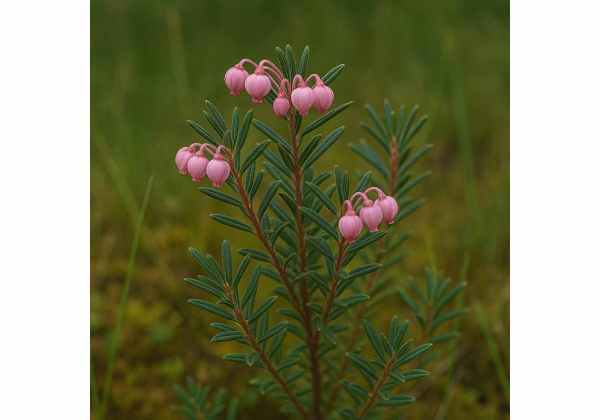
Wild Rosemary, better known botanically as Andromeda polifolia, is one of those plants that invites curiosity and caution at the same time. It is a northern bog shrub with graceful pink urn-shaped flowers and narrow leaves that resemble culinary rosemary, even though the two plants are unrelated. In folk records, Wild Rosemary appears as a tea herb and a remedy for complaints such as catarrh or rheumatic pain. Modern phytochemistry also shows that the plant contains flavonoids and other interesting compounds. Yet the larger truth is more important than the romantic one: this is generally regarded as a poisonous plant, not a routine wellness herb. Historical use exists, but modern self-treatment is hard to justify because Wild Rosemary contains the toxic principle traditionally called andromedotoxin, now grouped with grayanotoxin-type compounds linked to low blood pressure, slow pulse, vomiting, coordination problems, and more serious poisoning effects. So the best article about this plant is not one that encourages casual use. It is one that explains what Wild Rosemary is, why it attracted medicinal attention, and why modern caution should lead the conversation.
Key Facts
- Wild Rosemary has a small historical record as a pectoral and rheumatic folk herb, but it is not a safe everyday medicinal plant.
- The plant contains flavonoids and related compounds of pharmacological interest, yet its toxic compounds outweigh its practical wellness value.
- For modern self-care, the safest oral dose range is 0 g because no safe unsupervised internal dose can be recommended.
- Pregnant or breastfeeding people, children, and anyone with heart, blood pressure, or neurological concerns should avoid it entirely.
Table of Contents
- What Wild Rosemary is and what it contains
- Possible benefits and why they do not outweigh the risks
- Historical uses and what they actually mean
- How Wild Rosemary has been used and why modern use is discouraged
- Dosage, preparation, and why no safe self-care dose can be given
- Safety, side effects, and who should avoid it
- What the research actually says
What Wild Rosemary is and what it contains
Wild Rosemary is a low evergreen shrub of acidic bogs, fens, peatlands, and other wet northern habitats. It is native across parts of Europe, Asia, and North America, and it is often called bog rosemary or marsh andromeda. The common name creates immediate confusion because the leaves look somewhat like rosemary, yet the plant is unrelated to true rosemary and should never be treated as a culinary substitute. In practical herbal terms, that difference is crucial. Wild Rosemary belongs to the Ericaceae family, not the mint family, and its chemistry carries a very different risk profile.
From a medicinal perspective, the first thing to understand is that this plant is chemically mixed rather than simple. Older phytochemical work identified several non-volatile constituents in the aerial parts, including gardenoside, guaijaverine, avicularine, and a flavonol dipentoside called polifolioside. These are the kinds of compounds that make a plant look promising in a phytochemistry paper because they suggest antioxidant, polyphenolic, or biologically active potential. That is part of why Wild Rosemary has continued to attract scholarly interest despite its limited practical role.
But those constituents are not the whole story. The more important chemical point is toxicity. The plant has long been associated with andromedotoxin, the older name commonly used for a toxic principle in certain Ericaceae plants. In modern toxicology, this is generally understood within the grayanotoxin group. These compounds can interfere with sodium channel function and are linked to the characteristic poisoning pattern seen in grayanotoxin exposure: dizziness, low blood pressure, slowed heart rate, weakness, vomiting, altered coordination, and in severe cases more serious autonomic or neurological symptoms.
This changes how the plant should be read. If Wild Rosemary contained only flavonoids and glycosides, it might sit in the large category of mildly promising but underused bog herbs. Because it also contains toxic diterpenoid principles, it belongs in a very different category: historically interesting, pharmacologically real, but unsuitable for casual internal use.
That contrast between attractive phytochemistry and serious toxicology explains why the plant has such a mixed reputation. Gardeners may value it as an ornamental. botanists may notice its specialization for bog habitats. ethnobotanical records may preserve medicinal use. toxicologists, however, see a plant that deserves respect and distance. If you want an example of a bogland herb with a more practical traditional respiratory history, mullein for gentler respiratory support is far easier to justify in modern herbal care.
So the key ingredients of Wild Rosemary are not only its flavonoids and glycosides. They also include the compounds that make it unsafe. That is the central fact that every later section has to honor.
Possible benefits and why they do not outweigh the risks
The user-facing title asks about health benefits, but with Wild Rosemary the honest answer has to begin with a correction. This is not a plant whose “benefits” should be presented the way they would be for chamomile, ginger, or dandelion. It does have historical medicinal uses and phytochemical interest, but these do not translate into a practical recommendation for self-care. Still, it is useful to understand why people ever considered it medicinal at all.
The first possible benefit comes from historical pectoral use. In older records and plant references, Wild Rosemary appears as a respiratory aid for catarrh. In plain language, that suggests it was used when the airways felt congested, irritated, or thick with mucus. This sort of use is common in folk medicine, where aromatic or resinous-looking plants were often tried for chest complaints. But historical pectoral use does not prove clinical benefit. It only tells us that people once believed the plant fit that symptom pattern.
The second possible benefit comes from rheumatic folk use. One Estonian ethnobotanical record describes a decoction of the herb being drunk against rheumatism. Again, this is valuable as cultural evidence, but not as proof of effectiveness or safety. A great many plants were historically used for joint pain because pain is common and chronic pain often drives experimentation. Folk repetition can make a remedy famous long before anyone knows whether it is helping more than it is harming.
The third possible benefit lies in phytochemistry rather than clinical tradition. Wild Rosemary contains flavonoid-related compounds and other constituents that are chemically interesting. That may partly explain why the plant was not merely feared; it was also explored. Many toxic plants contain compounds with real biological activity. The problem is that biological activity is not the same as safe therapeutic value. A poisonous plant can absolutely affect the body. That does not mean it should be used to do so.
This is the point where a responsible article has to be firm: whatever benefits Wild Rosemary may have, they do not currently outweigh the risks for unsupervised internal use. The herb has not developed into a validated modern therapeutic. There are no recognized contemporary monographs supporting it as a safe over-the-counter botanical for cough, joint pain, or general inflammation. Its toxic profile overshadows its minor medicinal history.
That does not make the plant irrelevant. It still matters for several reasons.
- It illustrates how folk use and toxicology can coexist in the same species.
- It shows that historical medicine often included plants now regarded as too risky.
- It reminds modern readers that “traditional” and “safe” are not synonyms.
- It helps explain why some plants move from medicinal curiosity to toxicological warning.
In practical terms, Wild Rosemary is better understood as a cautionary herb than a wellness herb. A safer and more evidence-friendly option for old “rheumatic” pain questions would be something like willow bark as a better-studied plant for pain relief, where both historical use and modern clinical discussion are much more coherent.
So yes, Wild Rosemary has a medicinal story. But that story is valuable mainly because it teaches restraint. The plant may hold compounds of interest. It may have offered symptom relief in some historical settings. Yet none of that is enough to overcome the modern conclusion that its risks dominate its practical value.
Historical uses and what they actually mean
Historical use is often the part of herbal writing that feels most persuasive. A plant that has “been used for centuries” can sound trustworthy before any harder questions are asked. Wild Rosemary is exactly the sort of plant that proves why this instinct can mislead. Its folk uses are real enough to discuss, but they should be interpreted as historical evidence of human experimentation, not as modern proof of safety.
One of the clearest reported uses is as a respiratory aid. Some botanical and ethnobotanical references describe the plant as being used for catarrh or other airway complaints. That fits a broader pattern seen in many northern herbal traditions, where locally available bog or heathland plants were tried for stubborn chest symptoms. The plant may have been made into a tea or decoction from leaves or shoots. From a historical perspective, this is plausible and meaningful. From a modern clinical perspective, it is still only descriptive.
Another documented use comes from archival Estonian folklore material, where Andromeda polifolia appears as a decoction drunk against rheumatism. That use is equally important and equally limited. It tells us that people assigned the plant a role in pain or joint-related discomfort. It does not tell us the dose was safe, the effect was reliable, or the outcome was better than spontaneous improvement, ritual value, or placebo.
There is also a broader pattern hidden beneath these examples. Wild Rosemary seems to have been used where people had few options, where symptoms were chronic, or where a plant’s local availability shaped experimentation. This is a common theme in historical medicine. A remedy becomes traditional partly because it is nearby, memorable, and repeatedly tried. In isolated or wetland communities, a bog shrub can enter the medicinal repertoire simply because it is one of the more distinctive plants in the landscape.
That context matters because it helps prevent romantic overreading. Historical use does not mean the plant was broadly trusted by everyone. It does not mean the outcomes were uniformly positive. It does not mean the toxic risks were unknown, only that they were managed imperfectly, ignored, tolerated, or discovered the hard way. The same record that preserves plant use can also preserve plant danger.
This is especially important with Wild Rosemary because some traditional descriptions mention tea-like use, while modern poison warnings note that toxic compounds can be released by infusion in boiling water. That tension tells the real story. People did use the plant. Modern toxicology gives strong reasons not to repeat that use casually.
A careful reading of historical Wild Rosemary use leads to three practical conclusions:
- the plant had a real place in some folk medicinal traditions
- that place was narrow and symptom-driven rather than general wellness oriented
- the existence of use does not rescue the plant from its poisonous status
For readers who are mainly interested in older respiratory herb traditions but want something far more usable today, elecampane as a more established traditional chest herb offers a much safer and more coherent bridge between history and practice.
So what do Wild Rosemary’s old uses actually mean? They mean the plant was noticed, tried, and remembered. They do not mean it deserves a place in modern self-treatment. In this case, historical use is best treated as ethnobotanical evidence, not as a practical recommendation.
How Wild Rosemary has been used and why modern use is discouraged
If we ask how Wild Rosemary has been used, the answer is fairly simple: as a tea, decoction, or folk preparation made from tender leaves, shoot tips, or aerial parts. That sounds familiar because it resembles the way many other herbs are used. Yet with Wild Rosemary, familiarity is the danger. A plant can look like a tea herb and still be a poor choice for modern herbal practice.
Historically, the preparation style appears to have been uncomplicated. Leaves or young growth were boiled or infused, and the liquid was drunk for complaints such as catarrh or rheumatism. This was a classic folk-medicine pattern: use what is local, prepare it simply, and match it to a symptom that needs relief. There is no evidence that historical users had the kind of toxicological clarity we expect today, and there is no reason to assume they could standardize potency in any meaningful way.
Modern use is discouraged for several connected reasons.
First, the plant is widely regarded as poisonous. This is not a minor or disputed concern. Extension and federal plant resources warn about human poisoning symptoms and identify toxic principles in the plant. That alone should shift the burden of proof heavily against self-use.
Second, boiling or infusion does not neutralize the problem. In fact, poison information specifically warns that a toxin can be released if the plant is infused in boiling water. That is exactly the kind of detail that makes repeated folk-style tea use more concerning, not less.
Third, there is no recognized safe consumer framework for the herb. No reliable modern herbal authority has developed Wild Rosemary into a standard, quality-controlled, adult self-care botanical with defined dose ranges, duration limits, interaction guidance, and benefit-risk balance. Without that framework, trying to modernize it becomes guesswork.
Fourth, the symptoms it was historically used for now have safer alternatives. Catarrh, cough, and rheumatic pain are no longer conditions for which people need to experiment with toxic bog shrubs. The gap between necessity and risk has changed. A plant that may once have been tolerated because options were scarce becomes much harder to justify when safer herbs and medicines already exist.
This is why the phrase “used medicinally” needs care. Technically, yes, Wild Rosemary has been used medicinally. Practically, no, that does not mean a modern person should use it medicinally.
A realistic decision guide is therefore very short:
- historical use can be acknowledged
- home preparation should not be encouraged
- internal use should not be normalized
- a toxic plant should not be reframed as a forgotten wellness herb
In some cases, toxic plants remain important only as pharmaceutical starting points or toxicological teaching tools. Wild Rosemary seems closer to that category than to the everyday herb shelf. It is better read as a reminder that older medicine often lived closer to the edge than modern herbal branding suggests.
For readers who want soothing plant support without stepping into toxic territory, gentler herbs with clear topical or irritation-soothing roles, such as calendula in safer everyday herbal care, make much more sense than trying to rehabilitate Wild Rosemary into routine use.
So the modern conclusion is plain. Wild Rosemary has been used, but that history does not make it advisable. Today, the most responsible guidance is not “here is how to prepare it,” but “here is why preparation is no longer a good idea.”
Dosage, preparation, and why no safe self-care dose can be given
The dosage section for most herbs is where discussion becomes practical. For Wild Rosemary, it becomes protective. The most responsible answer is that no safe unsupervised internal dose can be recommended. That is not a refusal to be helpful. It is the most useful thing to say when a plant’s toxicology outweighs its therapeutic clarity.
Historical sources imply that people prepared the herb as teas or decoctions. Modern botanical references also note that some cultures boiled tender leaves and shoot tips as an aromatic tea. But those statements should not be mistaken for a dosing framework. They are historical observations, not safety-validated instructions. They do not tell us how much plant material was used, how variable the toxic principles were, or how many adverse reactions were never formally recorded.
This is exactly where many herb articles go wrong. A writer sees an old tea use, assumes that all tea herbs can be translated into grams per cup, and fills in a dosage range because the article format expects one. With Wild Rosemary, doing that would be misleading. It would transform a poisonous plant with uncertain potency into something that looks safely replicable. That would be worse than leaving the space blank.
So what should a practical dosage section say?
It should say that for modern self-care, the safest oral dose is none. Put another way, the sensible oral range is 0 g. That statement sounds severe, but it is simply the dosage equivalent of the plant’s toxic reputation.
Preparation advice follows the same logic. Although folk records mention boiling or infusion, modern readers should not interpret that as permission. Hot water extraction is not a detoxification step here. If anything, it can become part of the problem because toxic compounds may be extracted into the liquid. That means the ordinary herbal logic of “make a mild tea first” is not a safe translation strategy.
The same principle applies to tinctures, powders, capsules, and homemade extracts. Concentration is not your friend with toxic plants. A stronger preparation does not turn an uncertain remedy into a better one. It usually turns an uncertain remedy into a more efficient delivery system for harm.
A practical rule set for dosage and preparation is therefore short:
- do not assign yourself an oral dose
- do not prepare it as a home tea
- do not concentrate it into tincture or extract
- do not assume folklore is a substitute for toxicology
- do not use “small amount” as a synonym for “safe”
Another reason to avoid improvisation is variability. Bog plants can vary by environment, season, plant part, and chemistry. Even if one historical preparation was tolerated, that does not mean another would be. Without standardization, dose becomes guesswork stacked on top of toxicity.
If a reader is mainly searching this topic because they want a plant option for chest irritation or joint discomfort, the real advice is to leave Wild Rosemary alone and choose a non-poisonous herb matched to the symptom. This is one of those cases where a missing dose is not a gap in the article. It is the point of the article.
So the dosage answer, stripped of all ornament, is this: Wild Rosemary should not be dosed for self-care. The safest measurable range is 0 g by mouth, and no household preparation method changes that conclusion.
Safety, side effects, and who should avoid it
Safety is the central section for Wild Rosemary because the plant’s risks are clearer than its therapeutic value. If someone remembers only one thing from this article, it should be that Andromeda polifolia is generally treated as a poisonous plant. That single fact reframes everything else.
The reported toxic picture is consistent across plant references and grayanotoxin-related toxicology. Symptoms can include watering of the mouth, eyes, or nose; weakness; dizziness; vomiting; diarrhea; low blood pressure; slow pulse; lack of coordination; breathing problems; convulsions; and progressive paralysis in more severe cases. This is not the side-effect list of a mild herb. It is the profile of a plant that can meaningfully disrupt the nervous and cardiovascular systems.
Part of the risk comes from the grayanotoxin-type toxic principle historically called andromedotoxin. These compounds interfere with normal sodium channel function and can create the characteristic combination of vagal overstimulation, slowed heart rate, and blood pressure collapse that defines grayanotoxin poisoning. In the wider Ericaceae family, similar compounds are also responsible for certain cases of poisonous “mad honey” intoxication.
Who should avoid Wild Rosemary entirely?
- pregnant people
- breastfeeding people
- children and teenagers
- older adults with fragile cardiovascular status
- anyone with heart rhythm problems
- anyone with low blood pressure
- anyone with neurological disease or a seizure history
- anyone taking heart, blood pressure, or sedative medications
In practice, however, the safer message is even simpler: nearly everyone should avoid internal self-use because the plant is not justified as a household herbal remedy.
Another important safety point is that “small” does not mean “safe.” Toxic plants often seduce people precisely because tiny doses may not cause obvious harm every time. That inconsistency can create false confidence and encourage repeated use until symptoms appear. With Wild Rosemary, this kind of trial-and-error thinking is especially unwise.
There is also the issue of delayed recognition. If someone uses the plant in tea form and then develops dizziness, nausea, weakness, odd vision, shortness of breath, or a very slow pulse, they may not immediately connect the symptoms to the herb. That is one more reason the plant should not be normalized in home practice.
Wild harvest adds another layer of concern. Bog plants can be misidentified, mixed with other species, or harvested under variable conditions. Even a correctly identified specimen is still toxic, but a poorly identified one compounds the risk.
For people seeking plant-based support without this kind of toxic burden, a safer and far more established route is to use herbs whose benefits do not depend on flirting with poisoning. That is why Wild Rosemary belongs more in botanical education than in practical herbal medicine.
The clearest safety summary is direct: all parts of the plant should be treated with caution, internal self-use should be avoided, and any poisoning symptoms after exposure deserve prompt medical attention. Wild Rosemary is not an herb that becomes acceptable simply because it was once used. It remains a plant whose danger is easier to define than its benefit.
What the research actually says
The research on Wild Rosemary is enough to support a serious article, but not enough to support a modern wellness recommendation. That distinction matters. The plant is not empty folklore. It has real chemistry, real historical use, and real toxicology. What it lacks is a credible body of evidence showing that its benefits can be separated from its risks well enough for ordinary self-care.
The chemistry literature confirms that Andromeda polifolia contains identifiable constituents beyond its toxic principle. The 1987 phytochemical paper isolated known compounds such as gardenoside, guaijaverine, and avicularine, and identified a new flavonol dipentoside called polifolioside. This shows that Wild Rosemary is not chemically trivial. It has the kind of flavonoid-rich profile that often sparks pharmacological interest in medicinal plant research.
Ethnobotanical research also confirms that the plant did have a place in historical medicine. The 2022 Estonian archival study records a decoction of the herb being drunk against rheumatism. Other modern plant references mention folk tea use and pectoral use for catarrh. These details matter because they show that the plant’s medicinal reputation was not invented recently.
But the toxicology is the decisive part of the evidence. Extension and federal plant resources warn that the plant is poisonous to humans and describe a symptom pattern involving low blood pressure, slow pulse, vomiting, weakness, and more severe neurological or respiratory problems. Broader toxicology reviews of grayanotoxins explain how compounds of this type act on sodium channels and why intoxication can produce a distinctive autonomic syndrome.
This means the research supports a very specific conclusion:
- Wild Rosemary contains bioactive compounds.
- Wild Rosemary has a real folk medicinal history.
- Wild Rosemary also contains toxic compounds that make internal use risky.
- Modern evidence does not justify routine therapeutic use.
That is the correct balance. The plant is not useless, but its value is mostly educational and ethnobotanical rather than practical. It teaches how a single species can be chemically interesting, historically medicinal, and still unfit for modern household use.
Just as important, the research does not support a few common temptations. It does not support reframing Wild Rosemary as an overlooked superherb. It does not support giving it a consumer-friendly dose. It does not support treating traditional tea use as proof of safety. And it does not support marketing the plant as a natural remedy for respiratory complaints or joint pain in the way safer herbs are marketed.
In that sense, Wild Rosemary is a good example of what responsible herbal writing should do. It should neither sensationalize the plant as deadly in every context nor soften the danger because the name sounds quaint and traditional. The real lesson is more useful: some plants remain more valuable as warnings than as remedies.
So what the research actually says is not “this herb needs rediscovery.” It says something more sober and more important. Wild Rosemary deserves recognition for its history and chemistry, but modern self-treatment should give way to modern caution.
References
- Grayanotoxins in Mad Honey: Mechanisms of Toxicity, Clinical Management, and Therapeutic Implications 2025
- The Appeal of Ethnobotanical Folklore Records: Medicinal Plant Use in Setomaa, Räpina and Vastseliina Parishes, Estonia (1888–1996) 2022
- Andromeda polifolia (Bog Rosemary, Marsh Andromeda) 2026
- Andromeda polifolia 2008
- Constituents of Andromeda polifolia 1987
Disclaimer
This article is for educational purposes only and is not medical advice. Wild Rosemary is generally regarded as a poisonous plant, and it should not be used as a substitute for diagnosis, prescribed treatment, or urgent care. Do not ingest this plant for self-care. Seek professional medical help immediately if exposure is followed by dizziness, vomiting, weakness, breathing trouble, or a very slow pulse.
If this article was helpful, please share it on Facebook, X, or your preferred platform so more readers can find careful, evidence-aware plant information.