Wild senna, or Senna hebecarpa, is a tall North American legume best known in herbal medicine for one central action: it can stimulate the bowels. Like other senna plants, its leaves and pods contain anthraquinone-type compounds associated with laxative effects, which is why the herb was traditionally used as a purgative or cathartic rather than as a gentle daily tonic. Older ethnobotanical records also point to broader folk uses, but constipation relief remains the most recognizable theme.
That said, wild senna is not simply a wild version of every commercial senna product on the shelf. It is a native species with more variable chemistry, less clinical study, and less dosage standardization than the better-known medicinal sennas used in modern over-the-counter laxatives. This makes the plant interesting, but it also means caution matters. In practical terms, wild senna is best understood as a short-term, stimulant herb for occasional constipation, not as a routine “detox” tea or an herb to take casually for digestion. Its strongest value comes from precise, limited use, paired with a clear understanding of safety, duration, and the risks of overuse.
Key Takeaways
- Wild senna may help trigger bowel movements when occasional constipation calls for a stimulant laxative approach.
- The herb’s main active compounds are anthraquinone-type laxative constituents found especially in the leaves and pods.
- When senna is used medicinally, dosing is usually standardized to about 15 to 30 mg sennosides at bedtime rather than improvised from wild-harvested plant material.
- Pregnant people, anyone with bowel obstruction, dehydration, inflammatory bowel disease flares, or recurrent unexplained abdominal pain should avoid self-use.
Table of Contents
- What Wild Senna Is and How It Is Used
- Key Compounds in Wild Senna
- Potential Health Benefits and Medicinal Properties
- Traditional Uses and Modern Practical Applications
- What the Research Actually Supports
- Dosage, Preparation, and Best Ways to Use It
- Safety, Side Effects, and Who Should Avoid It
What Wild Senna Is and How It Is Used
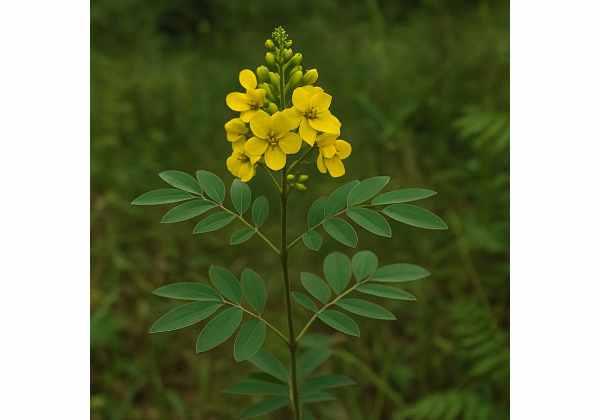
Wild senna is a perennial plant in the pea family, Fabaceae, native to eastern North America. It grows in moist meadows, forest edges, floodplains, roadsides, and other open, often disturbed places. In summer it produces upright clusters of yellow flowers, followed by dark seedpods that make the plant easy to recognize. Gardeners value it as a pollinator and butterfly plant, but herbalists have traditionally paid more attention to its leaves, pods, seeds, and sometimes its root.
The first thing to understand is that wild senna belongs to a broader medicinal group rather than standing entirely on its own. The genus Senna includes several species long used as stimulant laxatives. In that sense, wild senna shares the family trait that made “senna” famous in pharmacy and folk medicine. Yet Senna hebecarpa is not as standardized as the commercial senna species most often used in modern laxative products. This distinction matters because people often assume all senna plants can be used interchangeably. They should not be.
Its most recognizable traditional role is as a bowel stimulant. Unlike soothing digestive herbs that reduce gas or calm cramping, wild senna belongs to the “push the bowel to move” category. That is a very different action. It can be useful, but it also makes the herb more demanding to use well.
Older descriptions of wild senna point to several broad uses:
- as a purgative or laxative
- in short-term bowel clearing
- in scattered ethnobotanical records for fever or other compound remedies
- as a plant with strong physiologic action rather than a mild tonic effect
That last point is important. Wild senna does not belong to the same practical category as a pleasant daily tea. It is more of a problem-solving herb. People traditionally reached for it when something needed to move, not when they wanted a gentle digestive companion.
Another useful detail is that wild senna can be confused with related North American species, especially Maryland senna. For garden use that may not matter much, but for herbal use it adds one more reason to avoid casual foraging and self-dosing without accurate identification.
A good way to frame wild senna is this:
- It is a native North American senna with traditional laxative use.
- It likely shares core stimulant-laxative chemistry with other senna species.
- It is not as well standardized as commercial senna products.
- It should be treated as a short-term medicinal herb, not a daily wellness plant.
That framework helps prevent two common mistakes: underestimating its strength because it is a “wildflower,” and overestimating its versatility because it is a “senna.” Wild senna is useful, but it makes the most sense in a narrow, carefully defined role.
Key Compounds in Wild Senna
Wild senna’s medicinal identity depends mainly on anthraquinone-type constituents. These are the compounds that give the broader senna group its stimulant laxative reputation. In practical herbal language, they are the reason the plant is known for causing bowel movement rather than simply softening stool or adding bulk.
The USDA fact sheet for wild senna specifically notes that the leaves and pods contain anthraquinones. That species-level point matters because it anchors the plant’s traditional use in a concrete chemical class rather than vague folklore. These compounds help explain why grazing animals often avoid the plant and why human medicinal use has focused on purgative action.
In the wider senna literature, the best-known laxative molecules are sennosides and related anthraquinone derivatives. Whether a wild population of Senna hebecarpa contains these in the same concentrations as commercial senna species is a separate question. This is exactly where caution enters the picture. Wild senna belongs to the right chemical family, but its strength is not standardized the way pharmacy senna products are.
Beyond anthraquinones, senna plants more broadly have been described as containing a range of secondary metabolites such as:
- flavonoids
- phenolic compounds
- tannins
- terpenoid-related compounds
- other antioxidant constituents
These broader constituents help explain why researchers continue to study Senna plants for more than laxative action alone. The genus has drawn attention for antioxidant and anti-infectious potential in experimental settings. Still, those wider benefits should not distract from the core point: for wild senna itself, the most practical and historically important chemistry is the anthraquinone-driven bowel effect.
This chemical profile helps explain several things at once.
First, it clarifies why wild senna is not mainly a “digestive comfort” herb. A plant rich in stimulant-laxative anthraquinones works differently from a soothing herb like psyllium, which supports bowel movement through bulk and softness. Wild senna acts more by stimulating intestinal motility than by increasing stool moisture or volume alone.
Second, it explains why overuse can create side effects that are predictable rather than mysterious. If a plant’s main medicinal value is to push the bowel to contract and empty, then too much of it can lead to cramps, urgency, diarrhea, fluid loss, and dependence on repeated stimulation.
Third, it shows why standardized products exist at all. With stimulant plants, chemical consistency matters. That is why commercial senna products are usually dosed by sennoside content rather than by loose handfuls of leaf or pod.
So when readers ask about “key ingredients” in wild senna, the simplest honest answer is that anthraquinone-type laxative compounds define the herb, while other polyphenols and plant metabolites may add supporting properties but do not replace its main identity. Wild senna is, first and foremost, a stimulant laxative herb.
Potential Health Benefits and Medicinal Properties
Wild senna’s benefits are narrower than many herb articles imply, but they are still real. The most defensible benefit is short-term relief of occasional constipation when a stimulant approach is appropriate. That wording matters. Wild senna is not the first herb for everyone with bowel complaints. It is one option for a specific pattern: stool that is not moving, where a stronger push may be needed.
Its main likely benefits include the following.
Occasional constipation relief
This is the clearest use. Like other senna plants, wild senna likely works by stimulating bowel motility through anthraquinone-derived compounds. This can help when stool is delayed and softer, more passive strategies have not been enough.
Short-term bowel clearing
Historically, senna plants were often used as purgatives or cathartics. This stronger language reflects older medicine, where emptying the bowel was sometimes an intended therapeutic goal in itself. Today that use is much narrower, but it explains the herb’s historical reputation.
Possible antioxidant support at the genus level
Modern reviews of the Senna genus describe antioxidant and anti-infectious potential in extracts from various species. That is scientifically interesting, but it should not be exaggerated into a direct consumer promise for Senna hebecarpa. In this plant, the laxative effect remains the main practical takeaway.
Broader ethnobotanical interest
Some traditional records describe additional folk uses beyond constipation, including fever-related and compound-remedy applications. These help round out the herb’s history, but they are not the strongest basis for modern self-care.
Just as important is what wild senna does not do especially well. It is not the best herb for:
- crampy digestion without constipation
- general gut soothing
- bloating caused by food intolerance
- chronic long-term bowel management
- dry, hard constipation in dehydrated or depleted people without careful oversight
That last point often surprises people. A stimulant laxative can produce a bowel movement, but it does not necessarily correct the underlying reason constipation developed. In some cases, a gentler herb or a non-herbal strategy is more appropriate.
For example, if the main goal is calm, relaxed digestion rather than bowel stimulation, peppermint for crampy digestive discomfort fits a very different pattern. If the problem is sluggish bowel movement with dry stool and low fiber intake, psyllium may make more sense. Wild senna belongs later in the decision tree, not earlier.
A balanced summary of wild senna’s medicinal properties would look like this:
- stimulant laxative
- short-term purgative or cathartic
- possibly antioxidant at the genus level
- condition-specific rather than broadly tonic
That narrower profile is actually useful. It keeps the herb in the right lane. Wild senna works best when the goal is specific, the duration is brief, and the person using it understands that stronger action is not the same as better daily digestive health.
Traditional Uses and Modern Practical Applications
Traditional use of wild senna reflects the older logic of strong herbs. In many herbal systems, especially before modern laxatives were widely available, a reliable purgative was a serious medicinal tool. Wild senna was valued because it could provoke a bowel response when softer methods were not enough. That alone explains much of its historical role.
The species has also appeared in North American ethnobotanical records beyond simple laxative use. Some traditions used root preparations or compound remedies for fever, fainting, worms, or external problems. These broader uses are important historically, but they do not automatically translate into modern self-treatment. In today’s setting, wild senna’s most practical use remains occasional constipation support.
A helpful way to understand its traditional character is to think of it as an herb of movement and clearing. Herbalists reached for it when the body seemed stuck, heavy, or overburdened by retained waste. That is very different from using an herb daily to “optimize digestion.” In traditional terms, wild senna was corrective and forceful, not casual.
Its most likely traditional and modern applications include:
- short-term laxative tea or decoction
- use in stronger compound purgative formulas
- limited ethnobotanical root use in broader folk remedies
- occasional use when bowel movement is delayed and a stimulant is clearly desired
Modern practical use should be much narrower than historical use for one main reason: we now know more about the downsides of repeated stimulant-laxative exposure. What once looked like a broadly useful purgative can now be recognized as something better reserved for defined situations.
That is why wild senna is a poor match for several common modern habits:
- “detox tea” routines
- daily weight-loss use
- repeated unsupervised bowel cleansing
- using stronger and stronger laxatives instead of addressing diet, hydration, or medication side effects
These patterns are especially risky because senna-type herbs can become psychologically and physiologically easy to rely on. When the bowel starts to move only after stimulation, people often mistake the short-term result for long-term solution.
A better modern framework is simple:
- Use stimulant herbs only when gentler measures are not enough.
- Keep the duration short.
- Stop once the bowel pattern has normalized.
- Investigate the cause if constipation keeps recurring.
For people who need a more supportive digestive approach rather than a stimulant push, ginger for nausea and sluggish digestion may fit better. Wild senna is not a herb for “better digestion” in the broad sense. It is a herb for bowel movement when bowel movement is not happening.
That practical distinction prevents most misuse. Wild senna can still have a role in modern herbal care, but only when used as a precise tool, not as a lifestyle habit.
What the Research Actually Supports
The research story around wild senna is a mix of species-specific knowledge and broader senna evidence. That distinction matters. Senna hebecarpa itself is not a heavily studied clinical herb. Most of the strongest research applies to the senna group as stimulant laxatives, not to this species alone in modern human trials.
What the evidence supports fairly well:
- senna plants contain anthraquinone-type laxative compounds
- stimulant senna preparations are effective for constipation rescue
- short-term use is the safest and most accepted approach
- long-term or heavy use increases the chance of adverse effects
- the genus also shows antioxidant and anti-infectious promise in preclinical work
What the evidence does not support strongly:
- a robust clinical literature specific to Senna hebecarpa
- confident dosing of wild-harvested S. hebecarpa by grams alone
- broad daily wellness use
- long-term unsupervised stimulant-laxative use
Modern constipation guidance helps put this in perspective. Senna products are still accepted as effective stimulant laxatives, and some guidelines regard them as reasonable short-term or rescue options. At the same time, the same literature emphasizes caution with repeated use and notes that the strongest safety data are for limited durations rather than indefinite long-term use.
Research on anthraquinone laxatives also helps explain old concerns that still circulate around senna. These include questions about melanosis coli, bowel dependence, colon injury, and cancer risk. The best current reading is more balanced than older alarmist language. Standardized stimulant laxatives do not appear to have the catastrophic risks once feared, but long-term overuse remains a poor idea, especially when constipation is recurrent and unexplained.
That is why a research-based summary of wild senna looks like this:
- The laxative mechanism is believable and well supported at the genus level.
- The safety profile depends heavily on dose and duration.
- The main clinical value is short-term constipation relief.
- Wild senna itself remains less standardized than commercial senna species.
This is also the point where species honesty matters most. A person reading about “senna” in clinical reviews is usually reading evidence tied to commercial or medicinally standardized senna, not to a wild-collected stand of Senna hebecarpa. That does not make the evidence irrelevant. It means the evidence must be interpreted carefully.
For people with constipation that is frequent, chronic, or medication-related, gentler options such as psyllium or other non-stimulant approaches are often better long-term strategies. Wild senna belongs more to the rescue category than the maintenance category.
That is the fairest conclusion. Research supports the senna idea more than it supports this exact species in improvised home use. The herb is real, the action is real, and the caution is real too.
Dosage, Preparation, and Best Ways to Use It
Dosage is where wild senna becomes tricky. Many herb articles jump straight from plant identity to a homemade tea recipe, but that is not the safest way to think about this species. Because Senna hebecarpa is not as standardized as pharmacy senna, the most honest dosing guidance is comparative rather than absolute.
Modern senna products are usually measured by sennoside content, not by handfuls of wild leaf. A common standardized benchmark is about 15 to 30 mg sennosides, usually taken at bedtime, with an effect expected within several hours. That range is useful because it shows how senna is dosed when manufacturers actually know how much active laxative chemistry is present.
Wild senna does not offer that same certainty. The leaves and pods may contain anthraquinones, but the potency of wild plant material can vary with species, season, plant part, and preparation. For that reason, wild-harvested material should not be treated as interchangeable with standardized senna tablets or teas.
A cautious practical framework is:
- standardized senna products are safer to dose than improvised wild material
- wild senna should be reserved for experienced use, not beginner experimentation
- short-term bedtime use makes more sense than repeated daytime use
- the mildest effective amount is always preferable
If someone does prepare wild senna as an herbal tea under informed guidance, the infusion should be modest rather than aggressive. Strong decoctions or repeated dosing increase the likelihood of cramps and urgent diarrhea. In practical herbal terms, the plant is better “tested lightly” than “pushed hard.”
Timing also matters. Stimulant senna-type herbs are usually taken in the evening because bowel effects often occur 6 to 12 hours later. That timing reduces surprise and is one reason bedtime use became traditional.
The best use cases for wild senna are narrow:
- occasional constipation that has not responded to simpler measures
- temporary rescue use rather than daily maintenance
- brief, planned use with good hydration
- avoidance of repeated escalating doses
It is equally important to say when not to use it. Wild senna is a poor choice for:
- routine bowel training
- “detox” weekends
- bowel cleansing for weight loss
- frequent abdominal pain without a diagnosis
- constipation linked to dehydration or inadequate fiber where gentler correction would help more
If the goal is simply to make stool easier to pass rather than to stimulate the colon, bulk-forming options and food-based strategies are usually a better first step. A stimulant laxative is not automatically wrong, but it is not the place most people should start.
So the most truthful dosage message is this: use standardized senna measurements as the safest reference point, and do not assume wild Senna hebecarpa can be dosed casually by copying commercial senna directions leaf-for-leaf.
Safety, Side Effects, and Who Should Avoid It
Safety is the most important part of any wild senna article because the herb’s value and its risks come from the same place: stimulant laxative chemistry.
The most common side effects are exactly what you would expect from an overactive bowel stimulant:
- cramping
- urgent bowel movement
- loose stool or diarrhea
- nausea
- dehydration if fluid losses are not replaced
- weakness or lightheadedness after repeated purging
These effects are not rare accidents. They are the predictable extension of the herb’s intended action. That is why wild senna is best approached with moderation rather than bravado.
Longer-term or repeated use raises more serious concerns. The broader senna literature discusses:
- dependence on stimulant laxatives
- electrolyte imbalance, especially low potassium
- melanosis coli with prolonged anthraquinone exposure
- worsening bowel habits when the underlying cause is ignored
- rare liver injury in cases of chronic overuse or abuse
That last point is especially important for people who assume herbal laxatives are harmless because they are sold over the counter. They are not necessarily dangerous when used properly, but they are not risk-free either.
People who should avoid wild senna self-use include:
- people with bowel obstruction or suspected obstruction
- anyone with severe abdominal pain of unknown cause
- people with inflammatory bowel disease flares
- those with significant dehydration or vomiting
- people with eating disorders or purging behaviors
- pregnant people without medical guidance
- people taking medicines affected by fluid or potassium shifts, such as certain diuretics or heart medicines
Breastfeeding is more nuanced. Standardized senna products have a more reassuring lactation record than many people realize, but species-specific evidence for wild senna is not robust enough to justify casual use. That is why a cautious approach is still best.
Another overlooked safety point is plant identification. Wild senna is a real native medicinal plant, but using the wrong species, the wrong plant part, or poorly dried material adds risk without adding benefit. This is one more reason commercial standardized products are often preferable if senna is truly needed.
A balanced bottom line looks like this:
- short-term use is the safest lane
- standardized products are safer than improvised wild dosing
- more is not better
- chronic constipation deserves evaluation, not endless stimulation
- the herb should never become a weight-loss or cleansing habit
For people who need a gentler long-term approach to bowel regulation, herbs and foods that support bulk, lubrication, or nervous-system relaxation usually deserve attention before stimulant laxatives do. Wild senna has a place, but it is the place of a strong, short-term corrective, not a daily digestive companion.
References
- A Review of Recent Studies on the Antioxidant and Anti-Infectious Properties of Senna Plants 2022 (Review)
- Review article: do stimulant laxatives damage the gut? A critical analysis of current knowledge 2024 (Review)
- Review on melanosis coli and anthraquinone-containing traditional Chinese herbs that cause melanosis coli 2023 (Review)
- Senna – LiverTox – NCBI Bookshelf – NIH 2020 (Authoritative Monograph)
- Wild Senna 2008 (Official Plant Fact Sheet)
Disclaimer
This article is for educational purposes only and is not medical advice. Wild senna is a stimulant herb, not a routine daily digestive tonic, and improper use may cause cramping, diarrhea, dehydration, or laxative dependence. Anyone with chronic constipation, abdominal pain, inflammatory bowel disease, pregnancy, major medical conditions, or regular prescription medicine use should speak with a qualified healthcare professional before using senna in any form.
If you found this article helpful, please share it on Facebook, X, or another platform you prefer.