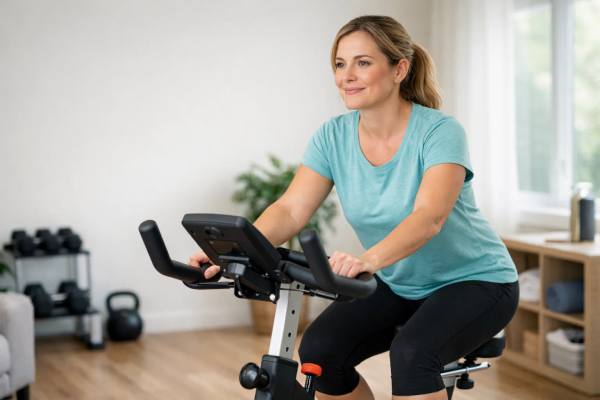
Stationary bike workouts can be one of the best beginner-friendly tools for weight loss because they are low-impact, easy to control, and simple to repeat. You do not need advanced fitness, perfect coordination, or a high pain tolerance to get useful workouts from a bike. What matters most is using the bike often enough, at the right effort, and with a plan you can actually stick to.
For beginners, the goal is not to survive brutal spin classes or chase huge calorie numbers on the screen. It is to build consistent rides that improve fitness, increase weekly calorie burn, and fit into a realistic fat-loss routine. This guide explains how to start, how hard to ride, which beginner workouts work best, and how to progress without burning out.
Table of Contents
- Why the Stationary Bike Works for Weight Loss
- How to Set Up Your Bike and Effort Level
- Best Beginner Bike Workouts
- Weekly Stationary Bike Plan for Beginners
- How Long and How Often to Ride
- How to Make Bike Workouts More Effective
- Mistakes Beginners Should Avoid
- When to Progress Beyond Beginner Rides
Why the Stationary Bike Works for Weight Loss
The stationary bike works well for weight loss because it solves several problems that stop beginners from exercising consistently.
First, it is low impact. That matters more than many people realize. When exercise feels rough on your knees, hips, feet, or lower back, it becomes hard to repeat. A bike reduces impact while still letting you work hard enough to raise your heart rate, breathe harder, and burn meaningful calories. For people who do not enjoy running or who need a more joint-friendly option, the bike is often a much better entry point than forcing high-impact cardio. It also fits naturally alongside other low-impact cardio options for bad knees if you want variety.
Second, the bike is easy to scale. You can change resistance, speed, or duration without needing to learn complicated technique. That makes it beginner-friendly in a way that many workouts are not. A walk that is too easy can feel unproductive. A run that is too hard can feel miserable. On a bike, you can usually find a middle ground quickly.
Third, indoor cycling removes a lot of friction. Weather does not matter. Traffic does not matter. Darkness does not matter. You can ride for 15 minutes or 45 minutes without commuting to a trail or gym class. That convenience is a major reason why beginners can build momentum on a stationary bike more easily than with some other cardio options.
There is also the recovery side. A stationary bike workout can challenge your cardiovascular system without leaving you as beat up as higher-impact training. That makes it easier to fit into a broader routine with walking, strength training, or a busy work schedule. A workout that is slightly less exciting but far more repeatable often wins over time.
For weight loss specifically, the bike helps in three main ways:
- it increases total weekly activity
- it can help create or support a calorie deficit
- it improves fitness so longer or harder workouts become possible later
The bike is not magic. You still need consistency and eating habits that support your goal. But as an exercise tool, it is one of the easiest places to start because it offers a strong mix of accessibility, safety, and progression. If you are trying to decide whether cycling is enough on its own or should sit inside a larger plan, it helps to think of it as one part of your overall best exercises for weight loss strategy rather than the only piece.
For beginners, that is a very good thing. Exercise works better when it feels doable this week, next week, and next month.
How to Set Up Your Bike and Effort Level
A good beginner workout starts before the first pedal stroke. Bike setup and effort control make a huge difference in whether your rides feel smooth and useful or awkward and punishing.
Start with the seat height. A simple rule is that when your foot is near the bottom of the pedal stroke, your knee should still have a slight bend. If the seat is too low, your knees stay too bent and the ride can feel cramped or uncomfortable. If it is too high, you may rock side to side and strain your hips or lower back. Handlebar height should feel comfortable enough that you are not folding yourself into a painful position, especially if flexibility is limited.
Next, think about resistance. Beginners often make one of two mistakes: they turn resistance so low that the ride becomes an empty leg-spinning session, or they crank it so high that it turns into a grinding slog. The sweet spot is enough resistance to feel like you are pushing against the pedals with purpose, but not so much that your form falls apart.
A simple effort scale works well:
- Easy effort: breathing is up a little, but conversation is easy
- Moderate effort: you can still talk, but only in short phrases
- Hard effort: breathing is heavy and sustained talking is difficult
- Very hard effort: only brief bursts are realistic
Most beginner fat-loss rides should live in the easy-to-moderate range, with small amounts of hard work later as fitness improves. You do not need every session to feel intense. In fact, many beginners get better results when most rides feel manageable enough to repeat.
Cadence matters too, but beginners do not need to obsess over exact numbers. Focus first on smooth, controlled pedaling and stable posture. Your shoulders should stay relaxed, your hands light on the bars, and your core gently braced. The bike should feel like a cardio tool, not a test of how much tension you can hold in your upper body.
A short warm-up helps a lot. Spend 3 to 5 minutes pedaling easily before you add effort. That small step can make the main ride feel much better, especially in the morning or after a long day sitting. If you want a more complete recovery routine around your cycling, warm-up, mobility and recovery habits can make your workouts feel better without adding much time.
The most important principle is this: control effort before you chase intensity. Beginner rides work best when you know how to stay steady, how to increase resistance gradually, and how to finish a workout feeling like you trained rather than survived.
Best Beginner Bike Workouts
Beginners do best with a small number of simple workout types rather than endless variety. You do not need twelve fancy ride templates. You need a few formats that are easy to understand and easy to progress.
| Workout type | Typical length | Effort | Best for |
|---|---|---|---|
| Easy steady ride | 20 to 40 minutes | Easy to moderate | Building consistency and recovery |
| Moderate steady ride | 25 to 45 minutes | Moderate | Calorie burn and aerobic fitness |
| Simple interval ride | 15 to 30 minutes | Alternating moderate and hard | Time-efficient challenge |
| Progression ride | 20 to 35 minutes | Starts easy, ends harder | Learning pacing and control |
1. Easy steady ride
This is the most underrated beginner workout. Ride at an easy to moderate pace for 20 to 40 minutes, keeping resistance comfortable and smooth. It may not feel dramatic, but it builds the habit, improves work capacity, and keeps recovery manageable.
2. Moderate steady ride
This is your bread-and-butter workout once basic fitness improves. You ride continuously at a purposeful effort where breathing is elevated but still under control. It is simple, effective, and easy to track over time.
3. Simple interval ride
Intervals help when you want a shorter workout with a little more intensity. For beginners, keep them basic. A good example is 1 minute harder, 2 minutes easier, repeated 5 to 8 times. You do not need all-out sprinting. Controlled hard efforts are enough.
If you later want to compare whether harder intervals are worth it for your schedule and recovery, the broader HIIT versus steady-state cardio tradeoff becomes useful. Beginners usually need more steady work than they think and less intensity than social media suggests.
4. Progression ride
Start easy, settle into moderate work, and finish with a slightly harder final block. This teaches pacing and helps you avoid the common beginner mistake of starting too hard and fading.
These workouts work because they are scalable. You can progress by adding time, slightly increasing resistance, or reducing rest during intervals. That is much more sustainable than jumping straight into extreme “fat-burning” rides.
For most beginners, the best weekly mix is:
- 1 to 2 steady moderate rides
- 1 easier ride
- 0 to 1 interval ride
That gives you enough structure to improve while keeping the plan manageable.
Weekly Stationary Bike Plan for Beginners
A stationary bike becomes much more effective when you stop choosing random rides and start following a simple weekly plan. Beginners usually do better with 3 to 4 rides per week than with daily sessions they cannot sustain.
Here is a practical 4-week beginner approach.
Week 1
- Ride 1: 20-minute easy steady ride
- Ride 2: 25-minute moderate steady ride
- Ride 3: 20-minute easy steady ride
Week 2
- Ride 1: 25-minute moderate steady ride
- Ride 2: 20-minute interval ride
5 rounds of 1 minute harder and 2 minutes easy - Ride 3: 25-minute easy to moderate ride
Week 3
- Ride 1: 30-minute moderate steady ride
- Ride 2: 22-minute interval ride
6 rounds of 1 minute harder and 2 minutes easy - Ride 3: 25-minute easy steady ride
- Optional Ride 4: 15-minute recovery spin
Week 4
- Ride 1: 30 to 35-minute moderate steady ride
- Ride 2: 25-minute progression ride
- Ride 3: 25-minute interval ride
6 to 8 rounds of 1 minute harder and 90 seconds easy - Ride 4: 20-minute easy recovery ride
This kind of plan works because the weekly volume rises gradually without becoming overwhelming. It also gives each ride a purpose instead of turning every workout into the same tired effort.
If you want to place these sessions inside a bigger routine, a broader weekly workout schedule for weight loss can help you fit the bike around walking and strength work. Many beginners do very well with a setup like this:
- 3 bike rides
- 2 strength sessions
- light walking on non-bike days
That approach helps weight loss while protecting muscle and keeping the routine balanced.
One important note: do not judge the plan only by calories shown on the console. Bike calorie estimates can be rough and often overly generous. Use them as a loose reference, not as a permission slip to eat more. The true value of the plan is that it increases weekly activity in a way you can actually maintain.
Also, do not panic if some days feel harder than others. Sleep, stress, hydration, meal timing, and soreness all change how a ride feels. Progress is about what happens over several weeks, not whether every ride feels equally strong.
How Long and How Often to Ride
Beginners often ask two questions right away: how long should each ride be, and how many rides per week are enough for weight loss? The most useful answer is that both matter, but consistency matters more than chasing the perfect number.
For many beginners, a good starting range is 20 to 30 minutes per ride, 3 times per week. That is enough to build the habit, improve cardiovascular fitness, and add meaningful activity without overwhelming recovery. As fitness improves, many people can move toward 30 to 45 minutes per ride, 3 to 5 times per week depending on the rest of their program.
A practical progression often looks like this:
- Starting out: 60 to 90 total bike minutes per week
- After a few weeks: 90 to 150 total bike minutes per week
- More established routine: 150 to 225 total cardio minutes per week from biking and other exercise
That fits well with broader guidance on how long workouts should be for weight loss and keeps the bike in a realistic role inside your week.
It also helps to think in terms of workout purpose:
- easy rides can be a bit shorter or used for recovery
- steady moderate rides are often the backbone of your plan
- interval rides can be shorter because the effort is higher
If time is tight, shorter rides still count. A focused 15- to 20-minute session is much more useful than doing nothing because you assumed only 45 minutes was “worth it.” That is one reason shorter sessions and 15-minute workouts for weight loss can still be valuable on busy days.
How hard should you ride? Most beginner sessions should be in the easy-to-moderate range, with maybe one harder session per week once you have some base fitness. A good rule is that you should finish most rides feeling worked, but not destroyed. If every workout leaves you with burning legs and dread for the next one, your plan is too aggressive.
It is also smart to keep the bike inside a bigger cardio picture. If biking is your main cardio, great. If it is one piece among walking, swimming, or gym sessions, also great. The better question is not “How long should one bike ride be?” but “How much useful cardio can I repeat this week?”
For weight loss, the answer is usually: enough to raise weekly energy expenditure, but not so much that your hunger, fatigue, or schedule makes the plan collapse.
How to Make Bike Workouts More Effective
A stationary bike workout becomes more effective for weight loss when it is part of a system, not a standalone event. The ride matters, but so do the habits around it.
One of the simplest upgrades is to fuel in a way that supports the workout without canceling out its benefit. You do not need elaborate sports nutrition for beginner bike sessions, but you do want enough energy to ride well and enough structure to avoid overeating later. If you ride before a meal, a small carb-and-protein snack may help. If you ride after, a balanced meal can support recovery without turning the ride into an excuse for a giant treat. That is why guidance on pre-workout meals for weight loss and post-workout meals for weight loss can be more useful than obsessing over a bike console.
Hydration matters too, especially for indoor rides. Even beginners can get surprisingly sweaty on a stationary bike, and dehydration makes the session feel harder than it needs to.
Another way to improve results is to keep some light activity outside the workout. A bike ride helps, but fat loss usually goes better when you also keep your daily movement up. That might mean walking more, standing more often, or simply avoiding the pattern where one tough ride leads to lying down for the rest of the day. That quiet drop in background movement can erase some of the benefit of the workout.
Bike workouts also work better when you do not rely on them alone forever. As your confidence improves, adding strength training can improve body composition and help keep muscle while dieting. Even two sessions per week can make a meaningful difference. If you are unsure how to layer that in, how often to strength train for weight loss is a useful next step.
There is also a mindset piece. The most effective bike workouts are not the ones that leave you drenched and wrecked every time. They are the ones that make next week easier to repeat. That usually means:
- enough challenge to improve
- enough recovery to stay consistent
- enough structure to measure progress
- enough flexibility to survive real life
A beginner ride becomes effective when it is something you can do even on an average Tuesday, not just on your most motivated day. That is where real fat-loss results start to build.
Mistakes Beginners Should Avoid
Most beginner bike problems are not about choosing the wrong machine. They come from pacing, programming, and expectations.
Starting too hard
This is the biggest mistake by far. Beginners often assume fat loss requires extreme effort from day one, so they ride too hard, too long, or too often. That usually leads to sore legs, low motivation, and inconsistent training. Start with a level you can repeat.
Using resistance badly
Resistance that is too low turns the workout into aimless spinning. Resistance that is too high can strain your knees and make cadence collapse. The right resistance lets you pedal with purpose and control.
Trusting calorie numbers too much
Bike consoles and app estimates can be helpful for consistency, but they are not precise enough to “eat back” every calorie with confidence. If weight loss stalls, overly trusting these numbers is often part of the problem. This is one reason people can end up overestimating exercise calories without realizing it.
Doing only intervals
Hard sessions have a place, but many beginners use intervals for every ride because they sound more effective. In reality, too much intensity makes recovery harder and can hurt consistency. Steady moderate rides often do more of the long-term work.
Ignoring discomfort signals
A hard workout is not the same thing as bad pain. Knee pain, numb hands, saddle pain that does not improve, or back discomfort often mean setup or technique needs attention.
Skipping progression
Some beginners repeat the same 20-minute easy ride forever and then wonder why results slow. Others progress too fast and crash. The goal is gradual progression: more time, slightly better control, or one extra session, not a giant jump.
Expecting the bike to replace all other habits
The bike can support weight loss well, but it cannot overcome constant overeating, very poor sleep, or a mostly inactive lifestyle by itself. It works best inside a broader routine.
The encouraging part is that all of these mistakes are fixable. You do not need perfect workouts. You need slightly smarter ones.
When to Progress Beyond Beginner Rides
You are ready to move beyond beginner rides when the current plan feels stable, not when you are bored for one day. Progression should come from evidence that your body is adapting.
Good signs you are ready include:
- you finish rides feeling like you could do a little more
- your usual resistance feels easier
- your recovery between rides is good
- your breathing settles faster after harder blocks
- you are completing your weekly plan without dread
When that happens, you have a few good options. You can make steady rides a little longer, make interval rides slightly denser, add one more session per week, or increase resistance modestly while keeping good form. Most people only need one of those changes at a time.
A simple progression ladder looks like this:
- Add 5 to 10 minutes to one steady ride.
- Add one extra interval round.
- Add one short recovery ride or one extra moderate ride.
- Increase resistance slightly during work blocks.
- Combine biking with a more complete weekly routine.
Eventually, you may want to branch into other cardio or broader training blocks. That does not mean the bike stopped working. It means it built the base you needed. Some people progress into walking-and-bike combinations, some into gym circuits, and some into more structured cycling plans. Others keep the bike as a long-term staple because it stays comfortable and effective.
It is also normal to cycle through phases. Some months the bike may be your main cardio. In busier or colder seasons, it may become your easiest fallback workout. During stressful periods, a low-friction cardio option can be the difference between staying active and dropping exercise entirely.
That is part of what makes stationary bike training so useful for beginners: it is not just a starter tool. It can become a permanent part of your routine if you enjoy it and keep progressing.
The most important next step is not to ask whether your rides are “advanced enough.” It is to ask whether they are still helping you stay active, recover well, and support your weight-loss plan. If the answer is yes, the bike is still doing its job.
References
- WHO guidelines on physical activity and sedentary behaviour 2020 (Guideline)
- Aerobic Exercise and Weight Loss in Adults: A Systematic Review and Dose-Response Meta-Analysis 2024 (Systematic Review)
- Physical activity and exercise for weight loss and maintenance in people living with obesity 2023 (Review)
- Effect of timed exercise interventions on patient-reported outcome measures: A systematic review 2025 (Systematic Review)
- Health Benefits of Indoor Cycling: A Systematic Review 2019 (Systematic Review)
Disclaimer
This article is for general educational purposes only and is not a substitute for medical advice, diagnosis, or treatment. If you have heart, lung, knee, hip, or back problems, are pregnant, or are unsure whether stationary bike exercise is appropriate for you, speak with a qualified clinician before starting or increasing your workouts.
If this article helped you, please share it on Facebook, X, or your preferred platform so more people can find a beginner-friendly workout plan that actually feels doable.