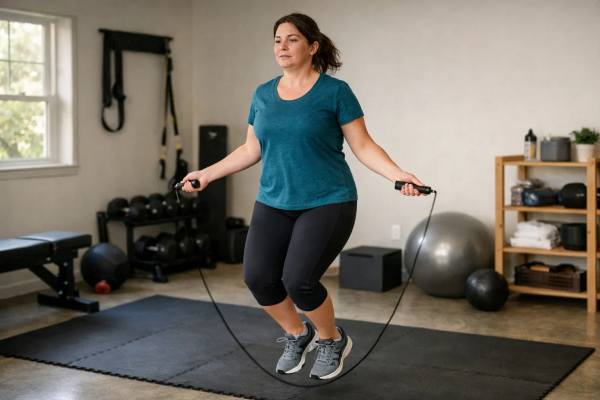
Jump rope can be a very effective tool for weight loss, but it works best when you understand what it actually does well. It is time-efficient, intense for its duration, easy to scale, and surprisingly good at making a short workout feel like real training. What it does not do is bypass the usual rules of fat loss. You still need a calorie deficit, enough recovery, and a plan you can repeat consistently.
That is why jump rope tends to help most when it is used as a practical form of cardio inside a broader routine, not as a miracle shortcut. The upside is that it requires little equipment, little space, and very little setup. The downside is that it is more technical and more high-impact than many beginners expect.
Table of Contents
- Can jump rope help you lose weight?
- Why jump rope feels so effective
- Calories burned and what affects them
- Form, rope size, and safety
- A beginner jump rope plan
- How to fit it into a fat-loss plan
- Mistakes that slow progress
- When jump rope is not the best choice
Can jump rope help you lose weight?
Yes, jump rope can help you lose weight, but only in the same honest way that other useful forms of cardio can help. It increases energy expenditure, improves fitness, and can make it easier to maintain a calorie deficit over time. Those are real advantages. The mistake is assuming the rope itself has some unique fat-burning magic.
What makes jump rope attractive is its efficiency. A short session can feel hard very quickly. That appeals to people who do not want long workouts or do not have much space or equipment. It can also blend strength-endurance, rhythm, coordination, and cardio in a way that makes even ten or fifteen minutes feel productive.
Still, weight loss comes from your overall system, not one exercise alone. If your daily food intake rises enough to cancel out the extra activity, jump rope may improve fitness without doing much for the scale. On the other hand, if it becomes a repeatable cardio habit that helps you keep your weekly movement high, it can absolutely support fat loss.
For many people, jump rope is especially useful because it removes friction:
- it is easy to do at home
- it needs very little time
- it can be built into short intervals
- it does not require a gym
- it can progress from very simple to very challenging
That does not mean it suits everyone. Because it is high-impact and fairly technical, some people will do better with walking, cycling, or another lower-impact option. But for those who tolerate it well, jump rope is one of the more time-efficient forms of cardio you can do.
The most realistic mindset is this: jump rope is a tool, not a complete program. It works best when it helps you stay active enough, often enough, to support a sustainable calorie deficit. If that happens, it can be very effective. If not, it is just another tough workout that feels impressive without changing much.
So yes, jump rope can help you lose fat. It just works because of consistency, effort, and total energy balance, not because a rope changes physiology.
Why jump rope feels so effective
Jump rope has a reputation for being brutal, and that reputation is not completely exaggerated. Even short sessions create a lot of work very quickly. Your calves, feet, ankles, shoulders, and core all contribute, while your heart rate rises fast if you keep the rope moving continuously.
That combination creates several benefits that matter for fat loss.
It is efficient
Many people can get a real cardio stimulus from jump rope in much less time than they need for a steady walk or light bike ride. That matters on busy days, when a long session is the easiest thing to skip.
It makes intervals simple
Jump rope works naturally in short work and rest blocks. That is ideal for beginners who cannot yet skip continuously for long stretches and for more advanced exercisers who want a compact conditioning session.
It improves coordination and rhythm
Not every cardio option does this. Jump rope asks for timing, light footwork, and body control. That makes it mentally engaging, which can help some people stay more interested than they would on a treadmill.
It can build work capacity fast
As technique improves, many people notice that the same session feels easier within a few weeks. That can show up as smoother breathing, fewer missed jumps, or the ability to complete more total work without long breaks.
These are strong advantages, but they come with a catch. What makes jump rope effective also makes it easy to misuse. Beginners often assume the goal is to jump as high as possible, move as fast as possible, and grind through mistakes. That usually leads to sloppy mechanics, calf burnout, frustration, and more impact than necessary.
The better approach is to think of jump rope as a skill-based cardio tool. It is not just about effort. It is about efficient effort. Small jumps, relaxed shoulders, consistent timing, and manageable intervals usually beat flailing intensity.
This is also why jump rope should not automatically replace all other cardio. In some fat-loss plans, it works best as one option among several. For example, you might use it for short, higher-effort sessions and rely on walking or steady-state cardio for lower-stress volume. That balance is similar to the larger tradeoff discussed in HIIT versus steady-state cardio for fat loss.
Jump rope feels effective because it really is demanding for its duration. The key is making that demand productive instead of chaotic.
Calories burned and what affects them
People love asking how many calories jump rope burns, but the honest answer is that the number varies too much to make one estimate universally useful. Your body weight, pace, coordination, rest periods, jump style, session length, and fitness level all change the result.
That said, jump rope is generally considered a high-energy-cost activity for the time spent doing it. In practical terms, it tends to burn more per minute than many light or moderate forms of steady cardio, especially when the pace is brisk and the rest periods are short. That is one reason it has such a strong reputation for fat loss.
Still, three important realities matter more than the number on a watch:
- Intensity changes everything.
Easy rhythm jumps with long breaks do not burn the same as hard intervals. - Skill affects output.
A beginner who misses the rope constantly may work hard, but the session can become stop-start and inefficient. A more skilled jumper often gets more total work done in less time. - Weekly totals matter more than one workout.
One hard 12-minute jump rope session may feel intense, but fat loss is driven by what your activity and diet look like across the whole week.
A better way to think about calories burned is to compare usefulness, not just theoretical output. Jump rope can be very effective because:
- it creates a strong training effect in a short window
- it is easy to repeat several times per week when programmed well
- it pairs well with short home workouts
- it does not require travel or machine access
That last point often matters more than calorie formulas. An exercise you actually do consistently is more valuable than a slightly “better” exercise you avoid.
It is also worth being careful with device estimates. Watches and apps often struggle with jump rope because the movement pattern is unusual, the wrists are involved, and the work is often interval-based. So use those numbers as rough guides, not precise accounting.
If you want more calorie burn from jump rope, the safest levers to adjust are:
- more total time
- slightly faster rhythm
- shorter rest intervals
- better technique
- more weekly frequency
You do not need all of them at once. In fact, increasing everything together is one of the fastest ways to get overuse symptoms.
For context, jump rope usually belongs in the category of exercises that can do a lot in a short time, but it still sits inside the bigger world of calories burned by common exercises. The exact number matters less than whether the sessions are hard enough, consistent enough, and sustainable enough to help your weekly energy expenditure move in the right direction.
Form, rope size, and safety
Jump rope looks simple from a distance, but technique changes everything. Good form makes the exercise smoother, quieter, and easier on your joints. Bad form makes it frustrating, exhausting, and much harder to progress with.
The first key is rope size. A rope that is too long can drag and disrupt timing. A rope that is too short forces awkward mechanics. A common beginner check is to stand on the middle of the rope and pull the handles upward. For many people, the handles should reach roughly around the chest or armpit area, though personal preference and style matter.
Once the rope is the right size, focus on these form cues:
- keep jumps low and economical
- land softly on the balls of the feet, not with loud stomping
- rotate mainly from the wrists, not huge arm circles
- keep elbows relatively close to the body
- stay tall through the torso
- look forward rather than down at your feet
The biggest beginner mistake is jumping too high. Most people do not need dramatic airtime. They only need enough clearance for the rope to pass. Excess height adds unnecessary impact and wastes energy.
The second big issue is surface choice. Hard concrete tends to be less forgiving than wood, rubber, or a suitable mat. Shoes matter too. Supportive training shoes usually work better than unsupportive casual sneakers.
Jump rope is also more high-impact than many people expect. That does not make it unsafe by default, but it does mean it is not ideal for everyone. You should be more cautious if you have:
- significant ankle, knee, hip, or low-back pain
- a recent lower-body injury
- poor balance or coordination
- a high body weight with low current conditioning
- symptoms that make vigorous exertion risky
In those cases, a lower-impact option may be smarter at first, especially something like joint-friendly low-impact cardio. You can always return to rope later if your capacity improves.
A quick warm-up helps a lot. Before jumping, do a few minutes of marching, calf raises, ankle circles, easy squats, and light bounce drills without the rope. That prepares the feet and lower legs better than grabbing the rope cold. If you need a broader framework, simple work from warm-up and recovery basics can help.
The right mental model is not “go harder.” It is “move cleaner.” Jump rope rewards efficiency more than brute force.
A beginner jump rope plan
The best beginner jump rope plan is not built around nonstop skipping from day one. That is how people end up with fried calves and the belief that jump rope “isn’t for them.” A much better approach is to build skill, tolerance, and rhythm at the same time.
| Week | Work interval | Rest interval | Total session time | Main goal |
|---|---|---|---|---|
| 1 | 10 to 15 seconds | 30 to 45 seconds | 8 to 10 minutes | Learn timing and land softly |
| 2 | 15 to 20 seconds | 30 seconds | 10 to 12 minutes | Reduce missed jumps and stay relaxed |
| 3 | 20 to 30 seconds | 20 to 30 seconds | 12 to 15 minutes | Build rhythm and work density |
| 4 | 30 to 40 seconds | 20 to 30 seconds | 15 to 18 minutes | Create a sustainable beginner cardio session |
A practical first session could look like this:
- 3 to 5 minutes of warm-up
- 10 rounds of 10 to 15 seconds of jumping
- 30 to 45 seconds of rest or marching between rounds
- 2 to 3 minutes of easy walking or cooldown
That may not look like much, but it is enough for many true beginners.
A few rules help the plan work better:
- stop before your form completely falls apart
- count successful rhythm and control as progress, not just time
- keep the first sessions shorter than you think you need
- train two or three times per week before adding more
You can also use jump rope inside a broader home workout instead of as a stand-alone session. For example, alternate short bouts of jumping with squats, incline push-ups, or step-ups. That can make the workout feel more varied and reduce repetitive lower-leg fatigue. If that appeals to you, it blends well with a beginner home workout plan.
The smartest beginner mindset is to treat jump rope as a skill first and cardio second. Once the movement gets smoother, the conditioning effect improves almost automatically. Most people who quit too early are not out of shape in a general sense. They are just under-practiced in the specific rhythm of jumping rope.
Build the rhythm first. The hard cardio will come with it.
How to fit it into a fat-loss plan
Jump rope works best when it sits inside a weekly training structure instead of trying to carry the whole fat-loss process by itself. For many people, that means using it as one cardio tool alongside walking, strength training, and decent nutrition.
A simple weekly setup could look like this:
- 2 to 3 jump rope sessions
- 2 to 3 strength workouts
- regular walking on most days
- at least 1 lower-stress recovery day
That kind of structure works well because jump rope is demanding enough to create a solid training effect, but usually not ideal as your only activity. If you rely only on brief jump rope sessions and remain sedentary the rest of the day, your total movement may still be lower than you think.
That is why daily walking and general activity still matter. Jump rope is efficient, but everyday movement helps keep your total calorie expenditure higher without adding as much fatigue. It also reduces the temptation to treat one intense session as your “movement for the day.”
Strength training matters too, especially if your goal is fat loss rather than just scale loss. Cardio helps expend energy, but resistance work helps preserve lean mass while dieting. In many cases, a simple 3-day strength plan plus a few rope sessions is more effective than trying to jump rope every day.
Nutrition is the other big piece. Jump rope can increase appetite in some people, especially when sessions are intense or poorly timed. That does not mean it is bad for fat loss. It just means you need a food structure that supports training without leading to constant rebound hunger. Helpful basics include:
- enough protein each day
- meals that are actually filling
- good hydration before and after training
- avoiding the habit of “earning” extra treats after cardio
This is where a guide to post-workout meals for weight loss can be useful, especially if you tend to finish cardio hungry and end up overeating later.
Jump rope is at its best when it complements the rest of your fat-loss plan. Used that way, it can give you a strong cardio stimulus in a short time without forcing your whole schedule to revolve around exercise.
Mistakes that slow progress
A lot of people quit jump rope too early, and it is usually not because the method is ineffective. It is because they make predictable mistakes that turn a good tool into a miserable experience.
The first mistake is doing too much too soon. Jump rope is harder on the calves, feet, and coordination than many beginners expect. Starting with long continuous sets often creates soreness and frustration instead of momentum.
The second mistake is chasing calorie burn over technique. People try to move as fast as possible, jump too high, tense their shoulders, and flail the rope with the whole arms. That makes the session more chaotic and less efficient.
Other common problems include:
- using a badly sized rope
- practicing on very hard surfaces
- skipping the warm-up
- relying on jump rope as the only exercise
- eating back the session without noticing
- assuming hard always means effective
There is also the issue of compensation. A short, intense cardio session can sometimes make people less active later in the day or hungrier than usual. If that happens regularly, the net fat-loss effect may be smaller than expected. That broader issue is part of what people run into with exercise compensation and daily fat loss.
Another mistake is staying emotionally attached to one exact routine. If you keep repeating the same interval pattern and progress stalls, you may need to adjust the work-rest ratio, total volume, or the rest of your weekly activity. Not every plateau means “do more jump rope.” Sometimes it means you need more walking, better recovery, more strength work, or tighter nutrition.
It also helps to track more than scale weight. Jump rope often improves coordination, conditioning, and workout density before the scale moves much. Better rhythm, longer work intervals, fewer missed jumps, and improved breathing are all real signs of progress.
If fat loss has slowed, it can help to troubleshoot the bigger picture using a guide to workout plateaus in fat loss. The rope may not be the problem at all.
Jump rope works best when it stays technical, progressive, and repeatable. Once it becomes an ego contest, progress usually gets slower, not faster.
When jump rope is not the best choice
Jump rope is a strong fat-loss tool for the right person, but it is not automatically the best choice for every beginner. Sometimes a lower-impact, less technical option is simply smarter.
You may do better with something else if:
- you have significant joint pain
- you are very deconditioned and high-impact work feels harsh
- you cannot yet tolerate repeated bouncing
- you hate the learning curve and keep dreading the sessions
- you need a form of cardio you can sustain for longer durations more comfortably
That does not mean jump rope is off the table forever. It may just mean it is not the best starting point.
Walking is often a better entry point for people who need a lower-friction, lower-impact habit. Cycling and elliptical training can also be more forgiving while still giving you enough intensity to support fat loss. If the main goal is to build consistency first, a simpler beginner cardio plan may get you better results than forcing jump rope before you are ready.
It is also okay to outgrow jump rope as your main cardio. Some people start with it because it is convenient, then later shift toward running, cycling, rowing, or mixed cardio once their fitness improves. Others keep it as a compact conditioning tool but rely on walking and strength training for most of their weekly routine.
The best exercise is not the one that sounds toughest. It is the one that fits your body, your schedule, and your ability to stay consistent. If jump rope checks those boxes, it can be excellent. If it does not, choosing another option is not quitting. It is good programming.
That is the most honest conclusion: jump rope can be very effective for weight loss, especially when time is limited and impact tolerance is good. But the right cardio is the one you can perform well, recover from, and keep doing long enough for the results to show up.
References
- WHO guidelines on physical activity and sedentary behaviour 2020 (Guideline)
- Exercise training in the management of overweight and obesity in adults: Synthesis of the evidence and recommendations from the European Association for the Study of Obesity Physical Activity Working Group 2021 (Review and Recommendations)
- Effects of Caloric Restriction and Rope-Skipping Exercise on Cardiometabolic Health: A Pilot Randomized Controlled Trial in Young Adults 2021 (Randomized Controlled Trial)
- Aerobic Exercise and Weight Loss in Adults: A Systematic Review and Dose-Response Meta-Analysis 2024 (Systematic Review and Meta-Analysis)
- Jump Rope Training Improves Muscular Strength and Cardiovascular Fitness in University Students: A Controlled Educational Intervention 2025 (Controlled Trial)
Disclaimer
This article is for general educational purposes only and is not a substitute for medical advice, diagnosis, or treatment. If you have joint pain, heart symptoms, dizziness, balance problems, a recent injury, or any medical condition that affects exercise tolerance, get personalized guidance before starting a jump rope program.
If this article helped, please share it on Facebook, X, or any other platform you prefer so more people can find it.