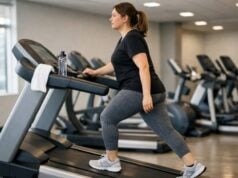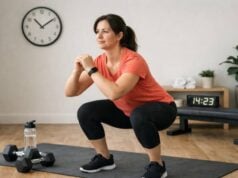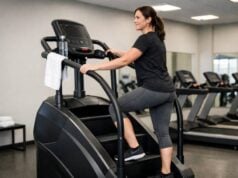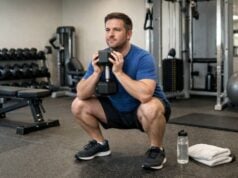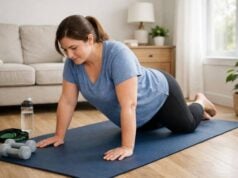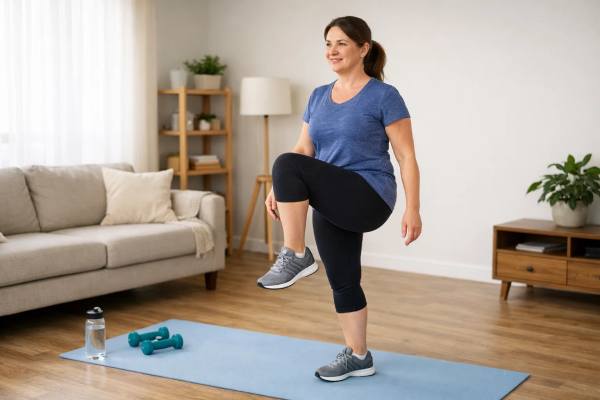
Low-impact home cardio can absolutely help with weight loss, especially for beginners who need something joint-friendly, practical, and easy to repeat. It works because it raises your daily energy expenditure, improves fitness, and helps you stay active without the soreness, pounding, or intimidation that often comes with jumping, running, or high-intensity classes.
That matters more than most people think. The best beginner workout is not the one that looks hardest online. It is the one you can do consistently, recover from, and build on week after week. This article explains what low-impact cardio really means, which home workouts are best for beginners, how to structure them for fat loss, and how to progress without turning a safe routine into a burnout plan.
Table of Contents
- Why low-impact home cardio can work
- What counts as low-impact cardio
- Best beginner low-impact cardio moves
- How to build a home cardio workout
- Sample low-impact workouts for beginners
- How often to do low-impact cardio
- Common mistakes and safer progressions
Why low-impact home cardio can work
Low-impact cardio works for weight loss for a simple reason: it makes movement easier to repeat. When a workout does not leave your knees angry, your calves wrecked, or your motivation crushed, you are more likely to do it again tomorrow and again next week. That consistency is where real results usually come from.
A lot of beginners assume they need burpees, jump squats, sprints, or sweaty bootcamp sessions to lose weight. In reality, low-impact cardio can support fat loss very well when it is done often enough and paired with eating habits that create a manageable energy deficit. The workout itself matters, but the bigger win is that low-impact training reduces friction. It is easier to start, easier to recover from, and easier to fit into a real life that includes work, family, stress, and limited energy.
Home workouts add another advantage: convenience. You remove commute time, gym anxiety, and the pressure to perform in front of other people. That makes it more realistic to train on busy days or keep a short session going even when motivation is not perfect.
Low-impact cardio is especially helpful for beginners who:
- have joint discomfort or a higher body weight
- feel intimidated by high-intensity programs
- have not exercised consistently in a while
- need home workouts with little or no equipment
- want to improve fitness without feeling punished by the process
It also helps that low-impact sessions can accumulate a meaningful amount of weekly activity. A 20-minute home workout done four or five times per week adds up fast. Even if each session feels modest, the weekly total can be enough to improve cardio fitness, support fat loss, and build momentum.
That does not mean low-impact cardio is magic. Weight loss still depends heavily on food intake, total daily movement, sleep, and adherence. But it is often a better starting point than aggressive routines that people abandon after a week. This is especially true if you are trying to build a sustainable beginner home workout plan instead of chasing short-term motivation.
Low-impact workouts also pair well with walking, strength training, and general movement. In many cases, the best beginner routine is not one perfect workout type. It is a simple combination of low-impact cardio, daily steps, and basic resistance work that becomes easier to maintain over time.
What counts as low-impact cardio
Low-impact cardio means exercise that keeps at least one foot in contact with the ground most of the time and places less stress on joints than jumping, sprinting, or repeated hard landings. It is not the same as “easy,” and it is not the same as “low effort.” A low-impact workout can still raise your heart rate, make you sweat, and challenge your lungs.
The key difference is the way force travels through the body. High-impact exercise usually includes harder landing forces. Low-impact exercise reduces that pounding, which makes it more accessible for beginners, people with excess body weight, and anyone managing mild joint sensitivity.
At home, low-impact cardio often includes movements like:
- marching in place
- step taps or side steps
- knee lifts
- low-impact jacks
- standing punches
- toe taps
- skaters without jumping
- step-ups on a sturdy platform
- shadow boxing
- fast walking indoors
This also explains why some popular beginner workouts feel better than others. Two sessions may burn a similar number of calories, but the one with less joint stress and less fear factor is often easier to stick with. That is especially relevant if you have concerns about knees, hips, ankles, or lower back, or if you are just returning to exercise after a long break. For those situations, a guide to joint-friendly low-impact cardio can help you choose safer movement patterns.
Low-impact cardio also exists on a spectrum. A relaxed march while watching television is very different from a paced 30-minute interval routine with fast step patterns, standing core work, and punch combinations. Both are low impact, but one is much more demanding.
A useful beginner mindset is this:
- low impact does not mean low value
- beginner does not mean ineffective
- home-based does not mean second-rate
- simple movement patterns are often better than flashy ones
That matters because a lot of people get discouraged by comparing their early workouts to advanced fitness content. The smarter comparison is not “Does this look intense enough?” It is “Can this routine help me move more, raise my heart rate, and keep me consistent?”
If the answer is yes, it counts.
Best beginner low-impact cardio moves
The best beginner low-impact cardio moves are the ones that are easy to learn, safe to repeat, and effective enough to keep your whole body moving. You do not need a huge library of exercises. You need a small set of reliable movements you can combine into short, repeatable workouts.
| Movement | What it trains | Why it works for beginners | Easy progression |
|---|---|---|---|
| March in place | Cardio and coordination | Very low barrier and easy to scale | Lift knees higher or swing arms faster |
| Side step with reach | Cardio and lateral movement | Improves rhythm without impact | Add a wider step or overhead reach |
| Low-impact jacks | Cardio and full-body rhythm | Feels athletic without jumping | Increase speed or arm height |
| Standing punches | Cardio and upper-body involvement | Raises heart rate quickly with little joint stress | Add faster combinations or a light squat |
| Step-ups | Cardio and legs | Builds stamina and leg strength | Use a slightly higher platform or faster pace |
| Toe taps | Cardio and balance | Simple and easy for short intervals | Alternate faster or use a small step |
| Skaters without jumping | Cardio and lateral hip work | Adds variety without impact | Wider reach or quicker tempo |
| Fast walk indoors | Cardio and endurance | Natural movement pattern for most people | Add longer duration or incline if available |
A good beginner workout usually mixes four to six of these rather than trying to do one movement for a long time. That keeps the session more interesting and spreads stress around the body.
A few moves deserve special mention.
Marching and fast walking are underrated because they look too simple. But they are often the best way to start. They build rhythm, warm the body up naturally, and make it easy to learn pacing.
Standing punches are great when beginners want something that feels more like a workout without needing impact. They raise heart rate fast and make the session feel less repetitive.
Step-ups are especially useful if you have a safe step, stair, or sturdy platform. They increase cardio demand while also building leg strength, which is helpful for beginners trying to improve general function.
If you eventually want to move from cardio-only to more complete home training, these movements can pair well with a simple bodyweight workout. That combination often works better for long-term fat loss than cardio alone.
The main goal early on is not to find the fanciest move. It is to choose movements you can do with solid posture, steady breathing, and enough confidence to keep going.
How to build a home cardio workout
A beginner low-impact cardio workout should feel structured, not random. That does not mean it needs to be complicated. In fact, simple structure is usually the reason beginners stick with it.
A useful session has three parts:
- a short warm-up
- a main cardio block
- a brief cooldown
For most beginners, that means:
- Warm-up: 3 to 5 minutes
- Main workout: 10 to 25 minutes
- Cooldown: 3 to 5 minutes
The warm-up can include easy marching, arm circles, gentle side steps, and a few slower versions of the moves you plan to use in the workout. This helps your joints feel better and makes the session more comfortable. A basic warm-up and recovery routine can make beginner cardio feel much smoother.
For the main workout, intervals are often easier than straight continuous cardio because they break the session into manageable chunks. A very beginner-friendly format is:
- 30 to 40 seconds of work
- 20 to 30 seconds of slower marching or transition
- repeat for 4 to 6 moves
- complete 2 to 4 rounds
That creates structure without overwhelming someone who is just getting started.
Here is a simple example:
- March in place
- Side step with reach
- Standing punches
- Low-impact jacks
- Toe taps
- Recovery march
Repeat that sequence for 2 to 4 rounds depending on fitness level.
The biggest mistake beginners make is assuming every home cardio session needs to be hard. It does not. A productive workout often feels like moderate effort, not maximum effort. You should be breathing harder, but still able to finish the session with good form. That is part of why workout length and pacing matter so much. A 20-minute session you finish well beats a 35-minute session that falls apart halfway through.
A good beginner rule is to stop while you still feel capable of doing a little more. That makes it easier to come back tomorrow instead of needing three days to recover from a home workout that was supposed to help you build consistency.
Sample low-impact workouts for beginners
The best beginner workouts are the ones you can repeat, not the ones that look dramatic. These examples are built to be practical, joint-friendly, and easy to scale at home.
Workout 1: Very beginner cardio session
Do each move for 30 seconds, then march in place for 20 seconds before the next one. Complete 2 to 3 rounds.
- March in place
- Side step with arm reach
- Standing punches
- Toe taps to a small step or target
- Low-impact jacks
- Slow recovery march
This is a good option for people who are just starting, returning after time off, or nervous about cardio.
Workout 2: Beginner interval session
Do each move for 40 seconds and rest or march for 20 seconds. Complete 3 rounds.
- Fast march with strong arm swing
- Step-ups or stair taps
- Standing jab-cross punches
- Side-to-side skaters without jumping
- Knee lifts
- March in place
This session raises heart rate more while still staying low impact.
Workout 3: Low-impact cardio and strength mix
Do each move for 35 seconds, rest 25 seconds, and complete 2 to 4 rounds.
- March in place
- Sit-to-stand from chair
- Standing punches
- Wall push-ups
- Side step with reach
- Glute bridge or standing hip hinge
This hybrid style is useful because it adds a little strength work alongside cardio. That can make home training more complete, especially if weight loss is the goal and you want more than just breathless movement.
| Day | Plan | Goal |
|---|---|---|
| Monday | Workout 1 | Learn movement patterns |
| Tuesday | Easy walk or light movement | Recovery and consistency |
| Wednesday | Workout 2 | Cardio progression |
| Thursday | Easy walk or rest | Recovery |
| Friday | Workout 3 | Cardio plus strength support |
| Saturday | Optional walk, stretch, or repeat Workout 1 | Extra activity |
| Sunday | Rest or gentle walk | Recovery |
If you like indoor walking, you can also blend these workouts with an indoor walking routine to add variety without increasing impact.
How often to do low-impact cardio
For most beginners, 3 to 5 days per week of low-impact cardio works well. That is frequent enough to build fitness and support weight loss, but usually not so much that recovery becomes a problem.
The exact number depends on how hard the sessions are, how long they last, and what else you are doing. A 15-minute low-impact routine is very different from a 40-minute paced session with lots of step-ups and upper-body combinations.
A practical starting point looks like this:
- 3 days per week if you are very new, deconditioned, or recovering from a long break
- 4 days per week if you want steady progress and recover well
- 5 days per week if sessions are moderate and you enjoy frequent movement
You do not need every session to be a formal workout. One of the advantages of low-impact cardio is that it blends well with walking, short movement breaks, and easier active days. That can make a weekly plan feel much more realistic than trying to force high-intensity training into every slot.
It also helps to think beyond formal workouts. Someone who does three home cardio sessions and walks regularly may see better results than someone who does five workouts but spends the rest of the day sitting. That is where total daily movement matters. A simple routine built around home cardio plus regular walking can work very well for beginners.
If you are unsure how much activity to aim for, the simplest answer is to start with a level you can repeat for at least two weeks, then build from there. More is not always better. Better recovery, better consistency, and better movement quality usually matter more than squeezing in one extra workout day.
This is also why workout frequency should fit your life, not someone else’s routine. The best weekly pattern is the one you can keep doing when motivation dips, work gets stressful, or your schedule gets messy. That is the same reason many beginners do well with a realistic answer to how many days to work out for weight loss rather than assuming daily workouts are required.
Common mistakes and safer progressions
Low-impact cardio is beginner-friendly, but it is still easy to misuse. The biggest mistake is assuming “low impact” means “I can do anything, any amount, right away.” Beginners still need pacing, recovery, and progression.
Common mistakes include:
- starting too long and getting discouraged
- turning every session into a max-effort workout
- using sloppy posture because the moves look simple
- skipping warm-ups
- choosing routines that move too fast to follow safely
- relying on cardio alone while ignoring diet and overall activity
- comparing beginner home workouts to advanced online routines
Another common problem is underestimating how much consistency matters. Many people keep switching videos, styles, and trainers before they have even repeated the same beginner routine enough to adapt. It is usually better to repeat a small set of basic sessions for a few weeks and gradually improve pace, coordination, or duration.
A safer progression usually looks like this:
- Increase total workout time slightly.
- Reduce transition time between moves.
- Move a little faster while keeping form under control.
- Add one extra round.
- Add more challenging but still low-impact movements.
That order matters. Do not start by making everything faster at once. Beginners usually do better when one variable changes at a time.
You should also know when to scale back or modify. Reduce range of motion, shorten the interval, or slow the pace if you notice:
- knee pain that feels sharp rather than muscular
- dizziness
- chest pressure
- pain that worsens during the session
- form falling apart because you are too fatigued
If you have significant joint pain, balance issues, recent surgery, or a medical condition that changes exercise safety, use extra caution. Some people may do better beginning with short walks, chair-supported movement, or a more specific low-impact beginner plan designed for larger bodies or limited mobility.
The goal is not to prove toughness. It is to build a routine that helps you move more, feel better, and support fat loss without creating a new reason to stop.
References
- Aerobic Exercise and Weight Loss in Adults: A Systematic Review and Dose-Response Meta-Analysis 2024 (Systematic Review and Meta-Analysis)
- Adult Activity: An Overview | Physical Activity Basics | CDC 2023 (Official Guidance)
- Resistance training effectiveness on body composition and body weight outcomes in individuals with overweight and obesity across the lifespan: A systematic review and meta-analysis 2022 (Systematic Review and Meta-Analysis)
- Exercise training in the management of overweight and obesity in adults: Synthesis of the evidence and recommendations from the European Association for the Study of Obesity Physical Activity Working Group 2021 (Review and Recommendations)
- Effect of exercise training on weight loss, body composition changes, and weight maintenance in adults with overweight or obesity: An overview of 12 systematic reviews and 149 studies 2021 (Overview of Systematic Reviews)
Disclaimer
This article is for general educational purposes only and is not a substitute for medical advice, diagnosis, or treatment. If you have severe joint pain, chest pain with activity, balance problems, recent surgery, or a medical condition that makes exercise safety uncertain, speak with a qualified clinician before starting a new home cardio routine.
If this article helped, share it on Facebook, X, or any other platform where it may help someone start moving with more confidence.