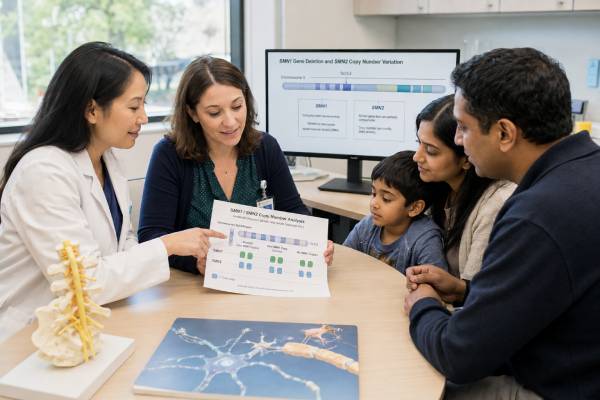
A spinal muscular atrophy genetic test usually measures copies of SMN1, the gene whose loss causes most 5q SMA, and SMN2, a closely related gene that modifies disease severity. The meaning depends on why the test was ordered. In a weak infant or child, finding no functional SMN1 exon 7 copies can confirm the common molecular diagnosis and trigger urgent treatment planning. In an adult having carrier screening, one SMN1 copy usually indicates carrier status, while two copies lower—but do not eliminate—carrier risk because both copies may sit on the same chromosome. SMN2 copy number helps estimate the likely untreated disease range in an affected person, yet it cannot predict an exact course or treatment response. Newborn screening, diagnostic testing, and carrier testing also use different assumptions and can miss different variants. The report must therefore be read with symptoms, family history, assay methods, and the testing purpose.
- Most people with 5q SMA have loss of both functional SMN1 exon 7 copies.
- A standard copy-number test detects most affected people but can miss an SMN1 sequence variant on one chromosome.
- Two SMN1 copies do not completely exclude carrier status because of the 2+0 silent-carrier configuration.
- SMN2 copy number modifies severity but does not assign a certain SMA type or outcome.
- A positive newborn screen is time-critical and requires prompt confirmatory testing and neuromuscular referral.
Table of Contents
- Why SMA Testing Counts Two Nearly Identical Genes
- Diagnostic Testing for Symptoms or a Positive Screen
- Carrier Screening and the 2+0 Silent Carrier
- How to Read SMN1 and SMN2 Results
- What SMN2 Copy Number Can and Cannot Predict
- Newborn Screening and Why Follow-Up Is Urgent
- Inheritance, Family Testing, and Reproductive Options
- Negative, Inconclusive, or Unexpected Results
Why SMA Testing Counts Two Nearly Identical Genes
Most spinal muscular atrophy discussed in genetic testing is 5q SMA, an autosomal recessive motor neuron disorder caused by biallelic loss of functional SMN1. Motor neurons in the spinal cord and brainstem depend on survival motor neuron protein. Too little functional protein leads to progressive weakness, reduced muscle tone, loss of reflexes, breathing difficulty, feeding problems, and motor decline. Age at onset and severity vary from prenatal or early-infantile disease to adult-onset weakness.
SMN1 sits in a complex region of chromosome 5 beside the almost identical SMN2 gene. The two genes differ at a few critical positions. SMN1 normally makes abundant full-length SMN protein. A key nucleotide difference in SMN2 causes most SMN2 messenger RNA to skip exon 7, so only a minority produces stable full-length protein. SMN2 is therefore a partial backup, not a full substitute.
This biology explains why a routine sequence panel is not enough. Laboratories must distinguish nearly identical SMN1 and SMN2 sequences and determine copy number at exon 7, often with exon 8 and selected linked variants. Common methods include multiplex ligation-dependent probe amplification, quantitative PCR, digital PCR, and validated next-generation sequencing algorithms. Some assays also sequence SMN1 or look for markers associated with duplicated SMN1 copies.
The notation is easy to misread. “Two SMN1 copies” normally means two copies in the tested genome, not necessarily one on each chromosome. “Zero copies” generally means no detectable SMN1 exon 7 copies. “Three SMN2 copies” describes a modifier count, not three disease-causing variants. Reports should state the exons measured, method, detection limits, and whether the assay distinguishes gene conversion, partial genes, or hybrid SMN1/SMN2 structures.
The same laboratory numbers answer different questions. For a symptomatic person, the goal is to confirm or exclude biallelic SMN1 dysfunction. For a reproductive carrier screen, the goal is to estimate whether one chromosome lacks functional SMN1. For an affected newborn, SMN2 copy number helps guide urgency and counseling. Before interpreting any result, identify which question the order was designed to answer.
Diagnostic Testing for Symptoms or a Positive Screen
Diagnostic SMA testing is appropriate when the clinical picture suggests lower motor neuron disease. In infants, clues include symmetric weakness, hypotonia, poor head control, weak cry, feeding or swallowing difficulty, paradoxical breathing, and absent or reduced reflexes, often with alert facial expression and preserved eye movements. Older children and adults may have proximal weakness, difficulty rising or climbing stairs, tremor, scoliosis, or respiratory impairment. Symptoms overlap with congenital myopathies, muscular dystrophies, neuropathies, metabolic disease, and non-5q motor neuron disorders.
The first molecular step is usually quantitative SMN1 exon 7 analysis. About 95% of people with 5q SMA have homozygous absence of SMN1 exon 7, caused by deletion or conversion to an SMN2-like sequence. Finding zero copies in a compatible clinical setting confirms the common molecular form. The laboratory should also report SMN2 copy number because treatment decisions and early counseling may depend partly on it.
A smaller group has one deleted or converted SMN1 copy and a pathogenic sequence variant in the remaining copy. A dosage assay may report one SMN1 copy, which by itself looks like carrier status. In a symptomatic person, that result should trigger SMN1 sequence analysis, not dismissal of SMA. Sequencing can identify small substitutions, splice variants, and insertions or deletions that copy counting misses. Some complex rearrangements still require specialized analysis.
If a report finds two SMN1 copies in a person with convincing symptoms, common 5q SMA becomes less likely but is not always completely excluded. Rare possibilities include two copies on one chromosome plus a pathogenic variant or deletion on the other, an intragenic change not covered by the assay, mosaicism, or a complex hybrid gene. More often, another neuromuscular diagnosis is responsible. A phenotype-driven neurologic genetic panel, exome or genome testing, enzyme studies, electromyography, or muscle imaging may be appropriate.
Diagnostic testing should not be delayed while waiting for every traditional study in a rapidly weakening infant. Genetic confirmation can be fast, and disease-modifying treatment has the greatest potential before substantial motor neuron loss. The care team may arrange neuromuscular evaluation, respiratory and feeding assessment, physical therapy, and treatment authorization while confirmatory work proceeds.
A report that confirms SMA should be reviewed for sample identity, SMN1 result, SMN2 count, any modifier variants, and whether parental testing is recommended. It should also be interpreted against treatment history: an early-treated child may not follow the untreated clinical “type” suggested by older natural-history data.
Carrier Screening and the 2+0 Silent Carrier
SMA is usually inherited in an autosomal recessive pattern. A typical carrier has one functional SMN1 copy on one chromosome and no functional copy on the other, written 1+0. The person is generally healthy because one SMN1 copy produces enough protein. If both reproductive partners are carriers, each pregnancy has a 25% chance of 5q SMA, a 50% chance of carrier status, and a 25% chance of inheriting neither parental disease allele.
Copy-number screening detects the typical carrier because the report shows one SMN1 exon 7 copy. The complication is phase: ordinary testing counts total copies but may not show how they are distributed. A person can have two SMN1 copies on one chromosome and zero on the other, written 2+0. The total is two, so the result may appear ordinary even though the person is a silent carrier.
Some laboratories test linked markers, especially SMN1 c.3+80T>G and sometimes c.211_*212del, that are associated with two-copy SMN1 alleles in certain populations. When a person has two SMN1 copies and one of these markers, silent-carrier risk rises. When the markers are absent, risk falls but does not become zero. These associations vary by ancestry, and the marker does not prove whether the two copies are in cis on one chromosome.
Residual-risk tables can be useful but must be applied carefully. Risk differs with self-reported ancestry, population data, family history, test method, and whether the linked markers were analyzed. Broad racial labels are imperfect proxies for genetic ancestry, and mixed ancestry may not fit one row. A report should provide the laboratory’s assumptions rather than simply labeling two copies “negative.”
Three or more SMN1 copies usually reduce carrier risk further, but a rare 3+0 configuration or an undetected sequence variant remains possible. Conversely, one SMN1 copy is normally interpreted as carrier status, but in a person with weakness it may represent part of an affected genotype and requires sequencing.
Family history changes the strategy. If a relative with SMA has a known SMN1 sequence variant, copy-number testing alone is incomplete; the family-specific variant must also be tested. Testing parents of an affected person can show whether each carries one disease allele, reveal a de novo event, and help phase duplicated copies. Carrier results should be documented with the exact laboratory report so relatives receive the correct assay.
A “reduced risk” result is not the same as no risk. Genetic counseling is particularly valuable when one partner is a known carrier, there is an affected relative, the result includes a duplication-linked marker, or ancestry-specific residual risk is difficult to estimate.
How to Read SMN1 and SMN2 Results
Start with the reason for testing, then read SMN1 copy number, SMN1 sequence findings, SMN2 copy number, linked markers, and the laboratory’s limitations. The same count can have different implications in a newborn, a symptomatic adult, or a healthy reproductive partner.
| Example result | Likely interpretation | Important next step |
|---|---|---|
| 0 SMN1 exon 7 copies | Consistent with the common biallelic SMN1 deletion or conversion genotype and usually diagnostic of 5q SMA. | Urgent neuromuscular referral, confirmatory review, SMN2 copy number, and treatment discussion. |
| 1 SMN1 copy in a healthy person | Usually an SMA carrier. | Offer partner testing, family counseling, and reproductive risk assessment. |
| 1 SMN1 copy in a symptomatic person | Could be a carrier with another diagnosis or an affected person with a sequence variant in the remaining copy. | Perform comprehensive SMN1 sequence analysis and clinical evaluation. |
| 2 SMN1 copies, linked marker absent | Carrier risk is reduced but not eliminated. | Use ancestry- and method-specific residual risk; consider family testing when history is positive. |
| 2 SMN1 copies, duplication-linked marker present | Increased chance of a 2+0 silent-carrier configuration, with magnitude dependent on ancestry. | Genetic counseling, partner testing, and possible family phasing. |
| 3 or more SMN1 copies | Lower carrier probability, but not an absolute exclusion. | Interpret with family history and assay limits. |
| Pathogenic SMN1 sequence variant | Meaning depends on whether the other chromosome has a deletion, another variant, or a functional copy. | Establish phase and test copy number; consider parental testing. |
| SMN2 copy number reported | A severity modifier relevant mainly after SMA is confirmed. | Use with age, symptoms, treatment timing, and modifier data—not as a standalone diagnosis. |
Pathogenic and likely pathogenic SMN1 sequence variants can be used for diagnosis or carrier assessment. A variant of uncertain significance is not proof of an affected or carrier state unless the copy-number and family data independently establish it. Parental or relative testing may show whether two findings are in trans, meaning on opposite chromosomes, which is generally required for an autosomal recessive diagnosis.
Pay attention to wording such as “exon 7 copy number,” “gene copy number,” “dosage,” and “hybrid gene.” An assay may quantify the critical exon without proving that every counted gene is structurally complete and functional. Ask the laboratory whether exon 8, gene conversion, partial deletions, sequence variants, and silent-carrier markers were included.
Also compare reports cautiously. Different validated methods can occasionally disagree on SMN2 copy number, especially with unusual hybrid structures or higher copy counts. A treatment center may request confirmation at an experienced laboratory if the number will materially affect counseling or a protocol.
What SMN2 Copy Number Can and Cannot Predict
SMN2 copy number is a disease modifier, not the primary diagnostic result. A person can have several SMN2 copies and no SMA if SMN1 is functional. Once biallelic SMN1 loss is confirmed, more SMN2 copies are generally associated with more full-length SMN protein and a milder untreated phenotype.
Historically, one or two SMN2 copies were more often associated with prenatal or infantile-onset disease, three copies with an intermediate range, and four or more with later-onset disease. These are overlapping distributions, not fixed rules. People with the same copy count can differ greatly in onset, motor milestones, respiratory needs, progression, and survival.
Copy number is not the whole modifier story. The structure of each SMN2 copy matters, and some variants can improve or worsen exon 7 inclusion. One example, SMN2 c.859G>C, has been associated with a milder-than-expected phenotype in some families. Not every laboratory tests for it or other modifiers. Environmental factors, other genes, supportive care, and random biological variation also contribute.
Treatment has changed the meaning of prognosis. Nusinersen and risdiplam increase productive SMN2 splicing, while onasemnogene abeparvovec delivers a functional SMN1 transgene. Availability and eligibility vary by age, country, clinical status, prior treatment, and regulatory label. Children treated before symptoms can achieve outcomes very different from historical untreated cohorts, so assigning “SMA type 1” solely from two SMN2 copies may be misleading.
Clinicians increasingly describe actual status—such as presymptomatic, non-sitter, sitter, or walker—alongside age, SMN2 count, respiratory function, swallowing, and treatment history. This approach is more useful than assuming the copy number has already determined the future.
SMN2 testing still matters. It helps prioritize urgent treatment after newborn screening, supports anticipatory counseling, and may be an eligibility variable in trials or payer policies. The safest message is: SMN2 copy number shifts probability, but it does not set a ceiling on benefit or guarantee a particular untreated course.
Newborn Screening and Why Follow-Up Is Urgent
Newborn screening for SMA usually tests dried blood spots for homozygous absence of SMN1 exon 7. This efficiently identifies the common genotype before weakness is obvious. It is a screening test, not the final diagnostic report, and programs differ in whether they perform confirmatory SMN1 analysis, SMN2 copy counting, or referral directly.
A positive screen should prompt immediate contact with an SMA-experienced neuromuscular team. Confirmatory testing should verify the SMN1 finding and determine SMN2 copy number, ideally using a fresh specimen. The infant also needs a focused examination, respiratory and feeding assessment, baseline motor measures, and rapid treatment discussion. The process should move in parallel rather than waiting for weakness to emerge.
Timing matters because motor neurons can be lost before symptoms are visible, and lost neurons are not readily restored. Presymptomatic treatment has produced substantially better motor outcomes than treatment after clear weakness in clinical studies. Current expert practice supports prompt treatment of genetically confirmed infants, including those with higher SMN2 copy counts, while accounting for individual medical circumstances.
A negative newborn screen does not exclude every form of 5q SMA. The common screen is designed to detect zero SMN1 exon 7 copies. It may miss an infant with one deleted copy and a pathogenic sequence variant in the other, as well as rare technical or structural situations. Any infant with progressive symmetric weakness, hypotonia, poor feeding, weak cry, or breathing difficulty requires diagnostic evaluation regardless of the screen result.
False-positive or inconclusive screens can occur because of specimen quality, assay thresholds, unusual gene structures, or administrative reporting. Families should not be told that the child definitely has SMA until confirmatory results are reviewed, but clinicians should preserve urgency. A rapid, organized pathway can avoid both harmful delay and unnecessary certainty.
Newborn screening availability is location-dependent and changes over time. Parents should verify what their program tests and whether SMN2 is included. A routine “normal newborn screen” is not a universal genomic clearance and should never override new neuromuscular symptoms.
Inheritance, Family Testing, and Reproductive Options
After an affected person is diagnosed, testing both biological parents usually clarifies the family’s alleles. Most parents each carry one SMN1 disease allele. In a small minority of families, one variant arose de novo or a parent has germline mosaicism, so recurrence calculations should use actual results rather than assuming both parents are standard carriers.
When both parents are confirmed carriers, each pregnancy has independent 25%, 50%, and 25% chances of affected, carrier, and unaffected non-carrier outcomes. Those probabilities reset with every pregnancy. SMN2 copy number is inherited separately and can differ among siblings because of chromosome structure and recombination, although affected siblings often have similar counts.
Testing should be offered to adult siblings and other relatives who may be carriers, beginning with the exact familial finding. If the affected relative has a deletion on one SMN1 allele and a sequence variant on the other, relatives need both dosage and targeted sequence testing. A generic carrier screen might miss the family’s rare variant.
Reproductive options include testing a partner, prenatal diagnosis with chorionic villus sampling or amniocentesis, preimplantation genetic testing with in vitro fertilization, donor gametes, adoption, or pregnancy without testing. Prenatal samples require careful handling and often maternal-cell-contamination studies. If a fetus has biallelic SMN1 loss, SMN2 copy number can add probabilistic information but cannot promise a specific severity, especially in the modern treatment era.
Carrier screening can be performed before or during pregnancy. Earlier testing gives more time for partner analysis and decision-making. When one partner is a carrier and the other has two SMN1 copies, the couple’s risk depends on the second partner’s residual carrier risk, linked-marker status, ancestry, and family history. A counselor can calculate a range and discuss whether prenatal diagnosis is reasonable.
Results can carry emotional weight, especially when a healthy person learns that a common recessive allele was passed to a child. Carrier status is not anyone’s fault and usually has no effect on the carrier’s health. The purpose of family testing is to provide choices, not assign blame.
Negative, Inconclusive, or Unexpected Results
When results do not fit the clinical picture, first audit the test rather than repeating the same order. Obtain the full report and ask:
- Was SMN1 exon 7 copy number measured quantitatively?
- Was SMN1 sequence analysis performed, or only dosage testing?
- Were exon 8, partial deletions, gene conversion, and hybrid genes assessed?
- Were SMN2 copy number and relevant modifier variants reported?
- For carrier screening, were duplication-linked markers included?
- Could sample quality, transfusion, transplant, mosaicism, or maternal-cell contamination affect the result?
A symptomatic person with one SMN1 copy needs sequencing of the remaining copy. A symptomatic person with two copies may need a specialized SMN1 assay and evaluation for other motor neuron, nerve, or muscle diseases. A VUS should be studied with parental phase, phenotype, population frequency, and laboratory reanalysis; it should not be forced into a diagnosis.
A healthy person with two SMN1 copies has a reduced carrier risk, not a zero risk. If a partner is a known carrier or there is family history, ask for linked-marker analysis, targeted familial-variant testing, and individualized residual-risk counseling. Direct phasing through relatives or advanced sequencing may help in selected families, but it is not always possible.
Unexpected SMN2 counts should be confirmed when they will change urgent counseling or treatment. Laboratories can differ because SMN1 and SMN2 are highly homologous and the region contains conversions and hybrid genes. The result should be interpreted by a laboratory or clinic experienced with SMA genetics.
Regardless of genotype, a person with breathing difficulty, weak cough, aspiration, or rapidly progressive weakness needs prompt clinical care. Genetic testing identifies the cause; it does not replace respiratory, nutritional, orthopedic, rehabilitation, and motor-function assessment. For confirmed SMA, discuss approved disease-modifying therapies promptly and build a multidisciplinary plan around the person’s age, current function, goals, and medical risks.
Keep the original report, family pedigree, treatment history, and any raw data available for future review. SMA testing methods and modifier interpretation continue to improve. A well-documented result can be reinterpreted more accurately than a remembered copy number without its method or context.
References
- Spinal Muscular Atrophy, GeneReviews (updated 2024).
- Recommendations for Diagnosis Considerations in Spinal Muscular Atrophy (2024).
- Spinal Muscular Atrophy Update in Best Practices: Treatment Considerations (2025).
- Newborn Screening for Spinal Muscular Atrophy: Variation in Practice Across the United States (2024).
- Recommendations for Interpreting and Reporting Silent Carrier and Disease-Modifying Variants in SMA Testing Workflows (2022).
- Comprehensive SMN1 and SMN2 Profiling for Spinal Muscular Atrophy Analysis (2023).
Disclaimer
This article is for general education and does not replace diagnosis, genetic counseling, or treatment from a qualified clinician. SMA results require interpretation with the complete laboratory method, symptoms, family history, and current treatment guidance. Seek urgent medical care for breathing difficulty, choking, rapidly worsening weakness, or another emergency.