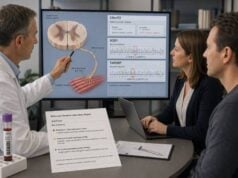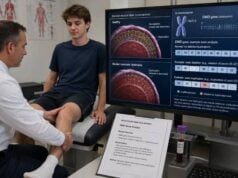
A facioscapulohumeral muscular dystrophy genetic test evaluates a specialized DNA repeat region called D4Z4 near the end of chromosome 4 and, in selected cases, genes that control its epigenetic silencing, especially SMCHD1. This is not a routine gene-panel problem. Most FSHD1 results depend on the number and chromosome location of large D4Z4 repeats and whether the shortened array lies on a permissive 4qA haplotype that allows stable DUX4 expression. FSHD2 usually involves excessive D4Z4 hypomethylation plus a permissive 4qA allele, often with a pathogenic SMCHD1 variant. A positive result can confirm the cause of asymmetric facial, shoulder-blade, upper-arm, trunk, or foot weakness and guide family testing. Borderline repeat sizes, mosaicism, and reduced penetrance require careful clinical interpretation. A normal exome or standard muscular dystrophy panel does not exclude FSHD because ordinary short-read sequencing generally cannot measure the D4Z4 array accurately.
- FSHD1 usually involves 1–10 D4Z4 repeat units on a permissive chromosome 4qA allele.
- A shortened array on chromosome 10 or on a nonpermissive 4qB allele does not establish FSHD1.
- FSHD2 testing combines D4Z4 methylation, 4qA permissive-haplotype assessment, and analysis of genes such as SMCHD1.
- Repeat sizes near the upper disease-associated range can have reduced penetrance and need strong clinical correlation.
- Optical genome mapping, Southern blotting, or molecular combing may be used; standard exome sequencing alone is inadequate.
Table of Contents
- When FSHD Genetic Testing Is Considered
- The D4Z4, DUX4, and Permissive-Haplotype Mechanism
- How FSHD1 and FSHD2 Differ
- Laboratory Methods for FSHD Testing
- Interpreting Repeat Size, Methylation, and SMCHD1 Results
- Mosaicism, Penetrance, and Phenotype Variation
- Inheritance, Family Testing, and Reproductive Options
- Negative and Inconclusive Results
When FSHD Genetic Testing Is Considered
Facioscapulohumeral muscular dystrophy, or FSHD, often produces a recognizable distribution of weakness. Facial signs can include difficulty closing the eyes tightly, whistling, using a straw, or puckering the lips. Shoulder-blade stabilizers weaken, causing scapular winging and difficulty raising the arms overhead. Weakness may be strikingly asymmetric, even within the same muscle groups.
The name describes common early regions—face, scapula, and upper arm—but the condition can involve abdominal muscles, spinal extensors, hip girdle, and ankle dorsiflexors. A positive Beevor sign, in which the navel moves upward when the person lifts the head while lying down, reflects lower abdominal weakness. Foot drop may precede obvious arm weakness in some people.
Age at onset ranges from infancy to late adulthood. Some carriers never develop recognizable symptoms. Early-onset disease can be more severe and may include retinal vascular disease or sensorineural hearing loss. Respiratory weakness is uncommon overall but can occur in people with severe weakness, spinal deformity, or wheelchair dependence.
Creatine kinase is often normal or only mildly elevated. Very high CK, prominent early contractures, marked calf enlargement, sensory loss, or inflammatory features may suggest another diagnosis. Electromyography usually shows a myopathic pattern but is not specific. Muscle biopsy may show dystrophic or inflammatory changes and can be misleading if interpreted without the clinical pattern.
Genetic testing is appropriate when the examination is typical, when a relative has molecularly confirmed FSHD, or when another muscular dystrophy panel was negative but the pattern remains suggestive. Testing can also clarify atypical cases with isolated scapular winging, foot drop, or hyperCKemia.
A clinical diagnosis alone may be convincing in a multigenerational family, but molecular confirmation has practical value. It separates FSHD from limb-girdle muscular dystrophies, scapuloperoneal syndromes, mitochondrial disease, inflammatory myopathy, and structural shoulder disorders. It also provides the specific familial marker needed for relatives or reproductive testing.
Standard exome sequencing should not be used as the sole exclusion test. The main FSHD1 change is a contraction of a large repeated array rather than a conventional sequence variant. A laboratory must use a method validated for D4Z4 sizing and for distinguishing chromosome 4 from the nearly identical array on chromosome 10.
The D4Z4, DUX4, and Permissive-Haplotype Mechanism
The D4Z4 array sits near the end of chromosome 4q35. Each repeat unit is about 3.3 kilobases and contains a copy of DUX4. In most skeletal muscle, the region is tightly packaged and chemically silenced, so full-length DUX4 is not stably expressed.
FSHD develops when this repression is weakened and a full-length DUX4 transcript can be stabilized. DUX4 is a transcription factor normally active in a narrow developmental setting. In mature skeletal muscle, inappropriate DUX4 expression activates genes, immune pathways, and cellular stress programs that damage muscle fibers.
A shortened D4Z4 array alone is not sufficient. The distal chromosome must carry a permissive haplotype, usually called 4qA, that contains a polyadenylation signal needed to stabilize the DUX4 messenger RNA. The common 4qB haplotype lacks the required context, so a similar contraction on 4qB does not usually cause FSHD.
Chromosome 10q26 contains a highly homologous D4Z4-like array. A short array on chromosome 10 is not considered the usual cause of FSHD because it lacks the necessary permissive chromosome 4 context. Diagnostic methods must therefore determine both repeat size and chromosomal origin.
In FSHD1, contraction of the chromosome 4 D4Z4 array reduces epigenetic repression. In FSHD2, the repeat array is not in the classic contracted range, but variants in chromatin-regulating genes cause excessive hypomethylation and relaxation. Both routes converge on inappropriate DUX4 expression from a permissive 4qA allele.
This mechanism explains why ordinary Mendelian labels can be misleading. FSHD1 is often inherited as an autosomal dominant trait, but disease expression depends on repeat size, haplotype, epigenetic state, and other modifiers. FSHD2 is typically digenic or oligogenic: a permissive DUX4 allele must occur together with a variant that weakens repression.
How FSHD1 and FSHD2 Differ
FSHD1 accounts for most molecularly confirmed cases. It is usually associated with 1–10 D4Z4 repeat units on a permissive 4qA chromosome. Unaffected people commonly have longer arrays, although repeat number is only one part of interpretation.
Very short arrays, especially 1–3 units, are often associated with earlier and more severe disease, including greater risk of hearing or retinal complications. Larger disease-associated arrays, particularly 8–10 units, show reduced penetrance and broader variability. Some people with these alleles remain asymptomatic, while others develop typical weakness.
FSHD2 has a clinically similar phenotype but a different molecular route. The D4Z4 array is usually longer than the FSHD1 range, yet it is abnormally hypomethylated. Pathogenic loss-of-function variants in SMCHD1 are the most common known cause. Less often, variants in DNMT3B or LRIF1 contribute.
SMCHD1 helps maintain repressive chromatin at D4Z4 and other genomic regions. A pathogenic SMCHD1 variant does not cause FSHD2 by itself in every carrier. The person also needs a permissive 4qA allele, often with a relatively short normal-range array that is more susceptible to derepression.
SMCHD1 variants can also modify FSHD1 severity. A person with a borderline FSHD1 contraction and a pathogenic SMCHD1 variant may have more marked hypomethylation and a more severe phenotype than expected from repeat size alone. This overlap supports viewing FSHD1 and FSHD2 as a biological continuum rather than entirely separate diseases.
SMCHD1 is linked to another condition, Bosma arhinia microphthalmia syndrome, through different variant effects. A report should not assume that every SMCHD1 variant has the same consequence. Classification must consider variant type, functional evidence, phenotype, methylation, and the permissive haplotype.
| Feature | FSHD1 | FSHD2 |
|---|---|---|
| Primary molecular finding | Contracted D4Z4 array, usually 1–10 units | D4Z4 hypomethylation with a chromatin-regulator variant |
| Permissive 4qA allele required | Yes | Yes |
| Common gene beyond the repeat | Usually none required | SMCHD1 most common |
| Typical inheritance | Autosomal dominant, with variable penetrance | Combined inheritance of permissive allele and modifier variant |
| Clinical appearance | Classic FSHD spectrum | Often clinically indistinguishable from FSHD1 |
Laboratory Methods for FSHD Testing
FSHD testing requires unusually careful DNA handling because the laboratory must measure long repetitive fragments. Some methods need high-molecular-weight DNA that is not sheared. Before sample collection, confirm whether the laboratory accepts routine blood tubes, isolated DNA, saliva, or cultured cells.
Southern blotting
Southern blot analysis has long been a reference method. Restriction enzymes cut the DNA, fragments are separated by gel electrophoresis, transferred to a membrane, and detected with a probe. Pulsed-field gel electrophoresis can resolve very large fragments. Additional enzymes and probes help distinguish chromosome 4 from chromosome 10 and characterize the 4qA or 4qB haplotype.
Southern blotting is technically demanding, slow, and requires substantial high-quality DNA. It can be difficult to interpret in mosaic cases, hybrid arrays, or unusual rearrangements. Its long clinical history remains valuable, especially when newer results are ambiguous.
Molecular combing
Molecular combing stretches individual DNA molecules on a surface and uses fluorescent probes to visualize the array, chromosome origin, and haplotype. It can characterize complex arrangements and mosaicism, but it also requires specialized equipment and expertise.
Optical genome mapping
Optical genome mapping labels sequence motifs on ultra-high-molecular-weight DNA and maps long molecules across the genome. It can size D4Z4 arrays, distinguish 4q and 10q, identify permissive haplotypes, detect mosaicism, and reveal some complex structural patterns. Clinical validation studies show strong agreement with established methods, and many laboratories are adopting it.
Optical mapping does not replace all testing. FSHD2 still requires methylation assessment and sequencing of SMCHD1 or other relevant genes. Low-quality DNA, unusual haplotypes, and complex arrays can produce unresolved findings.
D4Z4 methylation analysis
Methylation testing measures epigenetic repression across the D4Z4 array. Marked hypomethylation supports FSHD2 and can help interpret borderline repeat contractions or possible modifier effects. The exact assay, reference range, and genomic sites measured differ among laboratories, so results should not be compared as though every percentage is interchangeable.
Methylation can be influenced by repeat size. A contracted FSHD1 allele is expected to be hypomethylated because fewer repeats reduce repression. FSHD2 interpretation therefore considers the observed methylation relative to repeat length and the person’s overall genetic context.
SMCHD1 and related-gene sequencing
Sequencing identifies small variants in SMCHD1, DNMT3B, or LRIF1. Copy-number analysis may be needed for exon-level deletions or duplications. A standard exome can identify many sequence variants in these genes but cannot establish the necessary D4Z4 repeat and haplotype context.
Interpreting Repeat Size, Methylation, and SMCHD1 Results
A complete report should state the chromosome 4 D4Z4 repeat size, whether the allele is permissive 4qA or nonpermissive 4qB, whether chromosome 10 arrays were distinguished, whether mosaicism was detected, and which method was used. For suspected FSHD2, it should also provide methylation and sequence findings.
Clear FSHD1 result
A contracted array of 1–10 units on a permissive 4qA allele supports FSHD1 when the clinical pattern fits. The report may express size in repeat units, kilobases, or both. One repeat is about 3.3 kilobases, but fragment size can include flanking DNA, so raw kilobase values should be interpreted using the laboratory’s method.
A contraction on 4qB does not meet the usual molecular requirements for FSHD1. Likewise, a short chromosome 10 array is not diagnostic. Misidentifying these arrays can create false-positive results.
Borderline or reduced-penetrance result
An 8–10-unit permissive allele often requires stronger clinical correlation than a very short array. Such alleles can be found in unaffected people, and symptoms may be mild or late. The examiner should confirm the characteristic distribution of weakness and consider methylation, family segregation, and alternative diagnoses.
A borderline result should not be used as a convenient explanation for nonspecific fatigue, generalized pain, or weakness that lacks the FSHD pattern. Conversely, an asymptomatic relative with the same allele should not be told that disease is impossible; age-related penetrance and variable expression remain relevant.
FSHD2 result
FSHD2 is supported by significant D4Z4 hypomethylation, a permissive 4qA allele, and a pathogenic or likely pathogenic variant in SMCHD1 or another established chromatin-regulator gene. Laboratories may use slightly different algorithms, and not every clinically convincing case has an identifiable gene variant.
A pathogenic SMCHD1 variant without a permissive 4qA allele does not establish FSHD2. A permissive allele is common in the population and also is not diagnostic by itself. The combination creates the disease-associated context.
Variant of uncertain significance
An SMCHD1 variant of uncertain significance, or VUS, is not a confirmed explanation. Segregation, methylation, functional studies, population frequency, and prior reports may help. A VUS paired with normal D4Z4 methylation and an atypical phenotype is less persuasive than a de novo loss-of-function variant with marked hypomethylation and classic weakness.
Mosaicism, Penetrance, and Phenotype Variation
Somatic mosaicism occurs when the D4Z4 contraction forms after fertilization and is present in only a proportion of cells. A mosaic person may carry both a contracted and a noncontracted allele in blood. Symptoms can be milder or more asymmetric, but the percentage in blood does not precisely predict muscle involvement.
Detection depends on method and level. Southern blotting may show bands of different intensity; molecular combing and optical genome mapping can count individual molecules and may characterize mosaicism more clearly. A low-level mosaic contraction can be missed if the assay or sample quality is inadequate.
Mosaicism complicates recurrence counseling. A mosaic parent may transmit the contracted allele through an egg or sperm. A child who inherits it will usually have the contraction in all cells and can be more severely affected than the mosaic parent.
Penetrance is incomplete, especially for larger contracted arrays. Sex, age, epigenetic state, SMCHD1 or other modifiers, and background genetics influence whether symptoms appear. Men are often recognized earlier or more severely in families, but women can have substantial disease.
Repeat size correlates with severity at a group level, not with an individual timetable. A very short array raises concern for early and multisystem disease, but it cannot predict the exact age of wheelchair use, respiratory involvement, pain, or hearing loss. A larger array can still cause important disability.
FSHD is commonly asymmetric and can remain regionally selective for years. This makes manual strength testing and standardized functional measures more informative than a single CK level. Imaging can show a distinctive pattern of fatty replacement and may support diagnosis or monitor research outcomes, but it does not replace molecular testing.
Inheritance, Family Testing, and Reproductive Options
A person with a nonmosaic FSHD1 contraction has a 50% chance of transmitting the contracted chromosome 4 allele in each pregnancy. The child’s severity cannot be predicted reliably from the parent’s symptoms. A mildly affected or asymptomatic parent can have a more affected child, particularly when mosaicism or modifying factors differ.
About a portion of cases arise de novo, with no contraction detected in either parent’s routine blood sample. Parental testing helps clarify recurrence but cannot completely eliminate the possibility of germline mosaicism.
Testing relatives should target the known family configuration and use a laboratory capable of comparing repeat size, haplotype, and mosaicism. A routine “muscular dystrophy panel” will not answer whether the familial D4Z4 contraction is present.
Predictive testing of asymptomatic adults requires counseling about reduced penetrance and uncertain severity. The result may affect life planning, insurance in some jurisdictions, reproductive decisions, and eligibility for studies, but it cannot forecast an exact course. Testing minors without symptoms is generally considered only when the result would change childhood medical care or when early-onset disease is plausible in the family.
FSHD2 recurrence is more complex. A pathogenic SMCHD1 variant may be inherited in an autosomal dominant manner, but disease usually requires inheritance of a permissive 4qA allele as well. A child’s risk depends on which parent carries each factor, the repeat-array context, and whether both are transmitted.
Reproductive options may include prenatal diagnosis or preimplantation genetic testing. FSHD1 testing can be technically challenging because repeat sizing and haplotype analysis require specialized methods, and mosaicism can complicate interpretation. FSHD2 testing may need analysis of both the modifier variant and permissive D4Z4 allele. Families should work with a laboratory and reproductive genetics team before pregnancy whenever possible.
Negative and Inconclusive Results
A negative FSHD1 test means no diagnostic contraction was identified using that method; it does not automatically exclude FSHD2 or every unusual FSHD mechanism. Review whether the report confirmed both chromosome origin and permissive haplotype and whether DNA quality was adequate.
If the phenotype is classic and FSHD1 testing is negative, D4Z4 methylation and SMCHD1-centered FSHD2 testing are appropriate. If methylation is normal, the team should reconsider other scapuloperoneal, limb-girdle, mitochondrial, structural, or inflammatory conditions.
Some arrays are technically difficult because chromosome 4 and 10 repeats can exchange segments, creating hybrid arrays. Rare rearrangements, duplications, or unusual haplotypes can confuse a standard assay. Reanalysis with optical genome mapping, molecular combing, long-read sequencing, or another expert laboratory may resolve the structure.
An inconclusive result should be described precisely. “Borderline FSHD test” could mean a 9–10-unit permissive allele with reduced penetrance, uncertain chromosome assignment, low-level mosaicism, an SMCHD1 VUS, or abnormal methylation without an identified variant. Each situation has different next steps.
A negative molecular result should not lead to repeated immunosuppressive treatment solely because a muscle biopsy showed inflammation. FSHD muscle can contain inflammatory infiltrates. Treatment decisions should rely on the full clinical and molecular picture.
After diagnosis, care usually focuses on individualized physical therapy, scapular mechanics, pain, fall prevention, foot-drop management, hearing or retinal evaluation in higher-risk presentations, and respiratory assessment when weakness is severe. Seek prompt evaluation for new breathing difficulty, rapidly progressive weakness, swallowing problems, or symptoms that differ sharply from the expected slow course.
References
- Best practice guidelines on genetic diagnostics of facioscapulohumeral muscular dystrophy: update of the 2012 guidelines 2024 (Guideline).
- Evaluation of optical genome mapping in clinical genetic testing of facioscapulohumeral muscular dystrophy 2023 (Clinical Validation Study).
- Methylation of the 4q35 D4Z4 repeat defines disease status in facioscapulohumeral muscular dystrophy 2023 (Diagnostic Study).
- Optimising the molecular investigation of the FSHD locus: a retrospective analysis of 238 suspected cases 2025 (Cohort Study).
- Rethinking genomics of facioscapulohumeral muscular dystrophy 2026 (Review).
- Facioscapulohumeral Muscular Dystrophy 2020 (Clinical Reference).
Disclaimer
This article is general education and cannot diagnose FSHD or interpret an individual D4Z4, methylation, or SMCHD1 result. Testing should be ordered and reviewed by clinicians and laboratories experienced with FSHD’s specialized repeat and haplotype methods. Seek medical assessment for breathing difficulty, swallowing problems, or unexpectedly rapid weakness.