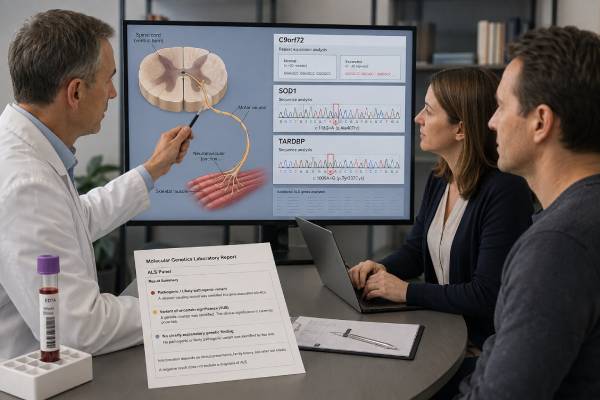
ALS genetic testing looks for inherited or disease-associated changes that may explain why motor neurons are degenerating. The most important first-line targets include the C9orf72 repeat expansion and sequence variants in SOD1, TARDBP, and FUS, although modern panels usually examine many additional genes. Current consensus guidance supports offering genetic testing to every person diagnosed with amyotrophic lateral sclerosis, even when no relative has had ALS or frontotemporal dementia. A result can clarify the cause, identify relatives who may be at risk, qualify a person for gene-specific treatment or a clinical trial, and prevent years of uncertainty. It can also produce difficult findings: an uncertain variant, a result with incomplete penetrance, or an unexpected connection to dementia. The test therefore works best when paired with genetic counseling and a laboratory method that can detect both ordinary DNA sequence changes and the special hexanucleotide repeat expansion in C9orf72. A negative panel does not disprove ALS and does not remove all inherited risk.
- All people with ALS should be offered genetic counseling and testing, whether the disease appears familial or sporadic.
- C9orf72 requires a dedicated repeat-expansion assay; standard sequencing or exome testing can miss it.
- A pathogenic SOD1 variant can affect treatment options, including eligibility for SOD1-targeted therapy in appropriate adults.
- Most ALS-associated variants are inherited in an autosomal dominant pattern, but penetrance and age at onset can vary widely.
- A negative test does not rule out genetic ALS, because current panels do not detect every causal gene or variant type.
- Healthy relatives should usually test only after a familial pathogenic variant has been identified in an affected family member.
Table of Contents
- Why Genetic Testing Is Now Routine in ALS
- Major Genes and Their Clinical Patterns
- Choosing the Right Laboratory Test
- Understanding Positive, Negative, and Uncertain Results
- Treatment and Trial Implications
- Risk to Relatives and Predictive Testing
- Questions to Ask After the Report Arrives
Why Genetic Testing Is Now Routine in ALS
ALS was once divided sharply into “familial” and “sporadic” disease. That distinction remains useful for describing family history, but it is no longer a reliable way to decide who should be tested. Pathogenic variants are found not only in families with several affected relatives but also in people who appear to be the first person in the family with ALS.
A family history can look negative for several reasons. Relatives may have died young from unrelated causes, received a different diagnosis, had subtle cognitive or behavioral symptoms rather than weakness, or carried a variant without developing disease. Adoption, small family size, limited medical records, and nonpaternity can also obscure inheritance. Some variants arise newly in the affected person.
Genetic testing can provide several kinds of clinical value:
- It may confirm a molecular subtype of ALS.
- It can identify overlap with frontotemporal dementia, especially in C9orf72-associated disease.
- It may guide gene-targeted treatment or trial enrollment.
- It allows relatives to consider focused testing rather than broad, ambiguous screening.
- It can refine recurrence-risk counseling for children and siblings.
- It may prompt testing for additional neurologic features in the family.
The neurologic diagnosis still comes first. ALS is diagnosed from progressive upper and lower motor neuron dysfunction, supported by examination, electrodiagnostic testing, and evaluation for conditions that can mimic motor neuron disease. A positive genetic result can strengthen or refine that diagnosis, but a genetic panel is not a screening test for unexplained fatigue, cramps, or isolated muscle twitching in the general population.
Testing should ideally begin soon after diagnosis because treatment and clinical-trial windows can be time sensitive. Early testing also gives the person more control over when and how results are shared. The broader concept of a neurologic genetic panel may be helpful when the presentation overlaps neuropathy, hereditary spastic paraplegia, myopathy, or dementia.
Major Genes and Their Clinical Patterns
More than 40 genes have credible links to ALS, but a smaller group accounts for much of the currently identifiable genetic burden. The phenotype ranges are broad, so no symptom pattern can reliably name the gene without testing.
C9orf72 repeat expansion
A large expansion of the six-letter DNA sequence GGGGCC in C9orf72 is a major cause of ALS and frontotemporal dementia in people of European ancestry. It may cause ALS alone, dementia alone, or a mixed ALS–frontotemporal dementia syndrome. Behavioral changes, loss of empathy, compulsive actions, language decline, psychosis, or a family history labeled as dementia can be important clues.
Normal alleles contain relatively few repeats. Pathogenic expansions can contain hundreds to thousands, but laboratories do not always report an exact number because conventional repeat-primed PCR may show that an expansion is present without sizing the entire expanded allele. The boundary between normal, intermediate, and pathogenic ranges is method dependent, and repeat size measured in blood does not perfectly reflect repeat size in the nervous system.
C9orf72 penetrance is age related and incomplete. Some carriers remain unaffected into older age. A positive result therefore indicates a substantial inherited susceptibility, not a guaranteed age of onset for an unaffected relative.
SOD1
SOD1 encodes superoxide dismutase 1, an enzyme involved in handling reactive oxygen species. Pathogenic variants usually cause motor neuron disease without prominent frontotemporal dementia. Clinical course differs markedly by variant: some forms progress rapidly, while others are slower. The same gene can also show different inheritance patterns. Most SOD1-ALS is autosomal dominant, but certain variants can behave recessively in some populations.
SOD1 matters immediately because a molecular diagnosis may establish eligibility for a gene-targeted antisense treatment. The report must identify a variant considered pathogenic or likely pathogenic in the clinical context; a VUS is not enough to support gene-specific therapy.
TARDBP and FUS
TARDBP encodes TDP-43, a protein that regulates RNA and forms abnormal deposits in most ALS, even when TARDBP itself is not mutated. Pathogenic TARDBP variants are uncommon but well established. They often cause autosomal dominant ALS with variable onset and progression. Cognitive involvement can occur but is less characteristic than with C9orf72.
FUS also encodes an RNA-binding protein. FUS-associated ALS may begin at a younger age, including adolescence or early adulthood, and can progress quickly in some people. Juvenile onset or rapid bulbar disease may increase suspicion, although testing remains necessary.
Other genes on a comprehensive panel
A modern panel may also include TBK1, OPTN, SQSTM1, KIF5A, VCP, UBQLN2, NEK1, ANXA11, SPG11, SETX, ALS2, FIG4, and other genes. Some are associated with frontotemporal dementia, Paget disease of bone, hereditary spastic paraplegia, neuropathy, juvenile motor neuron disease, or multisystem proteinopathy.
Not every gene listed on a commercial panel has equally strong evidence. Larger panels increase diagnostic reach but also increase variants of uncertain significance. The ordering team should favor a laboratory that explains gene-disease validity and reports only clinically defensible associations.
| Gene or variant | Typical laboratory method | Notable clinical considerations |
|---|---|---|
| C9orf72 expansion | Repeat-primed PCR, often with a sizing method | ALS, frontotemporal dementia, psychiatric or behavioral presentations; age-related penetrance |
| SOD1 | Sequence analysis plus copy-number analysis when indicated | Variable progression; gene-specific therapy may be available |
| TARDBP | Sequence analysis | Usually dominant ALS; variable age and course |
| FUS | Sequence analysis | Can cause young-onset or rapidly progressive disease |
| TBK1, VCP, SQSTM1 and others | Multigene sequencing panel | May reveal ALS–dementia or multisystem disease overlap |
Choosing the Right Laboratory Test
The most important technical point is that one method does not detect every ALS variant. A panel based only on next-generation sequencing may examine SOD1, TARDBP, FUS, and many other genes yet fail to detect the C9orf72 expansion unless the laboratory adds a dedicated assay.
Consensus recommendations call for, at minimum, testing that includes:
- A C9orf72 repeat-expansion assay
- SOD1 sequencing
- FUS sequencing
- TARDBP sequencing
In practice, many clinicians order an ALS multigene panel that includes these tests and additional genes. The requisition or methods section should explicitly state how C9orf72 was evaluated. “C9orf72 included” is not enough if the report does not specify repeat-expansion analysis.
Most testing uses blood. Saliva may be accepted, but blood often provides more reliable DNA quantity and avoids contamination. Fasting is unnecessary. The person generally continues normal medicines. Turnaround time commonly ranges from two to eight weeks, though sponsored programs, insurance authorization, confirmatory testing, or complex variant analysis can change that schedule.
Ask whether the test includes:
- Sequence variants and small insertions or deletions
- Copy-number changes when clinically relevant
- C9orf72 expansion analysis
- Mitochondrial or repeat-expansion genes if the phenotype suggests them
- Deletion or duplication analysis for genes not reliably assessed by sequencing alone
- Reanalysis or amended-report policies
- Access to raw data or a complete technical appendix
Whole-exome sequencing is not automatically superior to a disease-focused panel. Exome sequencing may miss repeat expansions, deep intronic variants, structural changes, and poorly covered exons. Whole-genome sequencing can broaden coverage but still may need specialized repeat analysis and careful interpretation. A focused genetic panel test often offers faster analysis and clearer clinical reporting for newly diagnosed ALS.
Pretest counseling does not have to delay care. It should explain the possible outcomes, implications for relatives, privacy concerns, and the chance of an unexpected dementia-associated result. Some clinics use a neurologist, genetic counselor, nurse, or telehealth counselor to make testing accessible.
Understanding Positive, Negative, and Uncertain Results
The result category must be read together with the gene, variant, inheritance pattern, and the laboratory’s evidence. The word “mutation” is often used informally, but clinical reports usually classify variants as pathogenic, likely pathogenic, uncertain, likely benign, or benign.
Pathogenic or likely pathogenic
A pathogenic or likely pathogenic result identifies a variant with strong evidence of causing or contributing to ALS. In a person with a compatible diagnosis, it can establish a genetic subtype. The report may discuss penetrance, previous cases, functional studies, and population frequency.
A positive C9orf72 expansion result usually supports C9orf72-associated ALS or ALS–frontotemporal dementia. A positive SOD1 result may affect treatment eligibility. A pathogenic TARDBP or FUS result may clarify autosomal dominant risk, but it does not provide a precise prognosis.
Even a confirmed causal result cannot predict the exact sequence of weakness, respiratory decline, communication changes, or survival. Variant-specific data may offer a broad pattern, but individual variation remains substantial.
Negative
A negative panel means no reportable pathogenic variant was found in the tested regions with the methods used. It does not mean the ALS is non-genetic. Possible explanations include:
- The causal gene has not yet been discovered.
- The relevant gene was not included.
- The variant lies in a region the assay does not cover.
- A repeat expansion or structural variant was not tested correctly.
- The person has a combination of lower-impact genetic factors rather than one high-impact variant.
- The family history reflects shared susceptibility that current clinical testing cannot resolve.
A negative result may still lower the likelihood of certain known forms, especially if the panel was technically complete. It should not be used to assure children or siblings that they have no increased risk.
Variant of uncertain significance
A VUS is not proof of genetic ALS. It may later be reclassified as benign or pathogenic as more families, laboratory data, and functional evidence become available. Care should not be based solely on a VUS, and healthy relatives should generally not undergo predictive testing for it.
Testing affected relatives can sometimes help if the laboratory requests segregation data. A variant present in several affected relatives and absent in unaffected older relatives may gain supporting evidence, but family size and incomplete penetrance complicate interpretation. The principles in genetic variant classification explain why rarity alone is not enough to label a change disease causing.
Carrier or risk allele findings
Some ALS-associated variants have reduced penetrance or act as risk factors rather than deterministic causes. Their contribution may depend on ancestry, other variants, or age. The report should avoid turning a modest association into a diagnosis. A genetics professional can distinguish a strong causal variant from a susceptibility allele that only shifts probability.
Treatment and Trial Implications
Genetic testing now has direct therapeutic relevance. In the United States, tofersen is approved for adults with ALS associated with a mutation in SOD1. Tofersen is an antisense oligonucleotide delivered into the spinal fluid. It is designed to reduce production of SOD1 protein.
A patient does not qualify merely because the report lists an SOD1 change. The treating specialist must confirm that the variant is clinically meaningful and that the diagnosis and treatment criteria are met. Treatment involves repeated lumbar punctures and monitoring for adverse effects, which can include headache, pain, inflammation, increased pressure, or neurologic complications. Benefits, uncertainties, access, and monitoring should be discussed at an experienced ALS center.
Genetic results can also open trial options for C9orf72, FUS, TARDBP, ATXN2, and other molecular targets. Trial availability changes frequently. Some studies enroll symptomatic people; others follow unaffected carriers to identify the earliest biomarker changes. Enrollment may depend on age, disease duration, respiratory function, prior medicines, exact variant, and laboratory confirmation.
A genetic diagnosis does not replace standard multidisciplinary ALS care. Riluzole, edaravone where appropriate, respiratory support, nutrition, communication devices, mobility equipment, symptom treatment, and advance care planning remain important. Genetics adds a molecular layer to care; it does not reduce the need for coordinated neurologic, respiratory, rehabilitation, speech, and palliative support.
Families should be cautious about unregulated clinics offering “gene therapy” outside a registered trial. A legitimate investigational program provides a protocol, ethics oversight, clear eligibility criteria, informed consent, adverse-event monitoring, and transparent costs.
Risk to Relatives and Predictive Testing
Many high-impact ALS variants follow autosomal dominant inheritance. When an affected person carries such a variant, each biological child has a 50% chance of inheriting it. That probability describes inheritance, not certainty of disease. Reduced penetrance means some carriers may never develop ALS or dementia.
Other inheritance patterns occur. UBQLN2 is X-linked. SPG11, ALS2, and some forms of SOD1-related disease can be recessive. A newly arisen variant may make sibling risk low while leaving a 50% risk to the affected person’s children. The specific report should drive counseling.
Predictive testing in a healthy adult is most informative after the familial pathogenic variant is known. The process usually includes:
- Verification of the affected relative’s laboratory report
- A personal neurologic and mental-health history
- Discussion of penetrance and the inability to predict exact onset
- Review of privacy and insurance implications
- A plan for result disclosure and emotional support
- Discussion of research, reproductive choices, and family communication
Testing minors is usually deferred for adult-onset ALS because no childhood treatment or surveillance has proven benefit. Exceptions may apply when the family variant causes juvenile disease or another medically actionable childhood condition.
An adult may reasonably choose testing, decline it, or postpone it. Some want information for family planning or life decisions. Others prefer uncertainty over living with a known carrier result. Neither choice is universally correct.
Reproductive options can include natural conception, prenatal diagnosis, in vitro fertilization with preimplantation genetic testing, donor gametes, adoption, or choosing not to have children. A review of autosomal dominant inheritance can help explain why each pregnancy starts with the same 50% transmission probability.
Questions to Ask After the Report Arrives
Bring the full report to the neurologist or genetics appointment. A useful review should answer these questions:
- Was C9orf72 repeat expansion tested with a dedicated method? If not, the panel may be incomplete.
- Is the finding pathogenic, likely pathogenic, or uncertain? Treatment and predictive testing should not rest on a VUS.
- What inheritance pattern applies to this exact variant? Do not assume every ALS gene is dominantly inherited.
- How strong is the penetrance evidence? Some variants confer high risk; others are incompletely predictive.
- Does the result change treatment now? SOD1 results may have immediate implications, while other genes may mainly affect trials or family counseling.
- Should relatives be tested, and who should be approached first? Targeted testing is preferable after a familial cause is established.
- Does the family need evaluation for frontotemporal dementia? This is particularly relevant with C9orf72, TBK1, VCP, SQSTM1, and related genes.
- Will the laboratory recontact the clinic after reclassification? Keep contact information current and retain the original report.
A result deserves reassessment if the clinical picture changes. New behavioral symptoms, loss of social judgment, language decline, hallucinations, or unusual movement findings may broaden the diagnosis. Conversely, a panel result that conflicts with the neurologic findings may need confirmation by an independent method or another laboratory.
Families should also preserve DNA and medical records when possible. In rapidly progressive disease, obtaining a high-quality sample early can prevent the loss of an opportunity to identify the familial variant. A stored sample may support future reanalysis as new genes and treatments emerge.
Genetic testing has moved from an optional research exercise to a standard part of ALS care. Its value depends on correct methods, careful classification, and a plan for action. The strongest approach combines timely testing, expert counseling, multidisciplinary management, and respect for each relative’s right to know—or not know—their own genetic status.
References
- Evidence-based consensus guidelines for ALS genetic testing and counseling 2023 (Guideline)
- Amyotrophic Lateral Sclerosis Overview 2023 (Review)
- Recent progress of the genetics of amyotrophic lateral sclerosis and challenges in clinical translation 2023 (Review)
- Integrating genetic testing into management of all patients with amyotrophic lateral sclerosis 2025 (Review)
- Advances in ALS genetics and emerging precision therapies 2025 (Review)
- FDA approves treatment of amyotrophic lateral sclerosis associated with a mutation in the SOD1 gene 2023 (Official Report)
Disclaimer
This article is for general education and does not diagnose ALS, interpret a specific variant, or recommend a treatment. ALS genetic testing and gene-targeted therapy decisions should be handled by a neurologist, genetics professional, and experienced ALS team using the complete laboratory report and current prescribing guidance. New or rapidly worsening breathing difficulty, choking, weakness, confusion, or neurologic symptoms require prompt medical evaluation.