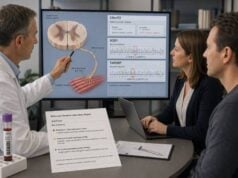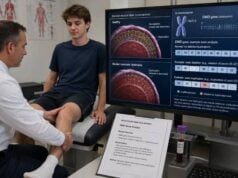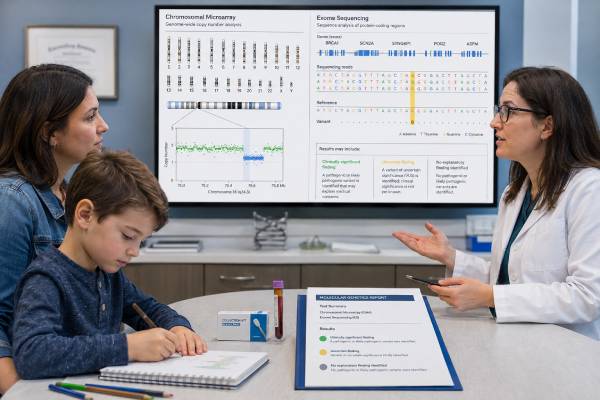
Genetic testing does not diagnose autism; autism is diagnosed from development, communication, behavior, and clinical observation. Genetic testing looks for an underlying chromosome or gene change that may help explain why an autistic person developed their particular combination of traits. The main broad tests are chromosomal microarray, which detects missing or extra DNA segments, and exome or genome sequencing, which searches for sequence variants across thousands of genes. Testing may also include Fragile X analysis or a targeted test when the examination points to a specific syndrome. A molecular diagnosis can guide screening for seizures, heart or kidney problems, growth differences, sleep disorders, or other complications. It can also clarify recurrence risk and connect a family with condition-specific resources or research. Many autistic people receive a normal or uncertain result because autism is genetically diverse and not always caused by one identifiable variant. Testing should be offered respectfully, with clear consent and without implying that autism makes a person less valuable or that a negative result makes their needs less real.
- Genetic testing can identify a cause or associated syndrome, but it cannot confirm or rule out autism itself.
- Chromosomal microarray detects deletions and duplications; exome sequencing detects many single-gene variants, so the tests are complementary.
- Testing is more likely to find an explanation when autism occurs with intellectual disability, developmental delay, seizures, congenital anomalies, or unusual growth.
- Parent-child trio sequencing usually improves interpretation by showing whether a variant is new, inherited, or present in more than one relative.
- A variant of uncertain significance is not a diagnosis and should not direct treatment by itself.
- A negative result does not mean autism is not genetic; current tests cannot detect every relevant variant or multifactorial cause.
Table of Contents
- What Genetic Testing Can Contribute
- Which Tests Are Used for Autism
- Who Is Most Likely to Benefit
- How Samples and Family Data Are Used
- Positive, Negative, and Uncertain Results
- How a Result Can Change Medical Care
- Family Planning, Privacy, and Reanalysis
What Genetic Testing Can Contribute
Autism spectrum disorder is clinically defined by persistent differences in social communication and restricted, repetitive, or highly focused patterns of behavior or interest that begin during development and affect daily life. No blood test, brain scan, or DNA result replaces a skilled developmental assessment.
A genetic evaluation answers a different question: Is there a chromosome or gene finding that explains part of the person’s neurodevelopmental profile? In some people, autism is one feature of a recognizable genetic condition. In others, a pathogenic variant is found even when there are few physical clues. Many cases reflect a complex combination of common genetic variants, rare variants, and non-genetic influences that current clinical testing cannot summarize as one cause.
A confirmed molecular diagnosis may:
- End repeated diagnostic testing and provide a name for the condition
- Identify health risks that are not obvious from behavior alone
- Inform seizure, cardiac, kidney, vision, hearing, growth, or cancer surveillance
- Clarify whether a variant was inherited or occurred for the first time in the child
- Refine recurrence risk for parents, siblings, and the autistic person’s future children
- Connect the family with syndrome-specific support and natural-history studies
- Qualify the person for a clinical trial or targeted therapy when one exists
- Help schools and clinicians understand that co-occurring motor, language, sleep, or medical needs share a biological cause
A result does not predict personality, happiness, intelligence, independence, communication style, or future quality of life with precision. Even people with the same pathogenic variant can have different abilities and medical needs. Genetics should add information, not reduce a person to a syndrome label.
Testing can be useful in adults as well as children. Adults diagnosed before modern testing may never have received chromosomal microarray or sequencing, particularly if they live in supported settings or have intellectual disability. Their medical and family-planning questions remain valid.
Which Tests Are Used for Autism
No single test detects every genetic cause. The clinician chooses methods based on developmental history, physical examination, family history, and previous results.
Chromosomal microarray
A chromosomal microarray, or CMA, measures DNA copy number across the genome. It detects deletions and duplications known as copy-number variants. These can involve part of one gene, several genes, or a larger chromosome region.
Examples of recurrent findings associated with autism or neurodevelopmental differences include 16p11.2 deletion or duplication, 15q11-q13 duplication, 22q11.2 deletion or duplication, 1q21.1 changes, and deletions involving SHANK3. The same copy-number variant may produce autism, language delay, intellectual disability, seizures, psychiatric illness, congenital anomalies, or few obvious features in different relatives.
Microarray can also detect some whole-chromosome changes and, when SNP probes are included, long regions of homozygosity that may suggest parental relatedness, uniparental disomy, or recessive disease. It usually cannot detect a balanced translocation, most single-letter DNA changes, repeat expansions, or low-level mosaicism below the platform’s sensitivity.
CMA has long been a first-line test for autism, developmental delay, intellectual disability, and multiple congenital anomalies. It remains useful even as exome and genome sequencing move earlier in the diagnostic pathway because copy-number analysis and sequence analysis are not identical. Some laboratories can call copy-number changes from sequencing data, but performance varies by size and genomic region.
A detailed explanation of this method is available in chromosomal microarray testing.
Exome sequencing
The exome contains the protein-coding portions of roughly 20,000 genes. Exome sequencing can identify many single-nucleotide variants and small insertions or deletions associated with neurodevelopmental conditions. Relevant genes include CHD8, SCN2A, SYNGAP1, ADNP, SHANK3, DYRK1A, POGZ, PTEN, TSC1, TSC2, MECP2, and hundreds of others.
Exome sequencing is often most informative when performed as a trio, using DNA from the autistic person and both biological parents. Trio analysis helps the laboratory find de novo variants, determine whether two recessive variants are on different gene copies, and interpret inherited findings. A duo with one parent is still useful when a full trio is not possible.
Exome limitations include uneven coverage, weak detection of repeat expansions, structural variants, mitochondrial variants, methylation disorders, deep intronic changes, and certain copy-number changes. A “negative exome” does not mean every gene was completely examined.
Genome sequencing
Genome sequencing examines coding and noncoding DNA more broadly and can detect some structural and copy-number variants that exome sequencing misses. It may combine several types of analysis in one test, but interpretation remains concentrated in genes and variant classes with established clinical evidence.
Genome sequencing is increasingly used as a first-tier or early test for unexplained developmental disorders. Cost, insurance coverage, data storage, and laboratory capability vary. It still may not reliably detect all repeat expansions, methylation abnormalities, or low-level mosaicism without specialized analysis.
Fragile X and other targeted tests
FMR1 CGG repeat analysis detects Fragile X syndrome. The repeat expansion is not reliably found by standard microarray or ordinary exome sequencing. Testing is particularly important in a person with intellectual disability, a suggestive family history, characteristic physical or behavioral features, or ovarian insufficiency or tremor/ataxia in relatives. Practice varies on whether every autistic person should receive Fragile X testing or whether it should be phenotype directed.
Targeted testing may be appropriate when the clinical picture is specific. Examples include:
- PTEN testing for autism with marked macrocephaly
- MECP2 testing for regression, loss of purposeful hand use, or a Rett-like pattern
- TSC1/TSC2 testing for tuberous sclerosis features
- UBE3A methylation and sequence testing for Angelman-like features
- Methylation testing for Prader-Willi syndrome
- Metabolic tests for regression, episodic decompensation, organ disease, unusual odor, movement disorder, or other biochemical clues
A targeted test can be faster and easier to interpret than broad sequencing when a syndrome is strongly suspected. A multigene panel may be chosen when the phenotype points to a narrower group such as epilepsy, overgrowth, or neurocutaneous disorders.
| Test | Main findings detected | Common blind spots |
|---|---|---|
| Chromosomal microarray | Deletions, duplications, some aneuploidies and homozygosity regions | Most sequence variants, balanced rearrangements, repeat expansions |
| Exome sequencing | Many coding sequence variants and some copy-number changes | Noncoding variants, methylation, many repeats and structural changes |
| Genome sequencing | Broad sequence and structural variation | Some repeats, methylation disorders, difficult or mosaic variants |
| FMR1 repeat analysis | Fragile X full mutation and premutation | Other autism-associated genes and chromosome changes |
| Targeted syndrome test | Specific variant type suggested by the phenotype | Unrelated causes outside the target |
Who Is Most Likely to Benefit
Genetic testing can be offered broadly to autistic people, but the probability of a diagnostic finding is not the same for everyone. Yield tends to be higher when autism occurs with:
- Intellectual disability or global developmental delay
- Significant speech delay or absent speech
- Epilepsy or an abnormal neurologic examination
- Congenital heart, kidney, skeletal, or other organ anomalies
- Unusual head size, growth pattern, facial features, or skin findings
- Motor regression or loss of previously acquired skills
- A family history of developmental disability, seizures, psychiatric illness, recurrent miscarriage, or congenital anomalies
- More than one affected sibling
- Consanguinity or ancestry from a founder population
- A parent with related learning, behavioral, neurologic, or medical features
A person with autism alone can still have a pathogenic finding. Conversely, multiple additional features do not guarantee one. Yield estimates differ across studies because cohorts, testing platforms, and definitions vary. In general, exome or genome sequencing finds more diagnoses in mixed neurodevelopmental cohorts than CMA alone, while CMA retains value for copy-number changes.
Testing should not be withheld because a child is young. A molecular result can guide care before the full phenotype appears. It also should not be withheld because a person communicates without speech, has high support needs, or cannot provide independent consent. In those situations, the legal representative should use supported decision-making and respect the person’s preferences as much as possible.
Not every family wants testing immediately. Some are focused on therapies, school access, or coping with a new diagnosis. Others worry about blood draws, privacy, or unexpected findings. Unless an urgent medical decision depends on the result, testing can often be revisited later.
How Samples and Family Data Are Used
Most tests use blood or saliva. Blood generally provides consistent DNA quality, while saliva can reduce distress for someone with needle sensitivity. A laboratory may request a new specimen if saliva contains too little DNA or too many nonhuman cells. Fasting and medication changes are not needed.
The genetics visit often includes a three-generation family history and physical examination. Details that may seem unrelated—large head size, skin spots, early cancers, miscarriages, seizures, kidney disease, or a relative with schizophrenia—can change test selection or interpretation.
For trio sequencing, parental samples are tested mainly to interpret the autistic person’s variants. Laboratories may discover that a parent carries the same variant, that the variant is de novo, or that the stated biological relationships do not match the DNA. Consent should address possible nonpaternity, consanguinity, or donor conception findings before samples are collected.
Exome and genome tests may also offer secondary findings: pathogenic variants unrelated to autism but associated with preventable or treatable conditions such as hereditary cancer or heart disease. Families may be able to opt in or out depending on laboratory policy, local guidance, and the person’s age. The distinction between a diagnostic finding and a secondary finding should be clear.
Clinical photographs, growth charts, MRI reports, EEG results, and Human Phenotype Ontology terms can improve variant prioritization. The laboratory does not diagnose from DNA in isolation; it compares candidate variants with the documented phenotype.
Turnaround ranges from several weeks to several months. Rapid sequencing may be available for critically ill infants, but routine outpatient autism evaluations generally take longer. Insurance may require prior authorization or documentation of developmental findings.
Positive, Negative, and Uncertain Results
A result should be interpreted by classification, inheritance, fit with the phenotype, and test limitations.
Pathogenic or likely pathogenic finding
A pathogenic or likely pathogenic variant may establish a molecular diagnosis. The report should name the gene or chromosome region, explain the disease association, and describe inheritance. “Likely pathogenic” indicates strong evidence, not a casual guess.
The finding may be de novo, inherited in an autosomal dominant pattern, inherited recessively from both parents, X-linked, mitochondrial, or caused by a chromosome change. The same variant may have incomplete penetrance, meaning some carriers have few or no recognized features.
A positive result does not replace the autism diagnosis or dictate support needs. It may add a syndrome diagnosis such as Phelan-McDermid syndrome, PTEN hamartoma tumor syndrome, SYNGAP1-related disorder, or SCN2A-related neurodevelopmental disorder.
Negative result
A negative result means no reportable cause was found with the test and knowledge available at that time. It does not mean autism is not genetic. Possible explanations include:
- A causal variant lies outside the regions analyzed.
- The test cannot detect the relevant repeat, methylation, structural, or mosaic change.
- Several common and rare variants act together rather than one high-impact variant.
- The gene-disease relationship has not yet been discovered.
- The person has a non-genetic or mixed cause that DNA testing cannot identify.
A negative microarray may be followed by exome or genome sequencing. A negative exome may prompt copy-number review, repeat testing, methylation analysis, mitochondrial testing, genome sequencing, or reanalysis.
Variant of uncertain significance
A VUS is a change whose role is not known. It should not be treated as the cause, used to predict a sibling’s outcome, or drive irreversible medical decisions. Parental testing can sometimes help. A de novo VUS in a highly relevant gene may attract more attention than an inherited VUS, but de novo status alone does not make it pathogenic.
Laboratories reclassify some uncertain variants over time. Families should keep contact information current and retain the original report. The principles in VUS interpretation explain why uncertain results require restraint.
Incidental or secondary finding
A secondary finding may reveal a separate health risk in the autistic person or a parent. The next step is confirmatory testing and referral to the appropriate specialist. It should not be assumed that every research-grade finding is clinically valid.
How a Result Can Change Medical Care
The practical value of a diagnosis depends on the condition. Some findings lead to a specific surveillance plan. Others mainly clarify recurrence risk and avoid further testing.
Examples include:
- PTEN pathogenic variants: cancer surveillance and monitoring for thyroid, breast, endometrial, renal, and other manifestations according to age and guidelines
- TSC1 or TSC2 variants: kidney, brain, heart, lung, skin, eye, and seizure surveillance
- SCN2A, SCN8A, or other epilepsy genes: seizure monitoring and, in selected cases, gene-informed medication choices
- SYNGAP1 or STXBP1: heightened attention to seizures, movement, sleep, and communication needs
- 22q11.2 deletion: cardiac, immune, calcium, palate, renal, hearing, psychiatric, and developmental follow-up
- 16p11.2 deletion or duplication: growth, head size, seizures, scoliosis, and behavioral or psychiatric monitoring
- SHANK3 deletion or variant: evaluation for absent speech, hypotonia, pain response, renal or cardiac issues, and regression
- ADNP-related disorder: vision, heart, growth, feeding, sleep, and motor assessment
A management recommendation should come from an authoritative condition-specific source rather than a generic gene website. Surveillance evolves, and some findings have age-specific guidance.
A genetic diagnosis can also prevent harmful assumptions. Regression may prompt evaluation for seizures or a syndrome-related complication rather than being dismissed as “part of autism.” Feeding or sleep problems may have a treatable medical component. At the same time, not every symptom comes from the genetic finding; ordinary illnesses still occur.
No molecular result justifies stopping speech-language, occupational, behavioral, educational, mental-health, or community supports that are helping. Genetics can refine care but does not replace individualized services.
Family Planning, Privacy, and Reanalysis
Recurrence risk varies dramatically. A de novo dominant variant may carry a low sibling recurrence risk but a 50% transmission chance for the autistic person’s future children. A recessive diagnosis often gives parents a 25% recurrence risk in each pregnancy. An inherited dominant copy-number variant may place several relatives at risk. Germline mosaicism means “de novo” rarely equals absolute zero recurrence.
Options may include prenatal diagnosis, preimplantation genetic testing, donor gametes, adoption, or natural conception without testing. These are personal choices, not requirements. Counseling should include the autistic person’s future reproductive autonomy when age and capacity allow.
Privacy rules differ by country. In the United States, genetic nondiscrimination protections do not cover every form of insurance, such as life, disability, or long-term-care policies. Families should understand local laws before broad testing, especially when results may affect several relatives.
Reanalysis is one of the most valuable follow-up steps after a negative exome or genome. New gene-disease links and variant classifications appear every year. Many laboratories offer reanalysis after one to three years or when new clinical features develop. Updated phenotype information improves the chance of a meaningful reinterpretation.
Before closing the evaluation, ask:
- Which methods were performed, and what important variant types were not assessed?
- Was copy-number analysis included in the sequencing test?
- Were parental samples used?
- Were secondary findings requested?
- Does the result change medical surveillance now?
- Which relatives should receive counseling or testing?
- When can the data be reanalyzed?
- Will the family be contacted if a VUS is reclassified?
Genetic testing should be framed as a tool for understanding health, not a search for someone to blame. Most de novo changes arise spontaneously, and inherited findings can come from a healthy or mildly affected parent. A respectful evaluation recognizes both the medical usefulness of a diagnosis and the full person beyond the laboratory report.
References
- Genetic Evaluation of the Child With Intellectual Disability or Global Developmental Delay: Clinical Report 2025 (Clinical Report)
- A meta-analysis of diagnostic yield and clinical utility of genome and exome sequencing in pediatric and adult patients with rare diseases across diverse populations 2025 (Systematic Review)
- Return of genetic research results in 21,532 individuals with autism 2024 (Research Study)
- Systematic evaluation of genome sequencing for the diagnostic assessment of autism spectrum disorder and fetal structural anomalies 2023 (Research Study)
- Evidence supporting whole exome sequencing as first tier test in autism spectrum disorder 2023 (Review)
- Exome and genome sequencing for pediatric patients with congenital anomalies or intellectual disability: an evidence-based clinical guideline of the American College of Medical Genetics and Genomics 2021 (Guideline)
Disclaimer
This article provides general education and does not diagnose autism, interpret a specific variant, or replace individualized care from developmental, genetics, neurology, or primary-care professionals. Testing choices and medical surveillance should be based on the person’s full clinical history, consent preferences, and an accredited laboratory report. Urgent regression, prolonged seizures, severe weakness, breathing problems, or sudden neurologic changes require prompt medical assessment.