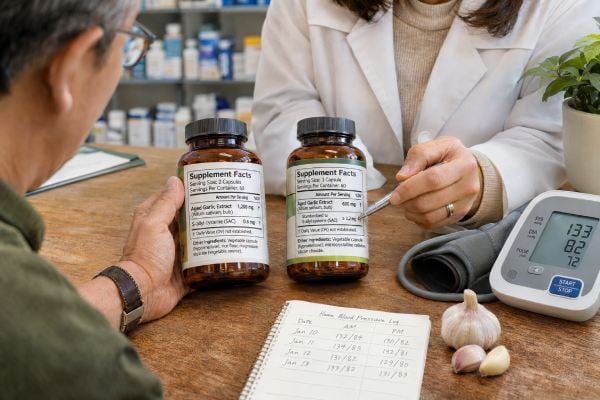
Aged garlic extract has been studied for blood pressure, but there is no single proven dose that works for everyone. Clinical trials have used products ranging from specialized low-dose extracts standardized to S-allyl cysteine to conventional aged garlic extract providing roughly 960–1,200 mg per day, and some cardiovascular studies have used higher amounts. The key problem is that milligrams of “garlic” do not tell the whole story: different extracts contain different active sulfur compounds and are produced in different ways. Recent meta-analyses suggest aged garlic may lower systolic blood pressure modestly on average, but results vary across trials and the evidence does not justify replacing prescribed hypertension medicine. If you are considering aged garlic extract, match the product type and standardized compounds to the research, check for bleeding and medication interactions, and track home blood pressure rather than assuming a high-dose capsule must be effective. Food garlic and supplement doses are not interchangeable.
Table of Contents
- What Aged Garlic Extract Is
- Doses Used in Blood Pressure Studies
- What Recent Evidence Suggests
- How to Read a Garlic Supplement Label
- How to Use Aged Garlic Safely
- Who Should Not Self-Treat With Garlic Supplements
- How to Test Whether It Is Helping
What Aged Garlic Extract Is
Aged garlic extract is not simply powdered raw garlic. Manufacturers typically age garlic in a solvent such as diluted ethanol for an extended period, which changes its chemical profile. The process reduces some of the harsh, unstable compounds associated with fresh garlic and increases water-soluble sulfur compounds such as S-allyl cysteine, often abbreviated SAC.
SAC is useful because it is relatively stable and can be measured, so some products use it as a marker of standardization. That allows researchers to describe not just the total weight of an extract, but the amount of a key compound delivered.
This matters because garlic supplements come in many forms:
- aged garlic extract;
- dried garlic powder;
- garlic oil;
- enteric-coated tablets;
- black garlic extracts;
- products standardized to allicin potential;
- blends containing garlic with other herbs or nutrients.
These are not automatically equivalent. A trial using aged garlic extract standardized to SAC does not prove that a garlic-oil softgel or an unstandardized powder will produce the same blood-pressure effect.
If you are deciding whether garlic belongs in your hypertension plan at all, start with the broader evidence and safety of garlic for blood pressure. The dose question only makes sense after you have decided that a supplement is appropriate for you.
Doses Used in Blood Pressure Studies
Several frequently cited trials help show why there is no universal “garlic dose.”
Around 960 mg per day
A randomized placebo-controlled trial in adults with treated but uncontrolled hypertension used 960 mg of aged garlic extract per day, providing 2.4 mg of S-allyl cysteine, for 12 weeks. Among participants with systolic blood pressure of at least 140 mmHg at baseline, systolic pressure was lower in the garlic group than in the placebo group over the treatment period.
This is one of the more recognizable aged-garlic dosing examples, but it does not mean 960 mg is the correct dose for every product. The standardized compound content matters.
Around 1,200 mg per day
Another 12-week trial in people with uncontrolled hypertension used 1.2 g, or 1,200 mg, of aged garlic extract daily, containing 1.2 mg of S-allyl cysteine. Blood pressure improved in the treatment group, with a subgroup of responders showing larger changes.
Notice the important detail: a higher total extract weight did not necessarily mean a higher listed SAC amount than the 960 mg trial. That is exactly why comparing supplements only by total milligrams can be misleading.
Higher amounts in cardiovascular studies
Some longer cardiovascular studies have used 2,400 mg per day of aged garlic extract. These studies have examined outcomes such as blood pressure, inflammation, glucose, or coronary artery calcification progression rather than establishing a simple dose-response rule for hypertension.
A 2,400 mg study therefore should not be interpreted as proof that twice the extract gives twice the blood-pressure reduction.
Newer standardized extracts may use much smaller marker doses
A 2023 randomized triple-blind trial tested an optimized aged black garlic extract in people with grade I hypertension already receiving antihypertensive medication. The product delivered 0.25 mg/day of S-allyl cysteine for 12 weeks and produced small reductions in systolic and diastolic blood pressure compared with placebo, along with changes in several vascular biomarkers.
This demonstrates another dosing challenge: newer extracts can be formulated and standardized differently, so the active-marker amount may be much smaller even when the product is designed for a similar goal.
The practical conclusion is that there is no defensible conversion such as “1,000 mg garlic equals X mg of every other garlic extract.” Match the formulation, not just the number on the front label.
Why dose-response claims should be treated carefully
It is tempting to line up trial doses from lowest to highest and conclude that the largest dose should work best. That is not how this evidence is structured. The studies use different extracts, different markers of standardization, different patient populations, and different blood pressure methods. A 1,200 mg product from one manufacturer may not be chemically comparable with 1,200 mg from another.
The people in the studies also differ. Some have untreated hypertension, some take one or more antihypertensive medicines, and some start with only mildly elevated readings. A higher baseline pressure can make an intervention look more powerful because there is more room for improvement. Trial duration matters as well: a 12-week result cannot automatically be projected to several years.
For these reasons, dose-response language in supplement research should be interpreted as exploratory unless the same standardized product has been tested across multiple doses in well-designed head-to-head trials. The current literature supports several studied formulations; it does not establish a universal dose ladder.
What Recent Evidence Suggests
Recent systematic reviews and meta-analyses generally find that garlic supplementation can lower blood pressure modestly in adults, particularly those with elevated blood pressure at baseline. A 2025 meta-analysis focused on aged garlic reported a small average reduction in systolic blood pressure, while effects on diastolic pressure were less consistent.
A larger 2025 review across many garlic preparations found reductions in systolic and diastolic blood pressure as well as small changes in several other cardiovascular risk markers. However, combining different products makes it difficult to translate the average effect into one specific aged-garlic dose.
Three points are especially important when interpreting the evidence.
The average effect is not the effect you will get
Meta-analysis averages include responders, nonresponders, people with different baseline blood pressures, different medications, and different products. A mean reduction of a few millimeters of mercury does not mean every user will experience exactly that change.
Higher starting pressure may create more room for improvement
Several garlic studies report larger effects in people whose blood pressure is uncontrolled at baseline. That is common with many blood-pressure interventions. Someone starting at 155 mmHg systolic has more room to change than someone already averaging 122 mmHg.
Product heterogeneity limits dose conclusions
The trials differ in extraction method, standardization, dose, duration, and background treatment. That makes it difficult to identify a precise “minimum effective dose” or an ideal maximum dose. Recent evidence supports possible benefit from aged garlic as a category, but not a simple more-is-better rule.
That is why a supplement should not be selected only because it contains 2,000 mg instead of 1,000 mg. A lower-milligram standardized extract may be closer to the product used in a good trial than a larger dose of a different preparation.
How to Read a Garlic Supplement Label
A useful label should tell you more than “garlic complex.” Before buying, look for four pieces of information.
1. The exact garlic form
Look for wording such as aged garlic extract, aged black garlic extract, garlic powder, or garlic oil. If the evidence you are trying to follow used aged garlic extract, choose that form rather than assuming all garlic supplements are equivalent.
2. The amount per daily serving
Check whether the listed milligrams apply to one capsule or the full daily serving. A front label may advertise “1,200 mg,” while the Supplement Facts panel reveals that reaching 1,200 mg requires four capsules.
3. Standardized compounds
For aged garlic extract, look for information about S-allyl cysteine when available. Some products use other standardization methods. The goal is not to chase one magic compound but to know whether the manufacturer provides a measurable marker that can be compared with clinical research.
4. Added ingredients
Combination products may include hawthorn, magnesium, potassium, CoQ10, or other herbs and nutrients. If your blood pressure changes, you will not know which ingredient was responsible. Combination formulas also create more interaction risk.
A simple single-ingredient product is easier to evaluate.
What not to infer from “odorless” or “high potency”
“Odorless” mainly describes how a product is processed or how much garlic odor it produces; it is not proof of superior blood-pressure activity. “High potency,” “maximum strength,” and “pharmaceutical grade” are also marketing terms unless the label ties them to a defined, validated standard.
Look for transparency instead: named extract type, amount per serving, standardization details, lot information, and independent quality verification when available. If the company will not tell you what the product contains beyond a vague garlic-equivalent claim, it is difficult to relate that product to published trials.
Third-party testing can provide some reassurance about identity and contaminants, although it does not prove clinical effectiveness. Be skeptical of products promising to replace medication, “clean arteries,” or normalize blood pressure in days.
Do not confuse garlic-equivalent claims with actual extract mass. A label may state that a concentrated extract is “equivalent to” several grams of fresh garlic. That conversion is a manufacturing claim, not proof that the supplement matches a researched dose.
How to Use Aged Garlic Safely
The most important safety issue is bleeding. Garlic supplements may affect platelet function and can add to the effects of anticoagulant or antiplatelet drugs.
Talk with a clinician or pharmacist before using aged garlic if you take:
- warfarin;
- apixaban;
- rivaroxaban;
- dabigatran;
- edoxaban;
- aspirin;
- clopidogrel;
- other medicines that affect bleeding.
You should also tell a surgeon, dentist, or procedural team about garlic supplements before an operation or invasive procedure. Follow their instructions about whether and when to stop the supplement.
Common side effects include abdominal discomfort, gas, nausea, heartburn, diarrhea, garlic odor, and body odor. Aged preparations may be easier to tolerate than raw garlic for some people, but gastrointestinal effects still occur.
Because garlic may lower blood pressure modestly, combining it with several antihypertensive drugs could contribute to lightheadedness or low readings in some people. Monitor home blood pressure, especially during the first few weeks.
Garlic may also affect glucose modestly. If you take insulin or other glucose-lowering medicines, discuss the supplement with your diabetes clinician rather than assuming the effect is too small to matter.
Pregnancy and breastfeeding require extra caution with supplement-level garlic amounts. Food use is different from taking concentrated extracts every day.
Who Should Not Self-Treat With Garlic Supplements
Aged garlic is not the right first response to severe or unstable hypertension. Do not use a supplement trial to delay medical evaluation if your blood pressure is repeatedly very high or rising quickly.
Seek urgent care for blood pressure around 180/120 mmHg or higher when accompanied by symptoms such as chest pain, severe shortness of breath, new weakness or numbness, confusion, vision changes, or a severe sudden headache.
You should also get professional advice before starting aged garlic if you:
- have a bleeding disorder;
- take anticoagulant or antiplatelet treatment;
- have upcoming surgery;
- frequently have low blood pressure or fainting;
- take several blood pressure medicines;
- have significant kidney or liver disease;
- are pregnant or breastfeeding;
- are using several other supplements with possible blood-pressure or bleeding effects.
If blood pressure remains high despite medication, the priority is to confirm adherence, measurement technique, lifestyle factors, and possible secondary causes. Sleep apnea, kidney disease, primary aldosteronism, thyroid disease, alcohol, certain medications, and high sodium intake can all contribute.
A supplement should not distract from those possibilities.
How to Test Whether It Is Helping
If your clinician agrees that aged garlic is reasonable, treat it like a structured trial rather than an open-ended habit.
First, establish a baseline home blood pressure average. Measure at consistent times for several days using a validated upper-arm cuff. Sit quietly for five minutes, keep your back supported and feet flat, and take two readings about a minute apart.
Then keep the rest of your treatment stable if medically appropriate. If you change your medication, sodium intake, alcohol intake, weight, exercise routine, and supplement all at once, you will not know what caused the blood-pressure change.
Record:
- exact product and formulation;
- daily dose;
- standardized compound amount if listed;
- start date;
- morning and evening blood pressure averages;
- side effects;
- medication changes.
Many blood-pressure garlic trials last roughly 8–12 weeks, so expecting a dramatic effect after one or two doses is unrealistic. Review the data with your clinician before deciding whether to continue.
Use averages rather than hunting for the lowest reading. Blood pressure naturally changes with sleep, stress, caffeine, exercise, pain, hydration, and time of day. If your usual systolic pressure is 145 mmHg and one reading is 126 mmHg, that single result does not prove the supplement worked. A consistent change in morning and evening averages over several weeks is more informative.
Also watch for a “measurement effect.” People who start tracking blood pressure often improve other habits at the same time: they take medication more consistently, reduce sodium, drink less alcohol, or become more active. Those changes are beneficial, but they make it harder to attribute the entire improvement to garlic. Keeping a brief log helps you and your clinician interpret what actually changed. If there is no clear improvement after an appropriate trial, continuing indefinitely adds cost, pill burden, and interaction risk without a demonstrated benefit. A supplement should earn its place in your routine just as any other intervention should, especially when blood pressure treatment is already complex and involves multiple medications and other daily health priorities over time safely overall.
If your average blood pressure falls enough that you develop dizziness or low readings, contact your clinician. Do not independently stop a prescribed antihypertensive medication.
Remember that aged garlic is an optional adjunct. Better-established measures include reducing excess sodium, regular physical activity, limiting alcohol, improving sleep, losing excess weight when appropriate, and using prescribed medication. A lower-sodium diet and DASH-style eating pattern usually have a clearer place in a hypertension plan than any supplement.
The best dose is therefore not simply the largest number you can tolerate. It is a researched formulation used at a reasonable dose, compatible with your medications, followed with objective home readings—and stopped if it provides no meaningful benefit.
References
- The Effect of Aged Garlic Supplementation on Blood Pressure and Lipid Profile: A Dose-Response Grade-Assessed Systematic Review and Meta-Analysis of Randomized Controlled Trials 2025 (Systematic Review)
- Effects of Garlic Supplementation on Cardiovascular Risk Factors in Adults: A Comprehensive Updated Systematic Review and Meta-Analysis of Randomized Controlled Trials 2025 (Systematic Review)
- Antihypertensive Effects of an Optimized Aged Garlic Extract in Subjects with Grade I Hypertension and Antihypertensive Drug Therapy: A Randomized, Triple-Blind Controlled Trial 2023 (RCT)
- Aged garlic extract lowers blood pressure in patients with treated but uncontrolled hypertension: a randomised controlled trial 2010 (RCT)
- Garlic: Usefulness and Safety | NCCIH 2025 (Official Fact Sheet)
- The effect of aged garlic extract on blood pressure and other cardiovascular risk factors in uncontrolled hypertensives: the AGE at Heart trial 2016 (Randomized Controlled Trial)
Disclaimer
This article is for general education and does not provide an individualized supplement dose. Aged garlic extract can interact with anticoagulants, antiplatelet medicines, blood pressure drugs, and other treatments, and may increase bleeding risk. Do not use garlic supplements to replace prescribed hypertension therapy or to delay evaluation of severely elevated blood pressure.