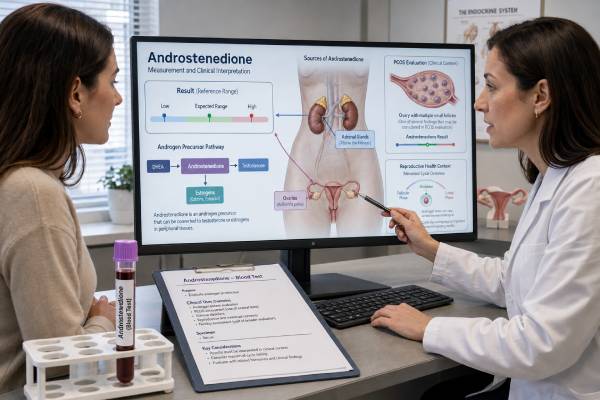
An androstenedione blood test measures a weak androgen made by the adrenal glands and gonads. The body can convert it into testosterone or estrogens, so the result helps investigate excess hair growth, acne, irregular periods, early puberty, infertility, adrenal disorders, or suspected steroid-producing tumors. In women, a high level commonly appears with polycystic ovary syndrome (PCOS), but the test cannot diagnose PCOS by itself. It may also rise in congenital adrenal hyperplasia or, less often, an ovarian or adrenal tumor. Low results are usually less specific and may occur with reduced adrenal or gonadal function. Age, sex, puberty stage, cycle phase, pregnancy, medicines, and laboratory method all influence the reference interval. Because androstenedione concentrations are low and related steroids can interfere with some immunoassays, liquid chromatography–tandem mass spectrometry is often preferred when accuracy is important.
- Androstenedione is an androgen precursor produced by both the adrenal glands and ovaries or testes.
- High results commonly occur with PCOS or CAH; a rapid symptom change raises concern for a tumor.
- Testing is usually most consistent in the morning and, for menstruating patients, early in the follicular phase.
- Normal ranges vary markedly by age, sex, puberty stage, and laboratory method.
- A normal result does not exclude androgen excess when testosterone, DHEA-S, or symptoms are abnormal.
- Low androstenedione is nonspecific and should be interpreted with cortisol, DHEA-S, testosterone, LH, and FSH.
Table of Contents
- What the androstenedione Test Measures
- Why the Test Is Ordered
- Preparation, Timing, and the Testing Process
- Normal Range and How Results Are Interpreted
- What High androstenedione Results Can Mean
- What Low androstenedione Results Can Mean
- How Results Fit With Other Hormones and Tests
- Next Steps After the Result
What the androstenedione Test Measures
Androstenedione sits in the middle of steroid-hormone production. The adrenal cortex, ovaries, and testes make it from earlier precursors, and peripheral tissues can convert it to testosterone or estrone. This shared origin makes it useful for detecting androgen excess but limits its ability to identify the source on its own.
The test is most informative when total testosterone and DHEA-S do not fully explain symptoms. DHEA-S points more strongly toward adrenal production, while testosterone often reflects ovarian or testicular production plus conversion in other tissues. Androstenedione adds another piece to that pattern.
A hormone result is a measurement made under defined laboratory conditions, not a diagnosis by itself. The same concentration can carry different meaning at different ages, cycle stages, pregnancy stages, or times of day. Laboratories also use different analyzers, calibration systems, antibodies, and calculation methods. For that reason, the reference interval printed beside the result should take priority over a range copied from another report or website.
Concentration changes across childhood and puberty, then generally declines with age. Menstrual-cycle variation is smaller than for estradiol or progesterone but can still affect a borderline result. Pregnancy can raise concentrations and requires a pregnancy-appropriate interval.
A focused androstenedione assessment in women can be useful when hirsutism or irregular cycles are the main concern.
Why the Test Is Ordered
The test is ordered when clinical androgen effects are present, when another androgen result is unclear, or when a known adrenal condition is being monitored.
- New or worsening hirsutism, acne, scalp hair thinning, or menstrual irregularity.
- Possible PCOS when biochemical androgen excess needs clarification.
- Possible nonclassic CAH, especially when 17-OHP is abnormal or symptoms began early.
- Rapid virilization, deepening voice, clitoromegaly, or a rapidly enlarging muscle pattern.
- Premature pubic hair or unusually rapid growth in a child.
- Monitoring selected patients with CAH, adrenal disease, or a steroid-producing tumor.
Androstenedione is not a general fertility score. It may help explain anovulation or hyperandrogenism, but egg quality, ovarian reserve, tubal factors, uterine factors, and semen parameters require separate evaluation. In men, an abnormal result is usually interpreted with testosterone and gonadotropins rather than used as a primary fertility marker.
Interpretation starts with the reason the test was ordered. A clinician looking for an adrenal enzyme disorder uses different cutoffs and follow-up tests than a clinician evaluating irregular periods, infertility, menopausal symptoms, or androgen deficiency. The result should be read with symptoms, examination findings, age, reproductive stage, and related laboratory values rather than compared with one universal “optimal” number.
When several androgens are elevated, a PCOS hormone evaluation can organize the differential diagnosis without relying on one result.
Preparation, Timing, and the Testing Process
Morning collection is commonly used because adrenal androgen production follows a daily rhythm. Standardizing the time improves repeat comparisons.
- Ask whether the laboratory uses mass spectrometry or an immunoassay and keep the same method for follow-up when possible.
- Schedule morning testing and follow cycle-day instructions; early follicular sampling is often preferred.
- List hormonal contraception, fertility medicines, glucocorticoids, antiandrogens, DHEA, and bodybuilding products.
- Report pregnancy, recent illness, major stress, or a recent change in hormone therapy.
- Do not stop prescribed medicines unless the ordering clinician provides a plan.
Fasting is not universally required, but the laboratory may combine this test with glucose, insulin, lipids, or other fasting measurements. In children, the interpretation must use age, sex, and Tanner stage rather than an adult interval.
Before collection, provide a complete list of prescription medicines, over-the-counter products, supplements, contraceptives, fertility drugs, and hormone therapy. Do not stop prescribed treatment without instructions. Some products change hormone production, while others alter binding proteins or interfere with an immunoassay. High-dose biotin is a well-known source of interference in several hormone tests, although the direction and size of the error depend on the platform.
Acute illness can temporarily suppress or stimulate reproductive signaling. A test drawn during fever, major surgery, severe calorie restriction, or intense training may describe that temporary state rather than the person’s usual hormone function. When the clinical situation is stable and there is no urgent reason to test immediately, postponing or repeating the measurement can prevent an incorrect label.
Normal Range and How Results Are Interpreted
Androstenedione reference intervals differ too much by method and life stage for one universal range. Many adult laboratories report values in ng/dL or nmol/L and provide separate intervals for males, females, and children.
| Report feature | Why it matters | Interpretive point |
|---|---|---|
| Age and puberty stage | Levels rise during adrenarche and puberty. | Use pediatric or Tanner-stage intervals. |
| Sex and reproductive stage | Ovarian, testicular, and adrenal contributions differ. | Do not apply a male interval to a female result or vice versa. |
| Cycle or pregnancy status | Ovarian production and pregnancy can shift levels. | Document cycle day and pregnancy week. |
| Assay method | Immunoassays may cross-react at low concentrations. | Mass spectrometry can improve specificity. |
| Magnitude and trend | Small deviations overlap with common conditions. | Large or rapidly rising values need faster evaluation. |
A result just above the upper limit is common in PCOS and may also reflect timing or assay bias. A value several times the upper limit, especially with rapid virilization, should not be attributed to PCOS without evaluating ovarian and adrenal tumors.
A value close to a cutoff deserves more caution than a value that is clearly and repeatedly abnormal. Borderline results may move across the reference limit because of normal biologic variation, recent illness, sleep disruption, exercise, stress, or sample timing. Clinicians often repeat a test under better-controlled conditions before ordering imaging or beginning treatment. The repeat is most useful when the timing, medication list, and assay method are documented.
Trends can be useful when the same question is followed over time, but only when the measurements are reasonably comparable. A change between laboratories may reflect a method difference. A change after starting or stopping hormones may be expected. Record the laboratory, units, collection time, cycle day or pregnancy week, and relevant treatment so later results can be compared in context.
The related DHEA-S test is often measured at the same time because a pronounced DHEA-S elevation supports an adrenal source.
What High androstenedione Results Can Mean
High androstenedione indicates increased androgen production or altered steroid conversion. The cause is judged by symptom speed, the degree of elevation, and the pattern of other hormones.
- PCOS, especially when periods are irregular and other androgens are mildly elevated.
- Nonclassic or classic congenital adrenal hyperplasia.
- An ovarian or adrenal androgen-producing tumor.
- Pregnancy or normal pubertal development when the wrong interval is used.
- Use of DHEA, prohormones, testosterone-related products, or some fertility medicines.
- Assay interference or cross-reactivity with structurally similar steroids.
PCOS remains a diagnosis based on a combination of ovulatory dysfunction, clinical or biochemical hyperandrogenism, and ovarian morphology or AMH in appropriate adults, after excluding important mimics. Androstenedione can support biochemical hyperandrogenism when testosterone is normal, but it is not mandatory in every evaluation.
Tumors are uncommon, yet the pace of symptoms matters. Virilization over a few months, a pelvic or abdominal mass, or a marked androgen elevation warrants prompt imaging and specialist review. A repeat by mass spectrometry may be appropriate before major decisions when the laboratory pattern and symptoms do not agree.
Follow-up commonly includes total testosterone, SHBG or free testosterone, DHEA-S, 17-OHP, and tests directed by menstrual or fertility symptoms. Imaging should follow biochemical and clinical assessment rather than being ordered for every mild elevation.
A CAH test panel is appropriate when 17-OHP or the clinical history suggests an adrenal enzyme disorder.
What Low androstenedione Results Can Mean
Low androstenedione is less diagnostically specific than a high result. It can occur when adrenal or gonadal steroid production is reduced, but isolated low values often have little clinical significance.
- Adrenal insufficiency or reduced ACTH drive.
- Ovarian insufficiency or testicular failure, usually with other abnormal sex hormones.
- Glucocorticoid treatment or suppression of adrenal steroid production.
- Aging and normal variation.
- Severe chronic illness, undernutrition, or hypothalamic-pituitary suppression.
- A method-specific low result that remains within expected variation.
Symptoms guide the workup. Fatigue, weight loss, low blood pressure, and salt craving point toward adrenal testing, while absent periods, hot flashes, infertility, or low libido may prompt gonadal and pituitary testing. Cortisol, ACTH, DHEA-S, estradiol or testosterone, LH, and FSH are usually more informative than repeating androstenedione alone.
There is no standard treatment aimed at raising androstenedione itself. Management addresses the confirmed adrenal, pituitary, ovarian, testicular, nutritional, or medication-related cause.
How Results Fit With Other Hormones and Tests
Related hormones help estimate where excess or deficiency originates. No pattern is perfectly specific, but combinations narrow the next step.
| Pattern | Possible source | Typical follow-up |
|---|---|---|
| Mild androstenedione and testosterone elevation | Often ovarian hyperandrogenism or PCOS | Assess cycles, clinical signs, and exclude mimics |
| Androstenedione plus high DHEA-S | Adrenal contribution more likely | Check 17-OHP and evaluate adrenal causes |
| Marked androstenedione with rapid virilization | Ovarian or adrenal tumor must be excluded | Repeat accurately and arrange urgent specialist assessment |
| High 17-OHP with high androstenedione | CAH pathway possible | ACTH stimulation and endocrine review |
| Low androstenedione with low cortisol or sex steroids | Adrenal or gonadal insufficiency possible | Evaluate the relevant endocrine axis |
LH and FSH are useful when periods are absent or testosterone is low, but the LH-to-FSH ratio is not a stand-alone PCOS test. Ultrasound findings also require context because polycystic ovarian morphology can occur without the syndrome.
Next Steps After the Result
A practical follow-up plan confirms the result, checks the most likely source, and responds to symptom severity.
- Review the exact value, units, age- and sex-specific interval, sample time, and assay method.
- Repeat an unexpected or borderline result under standardized conditions.
- Measure total testosterone, SHBG or free testosterone, DHEA-S, and 17-OHP when androgen excess is suspected.
- Evaluate menstrual, fertility, adrenal, or pubertal symptoms with targeted tests rather than a broad untimed panel.
- Refer rapidly progressive virilization or marked elevations to endocrinology or gynecology promptly.
- Treat the underlying condition and monitor clinical outcomes, not only the laboratory number.
For PCOS, management may include cycle protection, contraception, fertility treatment, or therapies for acne and hirsutism, depending on goals. For CAH, glucocorticoid decisions require endocrine supervision. A tumor evaluation may include pelvic or adrenal imaging after biochemical confirmation.
Bring the actual report to the follow-up visit rather than only recalling that the level was “high” or “low.” The report shows units, the laboratory interval, specimen type, and sometimes the assay method. Ask whether the result needs confirmation, whether a related hormone should be measured at the same time, and what finding would change management.
A useful plan defines the next step and its timing. That may be no action, a repeat test, a dynamic stimulation or suppression test, ultrasound, semen analysis, genetic testing, or referral to endocrinology, reproductive endocrinology, urology, or maternal-fetal medicine. It should also identify symptoms that warrant earlier contact instead of waiting for the routine appointment.
Rapidly progressive symptoms deserve faster evaluation than a mild, stable laboratory abnormality. Examples include sudden virilization, severe headache with visual change, signs of adrenal crisis, heavy bleeding with dizziness, or concerning pregnancy symptoms. The laboratory number may guide the workup, but urgent decisions are driven by the whole clinical picture.
Treatment should address the confirmed cause and the person’s goals. Lowering or raising a laboratory value without establishing why it is abnormal can hide an important condition or create new problems. Hormone therapy can affect fertility, blood counts, liver function, clot risk, bone health, and pregnancy, so monitoring plans should be individualized.
Prompt assessment is appropriate for rapid voice deepening, sudden severe hirsutism, clitoromegaly, an abdominal or pelvic mass, or a child with rapidly advancing puberty. Seek emergency care for symptoms suggesting adrenal crisis.
When a repeat measurement is planned, try to reproduce the conditions that matter for this test. Use the same laboratory when practical, note the collection time, and record any change in medicines or reproductive stage. Consistency does not remove all biologic variation, but it makes a true trend easier to distinguish from noise.
Reference intervals describe a population selected by the laboratory; they do not define a treatment target for every person. A result inside the interval can still require attention when symptoms are strong or when another hormone shows a clear mismatch. Conversely, a small deviation may not represent disease when the timing or clinical setting explains it.
A laboratory result can answer only the question built into the test. It may show hormone concentration, but it cannot by itself prove ovulation quality, egg quality, sperm production, placental health, or the cause of a symptom. Those conclusions usually require a combination of history, examination, imaging, and other targeted tests.
When fertility is the concern, age, duration of trying to conceive, menstrual pattern, pregnancy history, semen findings, and tubal or uterine factors often affect the plan as much as a single hormone value. Testing both partners in parallel can prevent months of delay and reduce the chance that an incidental hormone result distracts from a more direct cause.
When symptoms are being monitored rather than fertility, define the outcome that treatment is meant to improve. Examples include restoration of periods, relief of hot flashes, reduction of unwanted hair growth, recovery of sexual function, preservation of bone health, or safe progression of puberty. Laboratory monitoring is most useful when tied to one of these clinical outcomes.
People using nonprescription “hormone balance” products should mention them before testing. DHEA, progesterone creams, testosterone boosters, compounded preparations, and biotin can alter physiology or make results harder to interpret. Product labels may not reliably predict the dose absorbed, so the safest approach is to review the exact container or ingredient list with the clinician.
Results can also differ because laboratories report conventional and SI units. A value expressed in ng/dL cannot be compared directly with one expressed in nmol/L without a hormone-specific conversion. Always compare the number, unit, and interval together. This simple check prevents many apparent contradictions between reports.
An abnormal result can have emotional weight, especially during fertility treatment, pregnancy, or puberty evaluation. Ask the clinician to separate what is known from what remains uncertain. A clear explanation of the likely causes, the confirmation plan, and the time frame for action is more useful than trying to interpret every decimal place independently.
Clinicians also consider whether the test result agrees with the physical findings. A marked biochemical abnormality without expected symptoms may prompt confirmation with a more specific laboratory method. Strong symptoms with a normal result may lead to testing at a different time, measuring a related hormone, or looking for a nonhormonal cause.
The pace of change can be as important as the level itself. Slow changes over years commonly fit physiologic aging or a chronic endocrine condition. Changes over weeks or a few months raise more concern for a new medicine effect, pregnancy-related change, acute illness, or a hormone-producing lesion, especially when symptoms progress quickly.
No single follow-up pathway fits every abnormal value. Mild and explainable results may only need observation. Persistent or substantial abnormalities may require specialist review and tests chosen to locate the source of hormone production or the level of signaling failure. The sequence should be deliberate so that each test answers a specific unresolved question.
Keep a copy of the laboratory report and the order indication. The clinician needs more than the highlighted flag: the numeric value, unit, reference interval, specimen type, collection date and time, and any comment about the assay can change interpretation. A result copied into a patient portal message without those details may be impossible to compare with a later test. This documentation is especially important when care moves between a primary clinician, endocrinologist, fertility clinic, and hospital laboratory.
Before repeating testing, decide what the repeat is meant to resolve. It may confirm persistence, correct a timing error, remove a medication effect, or use a more specific assay. Repeating the same poorly timed test without changing the conditions often reproduces uncertainty rather than solving it. The clinician should also state what result would lead to observation, another laboratory test, imaging, or treatment.
Small deviations from a reference interval are common because the interval usually contains about 95% of a selected comparison population. Some healthy people fall outside it, while some people with disease fall inside it. The clinical importance depends on how far the value is from the limit, whether it persists, whether related hormones agree, and whether symptoms fit the physiology. A reference flag is therefore a prompt for interpretation, not proof of disease.
Hormone results are also affected by changes in binding proteins and metabolism. Liver disease, thyroid disease, kidney disease, pregnancy, body composition, and oral estrogen exposure can change measured concentrations without producing the same change in tissue effect. When a binding issue is suspected, the clinician may use a free or calculated hormone, a related binding protein, or a more specific laboratory method rather than interpreting the total concentration alone.
Fertility decisions should not be reduced to a single endocrine value. A hormone may help choose medication dose, confirm ovulation, or identify a treatable disorder, but it does not measure every step required for pregnancy. Reproductive age, sperm exposure or semen quality, tubal patency, uterine anatomy, timing, prior pregnancies, and the duration of trying all influence the next step. A balanced evaluation prevents overreaction to an incidental result.
Testing can be different during pregnancy, adolescence, menopause, or hormone treatment because physiology is intentionally changing. A range derived from untreated adults may be inappropriate in these settings. Ask whether the laboratory interval matches the patient’s age and reproductive state and whether the clinical team uses a separate treatment or pregnancy target. This is particularly important when a portal automatically marks a result high or low against a generic range.
References
- Society for Endocrinology Clinical Practice Guideline for the Evaluation of Androgen Excess in Women 2025 (Guideline)
- Approach to androgen excess in women: Clinical and biochemical perspectives 2022 (Review)
- Recommendations for the measurement of sexual steroids in clinical practice. A position statement of SEQCML/SEEN/SEEP 2023 (Position Statement)
- Age- and sex-adjusted reference intervals for steroid hormones measured by liquid chromatography-tandem mass spectrometry using a widely available kit 2024 (Study)
- Recommendations From the 2023 International Evidence-based Guideline for the Assessment and Management of Polycystic Ovary Syndrome 2023 (Guideline)
Disclaimer
This article is general education and does not diagnose PCOS, CAH, adrenal disease, or a tumor. Androgen results require age-, sex-, and method-specific interpretation. Rapid virilization or severe illness needs prompt medical assessment.