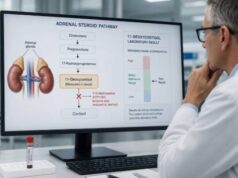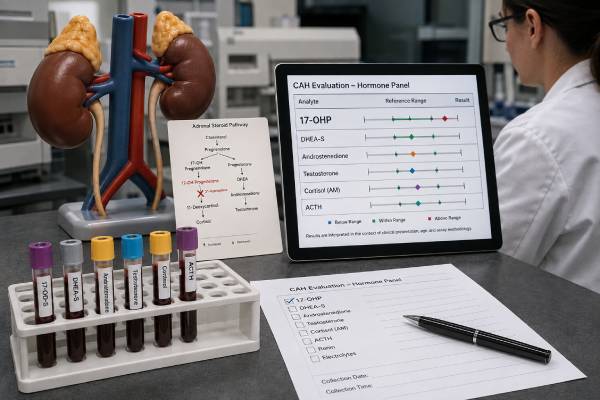
A congenital adrenal hyperplasia test panel measures steroid precursors, cortisol, and androgens to locate an inherited enzyme block in adrenal hormone production. For the common 21-hydroxylase deficiency, the core serum profile includes 17-hydroxyprogesterone (17-OHP), androstenedione, and cortisol. ACTH, testosterone, DHEA-S, renin, aldosterone, and electrolytes add information about cortisol feedback, androgen excess, and salt balance.
The panel serves several different purposes: confirming an abnormal newborn screen, evaluating early androgen signs or unexplained hirsutism, distinguishing classic from nonclassic disease, and monitoring established CAH. Results cannot be read from one universal range. Prematurity, age, pubertal stage, menstrual phase, time of day, acute illness, glucocorticoid timing, and laboratory method all matter. A clearly high 17-OHP strongly supports 21-hydroxylase deficiency, while a borderline morning value often requires cosyntropin stimulation. Other enzyme defects produce different patterns and need expanded steroid profiling or urine steroid analysis. A symptomatic newborn with vomiting, dehydration, poor feeding, low sodium, high potassium, or shock needs emergency treatment while confirmatory testing proceeds.
- High 17-OHP with high androstenedione and low or inadequate cortisol is the classic pattern of 21-hydroxylase-deficient CAH.
- A borderline early-morning 17-OHP may require an ACTH stimulation test; a random or luteal-phase value can mislead.
- Renin, aldosterone, sodium, and potassium distinguish salt-wasting mineralocorticoid deficiency from forms that preserve or increase mineralocorticoid activity.
- LC-MS/MS steroid panels improve specificity, especially after a false-positive newborn immunoassay screen.
- Monitoring uses consistently timed samples plus growth, blood pressure, puberty, symptoms, and treatment side effects—not complete suppression of 17-OHP.
Table of Contents
- What Congenital Adrenal Hyperplasia Is
- Tests in the CAH Panel
- Newborn Screening and Diagnosis
- Testing Children and Adults
- Interpreting CAH Patterns
- Genetic Testing and Less Common Causes
- Monitoring Treatment and Safety
What Congenital Adrenal Hyperplasia Is
CAH is a family of autosomal recessive disorders caused by defects in enzymes or proteins needed for adrenal steroid synthesis. The adrenal cortex makes cortisol, mineralocorticoids, and androgens from cholesterol through branching pathways. When one step is blocked, hormones after the block fall and precursors before it accumulate.
Low cortisol removes negative feedback on the pituitary. ACTH rises and chronically stimulates the adrenal cortex, producing hyperplasia and increasing every pathway that remains open. The clinical features depend on which products are deficient and where accumulated precursors are redirected.
About 90–95% of CAH is caused by 21-hydroxylase deficiency from pathogenic CYP21A2 variants. The enzyme normally moves 17-OHP toward cortisol and progesterone toward aldosterone. Deficiency raises 17-OHP and adrenal androgens. Severe classic disease can also reduce aldosterone.
Clinical forms include:
- Classic salt-wasting CAH: severe cortisol and aldosterone deficiency with androgen excess; adrenal crisis can occur in early infancy.
- Classic simple-virilizing CAH: substantial cortisol deficiency and androgen excess without typical neonatal salt wasting.
- Nonclassic CAH: partial enzyme activity; later symptoms may include early pubic hair, acne, hirsutism, irregular periods, or reduced fertility.
CAH is not limited to 21-hydroxylase deficiency. Eleven-beta-hydroxylase deficiency can cause androgen excess and low-renin hypertension through deoxycorticosterone accumulation. Seventeen-alpha-hydroxylase deficiency reduces sex steroids and causes hypertension. Three-beta-hydroxysteroid dehydrogenase deficiency, P450 oxidoreductase deficiency, lipoid CAH, and other rare disorders produce distinct steroid signatures.
The inheritance label “congenital” means the enzyme change is present from birth, not that every person is diagnosed as a newborn. Nonclassic disease can first become apparent at puberty or during a fertility evaluation. Rare partial defects can also present later. Conversely, not every adrenal hormone abnormality is CAH; tumors, medicines, physiologic stress, and other endocrine disorders remain in the differential.
Androgen effects vary by chromosomal sex, enzyme, severity, and timing. Prenatal androgen excess can change external genital development in a 46,XX fetus. Postnatal excess can accelerate growth and bone maturation in any child, leading to early tall stature but reduced adult height if growth plates mature too soon. Good treatment protects both stress physiology and development.
The panel’s purpose is therefore to identify a pattern, not merely label one value high. A result suggesting one enzyme block should be checked against blood pressure, electrolytes, sexual development, growth, and genetics.
Tests in the CAH Panel
17-Hydroxyprogesterone
17-OHP is the primary marker for 21-hydroxylase deficiency. A severe block causes pronounced accumulation, while nonclassic disease may produce only a modest baseline rise and a larger response after cosyntropin. Values vary with age, time, stress, and menstrual phase.
Cortisol and ACTH
Cortisol shows the product side of the pathway. ACTH reflects pituitary drive. Low or inadequate cortisol with high ACTH supports a primary synthesis problem. A normal single cortisol does not exclude nonclassic disease or guarantee stress reserve.
Androstenedione, testosterone, and DHEA-S
Androstenedione reflects adrenal androgen production and is useful for diagnosis and monitoring. Testosterone shows downstream androgen exposure but has major gonadal production after puberty. DHEA-S is largely adrenal and age-specific. Their relative patterns help assess androgen burden, not identify 21-hydroxylase deficiency alone.
Renin, aldosterone, and electrolytes
High renin with low or inappropriate aldosterone, low sodium, and high potassium supports salt-wasting primary adrenal disease. These values can evolve over days in a newborn. Eleven-beta-hydroxylase and 17-alpha-hydroxylase deficiencies instead produce mineralocorticoid-like excess, suppressed renin, hypertension, and sometimes low potassium.
Expanded precursor panels
LC-MS/MS can measure 11-deoxycortisol, deoxycorticosterone, 21-deoxycortisol, 17-hydroxypregnenolone, pregnenolone, and other steroids. The combination distinguishes rare enzyme defects and reduces immunoassay cross-reactivity. Urinary steroid profiling by gas chromatography–mass spectrometry can reveal pathway-wide metabolite patterns.
One current specialty profile for 21-hydroxylase deficiency measures 17-OHP, androstenedione, and cortisol together by LC-MS/MS. These three values show precursor accumulation, androgen diversion, and cortisol production from the same sample.
ACTH can support the mechanism but is less stable than the serum steroids. It requires chilled EDTA plasma and rapid processing. A falsely low ACTH from delayed handling can confuse the pattern. If ACTH is needed, the collection team should prepare a separate appropriate tube rather than treating it like routine serum.
Testosterone needs age- and puberty-aware interpretation. In a prepubertal child or a person with ovaries, a rise can reflect adrenal androgen conversion. In a pubertal or adult male, the testes contribute substantially, so androstenedione and 17-OHP may better track adrenal control. DHEA-S can remain less useful than the central CAH markers in treated 21-hydroxylase deficiency.
Newborn Screening and Diagnosis
Newborn programs measure 17-OHP in dried blood spots to identify classic 21-hydroxylase deficiency before salt-wasting crisis. The heel-prick screen prioritizes sensitivity, so a positive result is not a diagnosis.
False positives occur because 17-OHP and cross-reacting fetal adrenal steroids are high after birth. Prematurity, low birth weight, respiratory illness, delivery stress, and very early collection increase the rate. Programs may adjust cutoffs for gestational age or birth weight and use second-tier LC-MS/MS steroid profiles.
False negatives can occur with early sampling, milder disease, maternal or neonatal glucocorticoids, and some transfusion or collection circumstances. Newborn screening is designed mainly for classic 21-hydroxylase deficiency; it does not reliably identify nonclassic CAH or every rare form.
After a positive screen, follow-up may include:
- serum 17-OHP by LC-MS/MS;
- cortisol and ACTH;
- sodium, potassium, bicarbonate, glucose, and kidney function;
- plasma renin and aldosterone;
- androstenedione and testosterone;
- an expanded steroid profile; and
- CYP21A2 testing.
The baby’s clinical status sets urgency. Poor feeding, repeated vomiting, weight loss, dehydration, unusual sleepiness, low blood pressure, low sodium, high potassium, or low glucose can mark adrenal crisis. Draw confirmatory blood promptly if this causes no delay, then treat with hydrocortisone, fluids, glucose, and electrolyte management as needed.
A 46,XX infant with classic 21-hydroxylase deficiency may have virilized external genital development. A 46,XY infant may appear externally typical and remain at risk for an initially missed salt-wasting crisis. Respectful multidisciplinary assessment should avoid rushed assumptions about sex development while prioritizing medical stability.
Parents should receive explicit instructions after a positive screen: whether the result is borderline or high risk, when and where confirmatory blood will be drawn, who will review it, and which symptoms require emergency care. A repeat dried blood spot may be appropriate for a stable borderline result, but it is not a substitute for immediate serum and electrolyte assessment in an unwell infant.
Second-tier mass-spectrometry screening can compare several steroids or ratios on the original blood spot. This improves specificity and reduces false-positive referrals, especially in premature infants. It still remains a screen. Hydration, blood pressure, electrolytes, glucose, and clinical examination cannot be determined from the card.
Testing Children and Adults
Later testing may be prompted by early pubic or underarm hair, body odor, acne, rapid growth, advanced bone age, early genital development, hirsutism, irregular periods, infertility, or a family history of CAH. Nonclassic disease overlaps with PCOS and premature adrenarche.
For non-newborn evaluation, collect 17-OHP early in the morning. In menstruating patients, the early follicular phase is preferred because ovarian 17-OHP rises after ovulation. A random afternoon or luteal-phase sample may produce a false impression.
An early-morning baseline below the laboratory’s screening threshold makes nonclassic 21-hydroxylase deficiency less likely. A value around or above 200 ng/dL is often used as a prompt for cosyntropin testing, but thresholds vary by assay. A marked value, often above about 1,000 ng/dL, strongly raises suspicion. These are clinical guideposts, not portable cutoffs.
During an ACTH stimulation test, baseline blood is drawn, cosyntropin is given, and 17-OHP, cortisol, and selected steroids are measured at the protocol time. A stimulated 17-OHP around or above 1,000 ng/dL has traditionally supported nonclassic disease, but LC-MS/MS-specific thresholds should be used.
Preparation includes documenting glucocorticoid timing, oral contraceptives, fertility treatment, pregnancy, DHEA or androgen supplements, acute illness, and cycle day. Do not stop replacement steroids without an endocrine plan. In someone with classic CAH, withholding treatment for diagnostic clarity can be dangerous.
Children require Tanner-stage and age-specific ranges. Growth velocity and bone age show cumulative androgen effect. A stable mildly elevated hormone without accelerated growth means something different from the same value with rapidly advancing bone maturation.
PCOS and nonclassic CAH can share hirsutism, acne, and irregular ovulation. A consistently timed follicular-phase 17-OHP helps distinguish them, but coexistence is possible. LH-to-FSH ratios, ovarian appearance, or insulin levels do not replace CAH testing. The diagnosis should rest on basal and, when needed, stimulated adrenal steroid results.
In men, nonclassic CAH may be subtle and sometimes appears during infertility evaluation. Testicular adrenal rest tumors are a complication mainly of poorly controlled classic CAH and can impair fertility. Scrotal ultrasound is not a general screening test for everyone with a borderline 17-OHP; it is used according to diagnosis, age, examination, and control.
Interpreting CAH Patterns
| Possible defect | Key elevated markers | Typical clinical clues |
|---|---|---|
| 21-hydroxylase deficiency | 17-OHP, 21-deoxycortisol, androstenedione | Androgen excess; salt wasting in severe classic disease |
| 11β-hydroxylase deficiency | 11-deoxycortisol, deoxycorticosterone, androgens | Androgen excess with low-renin hypertension |
| 17α-hydroxylase/17,20-lyase deficiency | Deoxycorticosterone, corticosterone | Hypertension, low potassium, reduced sex steroids |
| 3β-HSD deficiency | 17-hydroxypregnenolone, DHEA relative to downstream steroids | Salt wasting and variable genital development |
| P450 oxidoreductase deficiency | Complex pregnenolone/progesterone metabolites | Skeletal differences, disordered sex development, maternal virilization |
No single high 17-OHP proves 21-hydroxylase deficiency. Stress and prematurity can raise it in newborns; the luteal phase can raise it in adults; 11β-hydroxylase deficiency can also produce some elevation. The ratio to cortisol and related precursors improves specificity.
High 17-OHP plus high androstenedione shows substrate diversion toward androgens. Low cortisol and high ACTH show inadequate feedback. High renin and low aldosterone identify mineralocorticoid deficiency. Each addition makes the pathway diagnosis more coherent.
Normal potassium does not exclude classic disease early, and high blood pressure points away from salt-wasting 21-hydroxylase deficiency toward a DOC-excess disorder. The 11-deoxycortisol test is particularly useful when 11β-hydroxylase deficiency is suspected.
In nonclassic CAH, cortisol reserve may be adequate and baseline ACTH may be normal. Symptoms and stimulated precursor response carry more weight. PCOS is more common and can coexist; diagnosis should not be based on hirsutism plus a single borderline 17-OHP.
Unit conversion can create major errors. A 17-OHP report in ng/dL cannot be compared directly with ng/mL or nmol/L. A stimulated threshold quoted in one unit system must be converted before use. The laboratory report should identify baseline versus post-cosyntropin samples and the exact collection minute.
A normal result after glucocorticoid treatment cannot disprove CAH. Medication lowers ACTH and the accumulated precursors. When historical diagnostic records are unavailable, an endocrinologist and genetic specialist design a safe confirmation strategy; patients with possible cortisol dependence should not stop treatment unsupervised.
Genetic Testing and Less Common Causes
CYP21A2 testing can confirm 21-hydroxylase deficiency, clarify carrier status, and support family planning. The gene sits near a highly similar pseudogene and is prone to deletions, conversions, and copy-number changes. A complete method may require sequencing plus deletion/duplication analysis; a small mutation panel can miss disease.
Biochemistry remains important because genotype does not perfectly predict severity and variants of uncertain significance do not establish disease. A confirmed affected person typically inherited one pathogenic variant from each carrier parent. With two carrier parents, each pregnancy has a 25% chance of an affected child, 50% chance of a carrier child, and 25% chance of a child who inherited neither familial variant.
Expanded genetic panels are chosen when the steroid pattern suggests CYP11B1, CYP17A1, HSD3B2, POR, STAR, CYP11A1, or another rare cause. Testing without a biochemical map can return uncertain variants that are difficult to interpret.
Carrier testing is not reliably performed with basal 17-OHP alone. Genetic counseling helps choose the correct familial variant analysis and explains reproductive options. Prenatal testing and any proposed prenatal treatment require an expert center and careful discussion of benefits, uncertainty, and maternal risk.
Imaging does not diagnose an enzyme deficiency. Chronic ACTH can enlarge both adrenal glands or create nodules, but hormone and genetic patterns identify the cause. Incidental imaging should not replace biochemical confirmation.
Genetic results need family-aware interpretation. A pathogenic variant on only one copy usually indicates carrier status, not classic autosomal recessive disease, unless a second variant was missed by an incomplete method. Testing parents can show whether variants lie on opposite gene copies. Pseudogene interference and complex rearrangements make specialist laboratories important.
Genotype can help predict salt-wasting risk and guide counseling, but observed clinical function still leads care. People with the same genotype may differ in androgen control, fertility, and treatment needs. Emergency education is based on actual cortisol deficiency and therapy, not a variant label alone.
Monitoring Treatment and Safety
Monitoring is different from initial diagnosis. Glucocorticoid treatment replaces cortisol and suppresses excess ACTH-driven androgen production. Fludrocortisone and salt supplementation address mineralocorticoid deficiency when needed. Blood values after treatment no longer show the untreated diagnostic state.
Collect monitoring samples at a consistent time relative to medication. A pre-dose early-morning 17-OHP can be much higher than a later post-dose value. Changing the timing can look like loss or improvement of control without any true treatment change.
Clinicians assess:
- growth velocity, weight, blood pressure, and pubertal development;
- bone age when growth or androgen exposure is concerning;
- 17-OHP, androstenedione, and selected androgens;
- renin, sodium, and potassium for mineralocorticoid replacement;
- menstrual function, fertility, and testicular adrenal rest tumors when relevant;
- bone and cardiometabolic health; and
- signs of glucocorticoid excess or deficiency.
The aim is not to push 17-OHP into the ordinary reference range. Complete suppression can require excessive glucocorticoid and cause slowed growth, weight gain, high blood pressure, diabetes, thin skin, low bone density, and Cushingoid features. An androstenedione appropriate for age and sex with acceptable clinical control may coexist with elevated 17-OHP.
High androgens can indicate undertreatment, missed doses, absorption problems, illness, or inconsistent sampling. Very low precursors do not prove overtreatment by themselves; growth, weight, cortisol exposure, and other steroids matter. Dose changes should be made by the treating endocrinologist.
People with classic CAH need sick-day rules, medical identification, and emergency hydrocortisone training. Fever, major injury, surgery, or vomiting raises cortisol needs. Inability to keep oral doses down is an emergency-plan trigger.
Routine emotional stress or ordinary exercise usually does not require a stress dose, while fever, surgery, major trauma, or significant illness often does. The treating team should provide written thresholds. Excessive stress dosing causes cumulative glucocorticoid exposure; insufficient dosing risks crisis. Individual written instructions are safer than generic online rules.
Transition from pediatric to adult care is a vulnerable period. The plan should preserve medication access, emergency skills, reproductive counseling, and monitoring of blood pressure, bone, metabolism, and fertility. Adults who feel well still need follow-up because undertreatment and overtreatment can both be clinically quiet at first.
Ask the clinician:
- Is this panel for newborn confirmation, diagnosis, or monitoring?
- Was the sample timed correctly for age, cycle, and medication dose?
- Does the pattern specifically support 21-hydroxylase deficiency or another enzyme block?
- Is cosyntropin stimulation or expanded LC-MS/MS profiling needed?
- Will CYP21A2 testing include copy-number analysis?
- Which clinical and biochemical targets will guide treatment without overtreatment?
The safest interpretation combines pathway-specific steroids with growth, blood pressure, electrolytes, symptoms, and genetics. A panel can identify the enzyme defect, but ongoing care protects development, fertility, and stress safety across the lifespan.
Balancing Control With Avoidance of Overtreatment
Monitoring CAH is not a search for the lowest possible 17-OHP value. Completely suppressing adrenal precursors can require too much glucocorticoid and expose a child or adult to weight gain, high blood pressure, impaired glucose control, bone loss, mood changes, and reduced growth. Clinicians instead combine hormone trends with growth, puberty, menstrual regularity, fertility goals, symptoms of androgen excess, blood pressure, weight, and signs of glucocorticoid excess or deficiency.
Collection timing must be consistent enough for trends to be meaningful. A sample drawn before the morning glucocorticoid dose cannot be compared directly with one taken soon after medication. The formulation, dose, time of the last dose, illness, and adherence should be recorded. Panels may include 17-OHP, androstenedione, testosterone, and other steroid precursors; renin and electrolytes help assess salt-wasting disease and mineralocorticoid treatment. The most informative targets differ by age, sex, treatment regimen, and laboratory method.
Follow-up also includes needs that blood tests cannot capture alone. Children require careful height and growth-velocity tracking, with bone-age assessment when clinically indicated. Adolescents need a planned transition to adult endocrine care and clear education about stress dosing. Adults may need support for fertility, sexual health, menstrual concerns, testicular adrenal rest tumors, pregnancy, and bone health. Any plan should include sick-day rules, access to emergency hydrocortisone when prescribed, and medical identification. Persistent vomiting, severe weakness, dehydration, confusion, low blood pressure, or collapse may represent adrenal crisis and needs immediate treatment rather than waiting for routine panel results.
References
- Congenital Adrenal Hyperplasia 2026 (Review)
- Current insights into monitoring of congenital adrenal hyperplasia 2026 (Review)
- 21-Hydroxylase Deficiency Congenital Adrenal Hyperplasia – 21-OHD CAH 2024
- Clinical guidelines for the diagnosis and treatment of 21-hydroxylase deficiency (2021 revision) 2022 (Guideline)
- Congenital Adrenal Hyperplasia (CAH) Profile for 21-Hydroxylase Deficiency, Serum 2026
Disclaimer
This article is educational and cannot diagnose CAH or guide steroid dosing. Newborn thresholds, stimulation cutoffs, and monitoring targets depend on age, assay, timing, and clinical condition. Suspected adrenal crisis requires immediate emergency treatment.