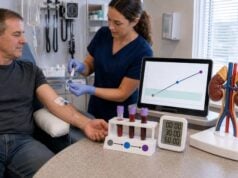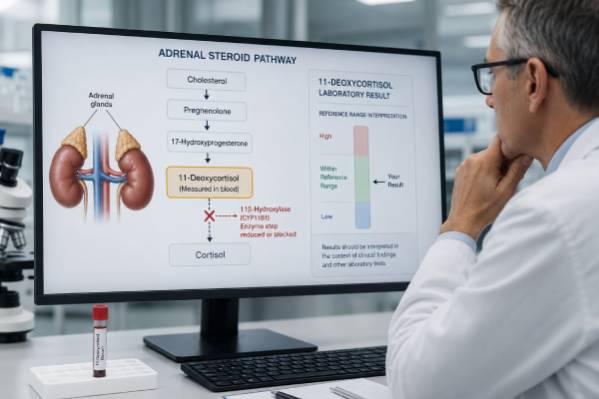
An 11-deoxycortisol test measures a steroid made one step before cortisol in the adrenal hormone pathway. Doctors use it mainly when they suspect a rare form of congenital adrenal hyperplasia caused by 11β-hydroxylase deficiency. In that condition, the adrenal glands cannot efficiently convert 11-deoxycortisol into cortisol, so 11-deoxycortisol and other upstream hormones build up. The result can help explain an unusual combination of androgen excess, early growth or puberty, and high blood pressure.
The same measurement has another, very different use: after a supervised dose of metyrapone, a medicine that temporarily blocks cortisol production, 11-deoxycortisol shows whether the hypothalamus, pituitary gland, and adrenal glands can respond as a connected system. A baseline result and a post-metyrapone result therefore answer different clinical questions. Interpretation depends on the testing protocol, collection time, age, symptoms, medicines, cortisol, ACTH, and related adrenal steroids. A number outside the laboratory range is a clue, not a diagnosis by itself.
- A high baseline 11-deoxycortisol level most strongly suggests impaired 11β-hydroxylase activity when cortisol is low and adrenal androgens and deoxycorticosterone are high.
- A normal baseline result does not completely exclude 11β-hydroxylase deficiency; some people show a clearer rise after ACTH stimulation.
- For an unstimulated sample, an early-morning blood draw is usually preferred because adrenal steroid production changes through the day.
- Reference ranges are method- and age-specific; one LC-MS/MS laboratory uses 10–79 ng/dL for adults, but the range printed on the report takes priority.
- Severe weakness, repeated vomiting, dehydration, confusion, fainting, or very low blood pressure needs urgent medical assessment, regardless of a pending test result.
Table of Contents
- What the 11-Deoxycortisol Test Measures
- Why the Test Is Ordered
- Preparation and Testing
- Normal Range and Result Interpretation
- Causes of High and Low Levels
- Related Tests and Diagnostic Follow-Up
- Questions, Safety, and Next Steps
What the 11-Deoxycortisol Test Measures
11-Deoxycortisol, also called compound S or cortodoxone, is an intermediate steroid rather than a major end hormone. The adrenal cortex makes it while building cortisol from cholesterol. The enzyme 21-hydroxylase converts 17-hydroxyprogesterone into 11-deoxycortisol. Another enzyme, 11β-hydroxylase, then completes the final step from 11-deoxycortisol to cortisol.
Cortisol supports blood pressure, metabolism, immune regulation, and the response to illness or injury. Its production is controlled by the hypothalamic-pituitary-adrenal, or HPA, axis. The hypothalamus signals the pituitary, the pituitary releases adrenocorticotropic hormone (ACTH), and ACTH tells the adrenal cortex to make cortisol. Rising cortisol normally feeds back to reduce ACTH. When cortisol synthesis is blocked, ACTH may remain high and drive more steroid production up to the blocked step.
This pathway explains why the same analyte can be used in two settings:
- Baseline or ACTH-stimulated evaluation for an enzyme defect: An unusually high concentration can show that 11-deoxycortisol is accumulating because 11β-hydroxylase is not working normally.
- Metyrapone testing of the HPA axis: Metyrapone deliberately blocks 11β-hydroxylase for a short time. A functioning axis should detect the fall in cortisol, increase ACTH, and produce a marked rise in 11-deoxycortisol.
11-Deoxycortisol should not be confused with 11-deoxycorticosterone, often abbreviated DOC. The two compounds sit in parallel branches of adrenal steroid production. Both can rise in 11β-hydroxylase deficiency, but DOC has mineralocorticoid activity and can retain sodium, expand blood volume, lower renin, and raise blood pressure. That is why a person with this form of congenital adrenal hyperplasia may have low cortisol yet develop hypertension rather than the salt-wasting pattern seen in some other enzyme defects.
It is also different from 21-deoxycortisol, a useful marker of 21-hydroxylase deficiency. Similar names can cause confusion when reading a result, so check the full analyte name, specimen type, units, and whether the sample was collected before or after stimulation.
Most modern specialty laboratories use liquid chromatography–tandem mass spectrometry, or LC-MS/MS. This method separates related steroids before measuring them and is generally more specific than older immunoassays. Even with a precise method, the clinical meaning comes from the pattern across several hormones rather than one isolated number.
Why the Test Is Ordered
Doctors most often order 11-deoxycortisol when symptoms, blood pressure, electrolytes, or another adrenal test suggests an uncommon steroid-production disorder. It is not a routine wellness test and is rarely useful as a stand-alone screen in someone without a specific clinical reason.
Suspected 11β-hydroxylase deficiency
11β-hydroxylase deficiency results from disease-causing variants in the CYP11B1 gene and is inherited in an autosomal recessive pattern. It accounts for a minority of congenital adrenal hyperplasia cases. Reduced cortisol feedback raises ACTH, which enlarges and overstimulates the adrenal glands. Steroid precursors are diverted toward adrenal androgens, while DOC contributes to low-renin hypertension.
Features that may lead to testing include:
- atypical or virilized external genital development in a 46,XX newborn;
- early pubic hair, acne, body odor, rapid childhood growth, or advanced bone age;
- early penile growth without matching testicular enlargement in a child;
- irregular periods, excess facial or body hair, or difficulty with fertility;
- hypertension at a young age, especially with low renin or low potassium;
- high 17-hydroxyprogesterone or androgens that do not fit the usual pattern of 21-hydroxylase deficiency; or
- a sibling or relative with confirmed CYP11B1-related disease.
The phenotype varies. High blood pressure may appear later than androgen-related signs and may not be present when a child is first evaluated. Potassium may remain normal. A mild or nonclassic presentation can overlap with polycystic ovary syndrome, premature adrenarche, or other causes of androgen excess. Biochemical and genetic confirmation prevents a suggestive symptom pattern from being treated as proof.
An adrenal hyperplasia test panel places 11-deoxycortisol alongside 17-hydroxyprogesterone, cortisol, ACTH, androgens, and mineralocorticoid-related markers. This combined view helps locate the likely enzyme block.
Assessment after metyrapone
Metyrapone testing examines the reserve of the entire HPA axis. A clinician may consider it when secondary or tertiary adrenal insufficiency remains uncertain. Secondary adrenal insufficiency begins at the pituitary, while tertiary disease reflects inadequate hypothalamic signaling, often after prolonged glucocorticoid exposure. In both, the adrenal glands may still respond to a direct ACTH injection early in the process, so a different dynamic test may be helpful in selected cases.
After metyrapone blocks cortisol synthesis, a healthy pituitary should increase ACTH and the adrenal glands should produce more 11-deoxycortisol. A weak rise can indicate impaired HPA-axis reserve, provided cortisol fell enough to show that the medicine produced the intended block. This is a specialized, supervised test. It is not the same as a routine baseline 11-deoxycortisol measurement, and it is not appropriate for home experimentation.
The test has also been used in the differential evaluation of ACTH-dependent Cushing disease, but current workups more often rely on other biochemical tests, imaging, and sometimes inferior petrosal sinus sampling. The correct Cushing syndrome test panel depends on whether the clinician is confirming cortisol excess or finding its source.
Preparation and Testing
Preparation changes according to whether the order is for a baseline measurement, an ACTH-stimulated steroid profile, or a metyrapone test. Confirm the protocol rather than relying on general blood-test advice.
For an unstimulated serum measurement, many laboratories prefer collection near 8 a.m. because ACTH and adrenal steroids follow a daily rhythm. The sample is taken from a vein, allowed to clot, and processed as serum. Fasting is not universally required. Follow the ordering laboratory’s instructions if the test is bundled with glucose, lipids, or another measurement that does require fasting.
Before collection, give the clinician and laboratory a complete list of:
- prescription and nonprescription medicines;
- steroid tablets, injections, inhalers, creams, nasal sprays, and eye drops;
- hormonal contraception or estrogen therapy;
- antiseizure medicines, including phenytoin, valproate, and barbiturates;
- supplements marketed for adrenal, bodybuilding, or hormone support;
- recent alcohol use, acute illness, surgery, or hospitalization; and
- pregnancy or possible pregnancy.
Do not stop glucocorticoids or other prescribed drugs on your own. Abruptly stopping long-term steroid treatment can cause dangerous adrenal insufficiency. Estrogens, exogenous glucocorticoids, certain antiseizure medicines, alcohol, and physiologic stress can alter adrenal measurements or the response to metyrapone. The clinician may adjust timing, interpret around the exposure, or choose another test.
ACTH stimulation protocol
When a baseline value is nondiagnostic but an enzyme defect remains possible, the clinician may collect a steroid panel before and after cosyntropin, a synthetic ACTH fragment. The medicine stimulates adrenal steroid production. Sampling times vary by protocol, so every tube must be labeled accurately. A disproportionate post-stimulation rise in 11-deoxycortisol can reveal limited 11β-hydroxylase capacity that was not obvious at baseline.
This is different from an ACTH stimulation test for adrenal insufficiency, in which cortisol response is usually the central endpoint. A clinician can measure both cortisol and precursor steroids during the same stimulation when the differential diagnosis requires it.
Metyrapone protocol and safety
An overnight metyrapone test commonly involves a late-night oral dose followed by early-morning measurements of cortisol, 11-deoxycortisol, and often ACTH. Exact dose and timing are clinician-directed. Cortisol must fall sufficiently; otherwise, a low 11-deoxycortisol response cannot be interpreted as HPA-axis failure because the enzyme may not have been adequately blocked.
Metyrapone can provoke nausea, dizziness, low blood pressure, or acute adrenal insufficiency. Risk is greater in someone with little cortisol reserve. For that reason, clinicians screen for contraindications, arrange observation appropriate to the patient, and ensure that rescue glucocorticoid treatment is available. Older multi-day protocols have largely fallen out of routine use because they are more burdensome and carry greater risk.
Normal Range and Result Interpretation
There is no universal 11-deoxycortisol “normal range.” Results depend on age, collection time, assay, and whether ACTH or metyrapone was given. The laboratory interval and protocol-specific decision limit printed on the report are the correct comparison.
For example, one major LC-MS/MS laboratory reports the following baseline serum reference values:
| Age group | Example interval | Important limitation |
|---|---|---|
| 18 years or younger | Less than 344 ng/dL | A broad pediatric limit does not replace age- and protocol-specific endocrine interpretation. |
| Older than 18 years | 10–79 ng/dL | Do not transfer this interval to another laboratory or a stimulated sample. |
Unit checking is essential. A value in ng/dL cannot be compared directly with a limit in ng/mL or nmol/L. A decimal-place or unit mismatch can create an apparent hundredfold error. The report may also use an assay-specific upper limit rather than a two-sided interval.
Reading a baseline result
A markedly high baseline result supports 11β-hydroxylase deficiency when the rest of the pattern agrees: low or inappropriately normal cortisol, high ACTH, high DOC, increased adrenal androgens, suppressed renin, and often low aldosterone. The result becomes more convincing when the clinical picture includes early androgen effects or low-renin hypertension.
A mild elevation has a wider differential. ACTH can rise with physiologic stress or primary adrenal cortisol deficiency. Some ACTH-producing conditions may also raise compound S. Sampling time, medicines, assay interference, and incomplete clinical information can matter. Repeating the measurement under controlled conditions or using a broader LC-MS/MS steroid profile may clarify the finding.
A baseline value within range reduces suspicion but does not eliminate partial 11β-hydroxylase deficiency. Some affected people show diagnostic precursor accumulation only after cosyntropin stimulation. Conversely, one high number does not establish a genetic diagnosis.
Reading a post-metyrapone result
The expected metyrapone response is low cortisol together with higher ACTH and a substantial 11-deoxycortisol rise. One laboratory considers an 8-hour post-metyrapone serum level below 1,700 ng/dL suggestive of probable adrenal insufficiency. That figure is a laboratory-specific interpretive threshold, not a general baseline range.
Interpretation should answer three questions in order:
- Did cortisol fall enough? If not, the drug block may have been incomplete.
- Did ACTH rise? A missing ACTH response points toward impaired central signaling, but collection and handling errors can falsely lower ACTH.
- Did 11-deoxycortisol rise appropriately? A low response despite adequate cortisol suppression suggests inadequate HPA reserve.
The metyrapone response alone does not reliably separate primary adrenal failure from pituitary or hypothalamic causes. Baseline ACTH, mineralocorticoid findings, history, imaging, and other dynamic tests provide that distinction.
Causes of High and Low Levels
High and low values mean different things in unstimulated and stimulated testing. The following comparison is a starting point, not a substitute for protocol-specific interpretation.
| Pattern | Possible explanation | Helpful context |
|---|---|---|
| High at baseline | 11β-hydroxylase deficiency | DOC and androgens high; ACTH often high; renin often low |
| Mildly high at baseline | ACTH drive, stress, medicine effect, or less common steroid disorder | Repeat timing and a complete steroid profile may help |
| Low or normal at baseline | Usually expected; may still occur in partial enzyme deficiency | Consider ACTH stimulation only when clinical suspicion remains |
| Large rise after metyrapone | Expected HPA-axis response if cortisol was adequately suppressed | Interpret with ACTH and cortisol from the same protocol |
| Small rise after metyrapone | Possible adrenal insufficiency or inadequate drug effect | Confirm cortisol suppression before calling the response abnormal |
In untreated 11β-hydroxylase deficiency, high DOC can cause hypertension even though aldosterone is low. This counterintuitive pattern is useful: low renin and low aldosterone do not rule out mineralocorticoid-like activity because DOC is supplying it. Chronic androgen excess may accelerate bone maturation, producing a tall child but a shorter-than-expected adult after growth plates close early.
Low 11-deoxycortisol is usually not interpreted by itself. At baseline, it may simply reflect normal low precursor production at that time of day. During metyrapone testing, however, failure to increase is clinically meaningful only if metyrapone lowered cortisol as intended. Exogenous glucocorticoids can suppress ACTH and flatten the response; certain medicines can change metyrapone metabolism. Acute illness can also distort the axis.
Treatment changes the pattern. Glucocorticoid replacement lowers ACTH and should reduce excess 11-deoxycortisol, DOC, and androgens. An apparently “normal” precursor in a treated person therefore cannot be used to decide whether the inherited disorder was ever present. Monitoring must balance disease control against signs of excess glucocorticoid, such as slowed growth, weight gain, easy bruising, bone loss, or glucose problems.
Related Tests and Diagnostic Follow-Up
No single steroid identifies every adrenal enzyme defect. A clinician builds a biochemical map from precursors, products, ACTH drive, mineralocorticoid activity, and androgen production.
Common companion tests include:
- Cortisol and ACTH: Low cortisol with high ACTH supports a primary adrenal synthesis problem; low or inappropriately normal ACTH points toward central suppression.
- 17-hydroxyprogesterone: A pronounced elevation most often prompts evaluation for 21-hydroxylase deficiency, but it can also rise in 11β-hydroxylase deficiency. The full pattern prevents misclassification.
- 11-deoxycorticosterone: High DOC explains low-renin hypertension and helps distinguish hypertensive forms of congenital adrenal hyperplasia.
- Androstenedione, testosterone, and DHEA-S: These show the degree and source of androgen excess.
- Renin, aldosterone, potassium, and sodium: These assess mineralocorticoid effects and the physiologic impact on blood pressure and electrolytes.
- Cortisol after cosyntropin: This helps assess adrenal reserve while stimulated precursors help locate an enzyme block.
An adrenal hormone panel should be selected around the clinical question; a generic bundle may omit the decisive precursor. If an unstimulated profile is ambiguous, an endocrinologist may arrange cosyntropin-stimulated steroid measurements. LC-MS/MS multisteroid panels can identify several abnormalities from the same timed samples.
Genetic testing for CYP11B1 can confirm the cause, support family testing, and inform reproductive counseling. Biochemistry and phenotype remain important because variant classification can be uncertain and disease severity does not always track neatly with genotype. Parents of an affected child are usually carriers, and each full sibling has a 25% chance of being affected, a 50% chance of being a carrier, and a 25% chance of inheriting neither familial variant, assuming both parents carry one disease-causing variant.
Imaging is not the first test for an inherited enzyme block. Bilateral adrenal enlargement can result from chronic ACTH stimulation, but a scan cannot name the biochemical defect. Imaging may be appropriate for a different suspected condition or a complication, not as a replacement for hormone and genetic evaluation.
Questions, Safety, and Next Steps
Ask the ordering clinician what question the test was designed to answer. The distinction between a baseline sample, ACTH-stimulated sample, and post-metyrapone sample changes every part of interpretation. Useful questions include:
- Was this value collected at the planned time, and is it baseline or stimulated?
- Which assay and reference interval did the laboratory use?
- Do cortisol, ACTH, DOC, 17-hydroxyprogesterone, and androgens form a consistent pattern?
- Could any prescription, steroid exposure, supplement, illness, pregnancy, or collection problem affect the result?
- Should the result be repeated, followed by cosyntropin testing, or evaluated with a multisteroid panel?
- Is CYP11B1 genetic testing appropriate for the patient or family?
- Does blood pressure or potassium require treatment now, before the diagnostic workup is complete?
For a child with rapid growth, early androgen signs, or genital differences, referral to pediatric endocrinology should be prompt. Care often involves a multidisciplinary team and should use respectful, developmentally appropriate communication. For an adult with hirsutism or irregular cycles, common causes such as PCOS are considered, but early onset, marked biochemical abnormalities, hypertension, or a suggestive family history increases concern for congenital adrenal hyperplasia.
Confirmed 11β-hydroxylase deficiency is treated with clinician-managed glucocorticoid replacement to replace cortisol and suppress excessive ACTH drive. Blood pressure medicines may be needed if hypertension persists. Follow-up looks beyond a target laboratory number: growth and bone age in children, puberty, menstrual or testicular health, fertility, blood pressure, electrolytes, and signs of glucocorticoid over- or undertreatment all matter.
People with adrenal insufficiency need written sick-day instructions, access to emergency injectable glucocorticoid when prescribed, and medical identification. Fever, surgery, trauma, or vomiting can raise cortisol needs. Emergency symptoms include repeated vomiting, severe weakness, dehydration, abdominal pain, confusion, fainting, or shock. Do not wait for an 11-deoxycortisol result if these occur.
An isolated abnormal value should lead to confirmation, not panic. Checking the protocol, units, related hormones, medicines, and clinical picture usually shows whether the result represents a true enzyme block, altered HPA-axis reserve, or a testing issue.
Before follow-up, keep a copy of the result with the collection time, units, reference interval, current medicines, and whether ACTH stimulation was used. Those details let an endocrinologist compare values accurately across laboratories. Families with a confirmed inherited enzyme deficiency may also benefit from genetic counseling, particularly before pregnancy or when siblings have suggestive symptoms. A biochemical result can identify the pathway involved, while counseling explains inheritance, carrier testing, reproductive options, and which relatives might reasonably be offered evaluation.
References
- 11-Deoxycortisol, Serum 2026
- Congenital Adrenal Hyperplasia 2026 (Review)
- Endocrine Hypertension in Children and Adolescence 2025 (Review)
- Clinical and Molecular Characteristics of a Patient with 11-Beta-Hydroxylase Deficiency 2025
- Congenital adrenal hyperplasia caused by compound heterozygosity for two novel CYP11B1 gene mutations 2022
Disclaimer
This information explains 11-deoxycortisol testing and cannot diagnose an adrenal disorder or replace care from an endocrinologist. Reference limits and dynamic-test cutoffs vary by laboratory and protocol. Seek urgent medical care for symptoms of adrenal crisis, severe low blood pressure, or acute deterioration.