A 24-hour urine free cortisol test measures the unbound cortisol filtered into urine over a complete day. It is one of the standard first-line tests for endogenous Cushing syndrome, a disorder caused by prolonged exposure to too much cortisol made inside the body. Because cortisol is released in pulses and changes from morning to night, a full-day collection provides a more representative measure than one random blood sample.
The test is useful only when the collection is complete. Missing one urine sample, collecting beyond 24 hours, drinking excessive fluid, or recording the wrong volume can shift the result enough to mislead. Clinicians commonly request at least two collections because cortisol production varies from day to day and mild or cyclic Cushing syndrome may not appear in every sample. A high urine free cortisol result shows cortisol excess but does not reveal whether the source is the pituitary gland, adrenal gland, or an ACTH-producing tumor elsewhere. A normal result lowers the likelihood of Cushing syndrome, yet it may not exclude mild, cyclic, or kidney-limited cases.
- Urine free cortisol reflects biologically active cortisol excreted across 24 hours and is used to screen for cortisol excess, not to find its source.
- Collect every drop after the discarded starting void through and including the final void exactly 24 hours later.
- Two properly collected 24-hour samples are often recommended because cortisol output can vary between days.
- A result more than three times the assay’s upper limit is strongly suggestive of Cushing syndrome when collection and interfering factors are addressed.
- Kidney impairment can produce a falsely reassuring result, while very high fluid intake and physiologic stress can raise urine cortisol.
Table of Contents
- How Urine Free Cortisol Testing Works
- Who Should Be Tested
- How to Collect Urine Correctly
- Preparation and Interferences
- Ranges and High Results
- Normal and Inconclusive Results
- Follow-Up After Testing
How Urine Free Cortisol Testing Works
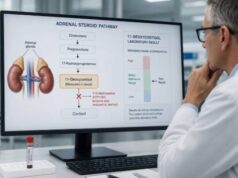
Cortisol is a glucocorticoid hormone made by the adrenal cortex. It helps maintain blood pressure and glucose availability, shapes immune and inflammatory responses, and supports the body during illness and injury. The hypothalamus releases corticotropin-releasing hormone, the pituitary gland releases adrenocorticotropic hormone (ACTH), and ACTH stimulates adrenal cortisol production. Cortisol then feeds back to reduce further signaling.
Most circulating cortisol is attached to cortisol-binding globulin or albumin. A smaller fraction remains free and biologically active. The kidneys filter free cortisol from blood, and a small amount passes unchanged into urine. When circulating cortisol rises enough to exceed binding capacity, urinary free cortisol, or UFC, increases disproportionately.
A 24-hour collection integrates many cortisol pulses and reduces the effect of a single high or low moment. It also avoids changes in cortisol-binding globulin that can complicate total serum cortisol, such as estrogen treatment or pregnancy. UFC is not completely independent of physiology, however. Kidney filtration, urine volume, stress, and collection accuracy all affect what reaches the container.
Most specialized laboratories report cortisol mass per 24 hours, such as micrograms per 24 hours (mcg/24 h), rather than a simple concentration. The laboratory measures cortisol in an aliquot and multiplies it by the total recorded urine volume. If the volume is wrong or the collection is incomplete, the calculated daily excretion is wrong.
Liquid chromatography–tandem mass spectrometry, abbreviated LC-MS/MS, is commonly used because it separates cortisol from similar compounds. Some laboratories use immunoassays, which may have different reference limits and more cross-reactivity. Results from different methods should not be compared as though they were interchangeable.
UFC answers whether daily free cortisol excretion is excessive. It does not reliably test for adrenal insufficiency, and it does not distinguish Cushing disease—a pituitary ACTH-producing tumor—from other causes of Cushing syndrome. Those questions require other tests.
Who Should Be Tested
Testing is most appropriate when several progressive features point toward pathologic cortisol excess or when a high-risk clinical finding is present. Common problems such as weight gain, high blood pressure, fatigue, depression, or type 2 diabetes are not specific enough on their own. Testing everyone with one common symptom creates false positives and unnecessary workups.
Features with greater discriminatory value include:
- easy bruising without a clear cause;
- wide purple or reddish stretch marks, especially wider than 1 cm;
- thinning skin and slow wound healing;
- progressive weakness in the hip or shoulder muscles, such as difficulty rising from a chair;
- facial redness or fullness with increasing fat around the trunk and above the collarbones;
- new osteoporosis or fracture at an unexpectedly young age;
- high blood pressure or diabetes that is unusually difficult to control;
- reduced growth rate with continuing weight gain in a child;
- menstrual disturbance, excess hair growth, low libido, or reduced fertility with other cortisol signs; or
- an adrenal mass discovered on imaging.
Before testing for endogenous disease, the clinician must look for glucocorticoid exposure. Prescription steroids are the most common cause of Cushing syndrome overall. Pills, injections, inhalers, creams, nasal sprays, eye drops, and some unregulated supplements can all contribute. “Exogenous” Cushing syndrome from medicine is diagnosed through exposure history and tailored evaluation; a standard UFC may be low because external glucocorticoid suppresses the body’s own cortisol.
UFC is one option among recommended initial tests. Others include the late-night cortisol test and the low-dose dexamethasone suppression test. The choice depends on kidney function, sleep pattern, medicines, pregnancy, age, and the suspected degree of cortisol excess.
UFC can be especially useful when estrogen raises cortisol-binding globulin, because urinary free cortisol is less affected than total serum cortisol. During pregnancy, however, cortisol physiology and UFC rise, particularly later in gestation, so specialist interpretation and pregnancy-specific expectations are necessary.
Children need collection instructions suited to their age and continence. A toilet-trained child can use a clean collection hat, while an infant or young child may need a pediatric collection plan designed by the laboratory. Urine squeezed from diapers is not an acceptable substitute because volume and contamination cannot be controlled. Pediatric results may be normalized to body surface area, and adult cutoffs should not be applied. In children, slowing height gain while weight continues to rise is a particularly important reason for endocrine assessment.
The test is less reliable with reduced kidney function. When estimated glomerular filtration rate falls below about 60 mL/min/1.73 m², less free cortisol may be filtered, creating a false-negative risk. In that setting, late-night salivary cortisol or dexamethasone testing may be more suitable if no other contraindication applies.
How to Collect Urine Correctly
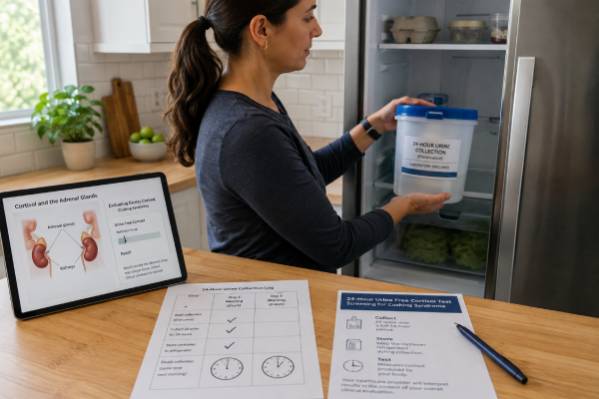
The laboratory or clinic should provide a large labeled container and written instructions. Some containers contain preservative. Do not empty, rinse, or touch preservative, and keep it away from children and skin. Ask how the container should be stored; many collections must remain refrigerated or chilled throughout the day.
Choose a fairly typical day when you can reach the container for every void. Avoid starting during travel, a major athletic event, or an acute illness unless the clinician specifically wants testing under those conditions.
Use this sequence unless the laboratory gives different instructions:
- Choose and record a start time. After waking, urinate into the toilet and discard this first void. Write down the exact time; this empties the bladder at the beginning of the collection.
- Collect all urine after the start. For the next 24 hours, place every void into a clean collection aid and transfer it to the main container, or use the method supplied by the laboratory. Include daytime, evening, overnight, and bowel-movement-associated urination.
- Store the specimen as directed. Keep the lid secure and the container cold if required. Do not add toilet paper, stool, menstrual products, or plain water.
- Finish exactly 24 hours later. At the recorded end time the next morning, urinate one final time and add that urine to the container. This final void is included even though the first one was discarded.
- Return the collection promptly. Confirm that the start and end times and total volume are recorded. The laboratory may measure the volume itself, but it still needs accurate timing.
If one void is missed or spilled, contact the laboratory. In most cases, the safest course is to discard the collection and restart with a new container. Guessing the missing amount does not correct the cortisol calculation.
If the container fills before 24 hours, do not stop early. Obtain a second approved container and continue; return all containers as one timed collection. Do not pour urine away to make room. If bowel movement contamination occurs, ask whether the collection must be restarted.
Checking completeness with urine creatinine
Clinicians often order 24-hour urine creatinine with cortisol. Creatinine excretion provides a rough check on completeness because an individual’s daily creatinine output is usually more stable than urine volume. A value that is unexpectedly low can suggest missed urine, while a very high value may suggest overcollection or an inaccurate time window. Muscle mass, age, sex, diet, and kidney function also affect creatinine, so it is a quality clue rather than proof.
The most common collection errors are easy to prevent: including the first void, forgetting the last void, missing an overnight sample, collecting for 23 or 25 hours, and failing to keep the specimen under required storage conditions. Writing the schedule on the container and setting phone reminders can help.
Menstrual bleeding does not always prevent testing, but visible blood or contamination can complicate some laboratory procedures. Ask the laboratory whether to postpone. For people who cannot safely refrigerate the container, the laboratory may supply an approved preservative or an insulated transport plan; improvising with household chemicals can destroy the specimen and create a safety hazard.
Preparation and Interferences
Maintain ordinary fluid intake unless the clinician gives another plan. Deliberately drinking several liters more than usual can increase urine volume and may raise UFC. Severe fluid restriction is also inappropriate. Record unusually high or low intake, vomiting, diarrhea, and any reason the day was not typical.
Give the clinician a full list of prescription drugs, over-the-counter products, and supplements. Important exposures include:
- hydrocortisone, prednisone, prednisolone, methylprednisolone, dexamethasone, or cortisone;
- steroid injections into joints, spine, muscle, or skin;
- inhaled, nasal, topical, ophthalmic, or rectal glucocorticoids;
- medications that alter steroid metabolism or interfere with a specific assay;
- estrogen-containing treatment or pregnancy;
- licorice products in large amounts, which can change cortisol metabolism; and
- supplements marketed as “adrenal support,” which may contain undeclared hormones.
Do not stop a prescribed glucocorticoid without medical direction. Abrupt withdrawal can cause adrenal crisis, particularly after long-term or high-dose use. The ordering clinician may verify the exact steroid with the laboratory, delay testing, or use a synthetic glucocorticoid screen when exposure is uncertain.
Strenuous prolonged exercise, uncontrolled pain, major sleep loss, acute infection, surgery, severe emotional distress, alcohol withdrawal, and hospitalization can activate the stress system. A transient elevation under those conditions does not automatically mean Cushing syndrome. When safe, stable outpatient testing is easier to interpret.
Several conditions can produce sustained non-neoplastic hypercortisolism, sometimes called pseudo-Cushing states. Examples include severe depression, alcohol use disorder, poorly controlled diabetes, severe obesity, eating disorders, and obstructive sleep apnea. The symptoms and initial test results can overlap with Cushing syndrome. Treating the underlying condition and repeating or combining tests may be necessary.
The day of collection should match normal intake and activity, but avoid extreme exercise. Follow any laboratory-specific restrictions. Some methods historically required avoiding certain drugs, while LC-MS/MS reduces many analytical interferences. Physiologic effects still remain even when the assay itself is specific.
Ranges and High Results
The normal range is assay-specific. One LC-MS/MS laboratory uses an adult upper limit of 45 mcg/24 h, while other reputable laboratories use limits around 40–60 mcg/24 h or report in nmol/24 h. Children may have age- or body-surface-area-related intervals. Compare the result only with the upper limit on the same report.
Interpret the result as a multiple of the upper limit of normal, abbreviated ULN:
| Result pattern | Meaning | Usual response |
|---|---|---|
| Within the laboratory range | Cushing syndrome is less likely, but mild or cyclic disease may be missed | Review collection quality and pretest probability |
| Slightly above the ULN | Could reflect mild disease, stress, high fluid intake, or collection error | Repeat and use another first-line test |
| About 2–3 times the ULN | Pathologic cortisol excess becomes more concerning | Endocrine evaluation and confirmation |
| More than 3 times the ULN | Strongly suggests Cushing syndrome when exogenous steroid and error are excluded | Prompt confirmation and cause-directed testing |
A very high value is more specific than a mild elevation. Even then, the clinician confirms hypercortisolism before pursuing tumor localization. Severe cortisol excess can cause low potassium, infection, blood clots, uncontrolled glucose, psychiatric changes, and cardiovascular complications; urgency depends on symptoms and associated abnormalities.
Day-to-day variation is important. One high and one normal collection may reflect a faulty sample, a changing stressor, or cyclic cortisol production. At least two collections on separate days improve confidence. In known Cushing syndrome, serial UFC can also help assess response to treatment, but the target and frequency depend on the therapy.
UFC does not indicate source. Once cortisol excess is established, a clinician typically measures plasma ACTH. Low ACTH suggests an adrenal source; normal or high ACTH suggests a pituitary or ectopic source. Imaging comes after biochemical classification because incidental pituitary and adrenal nodules are common.
Normal and Inconclusive Results
A normal, complete 24-hour UFC makes moderate or severe persistent Cushing syndrome unlikely. It is less reassuring when symptoms are strongly discriminatory, kidney function is reduced, the collection appears incomplete, or cortisol excess may be mild or cyclic.
Mild autonomous cortisol secretion from an adrenal incidentaloma often does not raise UFC. The 1-mg overnight dexamethasone suppression test is usually more sensitive for that question. Similarly, a person whose cortisol peaks episodically may collect urine during a quiet phase. Keeping a dated symptom record can help the endocrinologist time repeated testing.
False-low results can arise from:
- missed urine or a collection shorter than 24 hours;
- reduced glomerular filtration;
- excessive urine dilution combined with specimen or reporting problems;
- glucocorticoid medicine suppressing endogenous production;
- cyclic disease tested during remission; or
- mild cortisol excess that does not exceed binding and renal thresholds enough to raise UFC.
False-high or nonspecific elevations can arise from:
- overcollection beyond 24 hours;
- very high fluid intake, often above 5 liters per day;
- acute pain, illness, surgery, or intense exercise;
- severe depression, alcohol-related disease, eating disorders, or poorly controlled diabetes;
- pregnancy-related physiologic change; or
- analytical cross-reactivity, especially with some immunoassays.
If the result conflicts with symptoms, do not average away the disagreement. Verify collection time, total volume, creatinine, kidney function, assay method, medicines, and stressors. The clinician may repeat UFC and add a test based on a different physiologic feature. Late-night salivary cortisol tests loss of the normal midnight low point, while dexamethasone tests whether cortisol production suppresses appropriately.
Random serum cortisol and random ACTH are not screening substitutes. Cortisol can be normal at one moment in true Cushing syndrome, and stress from the blood draw can raise it in someone without the disorder.
Follow-Up After Testing
After an abnormal result, an endocrinologist usually confirms endogenous cortisol excess with another recommended test and often repeats the same test. The sequence can be summarized as:
- Confirm the collection and exclude external glucocorticoids. Review every route of exposure, urine creatinine, timing, and kidney function.
- Demonstrate persistent hypercortisolism. Repeat UFC and/or use late-night salivary cortisol or dexamethasone suppression.
- Measure ACTH after cortisol excess is established. This separates ACTH-independent from ACTH-dependent disease.
- Localize the source with targeted testing. Adrenal imaging follows low ACTH; pituitary evaluation follows ACTH-dependent findings. Inferior petrosal sinus sampling may be needed when biochemical and imaging results do not align.
- Assess complications. Blood pressure, potassium, glucose, infection risk, bone health, mental health, and blood-clot risk may need prompt attention.
A complete Cushing syndrome evaluation deliberately uses tests with different strengths. Agreement between independent abnormal tests is much more persuasive than repeated borderline values from a flawed collection.
Contact the clinician promptly for a markedly elevated result, especially with severe weakness, infection, very high blood pressure or glucose, low potassium, new confusion, or shortness of breath. Emergency care is appropriate for chest pain, signs of a blood clot, severe infection, acute psychosis, or rapid deterioration.
Useful questions after receiving a report include:
- Was urine creatinine appropriate for a complete collection?
- What was the total volume, and was it unusually high or low?
- How many times above the assay’s upper limit was the result?
- Does kidney function make the result less reliable?
- Could a medicine, injection, cream, inhaler, or supplement contain glucocorticoid?
- Should the next test repeat UFC or assess late-night rhythm or dexamethasone suppression?
- If cortisol excess is confirmed, when will ACTH be measured?
Careful collection makes UFC a strong screening tool. Its value comes from combining a trustworthy 24-hour specimen with the clinical pattern and a second, independent test—not from treating one number as a tumor diagnosis.
How Collection Quality Changes the Next Step
A urine cortisol number is useful only if the collection represents a true 24-hour period. The total urine volume and urine creatinine can help the clinician judge completeness, although neither measure proves that every void was captured. A very low creatinine amount may suggest missed urine, while an unexpectedly high amount can occur with overcollection, unusually high muscle mass, or inclusion of urine outside the scheduled window. If the container was spilled, a void was forgotten, or the start and stop times were unclear, repeating the collection usually provides more reliable information than trying to interpret a flawed sample.
Kidney function also matters. Reduced filtration can lower urinary free cortisol and make the test less sensitive for cortisol excess. Very high fluid intake may increase urine volume and can influence results, so patients should follow the laboratory’s usual hydration instructions rather than deliberately drinking extra water. Drugs that affect cortisol metabolism or interfere with the assay should be reviewed before testing, but prescription medicine should not be stopped without guidance.
Discordant results call for a deliberate plan. If symptoms are convincing but one urine result is normal, clinicians may obtain another properly collected sample or use a different first-line test, such as late-night salivary cortisol or an overnight dexamethasone suppression test. Repeated testing is particularly helpful when cortisol excess appears episodic. Imaging generally comes later, after biochemical evidence establishes that sustained or recurring hypercortisolism is likely.
References
- Consensus on Diagnosis and Management of Cushing’s Disease: A Guideline Update 2021 (Consensus Guideline)
- Cushing’s Syndrome 2024 (Review)
- Hypercortisolism (Cushing Syndrome) 2025 (Review)
- Cortisol, Free, 24 Hour, Urine 2026
- Cushing Syndrome/Disease in Children and Adolescents 2024 (Review)
Disclaimer
This information is educational and cannot diagnose or exclude Cushing syndrome. Urine cortisol ranges, collection requirements, and follow-up pathways vary by laboratory and patient circumstances. Seek prompt medical care for severe infection, confusion, chest pain, breathing difficulty, or rapid clinical decline.