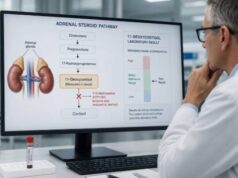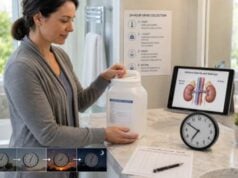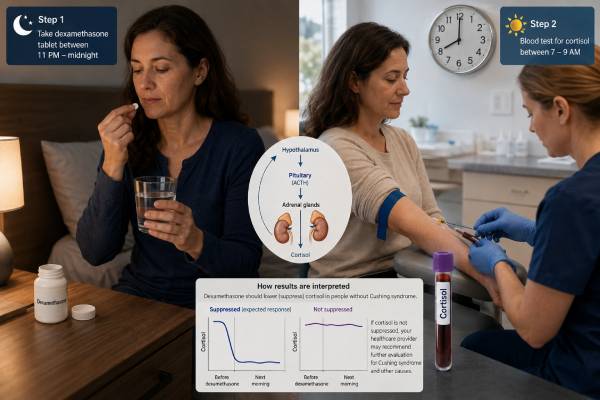
The low-dose dexamethasone suppression test checks whether a small dose of synthetic glucocorticoid can turn down the body’s cortisol production. It is one of the standard first-line tests for suspected Cushing syndrome and is also used to assess mild autonomous cortisol secretion in people with an adrenal mass. In the common overnight version, a person takes 1 mg of dexamethasone around 11 p.m. and has blood drawn for cortisol the next morning. A cortisol level below about 1.8 mcg/dL, or 50 nmol/L, generally shows appropriate suppression, although the laboratory method and clinical setting matter. A higher value is an abnormal screening result, not a diagnosis. Missed doses, poor absorption, medicines that change dexamethasone metabolism, oral estrogen, acute illness, alcohol use, and sleep disruption can all produce misleading results. The test must be interpreted with symptoms, medication history, other cortisol tests, and sometimes a measured dexamethasone level.
- The usual overnight test uses 1 mg dexamethasone at about 11 p.m. and measures cortisol around 8 a.m.
- Morning cortisol below 1.8 mcg/dL generally indicates normal suppression, but assay-specific guidance should be followed.
- Failure to suppress screens for cortisol excess; it does not show whether the source is pituitary, adrenal, or ectopic.
- Oral estrogen and medicines that speed dexamethasone breakdown can cause an apparently abnormal result.
- A borderline or unexpected result usually needs confirmation, often with late-night salivary cortisol, urine free cortisol, or a repeated controlled test.
Table of Contents
- What the Low-Dose Test Evaluates
- Who May Need the Test
- Overnight and Two-Day Protocols
- Preparation and Medication Effects
- Normal, Borderline, and Abnormal Results
- Why Cortisol May Fail to Suppress
- How the Test Compares With Other Screening Tests
- Follow-Up After the Result
What the Low-Dose Test Evaluates
Dexamethasone acts like a strong glucocorticoid at the pituitary and hypothalamus. In a healthy feedback system, it reduces ACTH secretion overnight. Lower ACTH tells the adrenal glands to reduce cortisol output, so morning serum cortisol becomes very low. Autonomous cortisol production or persistent ACTH drive can resist that feedback, leaving cortisol above the expected suppressed level.
The test evaluates suppressibility, not the ordinary morning cortisol range. A morning cortisol of 5 mcg/dL might be low in an untreated adrenal-insufficiency evaluation but is abnormally high after 1 mg dexamethasone, because the expected post-dose concentration is usually below 1.8 mcg/dL. The medication exposure completely changes the meaning of the number.
Low-dose dexamethasone is used in two related settings. For suspected overt Cushing syndrome, it is one of several accepted screening tests. For an adrenal incidentaloma, the 1-mg overnight test assesses whether the lesion may be producing cortisol without the classic appearance of Cushing syndrome. This milder state is commonly called mild autonomous cortisol secretion.
A failed test does not identify the source. Pituitary Cushing disease, an adrenal cortisol-producing lesion, ectopic ACTH secretion, and several non-neoplastic states can all produce nonsuppression. Plasma ACTH and further testing are used only after endogenous hypercortisolism is confirmed.
The low-dose test is different from the high-dose dexamethasone suppression test. High-dose testing has historically been used after ACTH-dependent Cushing syndrome is established to help distinguish a pituitary from an ectopic source. It is not a substitute for the low-dose screening protocol.
Dexamethasone is chosen because most cortisol assays do not detect it as cortisol. However, its concentration in the blood can still matter. If too little dexamethasone is present because of a missed dose, malabsorption, or rapid metabolism, cortisol may fail to suppress even when the feedback axis is normal.
Who May Need the Test
Testing is most appropriate when the clinical pattern makes Cushing syndrome plausible. Common symptoms such as obesity, fatigue, depression, hypertension, and type 2 diabetes are not enough by themselves because they are widespread. Concern rises when several progressive or relatively specific features occur together.
Examples include wide purple stretch marks, easy bruising, thin skin, proximal muscle weakness, facial redness, unexplained osteoporosis, recurrent infections, difficult-to-control blood pressure or diabetes, menstrual changes, and rapid body-composition changes. In children, weight gain with reduced height velocity is an important signal.
A 1-mg test is also commonly recommended for people with an adrenal incidentaloma, even when classic Cushing features are absent. Mild autonomous cortisol secretion can be associated with hypertension, diabetes, dyslipidemia, fractures, and cardiovascular risk. Interpretation in this setting emphasizes the degree of nonsuppression and related health problems rather than a simple yes-or-no Cushing label.
Before testing, clinicians must exclude or document exogenous glucocorticoid exposure. Tablets, injections, inhalers, nasal sprays, skin products, joint injections, rectal steroids, and unregulated supplements may alter the axis. Exogenous Cushing syndrome is diagnosed from exposure history and appropriate endocrine assessment, not by using the low-dose test as if no steroid were present.
Routine screening is not recommended for everyone with weight gain or stress. False-positive results become common when testing is used in very low-risk populations. The clinician should first review symptom progression, medication history, sleep, alcohol use, psychiatric illness, and other possible explanations.
The test may be unsuitable or require specialist planning in pregnancy, acute hospitalization, severe liver disease, malabsorption, uncontrolled alcohol use disorder, rotating shift work, or use of interacting medicines that cannot be safely changed. Another first-line test may be more reliable in those circumstances.
Overnight and Two-Day Protocols
The 1-mg overnight dexamethasone suppression test is the most widely used protocol. A typical schedule is:
- Take 1 mg dexamethasone by mouth between 11 p.m. and midnight.
- Avoid taking it earlier or later than instructed.
- Have serum cortisol drawn between 8 and 9 a.m. the next morning.
- Have serum dexamethasone measured at the same time when the center uses it to confirm exposure.
Some protocols use a slightly different dose or time, especially in children or in people with unusual body size or drug metabolism. The written instructions from the ordering center take priority over general descriptions.
The two-day low-dose test, sometimes called the 48-hour test, gives 0.5 mg dexamethasone every six hours for eight doses. Serum cortisol or urine free cortisol is measured before and after the dosing period. This protocol may reduce some day-to-day variation but is harder to complete accurately. Missing one of eight doses can compromise the result.
The overnight test is convenient and well validated. It can be completed at home and requires one morning blood draw. The two-day test may be used when a center has specific experience with it, when an overnight result is equivocal, or as part of a combined protocol. Neither method should be improvised without a prescription and laboratory plan.
Dexamethasone usually causes no major problem after one dose. Short-lived insomnia, restlessness, increased appetite, indigestion, mood change, or higher glucose can occur. People with diabetes may need more frequent glucose checks. Anyone with a history of severe psychiatric reaction to steroids should tell the clinician before testing.
If vomiting occurs soon after the dose, the patient should contact the ordering team rather than take an extra tablet automatically. The test may need to be rescheduled. The exact dose time and blood-draw time should be recorded, because even a valid laboratory number becomes hard to interpret if the interval is unknown.
Preparation and Medication Effects
Medication review is central to an accurate test. Dexamethasone is metabolized mainly through CYP3A4. Drugs that accelerate this pathway can lower dexamethasone exposure and cause false nonsuppression. Examples include phenytoin, carbamazepine, phenobarbital, rifampin, and some other enzyme inducers. Drugs that inhibit metabolism can increase dexamethasone exposure and may produce stronger suppression.
Do not stop antiseizure, antimicrobial, psychiatric, or other prescribed medicines without a clinician’s plan. In some cases, the safer choice is to use late-night salivary cortisol or 24-hour urine free cortisol rather than alter essential treatment.
Oral estrogen increases cortisol-binding globulin, which raises total serum cortisol. Because the post-dexamethasone blood test usually measures total cortisol, oral contraceptives or estrogen therapy can create an apparently high result even when free cortisol is suppressed. A clinician may recommend a supervised interval off oral estrogen before testing, often several weeks, or choose a different screening method. Transdermal estrogen has less effect on binding protein, but treatment decisions remain individualized.
Other preparation points include:
- Tell the clinician about all oral, inhaled, injected, topical, nasal, and rectal steroids.
- Report supplements, especially “adrenal,” bodybuilding, or anti-inflammatory products that may contain undeclared hormones.
- Follow fasting instructions for the morning draw; fasting is often requested because other tests may be collected.
- Avoid unusual heavy alcohol intake and discuss active alcohol use disorder.
- Postpone nonurgent testing during acute severe illness if the clinician agrees.
- Keep the usual sleep schedule and record major sleep disruption.
- Confirm whether high-dose biotin should be held for the laboratory’s assay.
Liver disease can slow or alter dexamethasone metabolism, while gastrointestinal disease or bariatric surgery can affect absorption. Measuring serum dexamethasone can help identify inadequate exposure, although not every laboratory offers it.
The test should not be performed soon after an unscheduled glucocorticoid injection without discussing timing. Long-acting preparations can suppress ACTH or interfere with the broader interpretation for weeks.
Normal, Borderline, and Abnormal Results
The most sensitive commonly used cutoff is a morning cortisol below 1.8 mcg/dL, equivalent to 50 nmol/L. Suppression below this level generally makes endogenous Cushing syndrome unlikely in the tested setting. The cutoff favors sensitivity, so some people without autonomous cortisol production will have values above it.
Results between 1.8 and 5 mcg/dL are sometimes described as an intermediate or mildly abnormal range, especially in adrenal incidentaloma evaluation. Values above 5 mcg/dL show clearer nonsuppression but still do not identify the cause. Newer adrenal-incidentaloma guidance often treats any value above 1.8 mcg/dL as possible mild autonomous cortisol secretion after confounders are addressed rather than relying on older categories.
| Morning cortisol after 1 mg dexamethasone | General interpretation | Usual next step |
|---|---|---|
| Below 1.8 mcg/dL (50 nmol/L) | Appropriate suppression | Cushing syndrome usually unlikely unless cyclic disease is strongly suspected |
| 1.8–5 mcg/dL | Mild or intermediate nonsuppression | Review confounders, dexamethasone exposure, and clinical setting |
| Above 5 mcg/dL | More definite nonsuppression | Confirm hypercortisolism and assess ACTH after diagnosis |
| High cortisol with low dexamethasone level | Inadequate drug exposure possible | Correct the technical issue or choose another test |
These thresholds are not universal across assays. Modern specific cortisol methods may produce lower values than older immunoassays. The laboratory and endocrine service should use a validated cutoff for the method.
The number should be interpreted with pretest probability. A cortisol of 2.0 mcg/dL in a low-risk person taking oral estrogen is different from the same result in someone with progressive purple striae, proximal weakness, fractures, and two high late-night salivary samples.
A very low post-dose cortisol is expected and does not diagnose adrenal insufficiency. Dexamethasone intentionally suppresses ACTH. Adrenal reserve is assessed without dexamethasone, usually with morning cortisol and an ACTH stimulation test when needed.
Why Cortisol May Fail to Suppress
True endogenous hypercortisolism is one explanation. Pituitary Cushing disease, adrenal cortisol production, and ectopic ACTH secretion can all resist low-dose feedback. The low-dose result does not distinguish among them.
Mild autonomous cortisol secretion from an adrenal adenoma often produces modest nonsuppression without dramatic Cushing features. ACTH may be low or low-normal, and DHEA-S may be reduced because chronic cortisol feedback suppresses pituitary ACTH. The clinical significance depends on associated hypertension, diabetes, fractures, and cardiovascular risk.
Non-neoplastic hypercortisolism can also produce an abnormal test. Major depression, active alcohol use disorder, severe obesity, poorly controlled diabetes, obstructive sleep apnea, and intense physical stress may activate the cortisol axis. The hormone changes can be real but may improve when the underlying condition is treated.
Technical causes include a missed or mistimed dose, vomiting, malabsorption, rapid drug metabolism, and an incorrect blood-draw time. Oral estrogen raises total serum cortisol. Acute illness, hospitalization, pain, and major sleep loss can also affect the response.
False reassurance is possible as well. Cyclic Cushing syndrome may suppress normally during an inactive phase. Mild disease can produce borderline values, and assay limitations can obscure small differences. When highly specific symptoms continue to progress, a normal test may be complemented by repeated late-night cortisol or urine testing rather than dismissed automatically.
The result should be repeated only after a specific reason for repetition is identified. Repeating the same flawed conditions tends to reproduce confusion. A measured dexamethasone level, different screening method, or treatment of a confounding condition often adds more information.
How the Test Compares With Other Screening Tests
Late-night salivary cortisol looks for loss of the normal nighttime nadir. It is convenient and measures free cortisol, but it depends on sleep timing and clean saliva collection. The late-night cortisol test is often preferred when oral estrogen makes serum total cortisol difficult to interpret.
A 24-hour urine free cortisol test measures integrated free cortisol excretion. It can miss mild autonomous cortisol secretion and is unreliable with significantly reduced kidney function or incomplete collection. At least two collections are often obtained because cortisol varies from day to day.
The low-dose dexamethasone test is simple and sensitive, particularly for adrenal incidentaloma assessment. Its main weaknesses are medication interactions, binding-protein effects, and dependence on adequate dexamethasone exposure.
| Test | Physiology assessed | Important limitation |
|---|---|---|
| 1-mg overnight dexamethasone | Glucocorticoid feedback suppression | Drug metabolism and oral estrogen |
| Late-night salivary cortisol | Circadian nadir | Shift work, contamination, sleep disruption |
| 24-hour urine free cortisol | Daily free cortisol output | Collection quality and kidney function |
No first-line test localizes the source. Once hypercortisolism is confirmed, ACTH guides the next branch. Suppressed ACTH suggests an adrenal source; normal or high ACTH suggests pituitary or ectopic secretion. Imaging is most useful after that biochemical sequence.
Follow-Up After the Result
After appropriate suppression, no further Cushing testing may be needed when clinical suspicion is low. If symptoms are highly specific, progressive, or episodic, an endocrinologist may use another test or repeat testing during an active phase.
After nonsuppression, the clinician first checks the dose time, blood-draw time, dexamethasone level if available, oral estrogen, interacting medicines, steroid exposure, alcohol use, sleep, and acute illness. An independent cortisol test generally confirms the finding. Imaging should not be the immediate response to one abnormal screen.
For an adrenal incidentaloma, the clinician also reviews ACTH and cortisol-related conditions such as hypertension, diabetes, obesity, dyslipidemia, and fractures. Surgery is not based on the post-dexamethasone number alone. Age, overall health, persistence of cortisol autonomy, comorbidities, lesion characteristics, and patient preferences all matter.
For confirmed overt Cushing syndrome, source testing proceeds promptly. Severe low potassium, infection, blood clots, uncontrolled diabetes, heart failure, or psychiatric symptoms may require urgent cortisol-lowering treatment before the full source evaluation is complete.
Questions to ask after receiving the result include:
- Was my dexamethasone exposure adequate?
- Which cortisol assay and cutoff were used?
- Could oral estrogen or another medicine explain the value?
- Is the result mildly or markedly above the threshold?
- Which independent test should confirm it?
- Should ACTH be measured now, or only after confirmation?
- Does an adrenal mass change the interpretation?
The low-dose dexamethasone test works best as a controlled physiologic challenge within a planned diagnostic sequence. Its strength is sensitive screening; its limitation is that many clinical and technical factors can create nonsuppression.
Clinical follow-up should also distinguish overt Cushing syndrome from mild autonomous cortisol secretion. Overt disease usually produces a broader combination of progressive physical signs and abnormalities across several screening tests. Mild adrenal cortisol autonomy may be discovered during incidentaloma evaluation, with little visible change but a higher burden of hypertension, diabetes, or fractures. The same post-dexamethasone cortisol can therefore lead to different management depending on the rest of the phenotype.
Age and frailty affect decisions. In an older person with major surgical risk and well-controlled comorbidities, observation and medical management may be more appropriate than adrenal surgery for mild nonsuppression. In a younger person with persistent cortisol autonomy, worsening diabetes, and a unilateral adrenal lesion, surgery may offer more benefit. These decisions require endocrine and surgical review rather than a fixed cortisol number.
Children need weight-adjusted or pediatric protocols selected by a specialist. Dexamethasone pharmacokinetics differ with body size, and adult cutoffs cannot be transferred casually. Growth velocity, pubertal stage, and prior steroid exposure are central to interpretation.
Pregnancy is another special setting. Normal cortisol physiology changes, cortisol-binding globulin rises, and dexamethasone crosses the placenta. Screening choices and thresholds should be determined by an endocrinologist and obstetric team. The routine outpatient protocol should not be self-applied during pregnancy.
After the test, dexamethasone may remain in the circulation long enough to affect another cortisol measurement. The clinician should plan the timing of subsequent saliva, urine, or blood tests. Taking extra dexamethasone, repeating the challenge without instruction, or combining it with a commercial cortisol panel can create uninterpretable results.
A technically valid result includes the correct tablet, dose, administration time, collection time, specimen, and assay. Recording these details makes it possible to distinguish true physiology from avoidable test error and prevents unnecessary scans or prolonged uncertainty.
Interpreting change over time
A post-dexamethasone cortisol can be followed in selected adrenal-incidentaloma patients, but small numeric changes should not be called progression without considering assay variation, estrogen, medicines, and dexamethasone exposure. Clinical changes in blood pressure, glucose, fractures, weight, and muscle strength are equally important. Repeating the test is most useful when the result could change treatment rather than as automatic annual testing for every stable lesion.
The laboratory report should list both cortisol and, when available, dexamethasone. This pairing helps separate true feedback resistance from inadequate exposure and prevents an avoidable false-positive diagnosis.
Patients should record the tablet time immediately and bring the record to the morning draw. This simple step prevents uncertainty about whether a borderline cortisol reflects physiology or an incorrect dosing interval.
References
- Cushing Syndrome: A Review 2023 (Review)
- Diagnostic workup of Cushing’s syndrome 2022 (Review)
- Pitfalls in the Diagnosis and Management of Hypercortisolism (Cushing Syndrome) in Humans; A Review of the Laboratory Medicine Perspective 2023 (Review)
- Dexamethasone Suppression Test 2024 (Review)
- Development of diagnostic algorithm for Cushing’s syndrome: a tertiary centre experience 2024
Disclaimer
This article offers general education and cannot diagnose Cushing syndrome or mild autonomous cortisol secretion. Post-dexamethasone cutoffs, assay methods, medicines, and clinical circumstances affect interpretation. Do not change glucocorticoids, oral estrogen, antiseizure medicines, or other prescriptions without guidance from the ordering clinician.