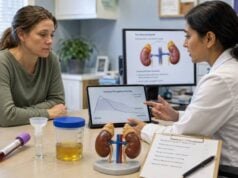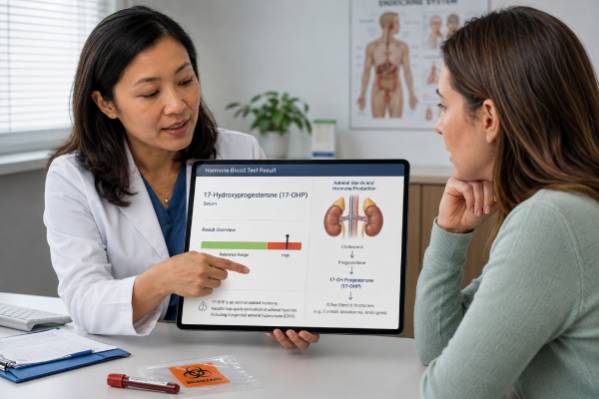
The 17-hydroxyprogesterone test measures a steroid precursor used to detect congenital adrenal hyperplasia, especially the common form caused by 21-hydroxylase deficiency. The name is often shortened to 17-OHP. When 21-hydroxylase does not work well, the adrenal glands cannot move 17-OHP efficiently toward cortisol production. 17-OHP accumulates, ACTH stimulation increases, and more precursor is diverted into androgen production.
The test appears in newborn screening, diagnostic blood work, and follow-up for people already living with congenital adrenal hyperplasia. It may also be ordered for early puberty, rapid childhood growth, excess facial or body hair, severe acne, irregular periods, or infertility. Timing matters: concentrations change during the day, across the menstrual cycle, with age, and during illness. Newborn heel-prick screening and a diagnostic serum measurement are not interchangeable, and an ACTH-stimulated value has a different meaning from a baseline value. A high result can be an important signal, but confirmation usually requires a properly timed repeat, related adrenal hormones, or a supervised stimulation test.
- A clearly high 17-OHP level most often points to 21-hydroxylase-deficient congenital adrenal hyperplasia, but the result must match the patient’s age, timing, and testing method.
- For non-newborn testing, collect the sample early in the morning; in menstruating patients, the early follicular phase is preferred when practical.
- A borderline morning level often leads to a cosyntropin stimulation test rather than an immediate diagnosis.
- Prematurity, newborn stress, acute illness, pregnancy, and the luteal menstrual phase can raise 17-OHP without proving congenital adrenal hyperplasia.
- Vomiting, poor feeding, weight loss, dehydration, unusual sleepiness, or shock in a newborn requires emergency care because salt-wasting adrenal crisis can progress rapidly.
Table of Contents
- What 17-Hydroxyprogesterone Is
- When 17-OHP Testing Is Used
- Newborn Screening and Follow-Up
- Preparing for the Blood Test
- Ranges and Result Interpretation
- High, Borderline, and Low Results
- Confirmation, Treatment Monitoring, and Follow-Up
What 17-Hydroxyprogesterone Is
17-Hydroxyprogesterone is a naturally occurring steroid made mainly by the adrenal cortex and, to a smaller degree, by the ovaries and testes. It is not the same hormone as progesterone. Both molecules are part of steroid production, but they have different laboratory ranges and clinical uses.
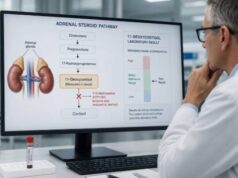
In the adrenal glands, 17-OHP sits at a branching point. The enzyme 21-hydroxylase converts it toward 11-deoxycortisol, which then becomes cortisol. Another pathway can turn steroid precursors into androgens such as androstenedione and testosterone. If 21-hydroxylase activity is severely reduced, cortisol production falls and 17-OHP builds up. Low cortisol removes normal feedback on the pituitary gland, which releases more adrenocorticotropic hormone (ACTH). Continued ACTH stimulation enlarges the adrenal cortex—hence the term congenital adrenal hyperplasia—and pushes still more precursor toward androgen production.
Most cases of congenital adrenal hyperplasia, or CAH, result from disease-causing variants in the CYP21A2 gene. The condition is autosomal recessive: an affected person usually inherits one altered copy from each parent. Severity forms a spectrum.
- Classic salt-wasting CAH causes major cortisol and aldosterone deficiency. Infants can lose sodium and fluid and develop life-threatening shock.
- Classic simple-virilizing CAH causes substantial cortisol deficiency and androgen excess, but enough mineralocorticoid activity remains to prevent typical salt wasting.
- Nonclassic CAH preserves more enzyme activity. It may appear later with early pubic hair, acne, hirsutism, irregular ovulation, or reduced fertility, and it does not usually cause neonatal adrenal crisis.
17-OHP can also rise in 11β-hydroxylase deficiency, a less common type of CAH. Measuring cortisol, androstenedione, 11-deoxycortisol, deoxycorticosterone, renin, and electrolytes helps distinguish enzyme patterns. A high 17-OHP value identifies a pathway problem; it does not always identify the exact enzyme by itself.
Laboratories increasingly use liquid chromatography–tandem mass spectrometry, or LC-MS/MS, for diagnostic serum tests. It separates similar steroids and reduces cross-reactivity compared with some immunoassays. Many newborn programs use immunoassay for the first screen because it is fast and scalable, then add a more specific second-tier steroid profile or diagnostic testing after a positive result.
When 17-OHP Testing Is Used
The reason for testing determines the right sample, threshold, and next step. Clinicians use 17-OHP for screening, diagnosis, and disease monitoring, but those purposes should not be blended.
Symptoms in infants and children
A diagnostic serum test may follow an abnormal newborn screen or be ordered when a child has signs of cortisol deficiency or androgen excess. These signs include atypical external genital development in a 46,XX infant, early pubic or underarm hair, adult-type body odor, severe acne, rapid linear growth, or advanced bone age. In 46,XY infants, external genital development can appear typical even with classic 21-hydroxylase deficiency, so salt wasting may be the first obvious presentation if screening does not identify it.
In a newborn, poor feeding, vomiting, weight loss, dehydration, lethargy, low blood pressure, low sodium, high potassium, or low glucose can signal adrenal crisis. These findings demand urgent treatment while confirmatory tests are collected. Waiting for the final 17-OHP report can be unsafe.
Androgen-related symptoms in adolescents and adults
A morning 17-OHP measurement is commonly used to screen for nonclassic 21-hydroxylase deficiency in someone with androgen excess. Possible reasons include:
- facial or body hair growth beyond the person’s usual pattern;
- persistent inflammatory acne;
- irregular, infrequent, or absent periods;
- difficulty ovulating or becoming pregnant;
- scalp hair thinning with other androgen signs;
- early pubic hair or rapid growth during childhood; or
- a family history of CAH or a known CYP21A2 variant.
Polycystic ovary syndrome is much more common than nonclassic CAH and can cause similar symptoms. The 17-OHP test helps separate them, but neither condition is diagnosed from one hormone alone. A broad PCOS hormone evaluation considers pregnancy, thyroid disease, prolactin disorders, androgen levels, metabolic findings, and the clinical pattern.
Rapidly progressing virilization—such as deepening voice, increasing muscle mass, clitoral enlargement, or very fast hair growth—requires prompt evaluation for a severe hormonal disorder or an androgen-producing tumor. 17-OHP may be included, but testosterone, DHEA-S, androstenedione, imaging, and other studies may be more decisive.
Monitoring known CAH
For someone already diagnosed, clinicians may follow 17-OHP with androstenedione, testosterone, renin, growth, blood pressure, menstrual function, and symptoms. The purpose is to balance sufficient glucocorticoid and mineralocorticoid treatment against overtreatment. Completely suppressing 17-OHP into a low-normal range is not always desirable because it may require excessive glucocorticoid exposure. A single monitoring value should not trigger a dose change without checking collection time, medicine timing, clinical control, and trends.
Newborn Screening and Follow-Up
Newborn screening aims to identify classic 21-hydroxylase deficiency before a salt-wasting crisis. A few drops of capillary blood are collected on filter paper, usually by heel prick, at the time set by the local screening program. The laboratory measures 17-OHP and applies cutoffs that may account for birth weight, gestational age, or age at collection.
A positive screen means the result crossed a safety threshold; it does not mean the baby definitely has CAH. False positives are common because 17-OHP is naturally higher just after birth and may be especially elevated in premature, low-birth-weight, critically ill, or stressed infants. Early collection, some maternal or neonatal exposures, and immunoassay cross-reactivity can also affect the result.
A negative screen greatly lowers the chance of classic CAH but is not perfect. Sampling very early, mild disease, steroid treatment, or transfusion can complicate screening. Nonclassic CAH is not the main target and may not be detected.
Follow-up urgency depends on the reported risk and the baby’s condition. The screening program may request a repeat dried-blood-spot sample or immediate serum testing. Diagnostic evaluation may include:
- serum 17-OHP measured by a specific method;
- sodium, potassium, bicarbonate, and glucose;
- cortisol and ACTH;
- plasma renin and aldosterone;
- androstenedione and testosterone;
- a broader adrenal steroid profile; and
- CYP21A2 genetic testing when appropriate.
An adrenal hyperplasia test panel can show whether the biochemical pattern fits 21-hydroxylase deficiency or another steroidogenic defect. Treatment should begin promptly when classic CAH is strongly suspected; confirmatory testing and emergency care can proceed together.
Families may be alarmed by a screening call. It helps to ask whether the result is borderline or high-risk, what symptoms require emergency care, where confirmatory blood should be drawn, and who will review it. Keep the baby feeding as instructed and do not give supplements or steroid medicine unless a clinician directs it.
Screening programs also differ in how they handle a second specimen. Some repeat the same first-tier assay after the normal newborn surge has fallen; others use a second-tier mass-spectrometry profile on the original card. A second-tier profile can compare 17-OHP with cortisol and other steroids, improving specificity in premature or stressed newborns. Parents should still complete follow-up on the program’s timetable. A more specific laboratory step reduces false alarms but cannot assess the baby’s hydration, blood pressure, feeding, or electrolytes.
Preparing for the Blood Test
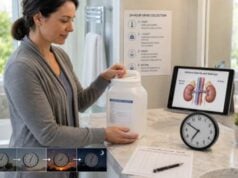
For older children and adults, a baseline sample is usually most informative early in the morning, commonly before 8 or 9 a.m. ACTH and adrenal steroid output rise overnight and fall later in the day, so an afternoon value can miss nonclassic CAH. The exact time should appear on the request and report.
In menstruating patients, collect during the early follicular phase—often within the first several days after menstrual bleeding begins—when feasible. The corpus luteum produces progesterone and 17-OHP after ovulation, so the luteal phase can create a misleading elevation. Do not delay urgent evaluation for cycle timing, and tell the clinician if cycles are unpredictable or absent.
Fasting is not always required for 17-OHP alone. Follow the laboratory’s instructions, especially if glucose, insulin, or other fasting tests are ordered at the same visit. Before testing, report:
- the first day of the last menstrual period and possible pregnancy;
- oral contraceptives, fertility medicines, progesterone, or other hormones;
- all forms of glucocorticoids, including injections, inhalers, creams, and nasal sprays;
- the time of the last hydrocortisone, prednisone, dexamethasone, or fludrocortisone dose;
- supplements containing DHEA, pregnenolone, progesterone, or “adrenal” ingredients;
- recent fever, injury, surgery, sleep disruption, or intense stress; and
- the prior CAH diagnosis and treatment target, if the test is for monitoring.
Never stop prescribed glucocorticoids to improve test accuracy without a specific medical plan. A missed or withheld dose can precipitate adrenal insufficiency in someone who depends on replacement. The clinician may schedule the draw relative to the usual dose or document the timing for interpretation.
Cosyntropin stimulation
When a baseline value is borderline, a clinician may perform an ACTH stimulation test. A baseline blood sample is collected, cosyntropin is given by injection, and another sample is drawn at the protocol time, commonly 60 minutes. The laboratory measures stimulated 17-OHP and often cortisol and other steroids.
The stimulated response helps separate normal variation or carrier status from nonclassic CAH. Cutoffs differ by assay. Older thresholds were developed using immunoassays and should not automatically be applied to LC-MS/MS results. The endocrinologist should use method-validated criteria.
Ranges and Result Interpretation
17-OHP concentrations vary sharply with age and reproductive stage. Newborn values can be much higher than later childhood values, and preterm infants need special interpretation. Adult reference intervals often differ by sex and by follicular or luteal menstrual phase. For these reasons, the result printed beside the laboratory’s own interval is more reliable than a generic online chart.
One LC-MS/MS laboratory, for example, reports adult baseline serum intervals such as 11–111 ng/dL for follicular-phase adults and 25–214 ng/dL for the luteal phase; its adult male interval is 32–307 ng/dL. These are examples, not universal targets. Other laboratories may report nmol/L, use different populations, or set lower decision limits for a screening algorithm.
Clinical interpretation often uses approximate decision bands rather than the reference interval alone:
| Pattern | Typical interpretation | Common next step |
|---|---|---|
| Within the appropriate phase- and method-specific range | Nonclassic CAH is less likely | Evaluate other causes if symptoms persist |
| Borderline elevation, often around 200–1,000 ng/dL | Nonclassic CAH is possible; timing and assay matter | Repeat correctly timed sample or perform cosyntropin testing |
| Marked elevation, often above 1,000 ng/dL | CAH becomes much more likely | Urgent endocrine review and confirmatory steroid testing |
These values are broad clinical conventions, not rigid rules. A morning threshold around 200 ng/dL is commonly used to decide who needs stimulation testing for nonclassic CAH, but LC-MS/MS-specific cutoffs may differ. Classic CAH often produces concentrations far above the upper range, yet treatment, age, sample timing, and residual enzyme activity change the number.
During cosyntropin testing, a stimulated 17-OHP around or above 1,000 ng/dL has traditionally supported nonclassic 21-hydroxylase deficiency. The laboratory and endocrinologist should confirm that the threshold matches the method. Genetic testing can resolve some uncertain cases, but a CYP21A2 result also requires expert interpretation because the gene is technically complex and variant severity varies.
Results should be read as a pattern. High 17-OHP with high androstenedione and ACTH, plus an inadequate cortisol response, strongly supports impaired 21-hydroxylase activity. Low sodium, high potassium, high renin, and dehydration point toward salt-wasting disease. In 11β-hydroxylase deficiency, deoxycorticosterone and 11-deoxycortisol rise and renin may be suppressed because blood pressure is high.
High, Borderline, and Low Results
High 17-OHP
21-hydroxylase-deficient CAH is the central cause of a substantially elevated result. The degree and context help distinguish classic from nonclassic disease, but there is overlap. Other explanations include 11β-hydroxylase deficiency, physiologic neonatal elevation, prematurity, acute stress or illness, the luteal menstrual phase, pregnancy, and some adrenal or gonadal tumors. Immunoassay cross-reactivity can produce an apparent elevation that a more specific LC-MS/MS test does not confirm.
A high result in a person already treated for CAH may reflect undertreatment, a sample taken long after the last glucocorticoid dose, missed doses, poor absorption, illness, or a treatment plan that intentionally avoids complete biochemical suppression. Dose changes should consider androstenedione, testosterone, symptoms, growth, blood pressure, bone age, and treatment side effects.
Borderline 17-OHP
Borderline results are common and deserve careful cleanup before labeling someone with a lifelong genetic condition. Verify morning collection, cycle phase, units, assay, acute illness, and hormone exposures. A repeat follicular-phase morning sample may normalize. If clinical suspicion remains, cosyntropin stimulation is more informative than repeated random measurements.
Carrier status can sometimes produce an intermediate response, but routine 17-OHP cannot reliably determine whether someone carries one CYP21A2 variant. Genetic counseling and targeted molecular testing are better suited to carrier questions, especially before pregnancy or when a partner has CAH.
Low 17-OHP
A low value is rarely a problem by itself. It may reflect normal variation, later-day collection, suppression by glucocorticoid treatment, or reduced ACTH drive. In a treated patient, a very low 17-OHP together with low androgens and signs such as weight gain, slowed childhood growth, bruising, or low bone density may raise concern for glucocorticoid overtreatment. The clinician adjusts treatment from the whole picture, not from a goal of making 17-OHP “perfect.”
17-OHP is not a reliable stand-alone test for general adrenal function. Someone with suspected cortisol deficiency needs a morning cortisol assessment and, when indicated, dynamic testing. A low 17-OHP cannot rule in adrenal insufficiency.
Confirmation, Treatment Monitoring, and Follow-Up
After an abnormal result, the next step should match the urgency. A symptomatic newborn needs immediate electrolyte, glucose, cortisol, ACTH, renin, and confirmatory steroid testing under pediatric endocrine guidance. Treatment for suspected adrenal crisis should not wait for genetic results.
For a stable adolescent or adult with a modest elevation, the clinician often repeats a properly timed LC-MS/MS measurement or arranges cosyntropin stimulation. The workup may also include pregnancy testing, total or free testosterone, DHEA-S, androstenedione, TSH, prolactin, and pelvic evaluation according to symptoms. A dedicated 17-OHP evaluation in women accounts for menstrual timing and overlap with PCOS.
If biochemistry supports CAH, CYP21A2 testing can confirm the cause and guide family counseling. Because CYP21A2 lies near a highly similar pseudogene, testing must detect sequence variants, deletions, conversions, and copy-number changes. A negative or uncertain genetic result does not override a convincing endocrine phenotype without specialist review.
Monitoring confirmed CAH involves more than periodic blood work:
- infants and children need growth, weight, blood pressure, and pubertal assessment;
- bone age may be checked when growth or androgen control is abnormal;
- renin and electrolytes help guide mineralocorticoid and salt replacement;
- menstrual regularity, fertility, and testicular health need age-appropriate review;
- patients and caregivers need sick-day dosing education and emergency hydrocortisone training; and
- clinicians screen for overtreatment, cardiometabolic risk, and bone health concerns.
Ask whether the sample was meant for diagnosis or monitoring, when it was drawn relative to medication, and which companion results were considered. Also ask what symptoms should trigger an emergency plan. People with cortisol deficiency should carry medical identification and follow their prescribed stress-dose instructions during fever, surgery, significant injury, or vomiting.
An abnormal 17-OHP result is most useful when it starts a focused evaluation. Correct timing, a specific assay, stimulation when needed, and interpretation alongside cortisol, ACTH, androgens, renin, and electrolytes can distinguish a true inherited enzyme defect from normal biologic variation.
When a Borderline Result Needs More Context
A mildly elevated 17-OHP result is common enough that it should be interpreted carefully rather than treated as a diagnosis by itself. The laboratory method, collection time, age, sex, menstrual phase, pregnancy status, illness, and medication use can all shift the number. In menstruating adults, an early-morning sample obtained during the early follicular phase is often easier to interpret because levels may rise after ovulation. Newborn results require age- and gestational-age-specific cutoffs; premature or medically stressed infants have more false-positive screens than healthy full-term infants.
When the result falls in an intermediate zone, clinicians may repeat a carefully timed baseline test or order an ACTH stimulation test. Measuring 17-OHP before and after synthetic ACTH can reveal an exaggerated precursor response that supports nonclassic 21-hydroxylase deficiency. A steroid profile measured by liquid chromatography–tandem mass spectrometry may help separate 17-OHP from similar compounds that interfere with some immunoassays. Genetic testing can clarify selected cases, especially when biochemical results remain uncertain, pregnancy planning is relevant, or relatives may also be affected.
Follow-up should match the clinical setting. A person with rapid virilization, severe electrolyte disturbance, dehydration, or an unwell newborn needs prompt medical assessment. Someone with acne or irregular periods and only a small elevation usually needs a broader evaluation for more common causes of androgen excess before treatment is considered.
References
- 17-Hydroxyprogesterone, Serum 2026
- Congenital Adrenal Hyperplasia 2026 (Review)
- Congenital Adrenal Hyperplasia 2025 (Review)
- Adrenal Insufficiency in Children 2024 (Review)
- Screening and Management of the Hyperandrogenic Adolescent 2019 (Committee Opinion)
Disclaimer
This article is educational and does not diagnose congenital adrenal hyperplasia or guide steroid dosing. Newborn reference limits and ACTH-stimulation cutoffs are method- and protocol-specific. Seek emergency care for vomiting, dehydration, severe weakness, confusion, fainting, or suspected adrenal crisis.