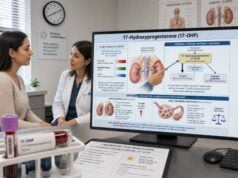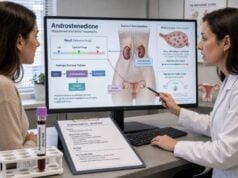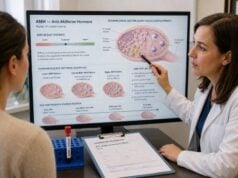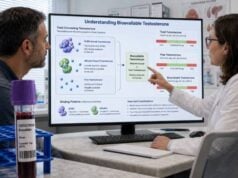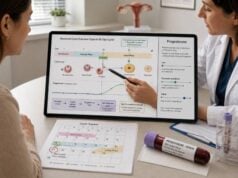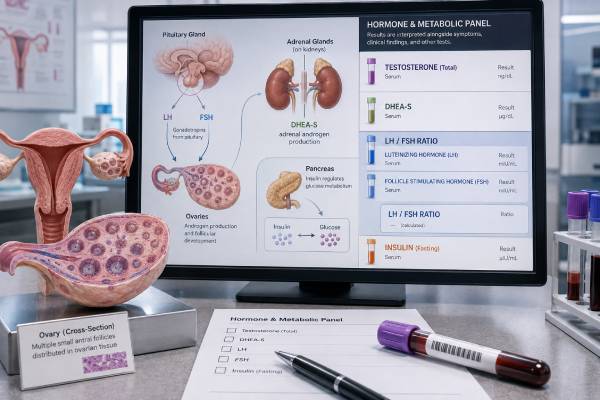
A PCOS hormone test panel may include total and free testosterone, sex hormone-binding globulin (SHBG), dehydroepiandrosterone sulfate (DHEA-S), LH, FSH, glucose testing, and sometimes insulin. The goal is not to find one “PCOS number.” Polycystic ovary syndrome is diagnosed from a pattern of androgen excess, ovulatory dysfunction, and polycystic ovarian morphology or elevated anti-Müllerian hormone in adults, after other causes are excluded. Total and free testosterone are the preferred biochemical tests for androgen excess. DHEA-S can help identify an adrenal contribution, but it is less specific. An elevated LH-to-FSH ratio can occur in PCOS, yet it is not required and is not reliable enough to diagnose or exclude the condition. Insulin resistance is common, but routine insulin levels and HOMA-IR do not have universally accepted diagnostic cutoffs. Glucose tolerance testing is generally more useful for identifying metabolic risk. Results must be interpreted with symptoms, menstrual history, age, medications, pregnancy status, and the laboratory method.
- No single blood test confirms PCOS.
- Total and free testosterone are the main tests for biochemical androgen excess.
- DHEA-S may suggest an adrenal source but can also be normal in PCOS.
- The LH/FSH ratio is neither required nor diagnostic.
- Insulin levels do not have a universal cutoff for PCOS or insulin resistance.
- Testing must exclude pregnancy, thyroid disease, high prolactin, and other androgen disorders.
Table of Contents
- How PCOS Is Diagnosed
- Who May Need a PCOS Hormone Panel
- Testosterone and DHEA-S Results
- LH/FSH Ratio and Ovulation Tests
- Insulin, Glucose, and Metabolic Testing
- Other Tests That Rule Out PCOS Mimics
- Interpreting Patterns and Next Steps
How PCOS Is Diagnosed
PCOS is a clinical syndrome, not a single laboratory abnormality. In adults, current international guidance generally uses two of three features after excluding other causes:
- Clinical or biochemical hyperandrogenism
- Ovulatory dysfunction, such as irregular or absent periods
- Polycystic ovarian morphology on ultrasound or an elevated AMH level used according to validated adult criteria
Clinical hyperandrogenism includes excessive terminal hair growth, especially on the face, chest, abdomen, or back. Persistent acne and female-pattern scalp hair loss can support the assessment but are less specific. Biochemical hyperandrogenism means elevated total testosterone, free testosterone, or calculated free androgen measures using an accurate assay.
Ovulatory dysfunction is often suggested by cycles longer than 35 days, fewer than eight cycles per year, or prolonged gaps between periods. Ovulation can occasionally be absent despite apparently regular cycles, in which case a correctly timed progesterone test may help.
If an adult has both irregular cycles and clear hyperandrogenism, ultrasound or AMH is not required to make the diagnosis. Conversely, polycystic-appearing ovaries alone do not equal PCOS; many people without the syndrome have a high follicle count. AMH should not be used as the only diagnostic test.
Adolescent diagnosis is more cautious because irregular cycles, acne, and multifollicular ovaries can be normal during pubertal maturation. Persistent menstrual irregularity defined by years since the first period plus clinical or biochemical hyperandrogenism is required; ultrasound and AMH are not recommended for diagnosis in adolescence.
A PCOS hormone panel therefore serves two purposes: documenting androgen excess and excluding conditions that resemble PCOS. It should not be interpreted as a checklist in which every result must be abnormal.
Who May Need a PCOS Hormone Panel
Testing may be appropriate for people with a combination of menstrual, androgen, fertility, or metabolic concerns. Common reasons include:
- Cycles repeatedly longer than 35 days or fewer than eight periods per year
- No period for 90 days when not pregnant
- New or progressive facial or body hair growth
- Persistent severe acne, especially with irregular cycles
- Scalp hair thinning in an androgen-sensitive pattern
- Difficulty becoming pregnant because ovulation is infrequent
- A high antral follicle count or AMH result that needs clinical context
- Acanthosis nigricans, central weight gain, or a history of gestational diabetes
- A family history of PCOS or type 2 diabetes
Testing is particularly important when androgen symptoms begin suddenly, worsen rapidly, or include deepening of the voice, increased muscle mass, clitoral enlargement, or severe temporal balding. Those features are not typical of slowly developing PCOS and may indicate an androgen-producing ovarian or adrenal tumor, ovarian hyperthecosis, or exposure to androgen medication.
Hormonal contraception can make assessment difficult. Combined pills often lower ovarian androgen production and raise SHBG, reducing free testosterone. Progestin methods can alter bleeding patterns. When biochemical testing is essential, a clinician may recommend stopping combined hormonal contraception for a period—often about three months—while using another reliable contraceptive method. This decision should be individualized rather than done without supervision.
Pregnancy, recent pregnancy, breastfeeding, menopause, and gender-affirming hormone therapy also change the expected pattern. Biotin supplements can interfere with some immunoassays, and anabolic steroids or testosterone products used by a household member may cause direct or accidental exposure.
A complete history should include cycle dates, age at first period, hair-removal practices, acne treatment, weight changes, eating and exercise patterns, sleep symptoms, medications, and pregnancy goals. The same laboratory result may lead to different next steps in someone seeking contraception versus someone trying to conceive.
Testosterone and DHEA-S Results
Total and Free Testosterone
Total testosterone is the preferred first-line androgen test when measured with a high-quality liquid chromatography–tandem mass spectrometry method. Immunoassays may be less accurate at the low concentrations typical in women. Free testosterone can be calculated from total testosterone, SHBG, and albumin, or estimated with a validated free androgen index. Direct free-testosterone immunoassays are often unreliable.
Elevated total or free testosterone supports biochemical hyperandrogenism. Free testosterone may be high even when total testosterone is within range if SHBG is low. Low SHBG is common with insulin resistance, higher body weight, hypothyroidism, and some medications. Estrogen-containing contraception usually raises SHBG and can mask androgen excess.
There is no universal PCOS testosterone cutoff. Results should be compared with an age-appropriate female reference interval from the performing laboratory. Mild elevation is common in PCOS. A result markedly above the upper limit—especially two or more times the laboratory limit—or rapid virilization warrants urgent evaluation for non-PCOS causes.
An elevated testosterone result in women can also occur with congenital adrenal hyperplasia, Cushing syndrome, ovarian hyperthecosis, tumors, and exogenous androgen exposure. Repeating an unexpected result with LC-MS/MS can prevent unnecessary imaging caused by assay error.
DHEA-S
DHEA-S is produced mainly by the adrenal glands. It is useful when testosterone is normal but clinical androgen excess remains convincing, or when an adrenal source is suspected. DHEA-S naturally declines with age, so age-specific ranges are essential.
Mild DHEA-S elevation can occur in PCOS and does not prove adrenal disease. A very high value, particularly with rapid symptoms, may prompt evaluation for an adrenal tumor. Exact thresholds vary by laboratory and age; clinicians often become more concerned when DHEA-S is several times the upper limit rather than slightly elevated.
DHEA-S is generally more stable across the day and menstrual cycle than testosterone, but supplements containing DHEA can raise it substantially. The DHEA-S test should always be interpreted after reviewing supplements and medications.
Androstenedione may be added when both testosterone and DHEA-S are normal despite strong clinical suspicion. It is less specific and is not always necessary.
LH/FSH Ratio and Ovulation Tests
LH and FSH coordinate follicle growth and ovulation. Some people with PCOS have relatively high LH secretion and an LH/FSH ratio above 2:1 or 3:1. However, many have a normal ratio, and healthy people can have a high ratio during the normal midcycle LH surge. The value also changes with cycle day, age, body weight, and assay method.
For these reasons, the LH/FSH ratio is not part of the required diagnostic criteria. A normal ratio does not exclude PCOS, and an elevated ratio does not confirm it. Writing “LHFSH ratio” on a panel request usually means LH divided by FSH, with both results measured in the same units.
Early-follicular testing on cycle days 2–5 is sometimes used to reduce timing variation. Even then, the result is contextual rather than diagnostic. FSH is also useful for identifying other explanations for irregular periods. High FSH with low estradiol may suggest primary ovarian insufficiency or menopause rather than PCOS. Low or normal LH and FSH with low estradiol may point toward hypothalamic suppression.
Ovulation can be assessed with menstrual history and, when needed, serum progesterone. The sample should be drawn about seven days before the next expected period rather than automatically on day 21. A progesterone level above 3 ng/mL generally supports recent ovulation. Repeated low levels may reflect anovulation, but poor timing must be excluded.
Urine LH kits may be less reliable in PCOS because baseline LH can be elevated or several surges may occur before successful ovulation. Ultrasound and clinician-supervised monitoring can be more useful during ovulation induction.
AMH is often high in PCOS because of the increased number of small follicles. Current adult guidelines allow AMH to define polycystic ovarian morphology in an appropriate diagnostic algorithm, but it should not be used alone, in adolescents, or as a substitute for excluding other disorders. Assay- and population-specific cutoffs are necessary.
Insulin, Glucose, and Metabolic Testing
Insulin resistance is common in PCOS and contributes to higher androgen production and lower SHBG. However, insulin resistance is difficult to measure accurately in routine care. Fasting insulin, post-meal insulin, and HOMA-IR vary by assay, population, recent diet, and mathematical cutoff. International guidance does not recommend routine insulin assays as a diagnostic test for PCOS.
A high fasting insulin result may support metabolic concern, but a normal value does not exclude insulin resistance. HOMA-IR is calculated from fasting glucose and fasting insulin and is useful mainly in research or selected clinical settings. There is no universal HOMA-IR threshold that applies across laboratories and ethnic groups.
The more important clinical question is whether glucose regulation is abnormal. A 75-gram oral glucose tolerance test is generally the most accurate test for glycemic status in PCOS, regardless of body size. It measures fasting glucose and glucose two hours after the drink. When an oral glucose tolerance test cannot be completed, fasting plasma glucose and hemoglobin A1c can be used, although they may miss some impaired glucose tolerance.
A metabolic assessment may include:
- Blood pressure
- Weight, body mass index, and waist-related risk assessment
- Fasting lipid profile
- Oral glucose tolerance test
- Fasting glucose and A1c when appropriate
- Screening for obstructive sleep apnea symptoms
- Review of smoking, activity, nutrition, and family history
People with PCOS have increased risk of impaired glucose tolerance, type 2 diabetes, dyslipidemia, hypertension, sleep apnea, and cardiovascular risk factors. Risk exists across body sizes, although absolute risk may be higher with additional metabolic factors. Glycemic testing is recommended at diagnosis and repeated every one to three years based on individual risk.
Before fertility treatment or pregnancy, an oral glucose tolerance test is especially useful because hyperglycemia affects pregnancy outcomes. The fasting insulin test may provide supplemental information, but treatment decisions should not depend on it alone.
Other Tests That Rule Out PCOS Mimics
PCOS is a diagnosis made after excluding other conditions that can cause irregular periods or androgen excess. The exact workup depends on symptoms, but commonly includes:
| Test | Condition assessed | Why it matters |
|---|---|---|
| Pregnancy test | Pregnancy | The first consideration when a period is late |
| TSH | Thyroid dysfunction | Can alter cycles, weight, hair, and fertility |
| Prolactin | Hyperprolactinemia | Can suppress ovulation and cause absent periods |
| 17-hydroxyprogesterone | Nonclassic congenital adrenal hyperplasia | Can mimic PCOS with hair growth and irregular cycles |
| FSH and estradiol | Ovarian insufficiency or hypothalamic causes | Clarifies the hormone-axis pattern |
| Cortisol testing when indicated | Cushing syndrome | Needed only when characteristic clinical features are present |
| Pelvic or adrenal imaging | Androgen-producing tumor | Used for marked androgen elevation or rapid virilization |
A morning 17-hydroxyprogesterone is commonly measured in the early follicular phase. An elevated screening result may require an ACTH stimulation test. The 17-hydroxyprogesterone test is particularly important in higher-risk ethnic groups or when symptoms began near puberty.
Cushing syndrome testing is not routine for everyone with PCOS-like symptoms. It is considered when there are features such as wide purple stretch marks, easy bruising, proximal muscle weakness, facial plethora, or unusually rapid progression. Likewise, imaging should not replace biochemical confirmation because incidental ovarian and adrenal findings are common.
Medications can mimic or worsen the pattern. Valproate, some antipsychotics, glucocorticoids, anabolic steroids, and androgenic supplements deserve specific review. Severe calorie restriction and intense exercise can cause irregular periods, but that pattern usually involves low estradiol rather than androgen excess.
Interpreting Patterns and Next Steps
PCOS results are interpreted as patterns:
| Pattern | Possible interpretation | Important caution |
|---|---|---|
| Mildly high free testosterone, low SHBG, irregular cycles | Common PCOS pattern | Exclude thyroid, prolactin, pregnancy, and nonclassic CAH |
| Normal testosterone, mildly high DHEA-S, irregular cycles | Possible adrenal-predominant androgen excess within PCOS | Age-specific range and symptom speed matter |
| High LH/FSH ratio only | Nonspecific finding | Does not diagnose PCOS |
| High AMH or polycystic ovaries only | Polycystic ovarian morphology | Not sufficient for PCOS without another criterion |
| Marked testosterone or DHEA-S elevation with rapid virilization | Possible tumor or other serious androgen disorder | Requires prompt specialist assessment |
| High FSH with low estradiol | Possible ovarian insufficiency | Not the usual PCOS pattern |
| Low gonadotropins and low estradiol | Possible hypothalamic or pituitary suppression | Review nutrition, exercise, illness, and stress |
Treatment is based on goals, not on forcing every hormone into range. For people not trying to conceive, options may include combined hormonal contraception for cycle control and androgen symptoms, anti-androgen medication with reliable contraception, topical or cosmetic hair treatments, and evidence-based acne care. Regular progestogen exposure is important when periods are very infrequent because prolonged unopposed estrogen can increase endometrial hyperplasia risk.
For fertility, first-line ovulation induction commonly uses letrozole when no other infertility factor changes the plan. Semen analysis and tubal assessment may still be needed. Metformin can be useful for metabolic indications and in selected reproductive situations, but it is not a universal substitute for ovulation-induction treatment.
Lifestyle care should be respectful and individualized. Sustainable nutrition, physical activity, sleep, and mental-health support can improve health even without weight loss. PCOS is also associated with anxiety, depression, eating disorders, and body-image distress, so screening and support matter.
Seek urgent evaluation for rapidly progressing virilization, severe pelvic or abdominal pain, fainting, or heavy bleeding. Otherwise, bring the full laboratory report—not just values marked high—to a clinician familiar with PCOS. Ask which diagnostic criterion each result supports, which alternative conditions were excluded, and how the findings change treatment.
Follow-up is usually longitudinal because PCOS features and health priorities change. Menstrual frequency, blood pressure, lipids, glycemic status, sleep, mood, and pregnancy plans should be revisited rather than focusing only on testosterone. A person whose cycles become regular may still need metabolic screening, while someone with normal glucose may still need treatment for troublesome hair growth or infertility.
Laboratory trends should be compared using the same method when possible. Androgens can vary with age, time of day, weight change, and medication use. Repeating a mildly abnormal testosterone result with a high-quality assay is often more useful than ordering immediate imaging. In contrast, marked elevation plus rapid physical change should not be delayed by repeated routine panels.
For irregular bleeding, clinicians also consider the endometrium. Months without ovulation may allow the uterine lining to thicken. Management may include regular withdrawal bleeding with a progestogen, combined hormonal contraception, or another plan based on contraindications and reproductive goals. Unexpected heavy, prolonged, or postcoital bleeding may require separate evaluation rather than being attributed automatically to PCOS.
People sometimes receive a PCOS label based only on weight, acne, or an ultrasound report. A careful review can confirm whether diagnostic criteria were truly met and prevent missed thyroid disease, hyperprolactinemia, hypothalamic amenorrhea, or an androgen-secreting disorder. The diagnosis should explain the pattern and guide care; it should not become a reason to dismiss new symptoms.
A clear laboratory plan also reduces unnecessary repeat panels. Once PCOS is established, testosterone does not need frequent measurement unless symptoms change or treatment monitoring requires it. Metabolic screening, cycle protection, fertility planning, and symptom response usually provide more useful follow-up information.
Results should be reviewed over time rather than treated as a permanent fixed profile.
New rapid hair growth, voice deepening, marked muscle change, or a sudden rise in testosterone deserves prompt reassessment rather than being attributed automatically to established PCOS.
References
- International Evidence-based Guideline for the assessment and management of polycystic ovary syndrome 2023 2023 (Guideline)
- International evidence-based guideline for the assessment and management of polycystic ovary syndrome 2023 – Summary 2023 (Guideline Summary)
- Polycystic ovary syndrome 2025 (Fact Sheet)
- Polycystic Ovary Syndrome 2022 (Clinical Education Resource)
Disclaimer
This article is for education and does not replace diagnosis or treatment by a qualified clinician. PCOS testing is affected by age, cycle timing, medications, pregnancy status, assay quality, and other medical conditions; seek prompt care for rapid virilization or markedly abnormal androgen results.