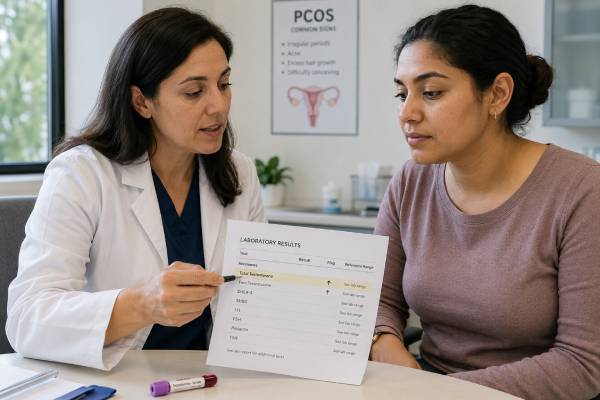
A testosterone test in women is mainly used to investigate signs of androgen excess, including new facial or body hair, persistent acne, scalp hair thinning, irregular periods, or difficulty ovulating. Testosterone is normally present in women and supports sexual function, bone, muscle, and general physiology, but concentrations are much lower than in men. The ovaries and adrenal glands produce androgen precursors, and other tissues convert those hormones into testosterone. An elevated result is most often associated with PCOS, yet the test cannot diagnose PCOS by itself. Medications, supplements, congenital adrenal hyperplasia, severe insulin resistance, ovarian hyperthecosis, Cushing syndrome, and rare ovarian or adrenal tumors can also raise testosterone. Accurate testing matters because many routine immunoassays perform poorly at the low concentrations found in women. Results should be interpreted with symptoms, SHBG, menstrual history, contraception, age, assay method, and the laboratory’s own reference interval.
- Total and free testosterone are the preferred blood measures for biochemical androgen excess, with SHBG helping explain how much testosterone is available to tissues.
- PCOS is the most common cause of high testosterone in reproductive-age women, but pregnancy, thyroid, prolactin, adrenal, and medication causes may need exclusion.
- Rapid hair growth, voice deepening, clitoral enlargement, or a markedly high result needs prompt evaluation for severe ovarian or adrenal androgen excess.
- LC–MS/MS is preferred for total testosterone in women because direct immunoassays can be inaccurate at low concentrations.
- Combined hormonal contraception changes testosterone and SHBG, so testing on the pill may not show the untreated androgen pattern.
Table of Contents
- What a Testosterone Test Measures
- When Testosterone Testing Is Useful
- Preparation, Timing, and Laboratory Methods
- Testosterone Ranges and Result Interpretation
- Causes of High Testosterone in Women
- Hair Growth, PCOS, and Related Tests
- Treatment, Low Results, and Common Questions
What a Testosterone Test Measures
Testosterone belongs to the androgen family of steroid hormones. In women, the ovaries and adrenal glands each contribute to androgen production, while conversion in skin, fat, and other tissues supplies additional testosterone. Testosterone can also be converted to dihydrotestosterone in androgen-sensitive tissues or to estradiol through aromatase.
Blood contains several testosterone fractions:
- Total testosterone includes free hormone plus testosterone bound to SHBG and albumin.
- Free testosterone is the small unbound fraction.
- Bioavailable testosterone usually means free plus the portion loosely bound to albumin.
- Calculated free testosterone estimates the free fraction from total testosterone, SHBG, and sometimes albumin.
- Free androgen index divides total testosterone by SHBG and multiplies by 100 when both are in nmol/L.
Total testosterone is generally the first measurement. Free testosterone adds value when total testosterone is normal but symptoms strongly suggest androgen excess, or when SHBG is unusually high or low. An SHBG test in women is therefore often ordered at the same time.
Androgens influence terminal hair growth, oil production, acne, ovarian follicle development, libido, muscle, and bone. Their effects do not track perfectly with a single blood number. Hair follicles vary in sensitivity, and local enzymes determine how much testosterone becomes more potent dihydrotestosterone. A woman can have troublesome hirsutism with testosterone within range, while another can have a mild biochemical elevation with few skin signs.
The test shows the concentration present in one sample. It does not show where excess androgen came from, establish how long it has been elevated, or determine whether a symptom will improve with treatment. The pattern of total testosterone, free testosterone, SHBG, DHEA-S, androstenedione, and 17-hydroxyprogesterone can help distinguish ovarian, adrenal, medication-related, and other causes.
Testosterone is reported in ng/dL, nmol/L, or occasionally another unit. For conversion, 1 ng/dL is approximately 0.0347 nmol/L. Use care with decimal points: female concentrations are low, so an error in units can make a result appear dozens of times higher or lower than it is.
When Testosterone Testing Is Useful
Testing is appropriate when clinical features suggest androgen excess. Common reasons include:
- Coarse, dark hair developing in androgen-sensitive areas
- Persistent or severe acne
- Female-pattern scalp hair loss
- Infrequent, unpredictable, or absent periods
- Infertility related to irregular ovulation
- Rapid increase in muscle mass
- Voice deepening or clitoral enlargement
- An ovarian or adrenal mass found on imaging
- Monitoring a known androgen-producing condition
- Suspected exposure to testosterone, DHEA, or anabolic steroids
Hirsutism means terminal hair growth in a male-pattern distribution, such as the upper lip, chin, chest, lower abdomen, back, or inner thighs. It differs from hypertrichosis, which is generalized hair growth that may be unrelated to androgens. A clinician may use a modified Ferriman–Gallwey score, but normal hair patterns vary with ancestry, age, hair-removal practices, and personal distress. The person’s concern remains clinically important even when a formal score is low.
Testing is particularly useful when hair growth is moderate to severe, progresses despite treatment, begins suddenly, or accompanies menstrual disturbance. Mild, stable facial hair with regular cycles and no other signs may be idiopathic, meaning follicle sensitivity rather than measurable hormone excess is the main factor.
PCOS evaluation commonly includes total and free testosterone. A PCOS blood test panel also excludes disorders that can resemble PCOS and evaluates metabolic risk. Testosterone alone cannot distinguish PCOS from all other causes.
Testing may be considered after menopause when new or rapidly worsening androgen signs appear. Gradual mild hair growth can occur as estrogen and SHBG fall, but rapid virilization is not a normal part of aging. Ovarian hyperthecosis and androgen-producing tumors become important possibilities in severe cases.
Low testosterone testing in women is less clearly defined. Concentrations decline with age and after removal of both ovaries, but symptoms such as fatigue, low desire, low mood, and reduced muscle have many causes. There is no universally accepted biochemical syndrome of “female testosterone deficiency” for the general population. A number below range should be interpreted within a broader endocrine and clinical evaluation, not used alone to justify hormone treatment.
Preparation, Timing, and Laboratory Methods
A morning blood draw provides the most consistent result because testosterone can be higher earlier in the day. The daily rhythm is smaller in women than in men, but morning collection is helpful for repeatable testing. Some laboratories request fasting, particularly when glucose, insulin, or lipids are drawn at the same visit. Follow the specific instructions on the order.
For a cycling woman, early follicular testing—often during the first several days after menstrual bleeding begins—can reduce cycle-related variation. Testosterone does not swing as predictably as estradiol or progesterone, and urgent evaluation should not be delayed because the cycle is irregular or a specific day is unavailable.
Report all hormone use and supplements. Relevant products include:
- Combined birth control pills, patches, or rings
- Progestin-only contraception
- Estrogen or testosterone therapy
- DHEA, pregnenolone, “adrenal support,” or bodybuilding products
- Anabolic steroids used by the patient or a household contact
- Spironolactone, finasteride, or other antiandrogens
- Glucocorticoids
- Antiseizure medicines
- High-dose biotin
Testosterone gels and creams can transfer through skin contact. A woman may develop an abnormal result after repeated contact with a partner’s application site, towels, clothing, or bedding. Sample contamination can also occur when topical testosterone is applied near the arm used for venipuncture. Wash hands after applying prescribed products, cover the site as directed, and tell the clinician about possible transfer.
Combined hormonal contraception suppresses ovarian androgen production and raises SHBG, often lowering free testosterone. This can hide the untreated pattern. When biochemical androgen assessment is essential, guidance for PCOS suggests stopping the combined pill for at least three months and using another contraceptive method during that interval. That is a clinician-directed decision, not a step to take independently. The article on hormone testing while using oral contraception explains these effects in more detail.
Laboratory method strongly affects accuracy. Female testosterone concentrations sit near the lower limit of many immunoassays developed for male levels. Liquid chromatography–tandem mass spectrometry, abbreviated LC–MS/MS, offers better specificity and is preferred for total testosterone when available. An unexpected elevation measured by immunoassay should often be repeated with LC–MS/MS before extensive imaging or treatment.
Direct free-testosterone immunoassays are usually unreliable in women. Free testosterone is better assessed by equilibrium dialysis, ammonium sulfate precipitation, or a validated calculation using accurate total testosterone and SHBG. The report should identify the method and provide a female reference interval.
Testosterone Ranges and Result Interpretation
There is no universal adult female testosterone range. Intervals depend on age, menopausal status, assay, sample timing, and laboratory population. Many total-testosterone intervals for reproductive-age women fall roughly between 15 and 70 ng/dL, but some validated ranges are narrower or lower. The number printed by the performing laboratory is the correct starting point.
Reference intervals also decline with age. A premenopausal interval should not be applied automatically after menopause, and an immunoassay result should not be compared with an LC–MS/MS range. Free testosterone may be reported in pg/mL, pmol/L, or as a calculated value with method-specific limits.
| Result pattern | Possible interpretation | Usual response |
|---|---|---|
| Mild total or free elevation | PCOS, low SHBG, medication exposure, or assay variation may explain it | Confirm method and evaluate symptoms and related hormones |
| Normal total, high calculated free testosterone | Low SHBG may reveal biochemical androgen excess | Assess PCOS, metabolic factors, thyroid function, and medicines |
| High total, normal free testosterone | High SHBG may be raising the total concentration | Review estrogen use, pregnancy, thyroid, and liver factors |
| Marked elevation or rapid rise | Severe ovarian or adrenal androgen excess becomes more concerning | Prompt repeat by LC–MS/MS and specialist evaluation |
| Low result | Age, ovarian removal, pituitary or adrenal disease, medication, or assay limits may contribute | Interpret only with symptoms and other hormone findings |
A mild elevation is much more common than an extreme one. PCOS values frequently overlap the upper end of the normal population, and the degree of elevation does not measure symptom severity. A small result above range should be confirmed before a diagnosis is changed.
Marked biochemical androgen excess deserves faster investigation, especially when symptoms progressed over months rather than years. Exact tumor thresholds vary by assay and guideline. Older rules such as “over 150” or “over 200 ng/dL” can be useful warning signals but should not be treated as universal boundaries. Current specialist guidance emphasizes a result substantially above the female range, reliable LC–MS/MS confirmation, symptom tempo, and imaging when indicated.
Assay interference can produce a false elevation. Heterophile antibodies, biotin effects, cross-reactivity with other steroids, and sample contamination are possible. A result that is dramatically abnormal in a woman with no clinical signs should be checked by a different method before invasive testing.
Changes over time are easiest to interpret with the same laboratory. Record the collection time, cycle status, contraception, supplements, and assay. A trend from 35 to 55 ng/dL may reflect a real change or simply a switch in methods; the reports provide the context.
Causes of High Testosterone in Women
High testosterone, or biochemical hyperandrogenism, has several possible sources. The pace and pattern of symptoms help rank them.
Polycystic ovary syndrome
PCOS is the most frequent cause in reproductive-age women. The ovaries produce more androgens, and insulin resistance can amplify ovarian production while lowering SHBG. Typical features include irregular ovulation, hirsutism, acne, and sometimes polycystic ovarian morphology. Some women have normal total testosterone but elevated free testosterone because SHBG is low.
PCOS remains a diagnosis of combined features after excluding mimics. A high testosterone result supports biochemical hyperandrogenism, but it does not prove that PCOS is the cause. Rapid virilization, a very high level, or onset after menopause is atypical and requires a broader search.
Medication, supplement, and accidental exposure
Prescribed testosterone, DHEA, anabolic steroids, compounded hormones, and mislabeled performance or sexual-wellness supplements can raise testosterone. Exposure may be intentional, undisclosed, or accidental through contact with a partner’s gel. Some ovarian stimulation protocols also alter androgen measurements.
Stopping a nonprescribed product may be appropriate, but prescribed therapy should be reviewed with the clinician. Bring the container or a photo of every supplement label; terms such as “prohormone” may hide androgenic ingredients.
Adrenal disorders
Nonclassic congenital adrenal hyperplasia from 21-hydroxylase deficiency can resemble PCOS. An early-morning 17-hydroxyprogesterone screen is used, with an ACTH stimulation test when the result is borderline. Cushing syndrome can cause hirsutism, acne, irregular periods, easy bruising, muscle weakness, wide purple stretch marks, and other features, but widespread cortisol screening is not needed for every mild testosterone elevation.
Adrenal tumors can produce testosterone, DHEA-S, or multiple steroids. A disproportionately high DHEA-S result points more strongly toward an adrenal source, although normal DHEA-S does not rule out every adrenal condition.
Ovarian hyperthecosis and tumors
Ovarian hyperthecosis involves androgen-producing theca cells distributed through the ovaries. It is more often recognized after menopause and can cause severe insulin resistance, hirsutism, and virilization. Ovaries may look enlarged or even appear unremarkable on imaging.
Androgen-secreting ovarian tumors are rare but important. They often produce rapidly progressive symptoms and a substantial testosterone elevation. Pelvic ultrasound is a common first imaging test, followed by MRI when needed. A small tumor may be difficult to see, so negative initial imaging does not always end the evaluation when biochemical evidence is strong.
Other endocrine and genetic patterns
Severe insulin-resistance syndromes can drive very high ovarian androgen production and low SHBG. Acromegaly and other uncommon endocrine disorders may contribute. Pregnancy-related ovarian conditions can cause temporary virilization. Differences of sex development may be considered in selected presentations, especially when symptoms began around puberty.
The cause should never be assigned from testosterone alone. Age, menstrual pattern, onset speed, physical examination, medication exposure, DHEA-S, 17-hydroxyprogesterone, SHBG, and imaging create the diagnostic picture.
Hair Growth, PCOS, and Related Tests
Testosterone helps explain hirsutism, but the blood level and hair burden often diverge. Terminal hair develops over months. Even after androgens fall, existing coarse hairs do not immediately become fine; treatment mainly slows new growth and reduces regrowth. Visible improvement from hormonal therapy may take six months or longer.
A focused examination looks for acne, scalp hair pattern, acanthosis nigricans, muscle change, clitoral enlargement, voice change, blood pressure, body-weight pattern, and signs of cortisol or thyroid disease. Menstrual history shows whether ovulation is likely regular. Family hair patterns and ancestry provide useful context without dismissing the person’s distress.
Tests chosen alongside testosterone may include:
- SHBG and calculated free testosterone to assess the active fraction
- DHEA-S for adrenal androgen contribution
- Androstenedione when testosterone is normal but suspicion remains
- 17-hydroxyprogesterone to screen for nonclassic congenital adrenal hyperplasia
- TSH and prolactin for irregular or absent periods
- Pregnancy testing when relevant
- Glucose or oral glucose tolerance testing and lipids for PCOS metabolic risk
- Cortisol testing only when clinical features suggest Cushing syndrome
An hirsutism hormone panel should be targeted rather than interpreted as a collection of independent pass-or-fail values. For example, a normal DHEA-S with elevated testosterone favors an ovarian pattern but is not absolute proof.
PCOS diagnosis in adults generally requires two of three features: ovulatory dysfunction, clinical or biochemical hyperandrogenism, and polycystic ovarian morphology, after other disorders are excluded. In some guideline pathways, AMH can substitute for ultrasound in adults, but it should not be used as a single diagnostic test. Adolescents require stricter criteria because irregular cycles and acne can be normal early after menarche.
Hair loss is also not specific to testosterone. Female-pattern scalp thinning may occur with normal androgens. Iron deficiency, thyroid disease, recent illness, weight change, postpartum shedding, medications, and autoimmune disease can contribute. A female hair-loss test panel should reflect the examination and history.
Urgent evaluation is appropriate for voice deepening, rapidly enlarging clitoris, sudden severe hirsutism, rapid muscle change, a palpable mass, or symptoms progressing within months. These features are more concerning than the exact number of hairs removed each week.
Treatment, Low Results, and Common Questions
Treatment depends on the cause, symptom priorities, pregnancy plans, and health risks. For PCOS-related hirsutism or acne in someone not seeking pregnancy, combined hormonal contraception is often considered because it suppresses ovarian androgen production and increases SHBG. Choice depends on migraine history, smoking, blood pressure, clot risk, age, and other contraindications.
An antiandrogen such as spironolactone may be added when response is inadequate. These medicines can affect a developing fetus, so reliable contraception is required when pregnancy is possible. Finasteride is used in selected cases. Flutamide is generally avoided for routine hirsutism because of liver toxicity concerns.
Lifestyle treatment in PCOS should support metabolic health, sleep, and sustainable nutrition rather than promise to “flush out” testosterone. In women with higher weight or insulin resistance, modest weight reduction may improve ovulation, free testosterone, and SHBG, but meaningful care should not depend on weight loss alone. Metformin is used for metabolic and ovulatory indications in selected patients; it is not primarily a cosmetic hair-removal drug.
Laser or light-based hair reduction, electrolysis, shaving, threading, waxing, and topical approaches can be combined with medical treatment. Hormone treatment slows future growth but does not remove established terminal hairs. Acne and scalp hair loss may need dermatologic therapy in parallel.
Tumors and ovarian hyperthecosis require specialist management, often including surgery. Nonclassic congenital adrenal hyperplasia, Cushing syndrome, and severe insulin-resistance conditions have cause-specific treatment. Exogenous androgen exposure is removed or adjusted safely.
What does low testosterone mean in a woman?
A low value may reflect age, menopause, removal of both ovaries, pituitary or adrenal disease, oral estrogen with high SHBG, glucocorticoid use, chronic illness, or assay limitations. It is rarely diagnostic by itself. When pituitary or adrenal disease is suspected, cortisol, ACTH, free T4, TSH, LH, FSH, estradiol, and other tests may be more urgent.
Can a testosterone result diagnose PCOS?
No. It can document biochemical hyperandrogenism, one component of the diagnosis. Some women with PCOS have testosterone within range, and some women with high testosterone have another condition. Menstrual history and exclusion of mimics remain essential.
Why is my total testosterone normal but free testosterone high?
Low SHBG leaves a greater proportion unbound. This pattern is common with insulin resistance, higher body weight, hypothyroidism, and PCOS. Confirm that total testosterone and SHBG were measured accurately and that the laboratory used a validated calculation.
Does high testosterone always cause facial hair?
No. Hair-follicle sensitivity, ancestry, age, local hormone conversion, and duration of exposure change the response. Hirsutism can occur with normal blood androgens, and mild biochemical elevation may cause little visible hair growth.
Should I take a supplement to lower testosterone?
Avoid products marketed as hormone detoxes or blockers. Evidence and purity are uncertain, ingredients can interact with medicines, and some supplements contain undisclosed hormones. Identify the cause first and use treatments with known dosing, safety, and pregnancy precautions.
When should the test be repeated?
Repeat an unexpected or borderline elevation with a reliable method, preferably under similar morning and medication conditions. A markedly abnormal result should be confirmed promptly, but repeat testing must not delay imaging or specialist assessment when virilization is progressing quickly.
The safest interpretation combines the laboratory report with symptom tempo. Slowly developing acne and irregular periods over years fit a different risk pattern from a deepening voice and rapid hair growth over three months, even before the final diagnosis is known.
References
- Testosterone Levels Test 2025 (Official Test Guide)
- Society for Endocrinology Clinical Practice Guideline for the Evaluation of Androgen Excess in Women 2025 (Clinical Practice Guideline)
- Recommendations From the 2023 International Evidence-based Guideline for the Assessment and Management of Polycystic Ovary Syndrome 2023 (Guideline Recommendations)
- Evaluating the diagnostic accuracy of androgen measurement in polycystic ovary syndrome: a systematic review and diagnostic meta-analysis to inform evidence-based guidelines 2025 (Systematic Review)
- Approach to androgen excess in women: Clinical and biochemical insights 2022 (Review)
- Practical Approach to Hyperandrogenism in Women 2021 (Review)
Disclaimer
This article provides general education and cannot diagnose PCOS, an adrenal or ovarian disorder, hirsutism, or androgen deficiency. Testosterone results require a reliable assay, female reference interval, SHBG context, medication and contraception history, symptoms, and clinical assessment. Seek prompt care for rapidly progressive hair growth, voice change, clitoral enlargement, severe symptoms, or a markedly elevated result.