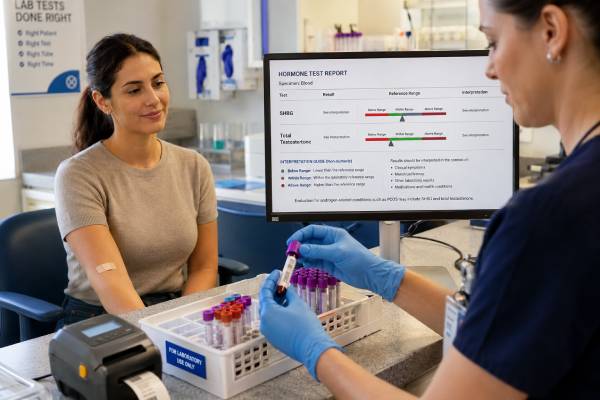
Sex hormone-binding globulin, or SHBG, is a protein made mainly by the liver that carries testosterone, estradiol, and other sex hormones through the bloodstream. An SHBG blood test is most useful when symptoms and a total testosterone result do not agree. A low SHBG level can leave a larger share of testosterone unbound and available to tissues, sometimes contributing to acne, excess facial or body hair, scalp hair thinning, or irregular periods. A high level can make total testosterone look adequate even when the free portion is low. SHBG is not a stand-alone diagnosis, and there is no single “ideal” value for every woman. Estrogen-containing contraception, pregnancy, thyroid disease, liver function, insulin resistance, body composition, age, medications, and genetics can all shift the result. Clinicians usually interpret SHBG beside total testosterone, albumin, symptoms, menstrual history, and the laboratory’s age- and sex-specific range.
- SHBG controls how much testosterone is tightly bound, so a low result often means a higher free-androgen fraction even when total testosterone is normal.
- Low SHBG is common with insulin resistance, obesity, hypothyroidism, androgen excess, and PCOS, but it cannot confirm any of these conditions alone.
- High SHBG commonly occurs with pregnancy, estrogen-containing birth control, estrogen therapy, and hyperthyroidism and may reduce calculated free testosterone.
- Total testosterone and SHBG are often tested together to calculate free testosterone or a free androgen index.
- Hormonal contraception can make androgen testing hard to interpret because it raises SHBG and lowers ovarian androgen production.
Table of Contents
- What SHBG Does and Why It Is Tested
- When Women Need an SHBG Test
- Preparation, Timing, and Test Methods
- Understanding SHBG, Total, and Free Testosterone
- Causes of Low SHBG
- Causes of High SHBG
- PCOS, Follow-Up, and Common Questions
What SHBG Does and Why It Is Tested
SHBG is a glycoprotein produced primarily by liver cells. It binds testosterone and dihydrotestosterone strongly and estradiol less strongly. Albumin also carries sex hormones, but its binding is weaker. In a typical blood sample, only a small fraction of testosterone is completely unbound, or free. The balance between total testosterone, SHBG, albumin, and binding affinity affects how much hormone is available to enter tissues.
This relationship explains why total testosterone can be misleading. Consider two women with the same total testosterone concentration. If one has low SHBG, she may have more free testosterone and signs of androgen excess. If the other has high SHBG, her free fraction may be much lower. The total number is identical, but the biological context differs.
An SHBG test does not directly show androgen action in the skin, hair follicle, ovary, brain, muscle, or bone. Tissue sensitivity, local conversion of hormones, age, genetics, and duration of exposure also influence symptoms. Some women develop marked facial hair with only modest biochemical elevation, while others have a high free-androgen result with few visible signs.
Clinicians most often order SHBG with total testosterone. The combination can support a calculated free testosterone result or a free androgen index. SHBG may also help explain why a total testosterone level changes after starting or stopping an estrogen-containing medicine, why symptoms persist despite a “normal” total value, or why a result appears unexpectedly high without signs of androgen excess.
SHBG is not a routine screening test for everyone. It is most informative when there is a defined question about androgen status, PCOS, medication effects, or an unexpectedly abnormal testosterone result. A broad female hormone panel may include many markers, but ordering more hormones does not automatically produce a clearer answer.
The protein is sometimes described as only a passive carrier. Its biology is more complex, but in everyday clinical interpretation its most useful role is still as a determinant of the circulating free fraction. Treatment decisions should focus on the cause and the person’s symptoms rather than trying to force SHBG toward a narrow target.
When Women Need an SHBG Test
An SHBG test may be useful when signs of high testosterone are present but total testosterone is normal or borderline. These signs include:
- Coarse terminal hair on the face, chest, abdomen, or back
- Persistent acne after adolescence
- Scalp hair thinning in an androgen-sensitive pattern
- Irregular, infrequent, or absent periods
- Difficulty ovulating or becoming pregnant
- Rapid muscle gain, voice deepening, clitoral enlargement, or other virilization
The test may also be ordered when low androgen availability is being considered. Symptoms such as low sexual desire, fatigue, reduced well-being, or loss of muscle are nonspecific, and no SHBG value can prove that testosterone is the cause. In premenopausal women, these symptoms require evaluation for sleep problems, depression, medication effects, anemia, thyroid disease, relationship factors, menopause transition, and other common explanations.
SHBG helps when a total testosterone result seems implausible. A high total value with high SHBG may leave free testosterone within range. A normal total value with very low SHBG can conceal biochemical hyperandrogenism. This is why a free testosterone assessment in women often includes SHBG rather than relying on a direct free-testosterone immunoassay.
Common clinical reasons for testing include:
- Suspected PCOS or another androgen-excess condition
- Hirsutism, acne, or female-pattern hair loss
- A total testosterone result that conflicts with symptoms
- Monitoring a known androgen disorder
- Evaluating the effect of oral estrogen, combined hormonal contraception, or hormone therapy
- Investigating unexpectedly high total testosterone without virilization
- Assessing possible liver or thyroid contributions to an abnormal binding-protein level
SHBG may be measured during menopausal hormone therapy or testosterone treatment, but routine testing schedules vary. Transdermal estradiol usually affects liver protein production less than oral estrogen. Oral estrogen passes through the liver first and can raise SHBG substantially. The result may help interpret total and free testosterone, but it does not replace clinical monitoring for benefit, dose, and adverse effects.
Testing solely as a “metabolic health score” is not recommended. Low SHBG is associated with insulin resistance, type 2 diabetes risk, and fatty liver in populations, yet an individual result cannot diagnose insulin resistance or predict disease with enough certainty. Glucose, hemoglobin A1c, lipids, blood pressure, waist measures, history, and risk factors provide more direct metabolic information.
Preparation, Timing, and Test Methods
An SHBG blood draw usually needs no special preparation. Because it is often collected with testosterone and other hormones, the clinician may request a morning sample, fasting, or a particular cycle phase. Follow the instructions for the whole panel rather than the SHBG test alone.
Testosterone has a daily rhythm, although it is less pronounced in women than in men. A morning sample can improve consistency, especially when a borderline result will be repeated. In cycling women, some clinicians prefer an early follicular-phase sample after menstruation begins because ovarian hormone conditions are relatively stable. Urgent evaluation of rapidly progressive virilization should not be delayed to wait for a perfect cycle day.
List every medicine and supplement. Important exposures include:
- Combined oral contraceptives, patches, and vaginal rings
- Oral or transdermal estrogen therapy
- Testosterone, DHEA, anabolic steroids, or “hormone support” products
- Progestins and antiandrogens
- Thyroid hormone
- Glucocorticoids
- Antiseizure medicines
- High-dose biotin, which can interfere with some assays
Do not stop prescribed contraception or hormone therapy without a plan. Combined hormonal contraception raises SHBG and lowers gonadotropin-dependent androgen production, so testing while using it may not reflect the untreated state. When biochemical evaluation is essential, current PCOS guidance advises that the combined pill may need to be stopped for at least three months while another contraceptive method is used. This step is not necessary for every patient and should be arranged with the prescriber. More detail is covered in oral contraceptive hormone testing.
SHBG is measured by an immunoassay and commonly reported in nmol/L. Reference intervals differ considerably by laboratory, age, puberty stage, pregnancy status, and hormone use. A result near a boundary should not be compared with a random online range.
Total testosterone should ideally be measured with a method accurate at the low concentrations found in women. Liquid chromatography–tandem mass spectrometry, or LC–MS/MS, is preferred when available, particularly for an unexpected or severe elevation. Direct free-testosterone immunoassays are often inaccurate at female concentrations. Equilibrium dialysis is a reference method for free testosterone but is not widely available; validated calculation methods are more practical in many laboratories.
Albumin may be measured or assumed in a calculated free-testosterone equation. The exact formula, assay method, and reference interval matter. Results generated by different calculators are not always interchangeable, so trends are easiest to interpret when the same laboratory and method are used.
Understanding SHBG, Total, and Free Testosterone
SHBG should be read as part of a pattern rather than as high or low in isolation. The laboratory report usually provides an adult female interval, but pregnancy, menopause, and hormone treatment can make that interval less applicable.
| Pattern | Possible meaning | Interpretive caution |
|---|---|---|
| Low SHBG, normal total testosterone | Free testosterone may be elevated | Confirm with a validated calculation and assess metabolic or thyroid causes |
| Low SHBG, high total testosterone | Androgen excess is more likely | Rapid symptoms or marked elevation need prompt evaluation |
| High SHBG, high total testosterone | Free testosterone may still be normal | Estrogen use, pregnancy, hyperthyroidism, and liver factors may explain the pattern |
| High SHBG, low or normal total testosterone | Calculated free testosterone may be low | Symptoms are nonspecific; do not diagnose androgen deficiency from one result |
| Normal SHBG and testosterone | Major biochemical androgen excess is less likely | Clinical hair or skin symptoms can still occur |
The free androgen index, or FAI, is commonly calculated as total testosterone divided by SHBG, multiplied by 100, when both are expressed in nmol/L. It is dimensionless. A low SHBG can increase the FAI sharply even when total testosterone changes little. Laboratories must use their own female reference interval; there is no universal cutoff that diagnoses PCOS.
FAI is simple but has limitations. It assumes a fixed relationship between testosterone and SHBG and does not explicitly account for albumin. It can become less reliable at very low SHBG concentrations and may exaggerate the free fraction. Calculated free testosterone based on mass-action equations may perform better when total testosterone, SHBG, and albumin are measured accurately. The report should state what method was used.
“Bioavailable testosterone” generally means free plus albumin-bound testosterone. It is different from free testosterone and from FAI. These terms are sometimes mixed in consumer reports, so check the units and calculation rather than comparing labels alone.
An abnormal SHBG level does not necessarily cause symptoms. It may be a marker of another process. For example, oral estrogen stimulates liver production of SHBG and raises total testosterone because more hormone is carried in the blood. The free fraction may fall or remain stable. Conversely, insulin resistance can suppress liver SHBG production, increasing the calculated free fraction without a large increase in total testosterone.
Repeat testing is reasonable when the result is unexpected, conflicts with the clinical picture, or was obtained during acute illness or a major medication change. The repeat should use the same assay where possible. Clinicians also look at the pace of symptoms: slowly developing hirsutism over years is different from rapid voice change and virilization over months.
Causes of Low SHBG
Low SHBG often reflects reduced liver production, increased androgen effect, or metabolic signaling. Common causes overlap and may occur together.
Insulin resistance and higher body weight
Insulin resistance and increased liver fat are frequently associated with lower SHBG. Higher insulin levels can suppress hepatic SHBG production, while ovarian androgen production may rise in susceptible women. This combination can increase free testosterone and worsen acne or hirsutism.
A low result is not a direct insulin measurement. Some lean women with PCOS have low SHBG, while some people with insulin resistance have values within range. Follow-up should use established metabolic tests rather than a single SHBG cutoff. Depending on risk, these may include fasting glucose, hemoglobin A1c, a 75-g oral glucose tolerance test, lipids, blood pressure, and liver assessment.
PCOS and androgen excess
PCOS commonly combines androgen excess, irregular ovulation, and metabolic factors that lower SHBG. Low SHBG can make free testosterone high even when total testosterone is only mildly elevated. However, SHBG is not one of the diagnostic criteria by itself. A PCOS blood test panel is used to document androgen status, exclude mimicking disorders, and assess metabolic risk.
Other androgen-excess causes can also lower SHBG. These include nonclassic congenital adrenal hyperplasia, Cushing syndrome, severe insulin-resistance syndromes, ovarian hyperthecosis, androgen-producing tumors, and exposure to testosterone or anabolic steroids. Rapidly progressive hair growth, virilization, or a marked testosterone elevation deserves urgent specialist assessment.
Hypothyroidism and other conditions
Low thyroid hormone can reduce SHBG production. TSH and free T4 are therefore useful when low SHBG occurs with fatigue, cold intolerance, constipation, dry skin, or menstrual change. A hypothyroidism blood test panel can clarify the thyroid pattern.
Glucocorticoid excess, nephrotic syndrome, acromegaly, and some chronic illnesses may lower SHBG. Exogenous androgens and certain progestins can do the same. Genetic variation also produces naturally low values in some people without disease.
Treatment should address the identified cause. Improving insulin sensitivity through sustainable nutrition, physical activity, sleep, and indicated medical treatment may raise SHBG in some women, but the aim is better metabolic and reproductive health rather than a specific protein level. Do not use estrogen solely to raise SHBG unless there is a separate clinical indication and the benefits and risks have been assessed.
Causes of High SHBG
High SHBG usually increases the bound fraction of testosterone and can raise total testosterone while reducing the calculated free portion. The most common explanations are physiological or medication-related.
Pregnancy and estrogen exposure
Estrogen stimulates liver SHBG production. Levels rise markedly during pregnancy and commonly increase with combined hormonal contraception or oral menopausal estrogen. The rise may persist for a period after treatment changes. Transdermal estradiol generally has a smaller liver effect than oral therapy, although individual responses vary.
A high SHBG result while taking estrogen is usually an expected pharmacological effect, not proof of liver disease. It can make androgen testing difficult to interpret. If symptoms began after a treatment change, clinicians review the formulation, route, dose, indication, and other possible causes rather than treating the SHBG number alone.
Hyperthyroidism
Excess thyroid hormone increases SHBG production. High SHBG may appear with a low TSH, high free T4 or T3, palpitations, tremor, heat intolerance, weight loss, or more frequent bowel movements. Correcting hyperthyroidism generally moves SHBG toward the usual range. Thyroid testing is particularly important when high SHBG is unexplained by pregnancy or estrogen use.
Liver conditions, low weight, and medications
Because the liver makes SHBG, some liver disorders alter its concentration. High values can occur with certain chronic liver conditions, although advanced liver dysfunction can produce complex and inconsistent patterns. Liver enzymes, albumin, bilirubin, symptoms, and imaging—not SHBG alone—determine whether liver evaluation is needed.
Low body weight, undernutrition, and some eating disorders may be associated with high SHBG. Certain antiseizure medicines and other drugs can also increase it. HIV infection and treatment have been associated with altered SHBG in some populations. Genetics and aging contribute to individual variation.
Very high SHBG can make calculated free testosterone small, but “low testosterone in women” remains difficult to define. There is no well-validated universal symptom syndrome or threshold for most premenopausal women. A clinician should not prescribe testosterone simply because SHBG is high and a calculator flags free testosterone. The treatment indication, menopausal status, symptoms, contraindications, and monitoring plan all matter.
PCOS, Follow-Up, and Common Questions
In suspected PCOS, SHBG helps estimate biochemical hyperandrogenism. Current guidance recommends total and free testosterone as the primary biochemical measures. Free testosterone may be calculated from total testosterone and SHBG or represented by FAI, provided reliable assays and female reference ranges are used.
PCOS is diagnosed from a combination of ovulatory dysfunction, clinical or biochemical hyperandrogenism, and polycystic ovarian morphology or an accepted alternative marker, after excluding other causes. Low SHBG can support the androgen interpretation but cannot substitute for this process. Menstrual history, pregnancy testing, TSH, prolactin, 17-hydroxyprogesterone, and sometimes DHEA-S or other tests may be needed.
What SHBG level is normal for a woman?
There is no universal range. Adult female intervals often span several-fold and differ by assay, age, pregnancy, and hormone use. Use the interval on the report. A value that is normal for a person taking estrogen may not be interpreted the same way in someone who is untreated.
Does low SHBG prove insulin resistance?
No. It may raise suspicion in the right context, especially with PCOS, central weight gain, high triglycerides, or abnormal glucose, but it is not a diagnostic test. Use validated metabolic screening and consider family history, blood pressure, sleep apnea, and pregnancy history.
Can birth control permanently raise SHBG?
Combined hormonal contraception commonly raises SHBG while it is used. The level generally falls after stopping, but the timing varies with formulation, duration, liver response, and individual biology. A result soon after discontinuation may not represent the long-term untreated baseline. There is no routine reason to track SHBG until it reaches a specific post-pill target.
Should high or low SHBG be treated directly?
Usually not. Treat hypothyroidism or hyperthyroidism, manage PCOS and metabolic risk, review medications, address liver or nutrition concerns, and manage androgen symptoms according to their cause. Changing a medically useful estrogen or contraceptive solely to normalize SHBG may create more harm than benefit.
Can SHBG explain hair growth when testosterone is normal?
Sometimes. Low SHBG may reveal an elevated free fraction that total testosterone misses. Yet hair follicles also vary in sensitivity, and established terminal hairs can persist after hormones improve. A complete hirsutism hormone evaluation considers symptom pace, menstrual pattern, medications, family traits, and other androgens.
When is follow-up urgent?
The SHBG value itself rarely creates an emergency. Prompt evaluation is needed for rapid-onset coarse hair, voice deepening, clitoral enlargement, rapidly increasing muscle mass, an abdominal or pelvic mass, severe headaches, or markedly high testosterone. These findings raise concern for severe androgen excess rather than a binding-protein abnormality alone.
Bring the full report to follow-up, including total testosterone, SHBG, albumin, calculated result, units, assay method, reference intervals, medications, and cycle or hormone-treatment status. This prevents a common error: interpreting an isolated SHBG number without the hormone it is meant to contextualize.
References
- SHBG Blood Test 2026 (Official Test Guide)
- Recommendations From the 2023 International Evidence-based Guideline for the Assessment and Management of Polycystic Ovary Syndrome 2023 (Guideline Recommendations)
- Society for Endocrinology Clinical Practice Guideline for the Evaluation of Androgen Excess in Women 2025 (Clinical Practice Guideline)
- Approach to androgen excess in women: Clinical and biochemical insights 2022 (Review)
- Role of sex hormone-binding globulin in the free hormone hypothesis and the relevance of free testosterone in androgen physiology 2022 (Review)
- Evaluating the diagnostic accuracy of androgen measurement in polycystic ovary syndrome: a systematic review and diagnostic meta-analysis to inform evidence-based guidelines 2025 (Systematic Review)
Disclaimer
This article provides general education and cannot diagnose PCOS, androgen excess, thyroid disease, insulin resistance, or a liver condition. SHBG must be interpreted with total testosterone, a reliable free-testosterone estimate, symptoms, medications, pregnancy or hormone-use status, and the reporting laboratory’s range. Seek prompt medical assessment for rapid virilization or a markedly abnormal androgen result.