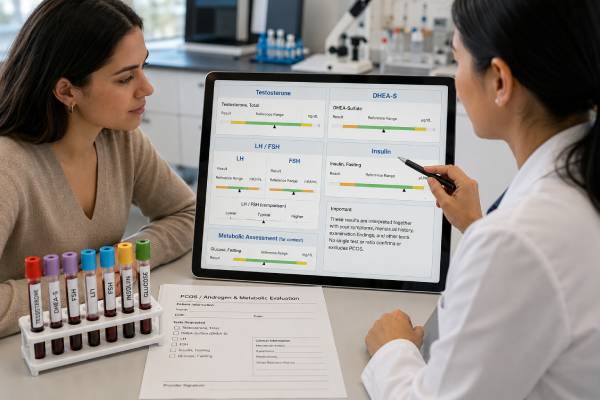
A PCOS blood test panel helps document androgen excess, exclude conditions that resemble polycystic ovary syndrome, and assess metabolic risks, but no single result confirms PCOS. The most useful androgen tests are total testosterone and an estimate of free testosterone using a high-quality assay. DHEA-S can add information about adrenal androgen production. LH and FSH may help identify other causes of irregular periods, yet the LH/FSH ratio is not a required diagnostic criterion and can be normal in PCOS. Insulin resistance is central to the condition for many people, but fasting insulin and HOMA-IR are not reliable routine diagnostic tests. Glucose testing—preferably a 75-g oral glucose tolerance test when appropriate—provides more actionable information. Results must be interpreted with cycle pattern, acne or excess hair growth, medicines, age, pregnancy status, and the laboratory method. Diagnosis generally requires a combination of ovulatory dysfunction, clinical or biochemical hyperandrogenism, and polycystic ovarian morphology or an accepted alternative marker, after other causes have been excluded.
- Total and free testosterone are the preferred blood markers for biochemical androgen excess in PCOS.
- DHEA-S can support adrenal androgen excess, but a high result is not specific to PCOS and marked elevation needs further evaluation.
- The LH/FSH ratio may be high, normal, or low in PCOS and should never be used as the deciding diagnostic test.
- Fasting insulin is not recommended as a routine PCOS diagnostic marker; glucose testing is more clinically useful.
- Combined oral contraceptives can raise SHBG and lower measurable androgens, making on-pill testing difficult to interpret.
Table of Contents
- What a PCOS Blood Panel Can Show
- Testosterone and SHBG
- DHEA-S and Other Androgens
- LH, FSH, and the LH/FSH Ratio
- Insulin, Glucose, and Metabolic Tests
- Tests That Exclude Other Causes
- Preparing for the Panel
- Interpreting Results and Next Steps
What a PCOS Blood Panel Can Show
PCOS is a clinical syndrome, not a single abnormal hormone level. In adults, diagnosis usually depends on at least two of three features: irregular or absent ovulation, clinical or biochemical androgen excess, and polycystic ovarian morphology on ultrasound or an accepted AMH-based alternative in appropriate settings. Other disorders that produce similar symptoms must be excluded.
Blood tests contribute in three ways:
- They document biochemical hyperandrogenism when visible signs are mild or uncertain.
- They identify another cause of irregular cycles or androgen excess.
- They screen for glucose and lipid abnormalities that affect long-term health.
The panel is selected according to symptoms. Someone with cycles every 60–90 days and new facial hair may need pregnancy testing, total and free testosterone, SHBG, TSH, prolactin, and 17-hydroxyprogesterone. Someone with an established PCOS diagnosis may need glucose, lipids, blood pressure, and fertility-related testing rather than repeated androgen levels.
A normal hormone panel does not always exclude PCOS. Clinical hirsutism can establish androgen excess even when testosterone is within the laboratory interval, and assays may miss small elevations at the low concentrations found in women. Conversely, polycystic-appearing ovaries or a mildly high AMH do not diagnose PCOS without the broader pattern.
Adolescents require extra caution. Irregular cycles and acne are common during normal pubertal development, and ultrasound or AMH should not be used too early to label PCOS. Persistent ovulatory dysfunction and androgen excess are the more important features after other causes are excluded.
Testing should answer a practical question. Repeating a broad panel every few months rarely measures “PCOS improvement” accurately. Cycle frequency, symptoms, blood pressure, glucose status, lipids, sleep, emotional health, and treatment goals are often better follow-up measures.
Ovulatory dysfunction is often recognized from the calendar before any blood draw. In adults, cycles longer than 35 days, fewer than about eight cycles per year, or any interval longer than 90 days are important clues. Regular-looking bleeding does not guarantee ovulation in every case; when confirmation matters, progesterone can be measured about one week before the expected period. A progesterone result can support recent ovulation, but it is not itself a PCOS test.
Ultrasound and AMH require age-appropriate interpretation. Polycystic ovarian morphology refers to an increased follicle number or ovarian volume, not dangerous ovarian cysts. Modern high-resolution ultrasound thresholds differ from older ones, and the finding can occur without PCOS. In adults, a validated AMH assay may be used within an accepted diagnostic algorithm as an alternative to ultrasound, but it should not be used as a single stand-alone test. Neither ultrasound nor AMH is generally recommended for PCOS diagnosis in adolescents because normal puberty can produce similar findings.
Testosterone and SHBG
Total and free testosterone are the preferred biochemical tests for androgen excess. Because female concentrations are low, laboratory quality matters.
Total testosterone measures free hormone plus testosterone bound to SHBG and albumin. Liquid chromatography–tandem mass spectrometry, often abbreviated LC–MS/MS, generally provides better accuracy than direct immunoassays at female levels. A mildly elevated result can support PCOS when the clinical pattern fits.
Free testosterone represents the small unbound fraction. Direct free-testosterone immunoassays are often unreliable. More useful approaches include equilibrium dialysis or calculated free testosterone using total testosterone, SHBG, and sometimes albumin. The free androgen index, calculated from total testosterone and SHBG, is another estimate, although its performance can be affected when SHBG is very low or very high.
SHBG is a liver-produced binding protein. Insulin resistance, obesity, hypothyroidism, and androgen excess can lower SHBG, increasing the free testosterone fraction even when total testosterone is not above range. Estrogen-containing contraceptives raise SHBG and may substantially lower calculated free testosterone.
| Pattern | Possible meaning | Important caution |
|---|---|---|
| High total or free testosterone | Biochemical hyperandrogenism | PCOS is common, but other ovarian or adrenal causes must be considered |
| Normal total, high calculated free testosterone | Low SHBG increases the active fraction | Confirm with a reliable assay and clinical signs |
| Low SHBG | Often associated with insulin resistance or higher body weight | Not specific to PCOS |
| High SHBG with low free testosterone | Often an estrogen-containing contraceptive effect | May hide untreated androgen excess |
Markedly high testosterone, rapid symptom progression, voice deepening, clitoral enlargement, or substantial new muscle growth requires timely evaluation for an androgen-producing ovarian or adrenal disorder. Exact urgent thresholds vary by assay, so the magnitude relative to the laboratory’s upper limit and the clinical pace matter more than one universal cutoff.
The testosterone test in women guide explains assay methods and result patterns in more detail. For binding-protein interpretation, see the SHBG test in women article.
DHEA-S and Other Androgens
DHEA-S, or dehydroepiandrosterone sulfate, is produced mainly by the adrenal glands. It is more stable through the day than DHEA and can help show whether adrenal androgen production contributes to acne, hirsutism, or hair loss.
DHEA-S may be mildly elevated in PCOS, but the test is less sensitive and specific than total or free testosterone. Guidelines generally suggest considering DHEA-S or androstenedione when testosterone is not elevated yet biochemical androgen excess is still suspected.
Interpretation is age-dependent. DHEA-S peaks in early adulthood and gradually declines, so a value that is normal for a younger woman may be unusual later in life. Laboratories use different reference ranges and units, including mcg/dL or µmol/L.
A markedly elevated DHEA-S result raises concern for an adrenal source. PCOS remains possible, but a clinician may repeat the test, review medicines and supplements, assess symptoms, and order additional adrenal testing or imaging. Over-the-counter DHEA supplements can raise the result and should always be disclosed.
Androstenedione comes from both ovaries and adrenal glands. It can identify additional cases of biochemical hyperandrogenism but is less specific and may increase false-positive findings. It is usually a second-line test rather than the first marker ordered.
17-hydroxyprogesterone is not an androgen test, but it screens for nonclassic congenital adrenal hyperplasia, a condition that can mimic PCOS. It is commonly measured in the morning during the early follicular phase when cycles permit. A raised screening result may lead to repeat or stimulation testing.
DHEA rather than DHEA-S is more variable and usually less useful for routine assessment. Salivary androgen panels and unvalidated dried-urine profiles are not standard methods for diagnosing PCOS.
LH, FSH, and the LH/FSH Ratio
LH and FSH are pituitary hormones that coordinate follicle development and ovulation. Some people with PCOS have faster hypothalamic signaling and relatively higher LH secretion. This led to the older idea that an LH/FSH ratio above 2:1 or 3:1 was diagnostic. It is not.
The ratio changes with cycle day, time of sampling, pulsatile LH release, age, body composition, and medication use. A blood draw near a natural LH surge can produce a high ratio in someone without PCOS. Many people with confirmed PCOS have normal LH and FSH values. Combined oral contraceptives suppress both hormones and make the ratio especially uninformative.
LH and FSH still have a role in the differential diagnosis:
- High FSH with low estradiol can suggest primary ovarian insufficiency or menopause rather than PCOS.
- Low or inappropriately normal LH and FSH with low estradiol can suggest hypothalamic or pituitary suppression, often associated with low energy availability, intense exercise, chronic illness, or pituitary disease.
- Normal FSH with irregular cycles and androgen excess may fit PCOS, but it is only one part of the pattern.
- A mid-cycle high LH may simply represent an ovulatory surge.
In people with irregular cycles, testing is often done in the early follicular phase if a spontaneous bleed occurs. When periods are absent, it may be drawn on any day, with pregnancy excluded and the lack of cycle timing noted.
The LH test in women guide covers urine surges and blood results. The key point for PCOS is that neither LH nor the ratio determines whether the syndrome is present or severe.
Insulin, Glucose, and Metabolic Tests
Insulin resistance is common in PCOS and can occur across body sizes. It increases insulin secretion, encourages ovarian androgen production, and lowers SHBG. Yet routine insulin assays do not provide a dependable yes-or-no diagnosis of PCOS or insulin resistance.
Fasting insulin varies with assay, recent diet, stress, sleep, medications, and individual physiology. There is no universally accepted cutoff for women with PCOS. HOMA-IR is calculated from fasting insulin and glucose, but its thresholds vary across studies and populations. Current international guidance does not recommend clinically available insulin assays for routine care.
Glucose testing is more actionable because it detects prediabetes and diabetes:
- 75-g oral glucose tolerance test: Measures fasting glucose and the response two hours after a glucose drink. It is the most accurate test for identifying dysglycemia in PCOS and is particularly useful before pregnancy or fertility treatment.
- Fasting plasma glucose: Easier to perform but can miss impaired glucose tolerance.
- Hemoglobin A1C: Reflects average glycemia over roughly 2–3 months, but may miss some abnormalities and can be affected by anemia, hemoglobin variants, pregnancy, or altered red-cell turnover.
A fasting lipid panel or nonfasting lipid assessment, depending on local practice, evaluates total cholesterol, LDL cholesterol, HDL cholesterol, and triglycerides. Blood pressure should also be measured. These findings help guide prevention and treatment even though they do not diagnose PCOS.
| Metabolic test | Best use | Limitation |
|---|---|---|
| Fasting insulin | Occasional specialist or research context | No standardized diagnostic cutoff for routine PCOS care |
| HOMA-IR | Research estimate of insulin resistance | Depends on fasting insulin assay and population-specific thresholds |
| Oral glucose tolerance test | Most accurate assessment of glucose status | Requires fasting and a two-hour visit |
| A1C | Convenient diabetes screening and monitoring | Can miss impaired glucose tolerance |
Metabolic testing is repeated according to baseline results, age, weight changes, family history, pregnancy plans, and other risk factors—not according to an androgen level alone.
International guidance recommends assessing glycemic status at diagnosis in all adults and adolescents with PCOS, regardless of body size. Reassessment is commonly considered every one to three years, with shorter intervals for abnormal results, additional diabetes risks, major weight change, or pregnancy planning. A 75-g OGTT is also preferred before fertility treatment or pregnancy because undetected hyperglycemia increases pregnancy risks. During pregnancy, testing follows obstetric guidance rather than the nonpregnant PCOS schedule.
Blood pressure should be checked at least periodically and before pregnancy. Lipids are usually assessed at diagnosis, then repeated according to the result and overall cardiovascular risk. Liver enzymes are not diagnostic for PCOS, but they may be ordered when metabolic-associated fatty liver disease is suspected. Screening for obstructive sleep apnea is symptom based; loud snoring, witnessed pauses in breathing, unrefreshing sleep, and daytime sleepiness matter more than a reproductive hormone level.
Tests That Exclude Other Causes
PCOS is a diagnosis made after reasonable exclusion of other explanations. The exact workup varies, but common tests include:
Pregnancy test: Pregnancy is a common cause of a missed period and should be checked first when possible.
TSH: Both underactive and overactive thyroid disease can disrupt cycles. Free T4 is added when TSH is abnormal or pituitary disease is suspected.
Prolactin: Persistent elevation can suppress ovulation and cause irregular or absent periods. A mildly high value may be repeated after avoiding exercise, nipple stimulation, and stressful venipuncture when practical.
17-hydroxyprogesterone: Screens for nonclassic congenital adrenal hyperplasia, especially with hirsutism or high androgens.
FSH and estradiol: Help distinguish ovarian insufficiency from hypothalamic suppression and PCOS.
Cortisol-related testing: Reserved for features such as wide purple stretch marks, easy bruising, proximal muscle weakness, facial rounding, or other signs suggesting Cushing syndrome. Routine cortisol testing in every PCOS evaluation creates false positives.
Other tests may be needed when symptoms are atypical, including hCG-related tumor assessment, adrenal studies, pelvic ultrasound, or imaging. A sudden change is more concerning than long-standing mild acne or hair growth.
An irregular period hormone panel can help organize this differential diagnosis, but the final selection should reflect the patient’s symptoms and history.
Preparing for the Panel
Preparation depends on the ordered tests. Ask whether fasting is needed, especially for an oral glucose tolerance test, fasting glucose, insulin, or triglycerides. During an OGTT, remain seated, avoid food, smoking, and exercise, and follow the laboratory’s timing instructions.
For androgen testing, morning collection is often preferred. If cycles are regular enough, early-follicular sampling can reduce cycle-related variation, although testosterone can be assessed on other days when necessary. Record the first day of the last period and any recent ovulation or bleeding.
Combined oral contraceptives make biochemical androgen assessment unreliable by increasing SHBG and reducing gonadotropin-dependent androgen production. When testing is essential, guidance recommends at least three months off the combined pill with alternative contraception. Do not stop it without a plan. Progestin-only methods, antiandrogens, glucocorticoids, fertility drugs, and menopausal hormones can also alter results.
Tell the clinician about DHEA, “testosterone boosters,” biotin, hair-loss treatments, supplements, antipsychotics, antiseizure medicines, and all prescribed hormones. Biotin can interfere with some immunoassays. Follow laboratory instructions rather than stopping medicines independently.
Acute illness, major sleep loss, intense exercise, and a difficult blood draw can affect some markers. A mildly abnormal result that does not fit the clinical picture may be repeated using a high-quality laboratory before extensive investigation.
Keep copies of the actual numbers, units, reference intervals, cycle day, and medication status. “Normal” and “high” labels cannot be compared safely across laboratories when assay methods differ. For follow-up, using the same laboratory may make trends easier to interpret. However, a change smaller than expected analytical and biological variation should not drive a treatment change on its own. Symptom progression, menstrual history, and the overall biochemical and metabolic pattern remain more important for sound, individualized clinical decisions over time in routine clinical care.
Interpreting Results and Next Steps
Results should be interpreted as patterns, not isolated flags.
A common PCOS pattern is irregular ovulation with clinical hirsutism or elevated total/free testosterone, while TSH, prolactin, and 17-hydroxyprogesterone do not reveal another cause. DHEA-S may be normal or mildly high. LH may be elevated or normal. Glucose and lipids can be normal, prediabetic, or abnormal regardless of androgen severity.
Normal testosterone does not end the evaluation when hirsutism is clear or the assay is poor. A clinician may repeat total testosterone by LC–MS/MS, calculate free testosterone with SHBG, or consider DHEA-S and androstenedione. Conversely, a small laboratory elevation without symptoms should be confirmed before assigning a lifelong diagnosis.
Marked androgen elevation or rapid virilization leads to urgent repeat testing and assessment for ovarian or adrenal causes. High FSH and low estradiol redirect the evaluation toward ovarian insufficiency. Low gonadotropins and low estradiol suggest hypothalamic or pituitary causes. High prolactin or abnormal TSH requires its own workup.
After diagnosis, treatment follows goals. Cycle protection may involve combined hormonal contraception or periodic progestin. Hirsutism and acne may be treated with contraception, topical or cosmetic methods, and selected antiandrogens with reliable pregnancy prevention. Lifestyle support should be individualized and free of stigma. Metformin is considered for metabolic indications and selected cycle goals, while letrozole is commonly first-line for ovulation induction when infertility is due to anovulatory PCOS.
Long gaps without bleeding need attention because prolonged unopposed estrogen exposure can allow the uterine lining to thicken. The exact interval and treatment plan vary, but people going many months without a period should discuss endometrial protection rather than waiting for the androgen panel to normalize. Unexpected heavy bleeding, bleeding after sex, or persistent intermenstrual bleeding may require pregnancy testing, examination, ultrasound, or endometrial evaluation depending on age and risk factors.
Fertility assessment should also look beyond ovulation. Even when PCOS clearly causes irregular cycles, semen factors, tubal disease, age, and uterine conditions can affect conception. A fertility hormone test panel may be part of the workup, but it does not replace semen analysis or tubal assessment when those are indicated.
Do not use repeated insulin or testosterone tests as a scorecard for personal effort. Improvement can appear as more predictable cycles, lower glucose risk, better symptom control, or progress toward fertility goals even when one laboratory value changes little overall.
References
- Recommendations From the 2023 International Evidence-based Guideline for the Assessment and Management of Polycystic Ovary Syndrome — 2023, international clinical practice guideline.
- Recommendations from the 2023 International Evidence-based Guideline for the Assessment and Management of Polyendocrine Metabolic Ovarian Syndrome — 2023, guideline recommendations.
- Current Guidelines for Diagnosing PCOS — 2023, peer-reviewed review.
- Polycystic Ovary Syndrome (PCOS) — 2024, American College of Obstetricians and Gynecologists patient guidance.
- International evidence-based guideline for the assessment and management of polycystic ovary syndrome (PCOS) — 2023, European Society of Human Reproduction and Embryology guideline page.
Disclaimer
This article is for general education and does not diagnose PCOS or another endocrine condition. Results must be interpreted with symptoms, cycle history, medicines, pregnancy status, laboratory methods, and appropriate exclusion testing. Rapid virilization, severe pelvic pain, or pregnancy-related pain and bleeding require prompt medical assessment.