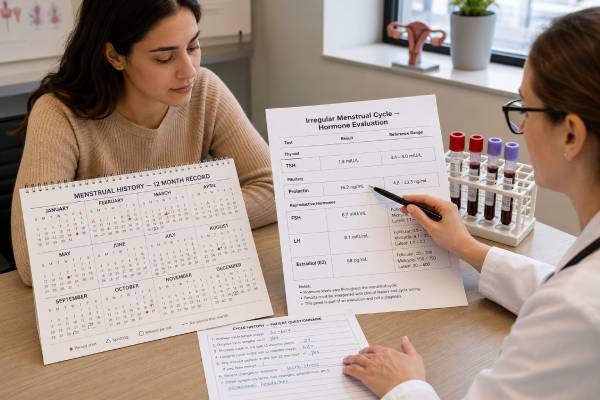
An irregular period hormone panel helps identify endocrine causes of cycles that are unusually long, short, unpredictable, or absent. TSH checks for thyroid dysfunction, prolactin screens for pituitary and medication-related causes, and FSH, LH, and estradiol show how the brain and ovaries are communicating. These tests can point toward polycystic ovary syndrome, hypothalamic suppression, primary ovarian insufficiency, thyroid disease, hyperprolactinemia, perimenopause, or another condition, but the panel does not diagnose every cause of abnormal bleeding. Pregnancy testing is usually the first step, and a complete evaluation may also require a blood count, androgen tests, pelvic ultrasound, or endometrial assessment. Cycle timing, age, symptoms, medications, contraception, and recent changes in weight, exercise, stress, or health strongly affect interpretation. The pattern over time often matters as much as one result.
- Pregnancy should be excluded first whenever a pregnancy is biologically possible, even when bleeding has occurred.
- TSH identifies thyroid patterns that can disrupt ovulation and change menstrual frequency or flow.
- High prolactin can suppress GnRH, lower FSH and LH activity, and cause missed periods or infertility.
- High FSH with low estradiol may suggest ovarian insufficiency or menopause, while low or normal FSH with low estradiol may suggest hypothalamic or pituitary suppression.
- The LH/FSH ratio alone does not diagnose PCOS and may be normal in people who meet accepted PCOS criteria.
- Heavy bleeding, fainting, severe pelvic pain, pregnancy with pain or bleeding, or soaking pads rapidly requires urgent evaluation.
Table of Contents
- When Periods Are Considered Irregular
- What the Panel Measures
- Common Result Patterns
- Causes the Panel Can Help Identify
- Timing and Preparation
- Tests That May Be Added
- How Results Affect Treatment
- When to Seek Prompt Care
When Periods Are Considered Irregular
Menstrual cycles are counted from the first day of one period to the first day of the next. Some variation is normal, especially during the first years after menarche and during perimenopause. In adults, cycles that repeatedly occur less than about 21 days apart, more than about 35 days apart, vary substantially from month to month, or stop for several months deserve assessment when the pattern is new, persistent, or concerning.
Irregularity can involve more than timing. Bleeding may last longer than expected, become unusually heavy, occur between periods, appear after sex, or return after menopause. These patterns can arise from ovulatory hormone problems, but they can also result from fibroids, polyps, adenomyosis, pregnancy complications, infection, bleeding disorders, medication effects, or endometrial disease.
A hormone panel is most useful for suspected ovulatory dysfunction. Ovulation depends on coordinated signals from the hypothalamus, pituitary gland, and ovaries. The hypothalamus releases gonadotropin-releasing hormone, which prompts the pituitary to release FSH and LH. The ovaries respond by developing follicles and producing estradiol. Disruption at any point can change the menstrual pattern.
Evaluation is often recommended when regular periods stop for about 3 months, irregular periods stop for about 6 months, or cycles remain persistently infrequent. Earlier testing may be appropriate with pregnancy symptoms, severe bleeding, infertility, headaches or vision changes, milk discharge, hot flashes at a young age, marked weight change, or signs of androgen excess.
A written or app-based cycle record can make the evaluation more accurate. Record the first and last day of bleeding, flow, clots, pain, spotting, pregnancy tests, medications, and associated symptoms. This history often narrows the cause before laboratory testing begins.
What the Panel Measures
The five hormones in this panel answer different questions. They should be interpreted together rather than compared with isolated online “optimal” values.
TSH
Thyroid-stimulating hormone is released by the pituitary and controls thyroid hormone production. Both hypothyroidism and hyperthyroidism can disturb cycles. Hypothyroidism may cause heavy, infrequent, or absent periods and can also raise prolactin. Hyperthyroidism more often causes lighter or less frequent bleeding, although patterns vary.
An abnormal TSH is usually followed by free T4 and sometimes thyroid antibody testing. The TSH test is not interpreted from symptoms alone because fatigue, weight change, anxiety, and temperature sensitivity overlap with many reproductive conditions.
Prolactin
Prolactin supports milk production after childbirth. When elevated outside pregnancy or breastfeeding, it can suppress hypothalamic GnRH and reduce normal FSH and LH signaling. The result may be irregular or absent periods, infertility, low estrogen symptoms, or galactorrhea.
Prolactin can rise temporarily from stress, sleep, exercise, breast stimulation, sex, venipuncture anxiety, and some medicines. Antipsychotics, certain antidepressants, metoclopramide, opioids, and estrogen-containing products are examples. Mild elevation often needs a carefully prepared repeat test before imaging is considered. A prolactin test in women should also be reviewed with pregnancy and thyroid results.
FSH
FSH stimulates ovarian follicles. Its meaning depends on estradiol and cycle timing. High FSH with low estradiol suggests that the pituitary is sending a strong signal but the ovaries are not responding normally. This pattern can occur in primary ovarian insufficiency or menopause.
Low or normal FSH with low estradiol can reflect reduced hypothalamic or pituitary drive, as in functional hypothalamic amenorrhea. A single normal FSH does not rule out ovarian insufficiency because values can fluctuate, especially early in the condition and during perimenopause.
LH
LH supports ovarian steroid production and triggers ovulation. It may be relatively high in some people with PCOS, but the LH/FSH ratio is neither required nor sufficient for diagnosis. LH can be low with hypothalamic suppression and high after menopause or with ovarian failure.
A random LH measurement cannot reliably prove that ovulation occurred. Urine LH kits detect the surge before ovulation, while midluteal progesterone is used when confirmation is needed. The LH test in women has different expected values across the follicular, surge, luteal, and postmenopausal phases.
Estradiol
Estradiol is the main estrogen during the reproductive years. It reflects follicle activity and ovarian response to pituitary signals. Low estradiol may occur with hypothalamic amenorrhea, ovarian insufficiency, menopause, or medication-related suppression. Higher values can occur near ovulation, in pregnancy, with ovarian cysts, during fertility treatment, or because of exogenous estrogen.
Estradiol can mask an elevated FSH if measured during an early follicular rise, so both are often drawn together on cycle days 2 to 4. A single estradiol result does not establish whether cycles are consistently ovulatory.
Common Result Patterns
Hormone patterns are more informative than one flagged value. The table below shows common interpretations, but none should replace clinical assessment.
| Pattern | Possible explanation | Usual follow-up |
|---|---|---|
| High TSH, low free T4 | Primary hypothyroidism | Thyroid antibodies, treatment, repeat thyroid testing |
| Low TSH, high free T4 or T3 | Hyperthyroidism | Thyroid evaluation and treatment |
| High prolactin | Pregnancy, medication effect, hypothyroidism, pituitary disorder, stress | Repeat under controlled conditions; review medicines; consider macroprolactin or imaging |
| High FSH, low estradiol | Primary ovarian insufficiency or menopause | Repeat FSH when appropriate; assess age, symptoms, bone and fertility implications |
| Low or normal FSH/LH, low estradiol | Hypothalamic or pituitary suppression | Review nutrition, exercise, stress, chronic illness, and pituitary symptoms |
| Normal estradiol with irregular cycles and androgen excess | PCOS is possible | Test testosterone and other androgens; apply diagnostic criteria; assess metabolic risk |
| Fluctuating FSH and estradiol in midlife | Perimenopause | Interpret mainly from age, symptoms, and cycle pattern |
Reference ranges vary by laboratory and cycle phase. FSH and LH may be reported in IU/L or mIU/mL, estradiol in pg/mL or pmol/L, prolactin in ng/mL or mIU/L, and TSH in mIU/L. Conversion and interpretation should use the report’s units.
Repeat testing is often more important than a narrow target. Prolactin can normalize when repeated after rest. FSH can shift from normal to elevated across cycles. Estradiol can change dramatically within days. The result should be checked against whether the sample was taken early in the cycle, near ovulation, during hormonal contraception, or after a prolonged gap in bleeding.
Why one “normal” panel may not settle the question
Hormone secretion is pulsatile and cyclical. LH can change within hours, estradiol can rise rapidly as a follicle matures, and prolactin responds to stress and sleep. A sample may therefore capture a normal moment in a disorder that is intermittent. This is especially relevant in perimenopause, early ovarian insufficiency, and mild hyperprolactinemia.
The reverse problem also occurs: one mildly abnormal value may not represent disease. A difficult blood draw can raise prolactin, an early estradiol rise can lower FSH, and a sample taken near the LH surge can make LH appear unexpectedly high. Clinicians often repeat a result under more standardized conditions when the number does not fit the history.
Laboratory reference intervals describe a population, not a personalized treatment target. They may also be broad because values differ by cycle phase. A report that lists one reproductive-age range for estradiol or LH may not show the narrower expected range for the exact day of the cycle. That is why the collection date and menstrual history belong with the result.
Menstrual tracking adds information that blood tests cannot. A pattern of consistently long cycles suggests infrequent ovulation, while random spotting or prolonged heavy bleeding may point toward structural or endometrial causes. Basal body temperature and consumer wearables can suggest patterns but do not replace clinical evaluation when bleeding is abnormal or pregnancy is desired.
Causes the Panel Can Help Identify
Several common disorders produce recognizable clinical and laboratory patterns.
Polycystic ovary syndrome
PCOS often causes infrequent or unpredictable ovulation, acne, excess facial or body hair, scalp hair thinning, and metabolic risk. In adults, diagnosis generally requires two of three features after excluding other causes: ovulatory dysfunction, clinical or biochemical hyperandrogenism, and polycystic ovarian morphology or an accepted AMH alternative in appropriate settings.
TSH and prolactin help exclude mimicking disorders. Testosterone, free testosterone or calculated free androgen measures, DHEA-S, and sometimes 17-hydroxyprogesterone may be added. The PCOS blood test panel also assesses glucose and cardiovascular risks where appropriate.
An elevated LH/FSH ratio may occur, but many people with PCOS have no such pattern. Diagnosing PCOS from the ratio alone can miss other causes and overdiagnose normal variation.
Functional hypothalamic amenorrhea
Low energy availability, significant weight loss, eating disorders, intense exercise, emotional stress, or chronic illness can reduce hypothalamic GnRH pulses. FSH and LH are often low or in the lower-normal range, with low estradiol. Periods become infrequent or stop.
Body weight can be normal, so appearance alone does not rule out energy deficiency. Evaluation should include nutrition, exercise load, stress, bone health, and eating-disorder screening. Restoring adequate energy intake and addressing the underlying trigger is central; simply prescribing estrogen without correcting the cause may not restore the full hormonal system.
Hyperprolactinemia
Persistent high prolactin can result from medicines, hypothyroidism, kidney or liver disease, pregnancy, or a prolactinoma. Headaches, vision changes, milk discharge, or very high values increase concern for pituitary disease. Mild results are commonly repeated because transient elevation is frequent.
Macroprolactin is a larger, less biologically active form that can cause an elevated laboratory number with few symptoms. Some laboratories test for it when the clinical picture and result do not match.
Primary ovarian insufficiency and perimenopause
Primary ovarian insufficiency is loss or marked reduction of ovarian function before age 40. It can cause irregular or absent periods, hot flashes, vaginal dryness, infertility, and low bone density risk. Diagnosis generally requires the clinical pattern and elevated FSH on repeat testing, not one panel alone.
Perimenopause is common in the 40s and can produce unpredictable FSH and estradiol levels. In people 45 or older with typical symptoms, blood testing is often unnecessary because a normal result does not exclude the transition. A perimenopause hormone panel is most useful when age, symptoms, or another diagnosis creates uncertainty.
Structural and nonhormonal causes
Normal hormone results do not end the evaluation when bleeding is heavy, painful, or occurs between periods. Fibroids, polyps, adenomyosis, endometriosis, infection, cervical disease, bleeding disorders, and endometrial hyperplasia can occur with normal TSH, prolactin, FSH, LH, and estradiol.
The PALM-COEIN framework separates structural causes such as polyps, adenomyosis, leiomyomas, and malignancy or hyperplasia from nonstructural causes such as coagulopathy, ovulatory dysfunction, endometrial disorders, and medication effects.
Timing and Preparation
Pregnancy testing can be performed at any time. For FSH, LH, and estradiol, cycle days 2 to 4 are often preferred when an early-follicular baseline is needed. If periods are absent or highly unpredictable, clinicians may test on any day and interpret the results with that limitation.
TSH is usually stable enough for testing at any cycle stage. Prolactin is more sensitive to short-term conditions. A morning sample, several hours after waking, is often preferred. Rest quietly for 20 to 30 minutes before collection when possible. Avoid strenuous exercise, nipple stimulation, and sex shortly beforehand if the clinician advises, and disclose stress or difficulty with the blood draw.
Fasting is not always required, but some clinicians request fasting for prolactin or when glucose and lipids are included. Follow the laboratory’s instructions.
Report all medicines and supplements, especially hormonal contraception, estrogen, fertility drugs, antipsychotics, antidepressants, nausea medicines, opioids, thyroid medication, and high-dose biotin. Do not stop prescribed medicine without guidance. Hormonal contraception can suppress FSH and LH and change estradiol and bleeding, making some results unsuitable for diagnosing natural-cycle conditions.
Tests That May Be Added
A five-hormone panel is only part of the workup. Additional tests are selected from symptoms and history.
Common additions include:
- urine or serum hCG for pregnancy;
- complete blood count and ferritin for anemia from heavy bleeding;
- free T4 when TSH is abnormal;
- total and free testosterone, SHBG, DHEA-S, and 17-hydroxyprogesterone for androgen excess;
- AMH or antral follicle count for selected ovarian reserve or PCOS questions;
- glucose testing, hemoglobin A1c, and lipids when PCOS or metabolic risk is suspected;
- coagulation studies and von Willebrand testing for lifelong heavy bleeding or a bleeding history;
- pelvic ultrasound for fibroids, polyps, ovarian masses, endometrial thickness, or ovarian morphology.
Endometrial sampling may be considered based on age, persistent abnormal bleeding, prolonged anovulation, obesity, PCOS, tamoxifen use, or other risk factors for endometrial hyperplasia or cancer. A reassuring hormone panel does not replace sampling when it is clinically indicated.
When ultrasound changes the interpretation
Pelvic ultrasound can show whether the endometrium is unusually thick, whether fibroids or polyps distort the uterine cavity, and whether an ovarian cyst or mass is present. It can also count antral follicles and describe ovarian morphology. Ultrasound does not diagnose PCOS by itself, because multifollicular ovaries can occur in healthy people and after hormonal changes.
A normal ultrasound does not rule out all causes of bleeding. Small polyps, adenomyosis, endometriosis, cervical disease, and bleeding disorders may need different testing. Conversely, an incidental cyst may have nothing to do with irregular cycles. Imaging findings should be connected to symptoms and hormone patterns rather than treated as a separate diagnosis.
For adolescents, transabdominal imaging may be used when necessary, but ovarian morphology is not recommended as an early diagnostic shortcut for PCOS because multifollicular ovaries are common after menarche. Persistent cycle irregularity and androgen excess are more informative.
How Results Affect Treatment
Treatment targets the cause and the person’s priorities, such as cycle control, bleeding reduction, fertility, symptom relief, or long-term protection of bone and endometrium.
Thyroid disease is treated according to thyroid diagnosis and severity. Correcting hypothyroidism or hyperthyroidism often improves menstrual function, although recovery may take time.
Persistent hyperprolactinemia is managed by addressing medicines or hypothyroidism when possible and treating a prolactinoma when present. Dopamine agonists can lower prolactin and restore ovulation in many patients.
PCOS treatment may include lifestyle support, combined hormonal contraception, cyclic progestin, metformin for selected metabolic or cycle indications, and ovulation-induction medication when pregnancy is desired. People with very infrequent periods need a plan to protect the endometrium from prolonged unopposed estrogen exposure.
Functional hypothalamic amenorrhea requires restoration of energy balance, reduction of excessive exercise when relevant, treatment of eating disorders, and psychological support. Bone density assessment may be needed after prolonged estrogen deficiency.
Primary ovarian insufficiency often requires hormone replacement until around the usual age of natural menopause unless contraindicated, along with bone, cardiovascular, fertility, and emotional support. Spontaneous ovarian activity can still occur intermittently, so counseling should include contraception or pregnancy planning as relevant.
When results are normal, treatment may still be appropriate for structural bleeding, contraception-related bleeding, or unexplained ovulatory dysfunction. The absence of a laboratory abnormality does not mean the symptoms are insignificant.
When to Seek Prompt Care
Seek urgent medical care for a positive pregnancy test with one-sided pelvic pain, shoulder pain, fainting, or significant bleeding because ectopic pregnancy must be excluded. Severe sudden pelvic pain can also signal ovarian torsion or a ruptured cyst.
Heavy bleeding needs urgent assessment when it soaks through a pad or tampon every hour for several hours, causes dizziness, fainting, shortness of breath, chest pain, or a racing heartbeat, or includes very large clots with weakness.
Prompt evaluation is also important for new severe headaches, vision changes, neurological symptoms, postmenopausal bleeding, bleeding after sex, persistent intermenstrual bleeding, or signs of marked androgen excess that progress rapidly.
Irregular periods are common, but persistent changes deserve a structured evaluation rather than random hormone testing. TSH, prolactin, FSH, LH, and estradiol can reveal important endocrine patterns when they are ordered at the right time and interpreted with pregnancy status, symptoms, medications, and imaging.
Bring previous laboratory reports, cycle records, pregnancy test dates, and a complete medication list to the appointment. Note whether bleeding began after childbirth, miscarriage, uterine surgery, a contraceptive change, major illness, or a change in exercise or eating. These details can prevent unnecessary repeat tests and direct attention to causes that a hormone panel cannot detect. When fertility is a concern, evaluation of the reproductive partner and tubal or uterine factors should occur alongside hormone testing rather than after months of repeated panels.
A coordinated plan usually provides clearer answers, reduces delays, and avoids treating a laboratory value that is not actually responsible for the cycle change or the bleeding pattern that prompted testing in the first place for that person.
References
- Current evaluation of amenorrhea: a committee opinion 2024 (Guideline)
- Recommendations From the 2023 International Evidence-based Guideline for the Assessment and Management of Polycystic Ovary Syndrome 2023 (Guideline)
- Secondary Amenorrhea 2024 (Review)
- Abnormal Uterine Bleeding 2025 (Review)
- International Evidence-based Guideline for the assessment and management of polycystic ovary syndrome 2023 (Guideline)
Disclaimer
This article provides general information and cannot diagnose the cause of irregular periods or interpret an individual hormone panel. Testing and treatment should be guided by a qualified clinician who can consider pregnancy, bleeding severity, age, medications, and personal risk factors. Seek urgent care for pregnancy with pain or bleeding, fainting, severe pelvic pain, or very heavy bleeding.