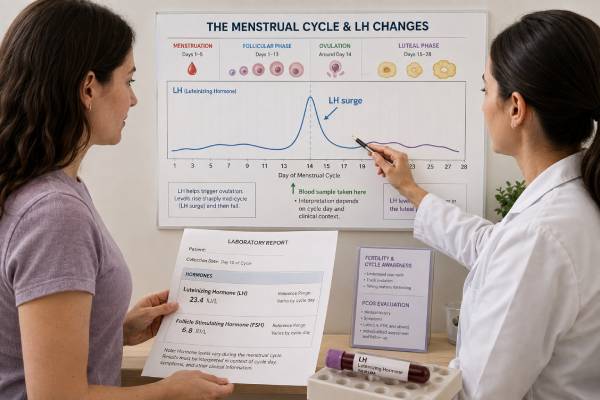
A luteinizing hormone test measures LH in blood or urine to help evaluate ovulation, menstrual changes, fertility, menopause, and pituitary or ovarian function. LH is made by the pituitary gland and works with follicle-stimulating hormone, or FSH, to regulate the menstrual cycle. A sharp mid-cycle LH surge triggers the final steps that lead to ovulation, while baseline LH changes across the cycle and rises after menopause. Blood testing gives a level at one moment; home urine tests look for the surge that usually appears shortly before an egg is released. Neither type should be interpreted alone. Cycle day, age, medicines, pregnancy status, symptoms, FSH, estradiol, and sometimes testosterone or ultrasound all affect what a result means. PCOS can produce persistently higher LH or repeated urine-test positives, but an LH level or LH-to-FSH ratio does not diagnose PCOS. The most useful test is the one chosen and timed for a specific clinical question.
- A positive urine LH test usually means ovulation may occur within about 1–2 days, but it does not prove that an egg was released.
- Blood LH is naturally low at some cycle stages, surges near ovulation, and is usually higher after menopause.
- High LH with high FSH can suggest reduced ovarian function; low or normal LH with low estradiol may point toward hypothalamic or pituitary suppression.
- PCOS may raise baseline LH and cause repeated positive ovulation tests, but LH and the LH/FSH ratio are not required diagnostic criteria.
- Hormonal contraception, fertility medicines, pregnancy, and cycle timing can substantially change LH results.
Table of Contents
- What LH Does in the Menstrual Cycle
- Why an LH Test Is Ordered
- Blood and Urine LH Tests
- How to Prepare and Time Testing
- Understanding LH Results
- LH Testing and PCOS
- Related Tests and Follow-Up
- Common Questions and Mistakes
What LH Does in the Menstrual Cycle
LH is one of two main gonadotropins released by the pituitary gland. The other is FSH. Both are controlled by pulses of gonadotropin-releasing hormone from the hypothalamus, a region of the brain that coordinates reproductive signaling.
Early in the menstrual cycle, FSH supports the growth of ovarian follicles. As a leading follicle develops, it produces increasing estradiol. Sustained high estradiol then changes its feedback effect on the brain and pituitary, producing a rapid LH surge. That surge helps the follicle complete egg maturation, rupture, and release the egg. Ovulation usually follows the urinary LH surge within roughly the next two days, although the interval varies.
After ovulation, LH supports the corpus luteum, the temporary ovarian structure that makes progesterone. Progesterone prepares the uterine lining and maintains the luteal phase. If pregnancy does not begin, the corpus luteum regresses, progesterone and estradiol fall, and menstruation follows.
LH is therefore not a steady hormone. A result can look very different depending on whether blood is drawn in the early follicular phase, around the surge, during the luteal phase, or after menopause. Pulsatile release also creates short-term variation, so one measurement is a snapshot rather than a complete picture.
After menopause, the ovaries produce much less estradiol and inhibin. The loss of negative feedback allows LH and FSH to rise. FSH usually rises more consistently and is generally more useful than LH when menopause or primary ovarian insufficiency is being evaluated.
LH also stimulates ovarian theca cells to produce androgens. In PCOS, faster gonadotropin-releasing hormone pulses may favor LH secretion in some patients. This mechanism helps explain why LH can be higher, but the pattern is not present in everyone with PCOS and is not specific to the condition.
Why an LH Test Is Ordered
A clinician may order LH when the result can help locate a problem within the hypothalamic-pituitary-ovarian system or clarify whether ovulation is occurring. It is commonly interpreted with FSH and estradiol rather than used by itself.
Reasons for blood LH testing include:
- Irregular, widely spaced, or absent periods
- Difficulty conceiving or suspected anovulation
- Possible primary ovarian insufficiency before age 40
- Menopause assessment when the history is unclear
- Symptoms suggesting pituitary or hypothalamic dysfunction
- Delayed or unusually early puberty
- Monitoring during selected fertility treatments
- Evaluation of androgen excess when PCOS or another disorder is being considered
Urine LH testing serves a narrower purpose: identifying the fertile window. People trying to conceive often use home ovulation predictor kits to detect the surge and time intercourse or insemination. These kits do not assess ovarian reserve, egg quality, fallopian tube function, uterine health, or sperm factors.
An LH test is not automatically helpful for every menstrual symptom. In a person with predictable monthly periods, a detailed history may already provide strong evidence of ovulation. In contrast, someone with no periods may need pregnancy testing, TSH, prolactin, FSH, estradiol, and other targeted tests before an isolated LH value is meaningful.
The timing of fertility evaluation also matters. In general, evaluation is appropriate after 12 months of regular unprotected intercourse when the woman is younger than 35, after 6 months at age 35 or older, or sooner when periods are very irregular, ovarian function may be reduced, or another known fertility factor exists.
A female hormone test panel can provide context, but more testing is not always better. The panel should be matched to the question, because normal biological variation can create confusing results when hormones are drawn on arbitrary cycle days.
Blood and Urine LH Tests
Blood and urine LH tests measure related signals but answer different questions.
Blood LH test
A laboratory measures LH in a venous blood sample, usually in international units per liter, written IU/L, or milli-international units per milliliter, written mIU/mL. Those numerical units are equivalent. The test can help evaluate pituitary-ovarian signaling, but its interpretation depends heavily on age and cycle phase.
A single blood result can miss the brief ovulatory surge. When a specialist needs detailed cycle monitoring, LH may be measured alongside estradiol and ultrasound over several days rather than only once. Fertility medicines can also alter the expected pattern.
Urine ovulation predictor test
A home kit detects rising urinary LH. Many kits display a positive line, symbol, or digital “peak” result when LH crosses a set threshold. Some advanced monitors also measure an estrogen metabolite to identify additional high-fertility days before the LH surge.
A positive result predicts that ovulation is likely approaching; it is indirect evidence, not confirmation. A follicle may occasionally fail to rupture after a surge, and some people have more than one surge attempt in a cycle. PCOS can keep baseline LH high enough to cause persistent or repeated positives.
Urine concentration affects the result. Excess fluid shortly before testing may dilute LH, while very concentrated urine can strengthen a line. Unlike pregnancy tests, first-morning urine is not always ideal for every ovulation kit because LH released into blood earlier in the day may appear in urine later. Follow the manufacturer’s exact timing instructions.
Line-based kits can also be misread. A faint second line is usually negative unless the instructions say otherwise; on many products, the test line must be as dark as or darker than the control line. Digital readers reduce visual interpretation but still use a device-specific threshold. Photographing strips in consistent light or using the same brand across a cycle may make trends easier to compare, yet the final result should follow the manufacturer’s reading window. A line that darkens after the stated time is not valid.
Some medicines used in fertility care can make home results misleading. An hCG trigger injection may cross-react with certain LH devices, and clomiphene, letrozole, or gonadotropins can change the timing and number of follicles. People in monitored treatment cycles should follow the clinic’s ultrasound and blood-test schedule rather than use an over-the-counter kit to change medication timing.
| Feature | Blood LH | Urine LH kit |
|---|---|---|
| Main use | Evaluate reproductive hormone signaling | Predict the fertile window |
| What it shows | LH concentration at the time of the draw | Whether urinary LH meets the device threshold |
| Best interpretation | With cycle day, FSH, estradiol, and symptoms | With cycle tracking and, when needed, progesterone or ultrasound |
| Main limitation | Wide normal variation and pulsatile release | Predicts but does not prove ovulation |
How to Prepare and Time Testing
No fasting is usually required for a routine LH blood test unless other ordered tests require it. Preparation centers on timing and medication history.
Tell the clinician about hormonal contraception, menopausal hormone therapy, fertility medicines, estrogen, progesterone, testosterone, antiandrogens, and supplements marketed for hormone balance. These products can suppress, stimulate, or otherwise alter LH. Biotin can interfere with some laboratory immunoassays, so ask whether it should be stopped before testing rather than discontinuing it without instructions.
For baseline fertility testing, LH may be drawn in the early follicular phase, often cycle day 2–5, together with FSH and estradiol. “Cycle day 1” means the first day of full menstrual flow, not light premenstrual spotting. If periods are absent, the test may be drawn on any day, but the interpretation must account for amenorrhea and pregnancy should usually be excluded first.
For an ovulation predictor kit, estimate the likely fertile window from the usual cycle length and start several days before expected ovulation. A person with a 28-day cycle may begin around day 10 or 11, while someone with longer or variable cycles may need more days of testing. Test at a similar time each day, avoid unusually high fluid intake beforehand, and use the device’s instructions for reading lines or digital results.
Once the test becomes positive, intercourse on the positive day and the following one or two days generally covers much of the fertile window. There is no need to wait for the line to fade. A positive result cannot guarantee pregnancy because fertilization also depends on sperm, egg, tubal, uterine, and age-related factors.
To confirm that ovulation occurred, a clinician may order progesterone about 6–8 days after the surge. The ovulation blood test panel guide explains how LH, progesterone, and estradiol contribute different information.
Understanding LH Results
There is no universal normal LH range for all women. Laboratories use different assays and divide reference intervals by cycle phase, pregnancy status, and menopause. Always compare the number with the range printed on the same report.
Typical laboratory intervals may place early-cycle LH in the low single digits to low teens, show a much wider and higher mid-cycle interval, and list elevated values after menopause. These broad ranges overlap. A value that is normal during an LH surge could be unexpectedly high if it was intended as an early-follicular baseline.
High LH
High LH can occur normally during the mid-cycle surge and after menopause. Outside those settings, interpretation depends on FSH and estradiol.
- High LH plus high FSH and low estradiol can indicate reduced ovarian feedback, as in menopause or primary ovarian insufficiency.
- High or high-normal LH with androgen excess and irregular ovulation can occur in PCOS, but the pattern is neither required nor diagnostic.
- An unexpectedly high result during fertility treatment may reflect medication effects or premature LH elevation and should be interpreted by the treating clinic.
- Rarely, assay interference or a pituitary condition may produce an unusual result that does not fit the clinical picture.
Low LH
Low LH may be normal at certain cycle stages or during hormonal suppression. Persistently low or inappropriately normal LH with low estradiol can suggest reduced signaling from the hypothalamus or pituitary. Potential contributors include significant calorie deficiency, low body weight, intense exercise, severe stress, chronic illness, high prolactin, pituitary disease, or certain medicines.
A “normal” LH value can still be inappropriate. For example, when estradiol is very low because the ovaries are not being stimulated, LH would be expected to rise. A low-normal result in that context may support central suppression. This is why the hormone pattern matters more than a single flag on the report.
Results also vary between laboratories. Two assays may not produce identical numbers from the same sample, and reference intervals are established from different populations. When a clinician is following a changing pattern—such as evaluation for primary ovarian insufficiency—it is often easier to compare tests performed by the same laboratory. Small differences near a cutoff should not be treated as a meaningful biological change without considering assay variation and the clinical picture.
LH compared with FSH
The relationship between LH and FSH can help distinguish broad patterns, but a calculated ratio is not a stand-alone diagnostic test. High values of both suggest ovarian-level loss of feedback. Low values of both with low estradiol suggest central suppression. Mixed or normal results require cycle timing and clinical context.
For more detail on the companion hormone, see the FSH test in women guide.
LH Testing and PCOS
PCOS is diagnosed from a combination of ovulatory dysfunction, clinical or biochemical androgen excess, and polycystic ovarian morphology or an accepted alternative marker, after excluding other causes. LH is not one of the required diagnostic criteria.
Some women with PCOS have faster gonadotropin-releasing hormone pulses and relatively higher LH compared with FSH. Older teaching often emphasized an LH/FSH ratio above 2:1 or 3:1. That approach is unreliable. Ratios vary with cycle day, body composition, age, assay, contraception, and PCOS phenotype. Many women with PCOS have a ratio below those values, while some without PCOS have a higher ratio near ovulation.
Blood LH can still add context. In a woman with irregular periods, acne, hirsutism, or scalp hair thinning, a clinician may order LH and FSH as part of a broader assessment. The important work is to document ovulatory dysfunction, evaluate androgen levels accurately, and exclude pregnancy, thyroid disease, hyperprolactinemia, nonclassic congenital adrenal hyperplasia, and other mimicking conditions when appropriate.
Urine ovulation kits can be frustrating in PCOS. Possible patterns include:
- A positive result on many consecutive days because baseline LH is elevated
- Several separate surges before ovulation finally occurs
- Long stretches without a positive result during an anovulatory cycle
- A clear positive that still does not lead to follicle rupture
When home results are confusing, basal body temperature, mid-luteal progesterone, or ultrasound monitoring may provide better confirmation. The PCOS blood test panel article covers the tests that assess androgen and metabolic features more directly.
Do not use an LH ratio to self-diagnose PCOS or to judge severity. Metabolic risk, symptoms, cycle frequency, fertility goals, blood pressure, glucose status, lipids, sleep, and emotional well-being are more clinically important than the ratio itself.
Related Tests and Follow-Up
The next test depends on the reason LH was ordered.
FSH and estradiol help show whether the ovaries are receiving stimulation and producing feedback. A high FSH pattern may need confirmation, especially when primary ovarian insufficiency is possible. The primary ovarian insufficiency blood test panel guide explains that evaluation.
Progesterone checked about one week before the expected period can support recent ovulation. A result above roughly 3 ng/mL is commonly used as presumptive evidence, but one level cannot grade luteal quality.
Pregnancy testing is essential when a period is late or absent. Pregnancy changes gonadotropin physiology, and hCG can also interact with fertility planning and symptom interpretation.
TSH and prolactin help investigate irregular or absent periods. Mild prolactin elevation may be repeated after avoiding temporary triggers such as intense exercise or stressful venipuncture.
Total and free testosterone, SHBG, and sometimes DHEA-S are useful when androgen excess is suspected. Markedly elevated androgens, rapidly progressive hair growth, voice deepening, or increased muscle mass require timely evaluation for less common causes.
Pelvic ultrasound can assess follicle development, ovarian morphology, the uterine lining, fibroids, and other structural findings. Ultrasound is not necessary solely because one LH result is outside a reference interval.
Follow-up may involve repeating LH at a more appropriate cycle time, comparing it with other hormones, or stopping unnecessary repeat measurements. During fertility treatment, use the clinic’s exact monitoring schedule because stimulated cycles do not follow natural-cycle reference patterns.
Seek prompt medical care for severe pelvic pain, fainting, heavy bleeding, new neurological symptoms, or a positive pregnancy test with one-sided pain. These symptoms require clinical assessment rather than more home LH testing.
Common Questions and Mistakes
Does a positive LH test mean I am ovulating right now?
Not necessarily. It means the urinary LH concentration has reached the kit’s positive threshold and ovulation is likely approaching. Ovulation may occur later that day, the next day, or within roughly two days. Occasionally, no egg is released after the surge.
Can I have an LH surge and still not ovulate?
Yes. The body may attempt to ovulate more than once, especially in long or irregular cycles. PCOS can create repeated surge-like patterns. Progesterone testing or ultrasound can help confirm whether ovulation followed.
What if I never get a positive ovulation test?
The surge may be brief and missed, urine may be diluted, testing may start too late, or ovulation may not occur. Review the device instructions and cycle timing. If the pattern repeats or periods are irregular, discuss medical evaluation rather than testing indefinitely.
Is a high LH/FSH ratio proof of PCOS?
No. The ratio is variable and not part of the required diagnostic criteria. PCOS diagnosis relies on the whole clinical pattern and exclusion of other causes.
Can hormonal birth control make LH low?
Yes. Combined pills, patches, rings, and many other hormonal methods suppress pituitary-ovarian signaling. Testing LH while using them usually does not show natural ovarian function. Do not stop contraception simply to obtain a test without medical guidance.
Common mistakes include comparing a mid-cycle result with an early-cycle range, assuming a positive urine test confirms egg release, drinking excessive water before testing, and using LH alone to diagnose PCOS or menopause. The better approach is to define the question first, time the test appropriately, and interpret the pattern with related hormones and symptoms.
References
- Luteinizing Hormone (LH) Levels Test — 2023, MedlinePlus laboratory test guide.
- Fertility evaluation of infertile women: a committee opinion — 2021, American Society for Reproductive Medicine committee opinion.
- Optimizing natural fertility: a committee opinion — 2022, American Society for Reproductive Medicine committee opinion.
- Recommendations From the 2023 International Evidence-based Guideline for the Assessment and Management of Polycystic Ovary Syndrome — 2023, clinical practice guideline.
- Ovulation home test — 2025, MedlinePlus Medical Encyclopedia.
- Treatments targeting neuroendocrine dysfunction in polycystic ovary syndrome — 2022, review article.
Disclaimer
This article provides general education and cannot diagnose an ovulation disorder, PCOS, menopause, or pituitary disease. LH must be interpreted with cycle timing, medicines, symptoms, related hormone results, and the reporting laboratory’s reference interval. Seek urgent medical care for severe pain, fainting, or heavy bleeding, particularly when pregnancy is possible.