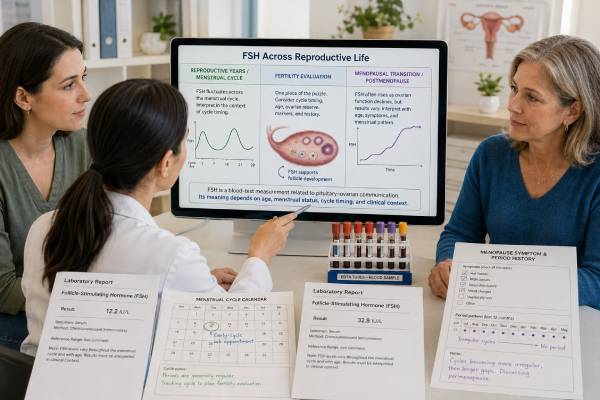
A follicle-stimulating hormone test measures FSH, a pituitary hormone that helps ovarian follicles develop and supports estrogen production. In women, the result is used to investigate irregular or absent periods, reduced ovarian function, infertility, early menopause, and selected pituitary or hypothalamic disorders. FSH changes throughout the menstrual cycle, rises briefly around ovulation, and becomes persistently higher after menopause. It should usually be interpreted with estradiol, age, cycle day, symptoms, pregnancy status, and medication use. A high early-cycle FSH may suggest diminished ovarian reserve or ovarian insufficiency, but one result does not measure egg quality or prove that natural pregnancy is impossible. A low FSH can be normal in pregnancy or during hormonal treatment, or it may reflect reduced signaling from the hypothalamus or pituitary. Menopause in women older than 45 is usually diagnosed from the clinical history rather than blood testing. Testing becomes more important when periods stop unusually early or the diagnosis is uncertain.
- FSH stimulates ovarian follicle growth: its level changes as ovarian estrogen and inhibin feedback change.
- Early-cycle testing is usually done on cycle days 2–4: estradiol should be reviewed at the same time.
- High FSH can indicate reduced ovarian function: it is also expected after menopause and can rise normally near ovulation.
- Low FSH with low estradiol suggests reduced hypothalamic or pituitary stimulation.
- FSH is not a stand-alone fertility test: age, AMH, antral follicle count, ovulation, tubes, uterus, and sperm factors also matter.
Table of Contents
- What FSH Does in the Menstrual Cycle
- Why an FSH Test Is Ordered
- Timing, Preparation, and Test Accuracy
- FSH Ranges and Result Interpretation
- High FSH Results in Women
- Low FSH Results in Women
- Fertility, Menopause, and Follow-Up Tests
What FSH Does in the Menstrual Cycle
FSH is a gonadotropin made by the anterior pituitary gland. The hypothalamus controls its release through pulses of gonadotropin-releasing hormone, or GnRH. FSH then travels through the blood to the ovaries, where it binds to receptors on granulosa cells surrounding developing eggs.
At the beginning of a menstrual cycle, a modest rise in FSH recruits a group of follicles. FSH helps those follicles grow and increases aromatase activity, allowing the ovary to convert androgens into estradiol. As estradiol and inhibin B rise, they send negative feedback to the pituitary and FSH begins to fall. The follicle most responsive to FSH becomes dominant while the others stop developing.
Near midcycle, high estradiol changes the feedback signal and contributes to a surge in luteinizing hormone, or LH, with a smaller FSH surge. Ovulation follows. During the luteal phase, progesterone, estradiol, and inhibin A suppress FSH. If pregnancy does not occur, those hormones fall and the next cycle begins.
This feedback loop explains why FSH cannot be interpreted without timing. The same number may be normal near ovulation but unexpectedly high during the early follicular phase.
FSH across life stages
FSH is low during much of childhood, rises during puberty, and cycles during the reproductive years. As the ovarian follicle pool declines with age, the ovaries make less inhibin and eventually less estradiol. The pituitary responds by releasing more FSH. During perimenopause, values can swing widely as ovarian activity becomes irregular. After menopause, FSH is generally persistently elevated because ovarian feedback remains low.
Pregnancy suppresses FSH. Hormonal contraception and many fertility or hormone treatments can also alter it. A result is therefore a measurement of the current feedback system, not a permanent personal hormone score.
FSH affects follicle recruitment and ovarian response, but it does not directly count eggs or assess their chromosomes. An AMH test and ultrasound antral follicle count provide different information about the number of recruitable follicles.
Why an FSH Test Is Ordered
Clinicians order FSH when the menstrual pattern or reproductive history suggests altered ovarian or pituitary function. It is commonly measured with estradiol and often with LH.
Reasons include:
- irregular, infrequent, or absent periods;
- infertility evaluation or planning for fertility treatment;
- symptoms of menopause before the usual age;
- suspected premature ovarian insufficiency;
- assessment after ovarian surgery, chemotherapy, or pelvic radiation;
- concern about hypothalamic amenorrhea from low energy availability, weight loss, intense exercise, stress, or illness;
- possible pituitary disease;
- delayed or unusually early puberty;
- determining menopausal status when the menstrual history is unavailable or treatment decisions require clarification.
FSH in infertility evaluation
Basal FSH, usually measured early in the cycle, can help estimate how strongly the pituitary must stimulate the ovaries. A higher value may predict a lower number of follicles or eggs obtained during ovarian stimulation. It does not reliably predict whether an otherwise unassisted woman will conceive during a particular month, and it does not measure egg quality independently of age.
A fertility evaluation also considers ovulation, ovarian reserve, the uterus, fallopian tubes, semen, intercourse timing, and age. A normal FSH cannot rule out endometriosis, blocked tubes, sperm abnormalities, or age-related egg changes.
FSH in absent periods
When periods stop, pregnancy should be excluded first. High FSH with low estradiol points toward ovarian insufficiency. Low or normal FSH with low estradiol points toward reduced hypothalamic-pituitary stimulation. Normal FSH with evidence of ongoing estrogen exposure may occur with chronic anovulation, including PCOS. Prolactin and TSH are commonly checked because pituitary and thyroid disorders can disrupt cycles.
An amenorrhea hormone panel uses these relationships to narrow the cause rather than relying on FSH alone.
FSH and routine menopause care
In women older than 45 with typical cycle changes and symptoms, biochemical testing is usually unnecessary. Perimenopausal FSH varies enough that one normal result cannot rule out the transition and one high result cannot prove that ovarian activity has permanently stopped. Testing is more useful before age 40, sometimes between 40 and 45, or when hysterectomy, hormonal contraception, or another condition makes the history difficult to interpret.
Timing, Preparation, and Test Accuracy
An FSH test uses a routine blood sample. Fasting is usually unnecessary unless other fasting tests are ordered at the same visit. Water is allowed and can make venipuncture easier.
Best cycle day
For ovarian reserve assessment, FSH and estradiol are commonly collected on cycle days 2 through 4. Day 1 is the first day of full menstrual bleeding, not light spotting. Using the early follicular phase makes comparisons more consistent because estradiol and progesterone are usually near baseline.
If periods are absent or extremely irregular, FSH can be measured on any day. The clinician interprets it with estradiol and the duration of amenorrhea. In perimenopause, a repeat may be needed because values fluctuate.
A midcycle sample can capture the normal gonadotropin surge. A high value at that time should not be compared with an early-follicular reference range. The laboratory requisition should state menstrual status and cycle day whenever possible.
Medicines that affect FSH
Report:
- combined or progestin-only contraception;
- fertility medicines, including injectable FSH;
- menopausal hormone therapy;
- GnRH agonists or antagonists;
- estrogen blockers or aromatase inhibitors;
- glucocorticoids, opioids, antipsychotics, and other medicines that affect reproductive signaling;
- chemotherapy or ovarian-suppression treatment;
- supplements containing biotin or hormones.
Do not stop prescribed medication without instructions. Hormonal contraception suppresses the natural cycle, so FSH measured while using it may not reveal untreated ovarian function. Some fertility drugs contain FSH and make serum interpretation protocol-specific.
Estradiol should be measured with basal FSH
Early-cycle estradiol can hide an elevated FSH. When estradiol rises early because a follicle is already developing, negative feedback may push FSH into the laboratory range even when ovarian reserve is reduced. A normal-looking FSH paired with unexpectedly high early estradiol therefore needs cautious interpretation.
Assay differences also matter. Serial results are easiest to compare when obtained from the same laboratory. Unexpected findings may be repeated, especially when they conflict with periods, ultrasound, AMH, or symptoms. High-dose biotin can interfere with some immunoassays; the laboratory can advise whether it should be withheld.
FSH Ranges and Result Interpretation
There is no universal FSH range for every woman. Laboratories report phase-specific intervals in international units per liter, which is numerically equivalent to mIU/mL for this test. Reference limits vary by assay.
A typical report separates:
- follicular phase;
- midcycle or ovulatory phase;
- luteal phase;
- postmenopausal status;
- sometimes pregnancy or pediatric stages.
Broadly, reproductive-phase FSH values are usually in the single digits or low double digits, while postmenopausal values are often several times higher. These broad patterns should not replace the range printed on the report.
Interpreting the result as a pattern
| FSH pattern | Estradiol pattern | Possible meaning |
|---|---|---|
| High early-cycle FSH | Low or normal E2 | Reduced ovarian reserve or ovarian insufficiency; confirm context |
| High FSH | Low E2 with months of irregular or absent periods | Menopause or premature ovarian insufficiency |
| Low or normal FSH | Low E2 | Hypothalamic or pituitary suppression |
| Normal FSH | Higher early-cycle E2 | FSH may be artificially suppressed; reserve assessment may be misleading |
| Midcycle rise | Rising/high E2 | Normal ovulatory surge when timing fits |
| Low FSH | Pregnancy or exogenous estrogen/progestin exposure | Expected suppression in the appropriate setting |
Age changes the meaning. An FSH of 11 IU/L in a 28-year-old starting fertility treatment may prompt more attention than the same value in a 43-year-old, but neither number alone predicts pregnancy. A clinic may use its own thresholds for stimulation planning, which should not be applied to routine diagnosis.
Why one result can mislead
FSH varies between cycles, particularly as ovarian reserve declines. A normal month does not erase a previously high result, and one high month does not prove permanent ovarian failure. Estradiol, AMH, antral follicle count, menstrual history, and treatment response provide additional context.
Reference intervals contain most values in a comparison population; they are not “optimal” targets. Trying to lower FSH with supplements does not restore the follicle pool. Estrogen medication can lower the measured FSH through feedback without reversing the underlying reason it was high.
High FSH Results in Women
A high FSH means the pituitary is sending a stronger signal or the sample was collected during a normal surge. Persistent elevation outside the ovulatory window most often reflects reduced ovarian feedback.
Menopause and perimenopause
As follicles become fewer and less responsive, inhibin B falls and FSH often rises before estradiol becomes consistently low. During perimenopause, FSH can be high in one cycle and much lower in another. After menopause, sustained elevation is expected.
High FSH does not require treatment by itself. Menopausal symptoms, bleeding patterns, bone health, cardiovascular risk, and personal preferences guide care. Hormone therapy is prescribed for appropriate indications and individualized risk, not simply to normalize FSH.
Premature ovarian insufficiency
Premature ovarian insufficiency, or POI, is loss or marked reduction of ovarian function before age 40. It can cause irregular or absent periods, infertility, hot flashes, vaginal dryness, sleep disruption, and low estrogen effects on bone and cardiovascular health.
Current international guidance supports diagnosis in the setting of menstrual disturbance for at least several months and FSH above 25 IU/L; repeat FSH is used when the diagnosis remains uncertain. Hormonal contraception can mask the pattern and may need specialist planning before testing. Estradiol supports the assessment but is not required to be below one universal cutoff.
Causes include chromosome differences, FMR1 premutation, autoimmune disease, ovarian surgery, chemotherapy, radiation, and infections, but many cases remain unexplained. Ovarian activity can occur intermittently, so POI is not identical to irreversible menopause and occasional spontaneous pregnancy remains possible.
Diminished ovarian reserve
Higher basal FSH may suggest a reduced number of recruitable follicles and a lower response to fertility medication. AMH often declines before FSH rises and has largely replaced FSH as the more sensitive reserve marker. Even so, basal FSH can add information when AMH is very low or results conflict.
Diminished reserve does not mean no eggs remain, and it does not directly indicate poor egg quality. Age is the strongest everyday predictor of chromosome-related egg quality.
Other causes
High FSH can follow removal of both ovaries, gonadotoxic treatment, severe ovarian damage, or certain chromosome conditions. Rarely, an FSH-secreting pituitary tumor can produce high or inappropriate levels, usually with ovarian enlargement or other unusual findings. Laboratory error or assay interference should be considered when the result is extreme and the clinical picture does not fit.
Low FSH Results in Women
Low FSH may be normal or may indicate inadequate hypothalamic-pituitary signaling. Estradiol and the clinical setting determine which explanation fits.
Normal suppression
FSH is normally low during pregnancy because estrogen, progesterone, and inhibin suppress gonadotropin release. Hormonal contraception, menopausal estrogen therapy, GnRH treatment, and some fertility protocols can also lower it. A low result in these settings may reflect the intended drug effect.
Functional hypothalamic amenorrhea
Low energy availability can reduce GnRH pulses and lead to low or inappropriately normal FSH and LH with low estradiol. This may occur with restrictive eating, substantial weight loss, intense exercise, psychological stress, or a combination. Body weight can be normal; energy availability and stress physiology matter more than appearance.
Periods may become irregular or stop, and prolonged estrogen deficiency can reduce bone density. Treatment focuses on adequate nutrition, reduced exercise load when excessive, stress support, and treatment of an eating disorder when present. Simply taking estrogen or a supplement without correcting the energy deficit does not restore the underlying reproductive signaling.
Pituitary or hypothalamic disease
Pituitary tumors, high prolactin, infiltrative disease, brain injury, radiation, genetic conditions, or postpartum pituitary damage can lower FSH. Clues include headaches, vision changes, nipple discharge, inability to produce breast milk after severe postpartum bleeding, persistent fatigue, excessive thirst, or abnormalities in other pituitary hormones.
A low FSH with low estradiol and unexplained amenorrhea may lead to prolactin, TSH, cortisol-related testing, other pituitary hormones, and magnetic resonance imaging. A normal or low FSH is inappropriate when estradiol is clearly low, because a healthy pituitary should increase its signal.
Chronic illness and medications
Severe illness, undernutrition, opioids, glucocorticoids, and some psychiatric medicines can suppress the reproductive axis directly or through prolactin. Treatment targets the illness or medication effect when possible. Low FSH itself is not treated with over-the-counter fertility supplements.
Fertility, Menopause, and Follow-Up Tests
FSH answers one part of a larger question. Follow-up depends on whether the concern is fertility, amenorrhea, menopause, or pituitary function.
Fertility follow-up
Common complementary tests include:
- estradiol on the same early-cycle sample;
- AMH on any cycle day;
- transvaginal ultrasound for antral follicle count;
- progesterone or other evidence of ovulation;
- TSH and prolactin when cycles are irregular;
- tubal and uterine assessment;
- semen analysis for the reproductive partner or donor source.
Ovarian reserve testing predicts response to stimulation better than natural fecundability. A woman with high FSH may still conceive, while a woman with normal FSH may have infertility from another factor. Decisions about trying naturally, ovulation induction, intrauterine insemination, IVF, donor eggs, or fertility preservation should consider age and the whole evaluation.
Menopause and POI follow-up
For a typical natural transition after age 45, repeated FSH checks rarely improve care. Persistent symptoms and abnormal bleeding should be evaluated clinically. Postmenopausal bleeding requires assessment regardless of FSH.
For suspected POI, follow-up may include repeat FSH when uncertain, estradiol, pregnancy testing, thyroid and adrenal autoimmunity assessment in selected cases, chromosome analysis, FMR1 premutation testing, and bone density assessment. Management often includes hormone replacement until around the usual age of menopause unless contraindicated, along with fertility counseling and psychological support.
A women’s FSH result should never be used to start or stop hormone therapy without a diagnosis and risk review.
When prompt care is needed
Seek timely medical assessment for periods stopping before age 40, severe headache with vision change, possible pregnancy with pain or bleeding, or heavy bleeding with weakness or dizziness. Sudden neurologic symptoms require urgent care. For infertility, evaluation should begin sooner than the standard waiting period when periods are absent, prior treatment may have damaged the ovaries, or the patient is 40 or older.
At-home urine FSH and “menopause tests”
Over-the-counter menopause tests usually detect FSH in urine. They may show that FSH was elevated on the day of testing, but they cannot diagnose menopause, exclude pregnancy, explain abnormal bleeding, or distinguish perimenopause from primary ovarian insufficiency. During the menopausal transition, FSH can move from a premenopausal to a menopausal range and back again. Hydration, urine concentration, test timing, and the product threshold add further variation. A negative test does not rule out perimenopause, and a positive test does not prove that contraception is no longer needed.
Hormonal contraception makes these products even harder to interpret. Combined pills, patches, rings, and some other hormonal methods suppress the hypothalamic-pituitary-ovarian axis, so urine or serum FSH may not reflect the untreated state. Stopping contraception solely to obtain a test can expose someone to pregnancy or symptom recurrence and should be planned with a clinician.
For fertility, consumer FSH kits also have limits. A high result may support further evaluation, but a normal result does not guarantee normal ovarian reserve or egg quality. Age, AMH, antral follicle count, menstrual history, prior ovarian treatment, and partner or tubal factors remain important. Confirm a surprising home result with a clinical laboratory when it would change care.
Making sense of repeat variation
When two serum FSH values differ, first compare cycle day, estradiol, medications, and assay ranges. Early follicular FSH can be temporarily lowered when estradiol is already elevated, while a later sample may rise as follicular activity changes. In suspected POI, repeat testing is used to document a persistent pattern when the diagnosis remains uncertain, not to search indefinitely for a single “best” number. A result should be repeated because it will resolve a defined question, not because normal biological fluctuation is uncomfortable.
FSH should also be separated from egg quality. The hormone reflects the amount of stimulation needed to recruit follicles, not whether an individual egg is chromosomally normal. Age remains the strongest practical predictor of aneuploidy risk. This distinction explains why a younger woman with reduced reserve may still have a meaningful chance with fewer eggs, while an older woman with a normal FSH may face age-related limits. Counseling should discuss both quantity and quality without turning either into a guarantee.
References
- European Society of Endocrinology clinical practice guideline for evaluation and management of menopause and the perimenopause 2025 (Guideline)
- Evidence-based guideline: premature ovarian insufficiency 2024 (Guideline)
- Current evaluation of amenorrhea: a committee opinion (2024) 2024 (Guideline)
- Fertility evaluation of infertile women: a committee opinion (2021) 2021 (Guideline)
- Testing and interpreting measures of ovarian reserve: a committee opinion (2020) 2020 (Guideline)
- More than a marker for menopause: FSH as a frontier for women’s health 2025 (Review)
Disclaimer
This article provides general information and does not replace medical diagnosis or fertility counseling. FSH must be interpreted with age, menstrual timing, estradiol, pregnancy status, medicines, symptoms, and the laboratory’s reference interval. Seek prompt care for severe bleeding, possible ectopic pregnancy symptoms, or headache with vision changes.