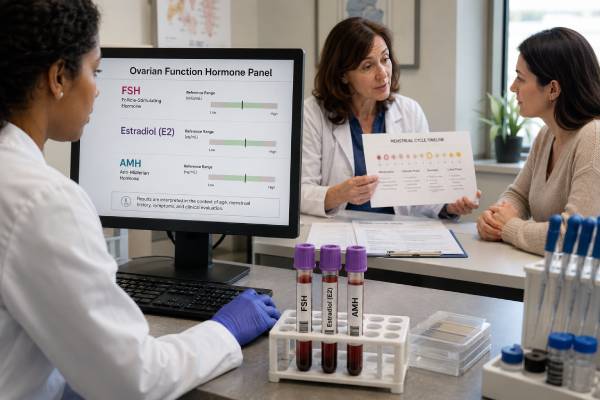
A primary ovarian insufficiency blood test panel is used when ovarian activity may be reduced before age 40. The central finding is disordered or absent menstrual cycles for at least four months with an elevated FSH level, commonly above 25 IU/L. Estradiol is often low and supports the pattern, but it should not be used alone to make the diagnosis. Anti-Müllerian hormone, or AMH, may be very low or undetectable, yet it is not the primary diagnostic test and can occasionally provide misleading reassurance. Pregnancy, thyroid disease, high prolactin, hypothalamic suppression, PCOS, and medication effects must also be considered. POI differs from permanent menopause because ovarian function can fluctuate and occasional ovulation or spontaneous pregnancy may still occur. Diagnosis matters beyond fertility: prolonged estrogen deficiency at a young age affects bone, cardiovascular, sexual, and emotional health. A complete evaluation therefore confirms the hormone pattern, investigates possible genetic, autoimmune, or treatment-related causes, and creates a long-term hormone replacement and health-monitoring plan.
- POI is generally considered before age 40 when cycles are irregular or absent for at least 4 months and FSH is above 25 IU/L.
- FSH can be tested on any cycle day; repeat testing after 4–6 weeks is useful when the first result or clinical picture is uncertain.
- Low estradiol supports ovarian insufficiency but cannot diagnose POI by itself.
- AMH should not replace FSH as the main diagnostic test, although it may help when FSH results are inconclusive.
- Hormonal contraception or hormone therapy can suppress FSH and hide the natural pattern, so medication context is essential.
Table of Contents
- What Primary Ovarian Insufficiency Means
- Who Should Be Tested
- FSH and Estradiol Results
- AMH and Ovarian Reserve Testing
- Other Tests to Confirm the Cause
- Preparation and Medication Effects
- Treatment, Health Monitoring, and Fertility
- Interpreting Results and Common Questions
What Primary Ovarian Insufficiency Means
Primary ovarian insufficiency, or POI, means the ovaries are not functioning consistently before age 40. It has also been called premature ovarian failure, but “insufficiency” is more accurate because ovarian activity may return intermittently.
The ovaries may contain fewer follicles than expected, follicles may not respond normally to FSH, or ovarian tissue may have been damaged by treatment or disease. As estradiol and inhibin production falls, the pituitary increases FSH in an effort to stimulate the ovaries. This creates the typical high-FSH, low-estrogen pattern.
POI is not identical to diminished ovarian reserve. Diminished reserve usually describes a reduced expected response to fertility stimulation or fewer remaining follicles, often with regular cycles and without sustained estrogen deficiency. POI includes menstrual disruption and impaired endocrine function. A low AMH alone may suggest reduced reserve but does not establish POI.
POI is also not the same as natural menopause. Menopause is diagnosed after 12 months without a period at the usual age. In POI, ovarian function can fluctuate, bleeding may return, and spontaneous ovulation can occur. Even so, fertility is substantially reduced and unpredictable.
Symptoms may include:
- Irregular periods, skipped periods, or amenorrhea
- Hot flashes and night sweats
- Vaginal dryness, painful sex, or urinary symptoms
- Sleep disturbance, fatigue, or concentration problems
- Mood changes or distress related to diagnosis and fertility
- Difficulty conceiving
Some people have few estrogen-related symptoms and are identified through cycle changes or infertility testing. Others have an abrupt onset after chemotherapy, radiation, or ovarian surgery.
Early recognition matters because estrogen deficiency during young adulthood can affect bone density and cardiovascular health. It also allows timely fertility counseling, genetic evaluation, and screening for associated autoimmune conditions.
The diagnosis can be spontaneous, iatrogenic, or syndromic. Iatrogenic POI follows an intervention such as bilateral oophorectomy, gonadotoxic chemotherapy, or pelvic radiation. Spontaneous POI includes genetic, autoimmune, metabolic, infectious, and unexplained cases. The absence of an identified cause does not make the diagnosis less real, and extensive testing does not always produce an answer.
Terminology can be confusing. “Early menopause” usually refers to menopause from age 40 through 44, while POI refers to ovarian insufficiency before 40. The distinction matters because the younger the age of estrogen loss, the longer the potential exposure to bone and cardiovascular consequences and the stronger the rationale for physiologic hormone replacement when safe.
Who Should Be Tested
POI should be considered in anyone younger than 40 with spontaneous amenorrhea or persistently irregular cycles for at least four months, especially when symptoms suggest low estrogen. Evaluation should not wait for a full year without periods.
Testing is also appropriate when risk is increased by:
- Chemotherapy, pelvic radiation, or bone marrow transplantation
- Bilateral ovarian surgery or repeated ovarian procedures
- A family history of POI or early menopause
- Turner syndrome or another known chromosomal condition
- An FMR1 premutation in the family
- Autoimmune adrenal or thyroid disease
- Galactosemia or certain rare genetic/metabolic conditions
- Unexplained infertility with irregular cycles
The first step is usually a pregnancy test. Pregnancy remains possible even with irregular periods and even after a prior high FSH result. Other common causes of amenorrhea must be considered, including PCOS, high prolactin, thyroid disease, low energy availability, intense exercise, major weight change, chronic illness, and pituitary disorders.
History helps separate these patterns. Hot flashes with previously regular cycles and high FSH point toward ovarian insufficiency. Acne or hirsutism with long-standing irregular cycles may suggest PCOS. Low body weight, restrictive eating, high training load, or severe stress may suggest hypothalamic amenorrhea, where FSH is usually low or inappropriately normal rather than high.
A pelvic ultrasound can assess the uterus, ovaries, antral follicles, and other structural findings, but it cannot confirm or exclude POI by itself. Some people with POI still have visible follicles, while small ovaries or a thin lining are supportive rather than diagnostic.
The irregular period hormone panel article explains how pregnancy, thyroid, prolactin, and pituitary-ovarian patterns are separated.
FSH and Estradiol Results
FSH is the main biochemical test for POI. Current international guidance uses an FSH concentration above 25 IU/L together with disordered cycles for at least four months. FSH testing does not need to be timed to a specific cycle day when POI is suspected.
One clearly elevated FSH result may establish the diagnosis when the history and other results fit. Repeat testing after 4–6 weeks is appropriate when there is diagnostic uncertainty, such as a borderline result, recent hormone use, an unexpected return of bleeding, or a pattern that does not match symptoms.
Estradiol provides supporting context. Low estradiol with high FSH is consistent with reduced ovarian feedback. Estradiol can fluctuate, however, and a temporarily active follicle may produce a normal or high value. A normal estradiol result therefore does not always exclude POI when cycles remain abnormal and FSH has been elevated.
| Hormone pattern | Likely direction | Interpretation |
|---|---|---|
| POI pattern | High FSH, often low estradiol | Reduced ovarian feedback before age 40 |
| Hypothalamic or pituitary suppression | Low or normal FSH with low estradiol | Reduced central stimulation of the ovaries |
| PCOS pattern | FSH usually not elevated; estradiol often present | Ovulatory dysfunction with a different mechanism |
| Hormonal contraception or HRT | FSH may be suppressed; estradiol altered | Natural ovarian function may be masked |
Reference ranges vary, and the report’s “postmenopausal” interval is not the diagnostic rule by itself. Age and four months of cycle disturbance remain part of the definition. A high FSH in a person over 40 may indicate early menopause or the usual menopausal transition rather than POI.
LH often rises alongside FSH but is not required for diagnosis. Progesterone is generally low when ovulation has not occurred and does not add much to the initial POI panel.
The FSH test in women guide explains units, cycle variation, and related hormone patterns.
AMH and Ovarian Reserve Testing
AMH is produced by granulosa cells in small growing ovarian follicles. It often becomes very low or undetectable in POI, but it should not be used as the primary diagnostic test.
There are several reasons. AMH assays and reference intervals differ, and low values overlap with diminished ovarian reserve in people who still have regular cycles and normal estrogen. Rarely, detectable AMH may persist despite clinically significant ovarian insufficiency. Hormonal contraception, recent pregnancy, ovarian surgery, and laboratory method can also affect interpretation.
AMH may help when FSH is inconclusive. For example, a person with four months of irregular cycles, fluctuating estradiol, and borderline FSH might have an AMH result that supports a severely reduced follicle pool. The result still needs clinical context and cannot replace the menstrual and FSH criteria.
AMH is not recommended as a screening test to predict who will develop POI in the general population. It cannot tell an individual exactly when periods will stop or whether spontaneous ovulation will occur. A low result should not be treated as proof of immediate infertility, while a higher result should not provide false reassurance when cycles and FSH indicate ovarian insufficiency.
Antral follicle count on ultrasound is another ovarian reserve marker. Like AMH, it can support fertility planning but is not the core diagnostic test for POI. Follicles may appear intermittently, and their presence does not guarantee normal ovarian function.
The distinction is practical:
- FSH plus menstrual history establishes the ovarian-insufficiency pattern.
- Estradiol supports the degree of estrogen deficiency.
- AMH and antral follicle count describe aspects of remaining follicle activity and potential response.
For more detail, see the AMH test in women guide and the ovarian reserve test panel article.
Other Tests to Confirm the Cause
After POI is diagnosed, the cause should be investigated when it is not already explained by surgery, chemotherapy, or another known exposure. Many cases remain unexplained, but testing can identify information that affects the patient or family.
Chromosome analysis: Karyotype testing can identify Turner syndrome, mosaicism, or another sex-chromosome difference. It is generally recommended for non-iatrogenic POI regardless of age at diagnosis.
FMR1 premutation testing: An FMR1 premutation can cause fragile X–associated POI and has important implications for relatives and future pregnancies. Standard gene panels or exome tests do not reliably replace the specific FMR1 repeat analysis.
Additional genetic testing: After counseling, next-generation sequencing panels may be considered where available, especially with early onset, family history, or syndromic features. Results can include uncertain variants and require careful interpretation.
21-hydroxylase autoantibodies: These screen for autoimmune adrenal involvement in POI of unknown cause. A positive result requires endocrinology assessment because adrenal insufficiency can be serious. Routine ovarian antibody testing is not recommended because available tests lack accuracy.
Thyroid testing: TSH is commonly checked at diagnosis and periodically thereafter. Thyroid peroxidase antibodies are not always required routinely, depending on the guideline and clinical context.
Other targeted tests: Symptoms may lead to glucose, calcium, cortisol, celiac, or other autoimmune evaluation. Testing every possible autoimmune marker without clinical indication can create false positives.
A pelvic ultrasound may identify absent or small ovaries, follicles, or an ovarian mass. Bone density measurement is often appropriate at diagnosis, particularly when estrogen deficiency may have been prolonged.
When an adrenal antibody is positive, a normal cortisol result at one visit does not necessarily end follow-up. Endocrinology may recommend additional testing and education about symptoms of adrenal insufficiency, including severe weakness, vomiting, abdominal pain, low blood pressure, salt craving, and skin darkening. Emergency care is needed for collapse, confusion, or severe illness in a person at risk.
Genetic counseling is valuable before and after testing. A chromosome result or FMR1 premutation can affect relatives, reproductive choices, and the interpretation of health risks. Testing should be accompanied by an explanation of possible outcomes, including a negative result, a pathogenic finding, or a variant of uncertain significance that may not provide a clear cause.
Preparation and Medication Effects
Pregnancy testing should come first when pregnancy is possible. FSH itself does not require fasting and can be drawn on any cycle day for suspected POI. Record the date of the last natural period and any recent bleeding.
Hormonal contraception and hormone therapy can conceal the biochemical pattern. Combined estrogen-progestin methods suppress FSH and may create withdrawal bleeding. Progestin-only methods can stop bleeding without proving ovarian failure. Prescribed estradiol changes serum estradiol and FSH.
Do not stop hormones without medical advice. They may be providing contraception, endometrial protection, symptom relief, or bone protection. If an untreated baseline is necessary, the clinician should specify how long to stop, what alternative contraception to use, and when to test. In some cases, the history and pre-treatment results are sufficient and interruption is unnecessary.
Fertility medicines, GnRH analogues, glucocorticoids, and some supplements can affect results. Biotin may interfere with certain immunoassays. Provide a complete medication and supplement list, including DHEA and products marketed for ovarian support.
Acute illness and major physiological stress can disrupt menstruation, but they usually produce a central low-estrogen pattern rather than clearly elevated FSH. A result that conflicts with the history should be repeated and interpreted with estradiol, pregnancy status, and medication exposure.
Use the same laboratory for repeat testing when practical, because assay differences can complicate comparison. Keep the numerical result, unit, reference interval, and collection date rather than only a “high” or “low” label.
Timing relative to a recent pregnancy also matters. Breastfeeding commonly suppresses ovulation through prolactin and can cause months of amenorrhea with a central hormone pattern. Postpartum hemorrhage can rarely damage pituitary function. A person whose periods do not return after weaning, or who has severe fatigue, low blood pressure, inability to lactate, headaches, or other pituitary symptoms, needs a broader evaluation rather than assuming POI from missed periods alone. This distinction changes both treatment and the urgency, sequence, and scope of pituitary or endocrine assessment, treatment planning, and appropriate, coordinated longer-term clinical follow-up.
Treatment, Health Monitoring, and Fertility
POI treatment replaces missing ovarian hormones and addresses long-term health, symptoms, fertility, and emotional well-being. In the absence of a contraindication, hormone therapy is generally recommended until the usual age of natural menopause, even when hot flashes are mild.
Estrogen replacement supports bone and cardiovascular health and treats vasomotor and genitourinary symptoms. When the uterus is present, systemic estrogen must be paired with enough progestogen to protect the endometrium. Options include physiologic-dose estradiol with cyclic or continuous progestogen, or a combined oral contraceptive when contraception and cycle control are priorities. The best choice depends on medical history, bleeding preferences, and pregnancy prevention needs.
Serum estradiol is not routinely used to titrate treatment. Review focuses on adherence, symptoms, bleeding, side effects, and health outcomes. A low serum value may prompt assessment of absorption in selected cases, but there is no universally proven target for every regimen.
Bone-health care may include baseline DXA, adequate calcium and vitamin D intake, weight-bearing and resistance exercise, smoking avoidance, and treatment of additional risk factors. Repeat DXA timing depends on the initial result, hormone use, and risks.
Cardiovascular assessment includes blood pressure, lipids, glucose risk, smoking, activity, and family history. POI itself is not a reason to withhold appropriate hormone replacement from a young person without contraindications.
Fertility counseling should be offered promptly. Spontaneous pregnancy can occur but cannot be predicted by FSH or AMH. There is no proven treatment that reliably restores the follicle pool. Donor-oocyte IVF is an established option for many, while use of previously frozen eggs, embryos, or ovarian tissue depends on prior fertility preservation. Adoption and other family-building paths may also be considered.
Because intermittent ovulation is possible, contraception is needed when pregnancy is not desired. Standard HRT does not provide reliable contraception.
Psychological support is part of treatment. The diagnosis can affect identity, relationships, sexual health, and family plans. Clear explanations and referral to counseling, fertility specialists, or support groups can reduce isolation.
Genitourinary symptoms may need local treatment in addition to systemic hormone replacement. Vaginal moisturizers and lubricants can help, while low-dose vaginal estrogen or other prescribed options may be considered when dryness, pain, or recurrent urinary symptoms persist. Sexual pain should also be assessed for pelvic-floor dysfunction, infection, vulvar conditions, and relationship or trauma factors rather than attributed only to low estrogen.
Follow-up should confirm that the regimen provides appropriate estrogen exposure and endometrial protection, but routine hormone targets are not required. Persistent unscheduled bleeding, poor adherence, patch detachment, drug interactions, or gastrointestinal absorption problems may need review. New migraine with aura, clot symptoms, severe hypertension, or a major health diagnosis can change the safest route or formulation.
Interpreting Results and Common Questions
Can one high FSH result diagnose POI?
Yes, one FSH above 25 IU/L may be sufficient when the person is under 40, cycles have been disordered for at least four months, and the clinical context fits. Repeat after 4–6 weeks when the result is borderline, medication effects are possible, or there is diagnostic uncertainty.
Does very low AMH prove POI?
No. Very low AMH supports a reduced follicle pool, but diagnosis relies on menstrual history and FSH. Some people with diminished ovarian reserve have low AMH without estrogen deficiency or irregular cycles.
Can periods or ovulation return?
Yes. Ovarian activity can be intermittent, which is why “insufficiency” is preferred to “failure.” A return of bleeding does not erase the diagnosis or remove the need for long-term health planning.
Does POI mean pregnancy is impossible?
No, but spontaneous conception is uncommon and unpredictable. FSH and AMH cannot identify who will ovulate. Early fertility-specialist counseling helps clarify realistic options.
Should hormone levels be checked every few months?
Usually not. Repeated FSH does not track treatment success, and routine estradiol monitoring is not required for most hormone regimens. Follow-up should focus on symptoms, bleeding, adherence, bone and cardiovascular health, and new medical issues.
Common mistakes include using AMH as the sole diagnosis, waiting 12 months to evaluate amenorrhea in someone under 40, assuming one normal estradiol excludes POI, and stopping contraception after a high FSH. The correct interpretation combines age, cycle duration, hormone pattern, and medication status, and repeat results when needed.
References
- Evidence-based guideline: premature ovarian insufficiency — 2024, international clinical practice guideline.
- Evidence-based guideline: Premature Ovarian Insufficiency — 2025, American Society for Reproductive Medicine guideline.
- Evidence-based guideline: premature ovarian insufficiency — 2024, guideline publication.
- Current evaluation of amenorrhea: a committee opinion — 2024, American Society for Reproductive Medicine committee opinion.
- Fertility evaluation of infertile women: a committee opinion — 2021, American Society for Reproductive Medicine committee opinion.
- Hormone Therapy in Primary Ovarian Insufficiency — 2017, clinical committee opinion retained for hormone-replacement guidance.
Disclaimer
This article is for general education and cannot diagnose primary ovarian insufficiency or determine fertility. FSH, estradiol, and AMH must be interpreted with age, menstrual history, pregnancy status, medications, and the laboratory method. Seek prompt care for pregnancy-related pain or bleeding, severe symptoms of adrenal insufficiency, or sudden heavy bleeding.