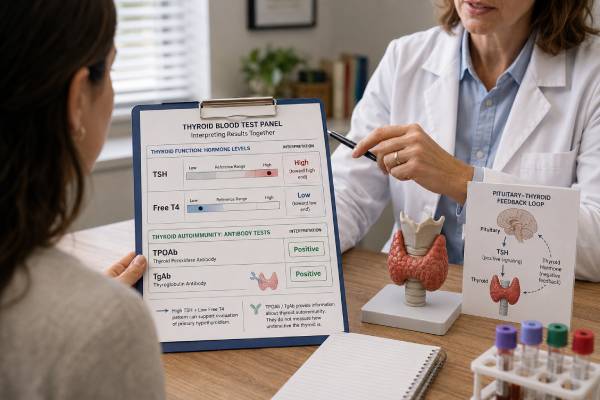
A hypothyroidism blood test panel checks whether the body has too little thyroid hormone and whether autoimmune thyroid disease is the likely cause. In primary hypothyroidism, the usual pattern is a high thyroid-stimulating hormone (TSH) with a low free T4. A high TSH with normal free T4 is called subclinical hypothyroidism and often needs repeat testing before treatment decisions are made. Thyroid peroxidase antibodies (TPOAb) and thyroglobulin antibodies (TgAb) can support Hashimoto thyroiditis, but antibody levels do not measure how underactive the thyroid is. Symptoms such as fatigue, cold intolerance, constipation, dry skin, slowed thinking, menstrual changes, and weight gain overlap with many other conditions, so blood results matter. Interpretation also changes during pregnancy, severe illness, pituitary disease, and treatment with levothyroxine. The most useful reading combines the pattern, the laboratory’s own ranges, medication timing, pregnancy status, prior results, and the direction of change over time.
- High TSH with low free T4 usually confirms overt primary hypothyroidism.
- High TSH with normal free T4 is subclinical hypothyroidism and should usually be confirmed unless treatment is clearly indicated.
- Positive TPOAb strongly supports autoimmune thyroiditis and predicts a higher chance of progression when TSH is already elevated.
- TgAb can support autoimmune thyroid disease, especially when TPOAb is negative, but it is less sensitive for Hashimoto thyroiditis.
- T3 testing is rarely needed to diagnose hypothyroidism because T3 can stay normal until disease is advanced.
- Severe drowsiness, confusion, low body temperature, slow breathing, or marked weakness with suspected hypothyroidism requires urgent care.
Table of Contents
- What the Hypothyroidism Panel Measures
- Common TSH and Free T4 Result Patterns
- Causes of Hypothyroidism and High TSH
- How to Interpret TPOAb and TgAb
- Preparation, Interference, and Repeat Testing
- Blood Tests During Levothyroxine Treatment
- Pregnancy, Pituitary Disease, and Urgent Findings
What the Hypothyroidism Panel Measures
A complete panel separates thyroid function from thyroid autoimmunity. TSH and free T4 show how the pituitary-thyroid feedback system is working. TPOAb and TgAb help identify an autoimmune process. These markers answer related but different questions, so a positive antibody result cannot replace hormone testing.
TSH
TSH is produced by the pituitary gland. When circulating thyroid hormone falls, the pituitary releases more TSH to stimulate the thyroid. In primary hypothyroidism, this compensation produces a high TSH. Many adult laboratories use a reference interval near 0.4 to 4.0 mIU/L, but age, pregnancy, assay method, iodine intake, and local population data affect the limits.
A mild elevation, such as 4.5 to 10 mIU/L, is often found with normal free T4. TSH above 10 mIU/L is more likely to persist and is more often treated, although age, symptoms, cardiovascular status, pregnancy plans, and cause still influence the plan. TSH can temporarily rise during recovery from illness, after missed thyroid medication, or during changing iodine exposure.
The dedicated TSH test is sensitive for primary thyroid failure but cannot reliably detect every pituitary or hypothalamic disorder.
Free T4
Free T4 measures unbound thyroxine, the main hormone produced by the thyroid. It helps distinguish overt from subclinical primary hypothyroidism. A low value with elevated TSH means the gland cannot make enough hormone despite strong pituitary stimulation. A normal value with elevated TSH means circulating hormone remains within range, although the pituitary is working harder to maintain it.
Typical free T4 intervals are approximately 0.8 to 1.8 ng/dL, but methods differ enough that the result must be read against the reporting laboratory’s interval. Pregnancy and severe illness may require method-specific or trimester-specific interpretation. The free T4 test is also central when TSH is unreliable because of pituitary disease.
TPO antibodies
TPO is an enzyme needed to make thyroid hormone. TPOAb develops when the immune system targets this enzyme. It is the most useful antibody marker for Hashimoto thyroiditis and can be present years before overt hypothyroidism appears.
A positive TPOAb does not mean immediate thyroid failure. Some people remain euthyroid, meaning their TSH and free T4 stay normal. The result is most meaningful when combined with an elevated TSH, a firm or enlarged thyroid, ultrasound changes, another autoimmune disease, or a compatible history.
Thyroglobulin antibodies
Thyroglobulin is a protein used inside thyroid follicles to produce T4 and T3. TgAb targets this protein. It may be positive in Hashimoto thyroiditis, Graves disease, or people without current dysfunction. TgAb is commonly added when autoimmune thyroiditis remains likely despite negative TPOAb or when thyroglobulin measurement is needed for thyroid cancer follow-up.
Why T3 is usually not part of the first panel
The body can preserve serum T3 by increasing conversion from T4, so T3 may remain normal even when TSH is high and free T4 is low. A low T3 is also common in severe non-thyroid illness and therefore lacks specificity. T3 testing is much more useful in suspected hyperthyroidism than in routine hypothyroidism diagnosis.
Common TSH and Free T4 Result Patterns
The relationship between TSH and free T4 provides the initial classification. Antibodies then help explain why the pattern occurred.
| TSH | Free T4 | Likely interpretation | Common next step |
|---|---|---|---|
| High | Low | Overt primary hypothyroidism | Assess cause, symptoms, pregnancy status, and treatment need |
| High | Normal | Subclinical hypothyroidism or temporary TSH elevation | Repeat TSH/free T4 and consider TPOAb |
| Low or normal | Low | Possible central hypothyroidism, severe illness, or drug effect | Review pituitary function and clinical context |
| High | High | Discordant result, recent medication dose, interference, or rare disorder | Repeat under standardized conditions and investigate assay issues |
| Normal | Normal | No biochemical primary hypothyroidism at that time | Consider other causes of symptoms or repeat if risk changes |
Overt primary hypothyroidism
High TSH with low free T4 is the classic pattern. The higher the TSH and the lower the free T4, the stronger the biochemical evidence. Symptoms can still vary widely. A young person may notice fatigue and menstrual changes, while an older person may present with slowed thinking, falls, constipation, high cholesterol, or no obvious symptoms.
Treatment is usually recommended because prolonged hormone deficiency can affect lipids, heart function, fertility, pregnancy, nerves, muscles, and quality of life. The starting levothyroxine dose depends on age, weight, severity, duration, heart disease, and whether the thyroid is absent or only partly impaired.
Subclinical hypothyroidism
This pattern is defined by elevated TSH and normal free T4. It may represent early Hashimoto thyroiditis, recovery from thyroiditis, medication under-replacement, laboratory variation, or transient illness. Because TSH fluctuates naturally, confirmation after an interval is often appropriate. NICE recommends considering repeat measurements no sooner than about six weeks when symptoms change or results are uncertain; many non-urgent evaluations repeat in roughly two to three months.
Treatment is more strongly considered when TSH is persistently 10 mIU/L or higher, during pregnancy or pregnancy planning, or when symptoms, positive TPOAb, goiter, rising TSH, cardiovascular risk, or prior thyroid treatment support benefit. In older adults, especially those over 80, a mild TSH elevation may reflect age-related physiology and treatment can cause harm if it pushes TSH too low.
Normal tests with persistent symptoms
Normal TSH and free T4 make primary hypothyroidism unlikely. Fatigue, weight change, hair loss, poor concentration, and cold sensitivity can result from anemia, sleep disorders, depression, nutrient deficiencies, medication effects, menopause, chronic disease, or insufficient calorie intake. Repeating thyroid panels frequently without a change in risk or symptoms may create confusing minor fluctuations rather than clarity.
A positive antibody result with normal hormone tests means autoimmune risk, not biochemical hypothyroidism. Periodic TSH monitoring may be reasonable, but thyroid hormone is not automatically needed.
Causes of Hypothyroidism and High TSH
Primary hypothyroidism begins in the thyroid gland. Central hypothyroidism begins in the pituitary or hypothalamus and often produces a different pattern.
Hashimoto thyroiditis
Hashimoto thyroiditis is the most common cause in iodine-sufficient regions. Immune cells gradually damage thyroid tissue, often with positive TPOAb and sometimes TgAb. Thyroid function may fluctuate early, but the long-term direction is usually toward reduced hormone production.
The Hashimoto thyroiditis panel combines hormone and antibody results with clinical findings. Ultrasound is not required in every case, but it may show a heterogeneous, hypoechoic gland and can evaluate enlargement or nodules.
Thyroid surgery and radioactive iodine
Removing the entire thyroid causes permanent hypothyroidism. Partial surgery may leave enough tissue initially, then TSH rises later. Radioactive iodine for Graves disease commonly produces hypothyroidism by design. It can also occur after treatment of toxic nodules, although some functioning tissue may remain.
After these treatments, the cause is already known, so repeated antibody tests usually add little. TSH and free T4 guide replacement.
Iodine imbalance
Both too little and too much iodine can impair hormone production. Iodine deficiency remains important worldwide. Excess iodine from supplements, seaweed products, contrast media, or amiodarone can temporarily block hormone synthesis, particularly in people with autoimmune thyroid disease.
Routine high-dose iodine is not a treatment for hypothyroidism. It may worsen thyroid dysfunction and can interfere with planned radioactive iodine procedures.
Medicines and medical treatments
Lithium can inhibit thyroid hormone release. Amiodarone contains a large iodine load and can cause either hypothyroidism or thyrotoxicosis. Interferon, immune checkpoint inhibitors, tyrosine kinase inhibitors, and some other cancer therapies can damage the thyroid or trigger autoimmunity. Certain antiseizure medicines alter hormone metabolism or laboratory measurements.
External-beam radiation to the neck can injure the thyroid years later. People treated for head-and-neck cancers or lymphoma may need long-term TSH surveillance.
Congenital and infiltrative causes
Some people are born without a normally formed thyroid or with defects in hormone synthesis. Newborn screening aims to detect these conditions before symptoms appear. Rare infiltrative disorders, including hemochromatosis, sarcoidosis, and Riedel thyroiditis, can impair the gland.
Central hypothyroidism
Pituitary or hypothalamic disease causes inadequate TSH stimulation. The TSH may be low, normal, or slightly high but biologically weak, while free T4 is low. Causes include pituitary tumors, surgery, radiation, trauma, postpartum pituitary injury, and genetic disorders. TSH alone can miss the diagnosis, and treatment monitoring relies primarily on free T4 rather than a normal TSH target.
How to Interpret TPOAb and TgAb
Antibody tests identify immune activity, not current hormone supply. Their clinical value is highest at diagnosis or when predicting progression, not during routine dose adjustment.
Positive TPOAb
A positive TPOAb result supports autoimmune thyroiditis. The exact cutoff and unit vary by assay, commonly IU/mL. A result several times above the upper limit does not necessarily indicate more severe symptoms than a modestly positive result. Antibody concentrations can rise and fall without matching TSH or free T4.
TPOAb positivity is especially useful when:
- TSH is mildly elevated and the likelihood of progression is uncertain
- A person has a goiter or typical ultrasound pattern
- Another autoimmune disease is present, such as type 1 diabetes, celiac disease, pernicious anemia, vitiligo, or Addison disease
- Pregnancy or pregnancy planning requires closer thyroid surveillance
- Postpartum thyroiditis is suspected
The specific TPOAb test should not be repeated simply to see whether levothyroxine is working. Treatment replaces missing hormone; it is not dosed to normalize antibody levels.
Positive TgAb
TgAb can reinforce an autoimmune diagnosis but is less sensitive than TPOAb for Hashimoto thyroiditis. It may be the only positive antibody in a smaller group of patients. A standalone TgAb result needs hormone tests because positive antibodies occur in euthyroid people.
TgAb has another important role: it can interfere with thyroglobulin measurement after differentiated thyroid cancer. In that setting, laboratories often follow both Tg and TgAb trends. That use is separate from evaluating hypothyroidism.
Negative antibodies
Negative TPOAb and TgAb do not exclude every case of autoimmune thyroiditis. Antibodies may be below the assay cutoff, decline after extensive gland destruction, or remain confined to thyroid tissue. A compatible ultrasound, persistent primary hypothyroidism, and exclusion of other causes can still support antibody-negative Hashimoto thyroiditis.
Preparation, Interference, and Repeat Testing
Most thyroid blood tests do not require fasting. Reliable comparison depends more on consistent medication timing, supplement disclosure, and avoiding known assay interference.
Biotin and laboratory interference
Biotin can distort some immunoassays. The classic interference pattern more often mimics hyperthyroidism by making TSH falsely low and free T4 falsely high, but platform-specific effects vary. Many authorities advise stopping over-the-counter biotin for at least 48 hours before testing. Very high doses may require a longer washout set by the laboratory or clinician.
Heterophile antibodies, macro-TSH, anti-reagent antibodies, and unusual binding proteins can also create implausible results. Macro-TSH can produce persistently high measured TSH in a person with normal free T4 and few symptoms. A laboratory can investigate with dilution studies, an alternate platform, polyethylene glycol precipitation, or specialized methods.
Medication timing and absorption
Taking levothyroxine shortly before the blood draw can raise free T4 temporarily while TSH still reflects the longer-term dose. For consistent monitoring, many clinicians prefer testing before the daily tablet or at the same time after dosing each visit. Liothyronine causes larger short-term T3 swings.
Iron, calcium, aluminum antacids, bile-acid sequestrants, sucralfate, and some fiber supplements reduce levothyroxine absorption when taken too close together. Proton pump inhibitors, celiac disease, gastritis, bariatric surgery, and inflammatory bowel disease can also increase dose needs. A high TSH during treatment may therefore reflect poor absorption or inconsistent use rather than worsening thyroid destruction.
When to repeat
Repeat TSH and free T4 when a mild abnormality is unexpected, after acute illness resolves, or after a medication change. After changing levothyroxine, wait about six weeks before judging the full TSH response because TSH adjusts slowly. Testing sooner may be appropriate during pregnancy, severe disease, or major symptoms under clinician direction.
Use the same laboratory when possible. If the result conflicts sharply with the clinical picture, repeating on a different platform can be more informative than ordering many additional markers from the same method.
Blood Tests During Levothyroxine Treatment
Levothyroxine replaces T4 and is the standard treatment for primary hypothyroidism. TSH is usually the main dose marker once the pituitary-thyroid axis is intact.
Starting and adjusting therapy
Healthy younger adults with marked deficiency may receive a weight-based replacement dose. Older adults and people with coronary artery disease often start lower and increase gradually to avoid provoking angina, arrhythmia, or heart failure. Residual thyroid function, body weight, pregnancy, interacting drugs, and the treatment cause all affect the dose.
TSH is typically checked around six to eight weeks after starting or changing the dose. Once stable, intervals can extend to six to twelve months, or sooner if symptoms, weight, pregnancy status, medications, or adherence change. The thyroid hormone replacement monitoring test focuses on this timing and the reasons a stable dose can stop producing stable results.
High TSH while taking levothyroxine
A persistent high TSH can result from:
- A dose that is too low
- Missed tablets or inconsistent timing
- Taking the tablet with food, coffee, calcium, or iron
- A new medicine that reduces absorption or increases metabolism
- Malabsorption from gastrointestinal disease
- Switching formulations in a sensitive patient
- Major weight gain or pregnancy
- An early blood draw before TSH has equilibrated
Increasing the dose without reviewing these factors can cause overtreatment if adherence later improves.
Low TSH during treatment
A low TSH usually indicates excess replacement in primary hypothyroidism. Long-term overtreatment increases the risk of atrial fibrillation and bone loss, particularly in older adults and postmenopausal women. Exceptions include intentional TSH suppression after selected thyroid cancers and central hypothyroidism, where TSH cannot be used in the standard way.
Persistent symptoms despite normal TSH
A normal TSH suggests adequate biochemical replacement for most people, but symptoms may continue for unrelated or overlapping reasons. Clinicians may assess anemia, sleep apnea, depression, menopause, chronic pain, medication effects, and nutritional problems. Repeatedly increasing levothyroxine above the dose that normalizes TSH can create harm without addressing the true cause.
Combination T4/T3 therapy is not routine first-line treatment. A supervised trial is sometimes considered in selected patients after diagnosis, adherence, absorption, and other causes of symptoms are carefully reviewed.
Pregnancy, Pituitary Disease, and Urgent Findings
Pregnancy and fertility
Thyroid hormone requirements often rise early in pregnancy. Untreated overt hypothyroidism increases risks to the pregnant person and fetus. TSH targets are lower and trimester-specific ranges are preferred. People already taking levothyroxine should contact their clinician promptly after a positive pregnancy test because an early dose increase and frequent monitoring may be needed.
TPOAb positivity affects risk assessment even when free T4 is normal. The pregnancy thyroid panel should be interpreted with gestational age, local ranges, fertility treatment, and prior pregnancy history in mind.
Older adults
TSH tends to rise with age, and a mild isolated elevation may not require treatment in a frail older adult. Aggressive replacement can cause palpitations, atrial fibrillation, tremor, insomnia, and fractures. Decisions should consider symptoms, TSH magnitude, free T4, antibodies, heart health, and personal priorities.
Pituitary and adrenal considerations
Low free T4 with a non-elevated TSH raises concern for central hypothyroidism. Other pituitary hormones should be assessed because adrenal insufficiency can coexist. Starting levothyroxine before treating significant cortisol deficiency may precipitate adrenal crisis. This is one reason a low free T4 with “normal” TSH should not be dismissed or treated casually.
Myxedema coma
Myxedema coma is rare, severe decompensated hypothyroidism. It can occur without actual coma. Typical features include altered mental status, low body temperature, slow heart rate, low blood pressure, low sodium, slow breathing, and marked weakness. Infection, cold exposure, sedatives, surgery, stroke, or stopping thyroid medication may trigger it.
Call emergency services for confusion, inability to stay awake, severe breathing difficulty, fainting, or profound coldness and weakness in someone with suspected or known hypothyroidism. Treatment requires hospital care and should not wait for routine outpatient confirmation.
For less severe abnormalities, a structured approach works best: confirm the TSH/free T4 pattern, identify the cause, check antibody status when useful, correct interference or absorption problems, and monitor at intervals long enough for TSH to respond.
References
– Thyroid disease: assessment and management 2023 (Guideline) – Thyroid testing in primary hypothyroidism 2025 (Review) – Hypothyroidism 2024 (Review) – A Focus on Proven Health Effects in the 2023 Korean Thyroid Association Guidelines for Subclinical Hypothyroidism 2023 (Review) – Thyroid Function Tests 2023 – Hashimoto’s Thyroiditis 2023
Disclaimer
This article is educational and cannot diagnose hypothyroidism or set a medication dose. Reference ranges, pregnancy targets, assay methods, and treatment needs vary by person and laboratory. Discuss abnormal results with a qualified clinician and seek urgent care for severe confusion, breathing problems, or marked weakness.