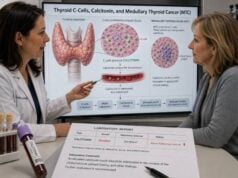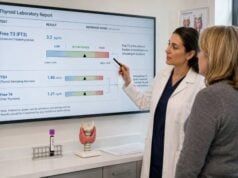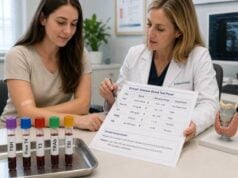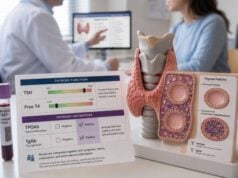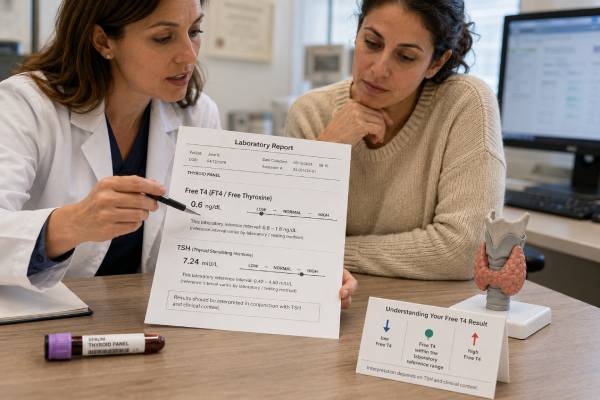
A free T4 blood test measures the unbound portion of thyroxine, the main hormone released by the thyroid gland. It is commonly paired with TSH to confirm whether the thyroid is underactive, overactive, or responding normally to pituitary signals. High free T4 with low TSH usually points toward hyperthyroidism or excess thyroid medication, while low free T4 with high TSH supports primary hypothyroidism. A low free T4 with a normal or low TSH can instead suggest pituitary disease, severe illness, medication effects, or a misleading assay result. Normal ranges vary because laboratory methods are not fully standardized, and pregnancy, illness, binding-protein abnormalities, biotin, heparin, and dose timing can distort results. Free T4 is therefore more informative as part of a pattern than as an isolated number. Unexpected values often need confirmation, review of medicines and supplements, and comparison with symptoms and previous results before treatment changes are made.
- Free T4 measures thyroxine that is not bound to transport proteins and is available to tissues.
- High TSH plus low free T4 usually indicates primary hypothyroidism; low TSH plus high free T4 usually indicates hyperthyroidism.
- Low free T4 with an inappropriately normal or low TSH can signal central hypothyroidism and deserves careful assessment.
- A typical adult range is roughly 0.8–1.8 ng/dL, but the performing laboratory’s interval must be used.
- Biotin, pregnancy, serious illness, heparin, abnormal binding proteins, and thyroid medicine timing can produce confusing results.
Table of Contents
- What the Free T4 Test Measures
- Why Free T4 Is Ordered
- Preparation and Blood Collection
- Normal Range and TSH Patterns
- What Causes High Free T4
- What Causes Low Free T4
- Assay Accuracy and Misleading Results
- Follow-Up and Treatment Monitoring
What the Free T4 Test Measures
Thyroxine is called T4 because each molecule contains four iodine atoms. Thyroid follicular cells make T4 after taking up iodine and attaching it to tyrosine residues within thyroglobulin. The gland stores substantial amounts of hormone and releases T4 when stimulated by thyroid-stimulating hormone, or TSH, from the pituitary gland.
More than 99.9% of circulating T4 is attached to proteins. Thyroxine-binding globulin carries most of it, while transthyretin and albumin carry smaller portions. The unbound fraction is only about 0.02%, yet this free portion can enter cells and is available for conversion to triiodothyronine, or T3. T3 binds thyroid hormone receptors more strongly and produces much of the hormone’s biological effect.
A free T4 assay estimates the concentration of unbound T4. A total T4 test measures both bound and unbound hormone. When binding proteins are unusually high or low, total T4 can change even if thyroid function is normal. Free T4 often gives a clearer picture, although routine immunoassays are not completely independent of binding-protein effects.
TSH and free T4 form a sensitive feedback pair. The hypothalamus releases thyrotropin-releasing hormone, which prompts the pituitary to release TSH. TSH stimulates the thyroid, and rising free T4 and T3 feed back to reduce TSH. A small shift in free T4 may produce a much larger change in TSH. That is why TSH often leaves its reference interval before free T4 does in early primary thyroid disease.
The TSH test is usually the first screening measurement when the pituitary-thyroid axis is intact. Free T4 then confirms the degree and direction of dysfunction. In pituitary or hypothalamic disease, however, TSH may be unreliable and free T4 becomes the central biochemical measurement.
Free T4 does not reveal the cause of an abnormal result by itself. Graves disease, thyroiditis, toxic nodules, Hashimoto thyroiditis, pituitary disorders, medicines, pregnancy, and laboratory interference can produce overlapping numbers. The cause is determined from the complete pattern and clinical context.
Why Free T4 Is Ordered
Free T4 is ordered to diagnose thyroid dysfunction, clarify an abnormal TSH, monitor treatment, and investigate situations in which TSH cannot be trusted.
Symptoms that may lead to testing include fatigue, heat or cold intolerance, unexplained weight change, tremor, palpitations, constipation, frequent bowel movements, menstrual changes, muscle weakness, hair or skin changes, anxiety, slowed thinking, and neck enlargement. These symptoms are common and nonspecific, so laboratory testing helps separate thyroid disease from other causes.
Confirming primary thyroid disease
In primary hypothyroidism, the thyroid cannot make enough hormone. The pituitary responds by increasing TSH. Overt primary hypothyroidism therefore usually produces high TSH and low free T4. High TSH with normal free T4 is called subclinical hypothyroidism.
In primary hyperthyroidism, excess thyroid hormone suppresses TSH. Overt disease usually produces low or undetectable TSH with high free T4, high T3, or both. Low TSH with normal free T4 and T3 is called subclinical hyperthyroidism.
Detecting central hypothyroidism
Central hypothyroidism results from inadequate stimulation of an otherwise capable thyroid gland because of pituitary or hypothalamic disease. Free T4 is low, but TSH may be low, normal, or mildly elevated. The TSH is “inappropriately” normal because a healthy pituitary should raise it strongly when free T4 falls.
Possible causes include pituitary tumors, surgery, radiation, traumatic brain injury, infiltrative disease, postpartum pituitary injury, and genetic disorders. Other pituitary hormones may also be deficient. Adrenal function often must be assessed before starting levothyroxine because untreated adrenal insufficiency can become dangerous when thyroid hormone is introduced.
Monitoring treatment
Free T4 helps monitor antithyroid drugs during early hyperthyroidism treatment because TSH can remain suppressed long after hormone concentrations improve. It is also used in central hypothyroidism, where clinicians generally adjust levothyroxine according to free T4 and symptoms rather than TSH.
For ordinary primary hypothyroidism treated with levothyroxine, TSH is usually the main target once levels are stable. Free T4 can help when TSH is very abnormal, symptoms persist, pregnancy changes treatment needs, absorption is uncertain, or results conflict.
Free T4 may also be ordered in newborn screening follow-up, pregnancy, amiodarone treatment, severe illness, or suspected thyroid hormone resistance. Each setting has specialized interpretation.
Preparation and Blood Collection
The test uses a routine blood sample from a vein. Fasting is generally not required unless another ordered test requires it. Collection risks are minor and may include temporary pain, bruising, or lightheadedness.
Several practical details can improve interpretation:
- Biotin: Many high-dose supplements can interfere with immunoassays. Depending on the platform, the result may appear falsely high while TSH appears falsely low, mimicking hyperthyroidism. Follow laboratory guidance about pausing nonessential biotin.
- Levothyroxine timing: Free T4 rises after an oral dose and may stay higher for several hours. A sample collected shortly after medication may not be comparable with one collected before the dose.
- Liothyronine or desiccated thyroid: These mainly affect T3 but can alter the overall feedback pattern and TSH.
- Heparin: Heparin can release an enzyme that generates free fatty acids in the sample, displacing T4 from proteins and creating an artificially high free T4 result, especially if processing is delayed.
- Amiodarone and iodine: Amiodarone contains iodine and blocks hormone conversion, often raising free T4 while lowering T3 even without overt hyperthyroidism.
- Glucocorticoids, dopamine, and severe illness: These can suppress TSH and alter conversion, creating patterns that resemble central disease.
- Estrogen and pregnancy: Estrogen raises thyroxine-binding globulin. Free T4 immunoassays respond differently to the changed binding environment.
Do not stop prescription medication on your own. A clinician may request a pre-dose sample, ask you to keep timing consistent, or interpret the value with the dosing schedule. Consistency is especially important when small changes will guide dose adjustments.
Tell the clinician about pregnancy, recent childbirth, hospitalization, kidney or liver disease, pituitary disease, and recent iodinated contrast. Mention all supplements and “thyroid support” products because some contain undisclosed thyroid hormones or iodine.
If a result is surprising, record where and when the sample was taken, the dose time, whether you were fasting, and the assay reference interval. Using the same laboratory for serial monitoring reduces confusion caused by method differences.
Normal Range and TSH Patterns
Free T4 is commonly reported in nanograms per deciliter (ng/dL) or picomoles per liter (pmol/L). To convert ng/dL to pmol/L, multiply by about 12.87. An adult interval might be approximately 0.8–1.8 ng/dL, or 10–23 pmol/L, but some laboratories use narrower or shifted limits.
There is no universal range because assays use different antibodies, calibration, incubation conditions, and ways of limiting disturbance to the free-bound equilibrium. Age, pregnancy, population iodine intake, and illness also affect reference intervals. The number should always be read against the range printed on the report.
Common combinations include:
| TSH | Free T4 | Possible interpretation |
|---|---|---|
| High | Low | Overt primary hypothyroidism |
| High | Normal | Subclinical hypothyroidism or recovery from illness |
| Low | High | Overt hyperthyroidism, thyroiditis, or excess thyroid hormone |
| Low | Normal | Subclinical hyperthyroidism, T3 thyrotoxicosis, medicine effect, or temporary suppression |
| Normal or low | Low | Central hypothyroidism, severe illness, medication effect, or assay problem |
| Normal or high | High | Assay interference, thyroid hormone resistance, TSH-secreting pituitary tumor, or medication timing |
A free T4 result in the reference range does not guarantee that thyroid function is normal in every person. A clearly abnormal TSH may indicate subclinical disease even while free T4 remains within range. Conversely, a person with pituitary disease can have a low free T4 despite a TSH that looks “normal.”
The reference interval is not the same as a treatment target. In central hypothyroidism, clinicians often aim for free T4 above the middle of the laboratory range, but age, heart disease, pregnancy, symptoms, and other factors influence the target. In primary hypothyroidism, adjusting levothyroxine solely to move free T4 higher can suppress TSH and cause overtreatment.
A single borderline result may reflect ordinary variation. TSH has a circadian rhythm, free T4 changes after levothyroxine dosing, and assays have measurement uncertainty. Repetition is often appropriate before diagnosing a mild abnormality, unless pregnancy, severe symptoms, or another urgent factor requires faster action.
What Causes High Free T4
High free T4 can result from true hormone excess, medication, altered physiology, or assay interference. TSH helps sort these categories.
Hyperthyroidism and thyroiditis
Graves disease is caused by antibodies that stimulate the TSH receptor. It commonly produces suppressed TSH and high free T4 and T3. Toxic adenoma and toxic multinodular goiter produce hormone autonomously and can create the same biochemical pattern. A hyperthyroidism blood test panel may include TSH, free T4, T3, and TSH receptor antibodies to help define the cause.
Thyroiditis releases stored hormone from damaged thyroid tissue. Subacute thyroiditis often causes neck pain and elevated inflammatory markers, while painless and postpartum thyroiditis may not hurt. Radioactive iodine uptake is usually low because the gland is not actively synthesizing excess hormone.
Excess iodine can trigger hyperthyroidism in susceptible thyroid tissue. Amiodarone can cause either iodine-driven hormone production or destructive thyroiditis. The distinction affects treatment and often requires endocrinology input.
Thyroid hormone exposure
Too much levothyroxine lowers TSH and raises free T4. This can happen after a dose increase, weight loss, improved absorption, stopping an interacting medicine, or taking extra tablets. Intentional TSH suppression after certain thyroid cancers may produce a high-normal or mildly high free T4, but the target should be individualized.
A blood draw soon after a levothyroxine dose can show a temporary peak. If TSH is stable and the person feels well, clinicians may repeat the sample before the daily dose before deciding that the prescription is excessive.
Pregnancy and binding changes
Human chorionic gonadotropin can weakly stimulate the TSH receptor in early pregnancy, lowering TSH and sometimes raising free T4. This is often physiological, especially with multiple pregnancy or severe vomiting, but Graves disease must be considered when elevation is substantial or persistent.
Routine free T4 immunoassays can be biased during pregnancy because thyroxine-binding globulin rises and albumin falls. Method- and trimester-specific ranges are preferable. Total T4 with pregnancy adjustment or specialized free T4 measurement may be used when results are unclear.
Discordant high values
High free T4 with a nonsuppressed TSH does not fit ordinary hyperthyroidism. Common explanations include recent levothyroxine dosing, inconsistent medication use, biotin, heterophile antibodies, anti-T4 antibodies, and familial dysalbuminemic hyperthyroxinemia. Rare causes include thyroid hormone resistance and a TSH-secreting pituitary adenoma.
Familial dysalbuminemic hyperthyroxinemia is an inherited albumin variant that binds T4 unusually strongly. Some free T4 immunoassays read high even though the person is euthyroid. TSH is usually normal, symptoms are absent, and direct methods can clarify the result.
What Causes Low Free T4
Low free T4 means different things depending on TSH and the surrounding clinical situation.
Primary hypothyroidism
High TSH with low free T4 is the classic pattern. Hashimoto thyroiditis is a common cause in iodine-sufficient regions. Other causes include thyroid surgery, radioactive iodine, congenital thyroid abnormalities, neck radiation, iodine deficiency or excess, and medicines such as lithium or some immune therapies.
Symptoms may include cold intolerance, constipation, dry skin, fatigue, slowed heart rate, muscle aches, menstrual changes, and weight gain. Severe longstanding hypothyroidism can cause cognitive slowing, low sodium, fluid accumulation, and rarely myxedema coma.
Central hypothyroidism
Low free T4 with low, normal, or mildly elevated TSH requires consideration of pituitary or hypothalamic disease. Symptoms may overlap with primary hypothyroidism, but headache, visual change, low blood pressure, loss of body hair, menstrual disruption, infertility, low libido, or excessive thirst can suggest broader pituitary dysfunction.
A normal TSH does not rule out central hypothyroidism. Evaluation may include morning cortisol, prolactin, gonadotropins, sex hormones, insulin-like growth factor 1, and pituitary MRI. Adrenal insufficiency should be addressed before thyroid replacement.
Nonthyroidal illness and medication effects
Severe illness can lower free T4, particularly as illness becomes prolonged. TSH may be low or normal, and free T3 is often low first. Testing during hospitalization should be limited to situations where thyroid disease is strongly suspected because illness-related changes can be difficult to distinguish from central hypothyroidism.
Glucocorticoids and dopamine suppress TSH. Antiseizure medicines can increase T4 metabolism or alter binding. Rifampin may increase hormone clearance. Nephrotic syndrome can lower binding proteins and total hormone, although free T4 may remain normal or become method dependent.
Pregnancy and assay bias
Free T4 often declines as pregnancy progresses, and nonpregnant reference ranges should not be used. An apparently low result may reflect normal gestational change or immunoassay bias. True maternal hypothyroidism is assessed with pregnancy-specific TSH and free T4 or an accepted alternative method.
Assay Accuracy and Misleading Results
Measuring free T4 is technically challenging because the assay must detect a tiny free fraction without disturbing equilibrium with the much larger bound pool. Most routine tests use automated immunoassays. Their speed and availability make them useful, but results can differ enough to change whether a value is labeled normal or abnormal.
Reference measurement uses equilibrium dialysis followed by isotope-dilution liquid chromatography-tandem mass spectrometry. Equilibrium dialysis separates free hormone across a membrane under controlled conditions. The method is expensive and usually reserved for reference laboratories or puzzling cases.
Interference should be considered when the result conflicts with TSH, symptoms, medication history, or previous values. Possible investigations include:
- Repeating the sample on the same platform to exclude handling error
- Testing with a different manufacturer’s assay
- Measuring total T4 and thyroxine-binding globulin
- Using equilibrium dialysis or ultrafiltration with mass spectrometry
- Performing dilution or blocking studies for interfering antibodies
- Reviewing biotin and heparin exposure
- Checking for familial binding-protein disorders
Free T4 can be falsely high after heparin because free fatty acids displace T4 from binding proteins in the tube. Long incubation makes the effect worse. The result reflects an in-vitro sample change rather than true hormone excess in the body.
Biotin interference depends on assay design. In a competitive free T4 assay, excess biotin may produce a falsely high value. The paired TSH assay may read falsely low, creating a convincing but artificial Graves-like pattern.
Autoantibodies to thyroid hormones can bind assay tracers. Heterophile antibodies can bridge or block assay components. These problems are uncommon but important because they may lead to unnecessary treatment, imaging, or pituitary workup.
Method changes also complicate trends. A patient may appear to have shifted from 1.3 to 1.7 ng/dL simply because the laboratory changed analyzers. The reference interval and assay name should travel with the result when records are compared.
Follow-Up and Treatment Monitoring
The response to an abnormal free T4 should match the pattern rather than the flagged value alone.
For high TSH and low free T4, clinicians usually evaluate primary hypothyroidism and consider levothyroxine. The starting dose depends on age, weight, pregnancy, heart disease, severity, and duration. TSH is commonly rechecked about six to eight weeks after a dose change because the feedback system needs time to reach a new steady state.
For low TSH and high free T4, evaluation focuses on the cause of thyrotoxicosis. T3, TSH receptor antibodies, radioactive iodine uptake, and ultrasound may be appropriate. Severe symptoms or cardiac complications require prompt treatment.
For low free T4 with normal or low TSH, do not assume the thyroid gland is normal. Review acute illness and medicines, repeat the test when appropriate, and assess pituitary function if the pattern persists or clinical features support it.
For high free T4 with normal or high TSH, first check medication timing and assay interference. Rare diagnoses should be pursued only after common analytical explanations are excluded.
People taking levothyroxine can improve comparability by using the same laboratory and collecting samples at a consistent point relative to the dose. The thyroid hormone replacement monitoring test is not interpreted from free T4 alone; adherence, absorption, interactions, TSH, pregnancy, and treatment purpose all matter.
Seek urgent care for severe shortness of breath, chest pain, fainting, marked confusion, high fever with rapid heartbeat, or extreme drowsiness and low body temperature. These symptoms can occur with serious complications of thyroid excess or deficiency, though many other emergencies can cause them.
A useful follow-up conversation should clarify four points: whether the TSH and free T4 agree, whether the result was collected under comparable conditions, whether a medicine or assay could explain it, and whether the pattern requires treatment now or confirmation first.
References
- Practical considerations for accurate determination of free thyroxine by equilibrium dialysis 2023
- Large method differences for free thyroid hormone assays are not explained by differences in T4 and T3 binding proteins 2023
- Analysis of Serum Free Thyroxine Concentrations in Healthy Subjects and Patients with Thyroid Disease: A Comparison of Five Immunoassays 2024
- 2024 European Thyroid Association Guidelines on diagnosis and management of genetic disorders of thyroid hormone transport, metabolism and action 2024 (Guideline)
- Free thyroid hormone: Methods and standardization 2025 (Review)
- Evaluation of the Current State of Thyroid Hormone Testing and Measurement Standardization 2025
Disclaimer
Free T4 results must be interpreted with TSH, symptoms, pregnancy status, medicines, and the laboratory method. Do not change thyroid medication based on one value without guidance from the prescribing clinician. Severe symptoms of thyroid excess or deficiency require prompt medical assessment.