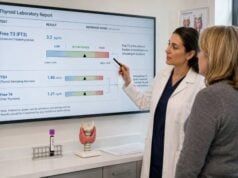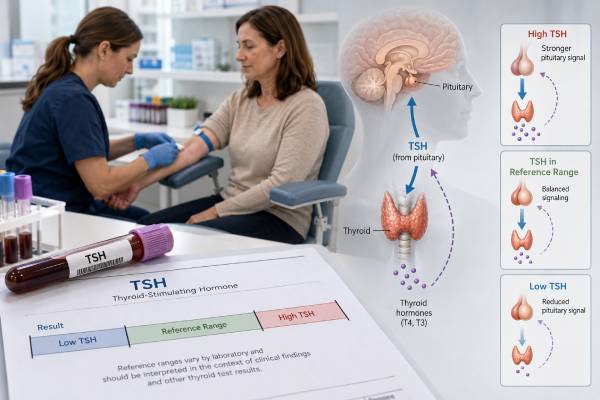
The thyroid-stimulating hormone test measures TSH, a pituitary hormone that tells the thyroid how much T4 and T3 to make. It is usually the first blood test used to screen for primary thyroid dysfunction and the main test used to monitor levothyroxine treatment in primary hypothyroidism. A high TSH commonly means the thyroid is not supplying enough hormone, while a low TSH commonly means thyroid hormone is excessive. The result is not diagnostic by itself. Free T4, and sometimes T3, shows whether the abnormality is overt or subclinical and helps identify pituitary disease, medication effects, pregnancy changes, severe illness, or assay interference. Adult reference ranges often fall roughly around 0.4 to 4.0 mIU/L, but there is no universal normal range. The laboratory’s method, age, pregnancy, time of day, medicines, and clinical context all affect interpretation.
- High TSH with low free T4 usually indicates overt primary hypothyroidism; high TSH with normal free T4 is subclinical hypothyroidism.
- Low TSH with high free T4 or T3 usually indicates hyperthyroidism or excess thyroid medication.
- Low or normal TSH with low free T4 can indicate central hypothyroidism, severe illness, medication effects, or assay interference.
- A mildly abnormal TSH often needs confirmation, especially after illness, during pregnancy, or before treating subclinical disease.
- For levothyroxine dose changes, TSH is commonly rechecked after about six weeks, when a new steady state has developed.
Table of Contents
- What the TSH Test Measures
- TSH Normal Range and Reference Limits
- High TSH Results
- Low TSH Results
- Interpreting TSH With Free T4 and T3
- Factors That Change or Distort TSH
- Testing, Monitoring, and Follow-Up
What the TSH Test Measures
TSH is produced by the anterior pituitary gland, a small gland at the base of the brain. The hypothalamus signals the pituitary with thyrotropin-releasing hormone, and the pituitary releases TSH into the blood. TSH binds receptors on thyroid cells and stimulates iodine uptake, hormone synthesis, and release of T4 and T3.
The system works through negative feedback. When the pituitary senses too little circulating thyroid hormone, it raises TSH. When thyroid hormone is abundant, it suppresses TSH. Because the response is sensitive, TSH may move outside its reference range before free T4 changes. That makes it a useful early marker of primary thyroid failure or excess.
The test requires a simple routine venous blood sample, usually from the arm, and is generally reported in milli-international units per liter, written mIU/L. Some reports use µIU/mL, which is numerically equivalent. Modern sensitive third-generation immunoassays can reliably measure very low concentrations, helping distinguish mild suppression from profound suppression.
TSH measures the pituitary response, not thyroid hormone itself. This distinction is essential. A high TSH is the pituitary’s request for more hormone; it is not a high thyroid hormone level. A low TSH is reduced stimulation; it does not automatically mean the thyroid is failing.
TSH works best when the pituitary and hypothalamus are healthy and the thyroid state has been stable for several weeks. It becomes less reliable in central hypothyroidism, immediately after a treatment change, during severe acute illness, and when medicines or assay interference alter the measurement.
A TSH with reflex to free T4 test uses this sensitivity efficiently. The laboratory measures TSH first and adds free T4 automatically when TSH is outside a predefined range. This limits unnecessary testing while still classifying most abnormal results.
Why a TSH test is ordered
Clinicians order TSH when symptoms, examination findings, medication history, or risk factors raise concern about thyroid function. Symptoms suggesting hypothyroidism include persistent cold intolerance, constipation, dry skin, slowed thinking, menstrual changes, and unexplained fatigue. Hyperthyroid clues include tremor, heat intolerance, palpitations, unexplained weight loss, frequent bowel movements, and muscle weakness. None is specific enough to diagnose thyroid disease without testing.
Testing is also common after a goiter or thyroid nodule is found. TSH does not determine whether a nodule is cancerous, but it shows whether the gland is producing hormone autonomously and helps select the next imaging step. A suppressed TSH may lead to a radionuclide scan in a nonpregnant patient, while a normal or high TSH usually leads to ultrasound-based assessment.
People with type 1 diabetes, celiac disease, Turner syndrome, Down syndrome, a strong family history, previous neck radiation, thyroid surgery, or radioactive iodine have a higher reason for periodic assessment. Lithium, amiodarone, immune checkpoint inhibitors, and some other medicines can trigger thyroid dysfunction, so a baseline and follow-up schedule may be used.
Newborn screening uses a specialized TSH strategy because untreated congenital hypothyroidism can impair development. Pregnancy and preconception care also use separate thresholds and monitoring intervals. These situations should not be interpreted with an ordinary adult outpatient algorithm.
Routine screening of every asymptomatic adult remains debated. Recommendations differ by country and risk profile because evidence that population-wide testing improves outcomes is limited. Targeted testing is more widely accepted when symptoms or risk factors are present. Repeating normal TSH frequently without a clinical change can uncover harmless variation and lead to unnecessary follow-up.
TSH is also used after treatment for hyperthyroidism, thyroiditis, and thyroid cancer. In each setting the timeline differs. TSH may remain suppressed after free T4 and T3 normalize, rise temporarily during recovery from thyroiditis, or be intentionally maintained below the usual range after selected thyroid cancers. The reason for ordering the test must accompany the result.
TSH Normal Range and Reference Limits
A laboratory reference interval usually includes the central 95% of results from a selected reference population. It is not a universal biological target. Adult intervals often resemble 0.4 to 4.0 mIU/L, but lower limits may be around 0.2 to 0.5 and upper limits around 3.5 to 5.0 depending on method and population.
Use the range printed on the report. TSH assays are calibrated with international standards, yet results are not perfectly interchangeable. Manufacturers use different antibodies, signal systems, and calibrators, and laboratories select or verify their own reference intervals.
Age changes the expected distribution. TSH tends to rise in older adults, particularly in advanced age. Applying a young-adult upper limit to every older person can overdiagnose subclinical hypothyroidism and lead to unnecessary treatment. Children and newborns need age-specific ranges because TSH is especially high shortly after birth and changes throughout development.
Pregnancy requires trimester- and method-specific intervals. hCG can lower TSH in the first trimester, sometimes below the nonpregnant lower limit. A pregnancy thyroid test should not be judged against an ordinary adult range.
The concept of an “optimal” TSH is often misunderstood. A value within the laboratory range can be normal even if it differs from a person’s previous result. Healthy TSH has within-person and day-to-day variability. A change from 1.2 to 2.3 mIU/L does not necessarily show declining thyroid function.
Treatment targets also differ from diagnostic intervals. Most adults taking levothyroxine for primary hypothyroidism aim for a TSH within an appropriate reference range. Central hypothyroidism uses free T4 rather than TSH. Some thyroid cancer patients have intentionally lower targets based on recurrence risk. Pregnancy uses tighter, gestation-specific management.
A result close to a cutoff should be interpreted as a continuum. A TSH of 4.1 is not biologically transformed compared with 3.9. Repeating the test, reviewing free T4, and assessing risk often matters more than the label “high.”
Within-person variation also means that an individual has a narrower usual set point than the broad population range, but that personal set point cannot be reliably reconstructed from one old result. Trends become useful when samples were collected under similar conditions and no major treatment, illness, pregnancy, or laboratory method change occurred.
High TSH Results
A high TSH most often indicates primary hypothyroidism, meaning the thyroid gland is not producing enough hormone for the pituitary’s expected feedback signal.
Common possible causes include:
- Hashimoto thyroiditis
- Prior thyroid surgery or radioactive iodine treatment
- Neck radiation
- Iodine deficiency or excess
- Lithium, amiodarone, and certain immune therapies
- Congenital thyroid disease
- Temporary recovery after thyroiditis or severe illness
- Inadequate levothyroxine dose, missed tablets, or reduced absorption
Free T4 determines severity. High TSH with low free T4 is overt primary hypothyroidism. Symptoms may include fatigue, cold intolerance, constipation, dry skin, slowed thinking, muscle aches, heavy menstrual bleeding, and weight gain, although symptoms are nonspecific.
High TSH with normal free T4 is subclinical hypothyroidism. Many cases are mild and asymptomatic. A single mild elevation may normalize on repeat testing, especially after illness. Treatment decisions depend on how high and persistent TSH is, age, symptoms, TPOAb status, cardiovascular risk, pregnancy, and fertility plans.
A hypothyroidism blood test panel may add TPOAb to support Hashimoto thyroiditis. Positive antibodies identify cause and future risk but do not set the medication dose.
In someone already taking levothyroxine, high TSH may mean under-replacement, but clinicians should first examine the dosing history. Calcium, iron, antacids, bile-acid binders, coffee, inconsistent fasting, celiac disease, bariatric surgery, and missed tablets can reduce exposure. Simply increasing the prescription without fixing the cause can lead to excess later.
Rarely, high measured TSH with normal free T4 and no symptoms comes from macro-TSH, a complex of TSH and immunoglobulin that remains in circulation and is detected by some assays. Heterophile antibodies can also produce false elevation. These possibilities are considered when results remain discordant despite careful review.
Very high TSH warrants timely evaluation, especially with low free T4, pregnancy, infancy, severe symptoms, or known pituitary-adrenal disease. Myxedema coma is rare but life-threatening; confusion, hypothermia, slow breathing, low blood pressure, and profound weakness require emergency care.
Low TSH Results
A low TSH most often reflects excessive thyroid hormone action. The source may be the thyroid gland, thyroid medication, or transient hormone release from inflamed tissue.
Common causes include:
- Graves disease
- Toxic adenoma or toxic multinodular goiter
- Thyroiditis
- Excess levothyroxine or liothyronine
- Iodine exposure or amiodarone-related thyroid dysfunction
- Early pregnancy hCG effects
- Glucocorticoids, dopamine, or severe illness suppressing pituitary TSH
- Pituitary or hypothalamic disease when free T4 is low
Low TSH with high free T4 or T3 is overt thyrotoxicosis. Symptoms may include palpitations, tremor, heat intolerance, sweating, anxiety, frequent bowel movements, muscle weakness, and weight loss. Older adults may present mainly with atrial fibrillation, fatigue, or heart failure.
Low TSH with normal free T4 and T3 is subclinical hyperthyroidism. It may be transient, particularly after illness or treatment. Persistent suppression is more important in older adults and people with heart rhythm or bone risks. The degree matters: a barely low result is different from TSH below the assay’s detection limit.
The hyperthyroidism test pattern may include TRAb or TSI to identify Graves disease. Radioactive iodine uptake or ultrasound can distinguish increased production from thyroiditis when appropriate.
A low TSH during treatment for Graves disease can lag behind free T4 and T3 improvement. It may stay suppressed for weeks or months. Increasing antithyroid medication solely because TSH remains low can cause hypothyroidism; early monitoring relies more on hormone levels.
Low TSH on levothyroxine often indicates over-replacement. Persistent suppression increases the risk of atrial fibrillation and bone loss, especially in older adults and postmenopausal people. Dose changes should account for sample timing, weight change, adherence, and whether suppression is intentional for thyroid cancer.
Seek urgent care for chest pain, fainting, severe shortness of breath, fever with marked hyperthyroid symptoms, confusion, or a sustained rapid or irregular heartbeat.
Interpreting TSH With Free T4 and T3
TSH gains meaning from the accompanying hormone pattern.
| TSH | Free T4 | T3 | Common interpretation |
|---|---|---|---|
| High | Low | Low or normal | Overt primary hypothyroidism |
| High | Normal | Usually normal | Subclinical hypothyroidism |
| Low | High | High or normal | Overt hyperthyroidism or medication excess |
| Low | Normal | High | T3-predominant hyperthyroidism |
| Low | Normal | Normal | Subclinical hyperthyroidism or transient suppression |
| Low or normal | Low | Low or normal | Central hypothyroidism, severe illness, or drug effect |
| Normal or high | High | High or normal | Assay interference, resistance to thyroid hormone, medication timing, or rare TSH-secreting tumor |
Central hypothyroidism deserves special attention. A TSH within range may appear reassuring, but it is inappropriate if free T4 is low. Pituitary tumors, surgery, radiation, head injury, and infiltrative disease can impair TSH production or biologic activity. Other pituitary hormones and imaging may be needed. Cortisol deficiency must be considered before thyroid hormone treatment.
T3 is mainly helpful when TSH is low. It may be the first hormone to rise in Graves disease or autonomous nodules. In hypothyroidism, T3 can remain normal until disease is advanced, so a normal T3 does not rule out significant T4 deficiency.
Discordant results should trigger a structured review before rare diagnoses are pursued. Check medicines, supplement use, recent illness, pregnancy, timing of thyroid medication, binding-protein changes, and the possibility of assay interference. Repeating on a different platform can clarify a method-specific problem.
Factors That Change or Distort TSH
TSH follows a circadian rhythm. It tends to be higher overnight and lower later in the day. Food intake and sampling time can create modest differences, especially near a diagnostic cutoff. For routine follow-up, similar timing improves comparison.
Acute illness can suppress TSH, while recovery can produce a temporary rise. Testing hospitalized patients without a strong thyroid indication can reveal non-thyroidal illness patterns that are difficult to interpret. Repeat testing after recovery is often more informative.
Medicines can change TSH secretion or thyroid physiology. Glucocorticoids, dopamine, somatostatin analogues, and some cancer drugs can suppress TSH. Lithium can contribute to hypothyroidism. Amiodarone affects iodine exposure, hormone conversion, and thyroid function. Estrogen changes binding proteins but usually affects total hormone more than TSH.
Biotin can interfere with immunoassays. In common assay designs it may create falsely low TSH and falsely high free T4 or T3, mimicking Graves disease. Over-the-counter hair and nail products can contain doses far above nutritional needs. Laboratories often advise stopping biotin for at least 48 hours, but high-dose therapy may require longer.
Other analytic problems include heterophile antibodies, human anti-animal antibodies, rheumatoid factor, macro-TSH, and anti-reagent antibodies. Interference is uncommon, but it should be suspected when the result conflicts sharply with symptoms or with the expected TSH–free T4 relationship.
Age, pregnancy, obesity, smoking, iodine status, and genetic factors alter population distributions. These effects do not justify replacing validated laboratory intervals with commercially marketed “functional” ranges. Clinical decisions should use established methods, current guidelines, and individual risk.
Testing, Monitoring, and Follow-Up
No fasting is usually required for TSH alone. When the test is part of a fasting panel, follow those instructions. Tell the clinician about thyroid medicine, biotin, amiodarone, lithium, steroids, dopamine-related drugs, pregnancy, and recent illness.
For levothyroxine monitoring, many clinicians draw blood before the morning dose or record the interval since dosing, particularly when free T4 is included. TSH itself reflects weeks of exposure and is less affected by one tablet. After a dose change, wait about six weeks before routine reassessment unless an urgent issue exists. Once stable, annual testing is often sufficient for primary hypothyroidism, with earlier review after pregnancy, major weight change, a new interaction, or symptom recurrence.
A mildly abnormal TSH in a stable nonpregnant adult is often repeated with free T4 before treatment. The repeat interval depends on severity. Marked abnormalities, low free T4, pregnancy, infants, or significant symptoms require faster action.
Normal TSH makes important primary thyroid dysfunction less likely in most stable adults, but it does not exclude central hypothyroidism or every cause of symptoms. Persistent fatigue, hair loss, weight change, or palpitations may require evaluation for anemia, sleep disorders, medication effects, heart rhythm problems, menopause, mood disorders, or other endocrine disease.
Do not alter medication from a single portal result without considering the full pattern. A safe plan answers: Was the result repeated? What was free T4? Has the dose or schedule changed? Were there interactions or illness? Is the target different because of pregnancy, pituitary disease, or thyroid cancer?
TSH is powerful precisely because it condenses pituitary feedback into one accessible laboratory number that can be followed over time. Its limitations are equally important: it is a signal within a living feedback system, not a stand-alone diagnosis or universal measure of how a person should feel.
References
- Thyroid-Stimulating Hormone and Thyroid Hormones (T3 and T4): An American Thyroid Association-Commissioned Review of Current Clinical and Laboratory Status 2023 (Review)
- Standardisation and harmonisation of thyroid-stimulating hormone measurements 2024 (Review)
- WHO/BS/2023.2454 WHO 4th International Standards for TSH (human, pituitary) 2023
- National recommendations of the Croatian society of medical biochemistry and laboratory medicine: Thyroid function tests from the laboratory point of view 2025 (Guideline)
- Reference Intervals of Thyrotropin, Thyroid Hormones, and Thyroid Antibodies in Healthy Thai Adults 2025
- Thyroid Function Tests 2023
Disclaimer
TSH results require interpretation with free T4, symptoms, medicines, age, pregnancy status, medical history, and the laboratory’s reference range. Do not start, stop, or change thyroid medication from an isolated value without clinical guidance. Urgent symptoms such as chest pain, fainting, severe shortness of breath, confusion, or a sustained rapid heartbeat require prompt care.