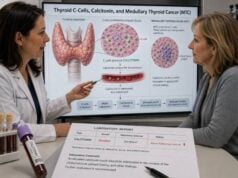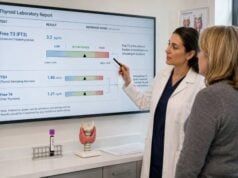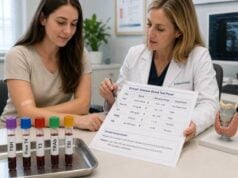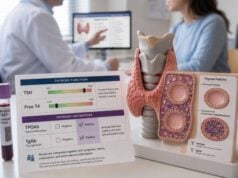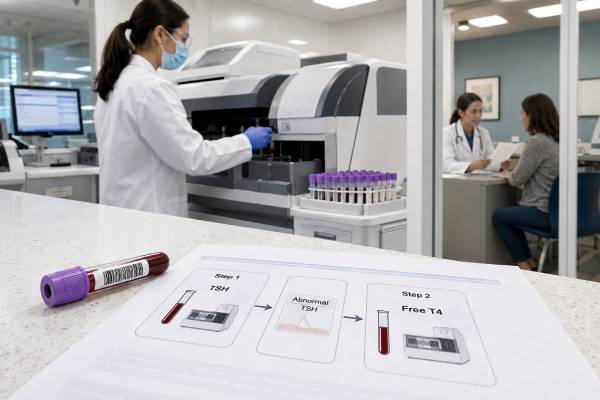
A TSH with reflex to free T4 test is a laboratory algorithm rather than a single combined measurement. The laboratory measures thyroid-stimulating hormone first. If TSH falls outside a preset reflex range, it automatically tests free T4 on the same blood sample. This approach efficiently identifies most cases of primary hypothyroidism and hyperthyroidism while avoiding unnecessary free T4 testing when TSH is normal. A high TSH with low free T4 supports overt primary hypothyroidism; high TSH with normal free T4 suggests subclinical hypothyroidism. Low TSH with high free T4 supports overt hyperthyroidism, while low TSH with normal free T4 may require total T3 and clinical follow-up. Reflex testing has important limits. It can miss central hypothyroidism when TSH appears normal, and standard outpatient ranges may not fit pregnancy, severe illness, pituitary disease, recent thyroid treatment, or certain medicines. Results should be interpreted with symptoms, history, medications, laboratory cutoffs, and the reason testing was ordered.
- The laboratory measures TSH first and adds free T4 automatically only when TSH crosses its reflex limits.
- High TSH plus low free T4 usually means overt primary hypothyroidism.
- Low TSH plus high free T4 usually means overt hyperthyroidism.
- A normal reflex result does not reliably exclude central hypothyroidism, pregnancy-specific disease, or all medication and illness effects.
- Low TSH with normal free T4 may require total T3 to detect T3-predominant hyperthyroidism.
- Reflex cutoffs differ from full reference intervals and vary among laboratories.
Table of Contents
- How TSH With Reflex to Free T4 Works
- When the Test Is Appropriate
- How to Read the Result Patterns
- Normal TSH and Conditions the Reflex May Miss
- Medications, Illness, and Assay Interference
- Pregnancy, Treatment, and Special Populations
- Preparation, Repeat Testing, and Next Steps
How TSH With Reflex to Free T4 Works
“Reflex” means that one result automatically triggers another test under rules programmed by the laboratory. The blood is usually collected in one tube. TSH is measured first. If it is above or below the laboratory’s reflex interval, free T4 is performed without requiring another order or blood draw.
The algorithm uses the strong inverse relationship between TSH and circulating thyroid hormone in people with an intact pituitary-thyroid feedback system. A small fall in free T4 can produce a large rise in TSH, and a small rise in free T4 can suppress TSH. This makes TSH a sensitive first-line marker for primary thyroid disease.
The reflex interval is not always identical to the printed TSH reference range. A laboratory may reflex free T4 only when TSH is below 0.3 or above 4.5 mIU/L, while another may use wider or narrower limits. Some systems also set upper or lower analytical boundaries or special rules for age groups. The report or laboratory directory should state the algorithm.
If TSH stays within the reflex interval, no free T4 result appears because the second assay was not run. This does not mean free T4 was measured and found normal. It means the algorithm judged it unnecessary for the usual primary-thyroid screening purpose.
Some laboratories offer expanded cascades. A low TSH may trigger free T4 and then total T3 if free T4 is normal. A high TSH may trigger free T4 and sometimes TPO antibodies under a separate protocol. The assignment name “TSH with reflex to free T4” should not be assumed to include these additional tests unless the order description says so.
Why reflex testing is used
Reflex testing reduces redundant assays, conserves sample volume, lowers cost, and can shorten the time to a complete interpretation. It also prevents the common problem of ordering TSH alone and then needing a second visit when it is abnormal. Laboratory studies show that well-designed reflex algorithms can reduce unnecessary free hormone testing while preserving detection of common primary thyroid disorders.
Efficiency depends on applying the algorithm to the right patient. A rule built for stable outpatients is less reliable when pituitary disease, pregnancy, critical illness, or recent treatment disrupts the usual TSH-free T4 relationship.
The order name should be checked carefully because laboratories use similar wording for different cascades. “TSH reflex FT4” may reflex only when TSH is high, only when it is low, or in both directions. Some laboratories cap the reflex when TSH is extremely high or below the assay’s measuring limit and report a comment instead. Knowing the local rule prevents the mistaken assumption that a missing free T4 was overlooked.
When the Test Is Appropriate
TSH with reflex to free T4 is well suited to initial evaluation of suspected primary thyroid dysfunction in a nonpregnant, clinically stable person without known pituitary or hypothalamic disease. It may be ordered for symptoms such as fatigue, temperature intolerance, unexplained weight change, constipation or frequent bowel movements, tremor, palpitations, menstrual changes, or a new goiter.
It is also useful for:
- Routine case-finding in people with risk factors for thyroid disease
- Follow-up of an incidental abnormal TSH
- Evaluating possible autoimmune primary hypothyroidism
- Initial assessment of suspected hyperthyroidism
- Periodic monitoring in selected stable patients when the laboratory’s algorithm matches the clinical plan
- Avoiding unnecessary free T4 testing in low-risk screening
The test is not a complete thyroid panel. It does not automatically identify the cause of an abnormal result. Antibodies, total T3, imaging, medication review, or pituitary testing may be needed afterward.
A normal TSH result usually makes significant primary hypo- or hyperthyroidism unlikely in a stable outpatient. “Primary” means the problem originates in the thyroid gland. Hashimoto thyroiditis, Graves disease, toxic nodules, thyroid surgery, and radioactive iodine treatment are common primary causes.
Reflex testing is less appropriate when the clinician already knows that both TSH and free T4 are needed regardless of TSH. In that case, ordering the two tests directly avoids reliance on an algorithm that may stop after a normal TSH.
Symptoms do not define the diagnosis
Thyroid symptoms overlap with anemia, sleep disorders, menopause, anxiety, depression, medication effects, chronic infection, heart disease, and many other conditions. Reflex testing can identify a biochemical thyroid pattern, but a normal result does not make symptoms unreal. It shifts attention toward other causes or toward special thyroid situations the algorithm may not cover.
Likewise, an abnormal TSH does not always prove permanent thyroid disease. Recent illness, medication exposure, pregnancy, and recovery from thyroiditis can produce temporary changes. The degree of abnormality, free T4 result, history, and repeat testing determine the next step.
How to Read the Result Patterns
The reflex result should be read as a pair when free T4 was triggered. TSH shows the pituitary signal; free T4 shows the unbound circulating hormone available to tissues and feedback control.
| TSH | Free T4 | Common interpretation | Typical follow-up |
|---|---|---|---|
| High | Low | Overt primary hypothyroidism | Confirm cause, assess severity, and discuss levothyroxine |
| High | Normal | Subclinical hypothyroidism or recovery phase | Repeat testing, consider TPOAb, symptoms, age, pregnancy plans, and TSH level |
| Low | High | Overt hyperthyroidism or thyrotoxicosis | Add total T3 and identify the cause with antibodies or imaging as appropriate |
| Low | Normal | Subclinical hyperthyroidism, T3 toxicosis, medication effect, or transient suppression | Check total T3, repeat TSH, and review medications and illness |
| Normal | Not performed | Primary thyroid function is usually normal | Consider direct free T4 only when a special clinical reason exists |
| Low or normal | Low | Possible central hypothyroidism, severe illness, or medication effect | Direct pituitary-focused evaluation; a standard reflex may not generate this pair |
High TSH patterns
High TSH with low free T4 indicates that the pituitary is strongly stimulating a thyroid that is not producing enough hormone. This is overt primary hypothyroidism. Hashimoto thyroiditis is common, but previous surgery, radioactive iodine, medications, and iodine imbalance may be responsible.
High TSH with normal free T4 is called subclinical hypothyroidism. “Subclinical” describes the biochemical stage, not whether symptoms exist. Many mild elevations normalize on repeat testing. Persistent TSH elevation, TPOAb positivity, pregnancy, infertility treatment, goiter, symptoms, age, cardiovascular risk, and how high the TSH is all influence whether treatment is considered.
A transient high TSH can appear during recovery from nonthyroidal illness or thyroiditis. Testing too soon after a levothyroxine dose change can also give an incomplete picture because TSH may require about six weeks to reach a new steady state.
Low TSH patterns
Low TSH with high free T4 supports overt hyperthyroidism. Graves disease, toxic nodules, thyroiditis, iodine exposure, and excess thyroid medication are common possibilities. The hyperthyroidism evaluation may include total T3, TRAb or TSI, and imaging when safe and necessary.
Low TSH with normal free T4 can represent subclinical hyperthyroidism, but total T3 is important because some people have T3-predominant disease. The total T3 test can convert an apparent subclinical pattern into overt T3 toxicosis.
TSH can also remain suppressed after successful treatment. Free T4 and T3 may normalize weeks or months before the pituitary recovers. Early antithyroid medication decisions should not be based on TSH alone.
Normal TSH and Conditions the Reflex May Miss
A normal TSH is reassuring only when the pituitary-thyroid feedback loop is expected to function normally. Central hypothyroidism is the most important exception. In central disease, the pituitary or hypothalamus does not deliver an adequate TSH signal. TSH may be low, normal, or even mildly high but biologically weak, while free T4 is low.
A TSH-first algorithm may stop after a value inside its reflex interval and never measure free T4. Central hypothyroidism can therefore be missed. Direct TSH and free T4 should be ordered together when there is known pituitary disease, a pituitary mass, brain radiation, significant head trauma, postpartum pituitary injury, unexplained low sodium, multiple pituitary hormone deficits, severe headaches with visual symptoms, or other strong clues.
Other situations in which a normal TSH does not end the evaluation include:
- Very recent onset of thyroid dysfunction before TSH has fully responded
- Recent thyroid surgery, radioactive iodine, or medication change
- Severe acute illness
- Pregnancy when trimester-specific interpretation is needed
- Use of medicines that suppress TSH
- Suspected thyroid hormone resistance or a TSH-secreting pituitary tumor
- Discordant symptoms and results suggesting assay interference
A normal TSH also does not rule out autoimmune thyroid antibodies. TPOAb may be positive years before hypothyroidism develops. Antibody testing is not routinely needed after every normal reflex result, but it may answer a specific question about autoimmune risk, pregnancy, or a goiter.
Why free T4 is not perfect either
Direct free T4 immunoassays estimate a very small hormone fraction and remain method-dependent. Binding-protein changes, pregnancy, severe illness, heparin exposure, abnormal albumin, biotin, and interfering antibodies can produce misleading values. A discordant free T4 may require repeat testing on another platform, a free thyroxine index, total T4 with an adjusted range, or a reference method.
Reflex testing improves efficiency; it does not eliminate analytical uncertainty. Results that contradict the examination and disease course deserve verification before treatment.
Medications, Illness, and Assay Interference
Medicines can change thyroid physiology, alter hormone binding, affect metabolism, or interfere with the assay itself. The pattern and timing matter.
Glucocorticoids, dopamine, and some severe-illness treatments can suppress TSH. Amiodarone changes iodine exposure and T4-to-T3 conversion and can cause either hypothyroidism or thyrotoxicosis. Lithium can impair thyroid hormone release. Antiseizure drugs and rifampin may increase hormone clearance. Immune checkpoint inhibitors can trigger thyroiditis or pituitary inflammation.
Levothyroxine timing can alter free T4. A sample drawn soon after the morning dose may show a higher free T4 than a pre-dose sample, while TSH changes more slowly. Consistent timing improves comparisons. Liothyronine and desiccated thyroid create larger daily T3 peaks and require a monitoring plan tailored to the medication.
Biotin is a common analytical interference. Some assay designs can report falsely low TSH and falsely high free T4, imitating hyperthyroidism. The risk depends on dose, kidney function, timing, and platform. Laboratories may recommend holding biotin for a defined period, but prescribed high-dose therapy should not be stopped without guidance.
Heterophile antibodies, anti-reagent antibodies, macro-TSH, and thyroid hormone autoantibodies can also produce discordant results. Macro-TSH may cause persistent high TSH with normal free T4 and few symptoms. Repeating the test on another platform, performing dilution studies, or using specialized laboratory procedures can identify interference.
Nonthyroidal illness
Serious illness can temporarily change TSH, T4, and T3 without primary thyroid disease. T3 often falls first; TSH may be low or normal during acute illness and rise briefly during recovery. Reflex testing in hospitalized patients can therefore create patterns that resemble central hypothyroidism, subclinical hyperthyroidism, or mild primary hypothyroidism.
Thyroid testing during acute illness should answer a clear clinical question. When there is no strong suspicion of thyroid storm, myxedema coma, pituitary failure, or medication-related thyroid disease, repeating tests after recovery may be more informative than diagnosing from a transient pattern.
Pregnancy, Treatment, and Special Populations
Pregnancy changes both TSH and free T4 interpretation. Human chorionic gonadotropin can lower TSH in early pregnancy, while estrogen raises thyroid-binding proteins. Free T4 immunoassays behave differently as pregnancy progresses. A generic adult reflex algorithm may use the wrong TSH cutoff and may not apply a trimester-specific free T4 range.
Pregnant patients often need thyroid tests ordered directly under a pregnancy protocol rather than a standard outpatient reflex. The pregnancy thyroid testing approach uses gestational age, assay-specific ranges, prior thyroid disease, TPOAb, and Graves antibodies when relevant.
People already receiving thyroid treatment also need individualized testing. In stable primary hypothyroidism, TSH is often sufficient for routine monitoring, but free T4 is useful after major dose changes, with persistent symptoms, during pregnancy, or when adherence and absorption are uncertain. The levothyroxine monitoring plan usually repeats testing about six weeks after a dose adjustment.
In central hypothyroidism, TSH cannot guide replacement. Free T4 must be ordered and interpreted directly, commonly targeting an appropriate portion of the reference interval while considering symptoms and other pituitary deficiencies. A TSH-reflex order is therefore the wrong monitoring test.
Children require age-specific reference ranges. Newborn screening follows separate program rules and may use TSH, total T4, or both. A standard adult reflex algorithm should not be applied to neonatal screening.
Older adults may have fewer classic symptoms and greater cardiac risk from overtreatment. Mild TSH elevations can also be more common with age. Decisions about repeat testing and treatment should consider age-specific evidence rather than using one universal target.
Preparation, Repeat Testing, and Next Steps
A TSH with reflex to free T4 test uses a routine blood draw. Fasting is usually unnecessary unless another ordered test requires it. Tell the clinician about thyroid medication, biotin, amiodarone, lithium, glucocorticoids, dopamine-related drugs, antiseizure medicine, estrogen, pregnancy, recent iodine contrast, acute illness, and pituitary history.
Use consistent sampling conditions when monitoring. Record whether levothyroxine was taken before the draw and the time since the dose. Do not change medication simply to create a preferred result.
Repeat timing depends on the pattern:
- Mild high TSH with normal free T4 is often repeated after several weeks to months, sooner in pregnancy or with marked symptoms
- After a levothyroxine dose change, about six weeks is commonly allowed for TSH to equilibrate
- Low TSH with normal free T4 may be repeated with total T3 after medication and illness review
- Severe abnormalities or significant symptoms require prompt evaluation rather than routine delayed retesting
- Suspected pituitary disease requires direct free T4 and broader pituitary assessment now, not another TSH-only reflex
A result should be reviewed in this order:
- Confirm whether free T4 was actually measured or not triggered.
- Check the laboratory’s TSH reflex cutoffs and reference intervals.
- Interpret TSH and free T4 as a pair when both are present.
- Add total T3 for a low-TSH/normal-free-T4 pattern when hyperthyroidism is suspected.
- Review pregnancy, illness, medications, supplements, and treatment timing.
- Repeat or use another assay when the result is clinically implausible.
- Investigate the cause only after confirming the biochemical pattern.
Urgent care is needed for chest pain, fainting, severe shortness of breath, a very rapid or irregular heartbeat, high fever with agitation or confusion, profound weakness, hypothermia, slowed breathing, or worsening mental status. Thyroid storm and myxedema coma are clinical emergencies and cannot be ruled out by waiting for a reflex algorithm.
TSH with reflex to free T4 is an efficient tool for the common outpatient question of primary thyroid dysfunction. Its safe use depends on recognizing when the ordinary feedback relationship does not apply and ordering the needed tests directly instead.
References
- A focus on thyroid function tests ordering 2025 (Clinical Study)
- Thyroid testing in primary hypothyroidism 2025 (Review)
- National recommendations of the Croatian society of medical biochemistry and laboratory medicine: Thyroid function tests from the laboratory point of view 2025 (Recommendations)
- Evaluation of the Current State of Thyroid Hormone Testing in Human Serum: Results of the Free Thyroxine and Free Triiodothyronine Immunoassay Method Comparison 2025 (Laboratory Study)
- Thyroid Disease Testing Algorithm 2026 (Clinical Algorithm)
- Thyroid Stimulating Hormone and Thyroid Hormones (Triiodothyronine and Thyroxine): An American Thyroid Association-Commissioned Review of Current Clinical and Laboratory Status 2023 (Review)
Disclaimer
This article provides general information and cannot diagnose an individual thyroid or pituitary disorder. Interpret TSH with reflex free T4 using the laboratory’s algorithm, reference ranges, symptoms, pregnancy status, medications, illness, and treatment history. Do not change thyroid medication based on a reflex result without guidance from the prescribing clinician.