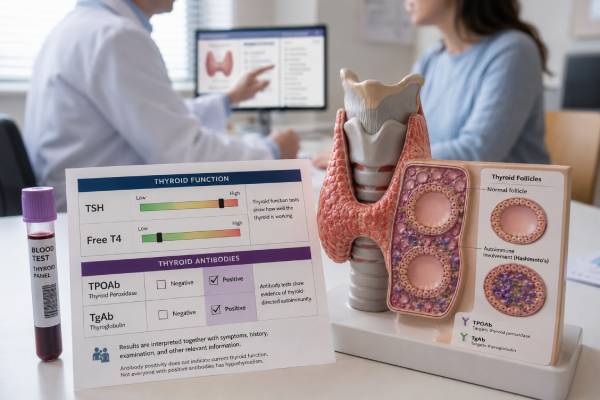
A Hashimoto thyroiditis blood test panel evaluates thyroid function and looks for evidence of thyroid autoimmunity. TSH and free T4 show whether the thyroid is still producing enough hormone. Thyroid peroxidase antibodies, or TPOAb, provide the strongest routine antibody support for Hashimoto thyroiditis, while thyroglobulin antibodies, or TgAb, can add evidence when TPOAb is negative or clarify another thyroid test. The common overt pattern is high TSH, low free T4, and positive TPOAb. Earlier disease may show positive antibodies with normal TSH and free T4, or high TSH with normal free T4. Antibody concentrations do not reliably measure symptom severity, thyroid damage, or treatment success, so repeating them is rarely useful. Some people with convincing chronic autoimmune thyroiditis have negative antibodies, and ultrasound may then provide supporting evidence. Results should guide a diagnosis and monitoring plan, not a search for a particular antibody number.
- High TSH with low free T4 indicates overt primary hypothyroidism; positive TPOAb makes Hashimoto thyroiditis a likely cause.
- Positive antibodies with normal TSH and free T4 show thyroid autoimmunity but do not automatically require levothyroxine.
- TPOAb is the main antibody test; TgAb can add information but is less sensitive for routine Hashimoto diagnosis.
- Antibody levels do not need regular monitoring because treatment decisions are based mainly on TSH, free T4, symptoms, and pregnancy status.
- A minority of people have antibody-negative autoimmune thyroiditis, which may be supported by ultrasound and the clinical course.
Table of Contents
- What the Hashimoto Panel Measures
- Common TSH, Free T4, TPOAb, and TgAb Patterns
- What Positive or Negative Antibodies Mean
- Preparing for Testing and Avoiding Interference
- Diagnosis, Ultrasound, and Related Conditions
- How Results Affect Treatment Decisions
- Pregnancy, Postpartum, Children, and Older Adults
- Follow-Up, Symptoms, and When to Seek Care
What the Hashimoto Panel Measures
Hashimoto thyroiditis is a chronic autoimmune disorder. Immune cells infiltrate the thyroid and target proteins involved in thyroid hormone production. Over time, inflammation and tissue loss can reduce the gland’s ability to make thyroxine, or T4, and triiodothyronine, or T3. The panel separates current hormone function from evidence of the autoimmune cause.
TSH
Thyroid-stimulating hormone is released by the pituitary gland. When circulating thyroid hormone falls, the pituitary increases TSH to push the thyroid harder. TSH is therefore the most sensitive routine test for early primary thyroid failure.
A high TSH does not by itself prove Hashimoto thyroiditis. It can also occur after thyroid surgery or radioactive iodine, with iodine deficiency or excess, during recovery from illness, and because of medicines or laboratory interference. Antibodies and history help identify the cause.
Free T4
Free T4 measures the unbound portion of the main hormone released by the thyroid. It shows whether a high TSH represents overt hormone deficiency or an earlier subclinical stage.
- High TSH plus low free T4: overt primary hypothyroidism
- High TSH plus normal free T4: subclinical hypothyroidism
- Normal TSH plus normal free T4: currently euthyroid, even if antibodies are present
Free T3 is not usually needed to diagnose Hashimoto-related hypothyroidism. T3 can remain normal until disease is advanced, and low T3 is common in illness without thyroid failure.
TPO antibodies
Thyroid peroxidase is an enzyme needed to attach iodine to tyrosine and build thyroid hormone. TPOAb is present in most people with Hashimoto thyroiditis and is the most useful routine antibody marker. A positive result supports thyroid autoimmunity and predicts a higher chance that subclinical hypothyroidism will progress.
TPOAb can also occur in Graves disease, postpartum thyroiditis, other autoimmune disorders, and a portion of healthy people. Positivity establishes immune recognition of thyroid tissue; it does not prove current hypothyroidism.
Thyroglobulin antibodies
Thyroglobulin is the large protein scaffold on which T4 and T3 are made. TgAb occurs in many people with Hashimoto thyroiditis but is less consistently present than TPOAb. It can support the diagnosis when TPOAb is negative and is important because it may interfere with thyroglobulin measurement used in differentiated thyroid cancer follow-up.
The TgAb test is not a direct measurement of thyroid hormone production. Its value depends on the clinical question and the assay cutoff.
Common TSH, Free T4, TPOAb, and TgAb Patterns
Hashimoto thyroiditis develops along a continuum. Antibodies can appear years before TSH rises, and thyroid function may fluctuate during inflammatory phases.
| TSH | Free T4 | TPOAb/TgAb | Likely interpretation |
|---|---|---|---|
| Normal | Normal | Positive | Euthyroid thyroid autoimmunity; monitor TSH based on risk and symptoms |
| Mildly high | Normal | Positive | Subclinical hypothyroidism likely due to Hashimoto thyroiditis |
| High | Low | Positive | Overt autoimmune primary hypothyroidism |
| High | Low or normal | Negative | Hypothyroidism is present or possible, but the cause needs review; antibody-negative thyroiditis can occur |
| Low | High or normal-high | Positive | Hashitoxicosis, postpartum thyroiditis, Graves disease, medication, or another cause must be distinguished |
| Normal | Normal | Negative | No biochemical or antibody evidence on this panel; thyroid disease is not completely excluded |
An isolated positive antibody result is common. Population prevalence varies with age, sex, iodine intake, and assay. Many antibody-positive people never develop overt hypothyroidism. Risk rises when TSH is already elevated, antibody titers are clearly positive, the thyroid is abnormal on ultrasound, or there is a strong personal or family autoimmune history.
Subclinical hypothyroidism is not one uniform condition. A TSH of 5 mIU/L with normal free T4 differs from a persistent TSH above 10 mIU/L. Age-specific ranges, pregnancy, symptoms, cardiovascular risk, and repeated values influence treatment.
Hashitoxicosis is a temporary hyperthyroid phase caused by release of stored hormone from inflamed thyroid cells. TSH falls, and free T4 or T3 may rise. Unlike Graves disease, the gland is not being continuously stimulated to synthesize hormone, so radioactive iodine uptake is generally low. TSH receptor antibody testing can help separate the two.
Results can move through phases: transient hyperthyroidism, euthyroidism, subclinical hypothyroidism, and overt hypothyroidism. Not everyone follows that sequence. Some remain euthyroid for decades, while others first present after substantial hormone loss.
A single TSH just outside the range is usually repeated before a lifelong diagnosis is made, unless the elevation is marked, free T4 is low, pregnancy changes urgency, or symptoms are severe.
What Positive or Negative Antibodies Mean
Thyroid antibodies identify autoimmunity, not the amount of thyroid hormone available to tissues. This distinction prevents several common mistakes.
A positive TPOAb result
Positive TPOAb supports Hashimoto thyroiditis when TSH is high or ultrasound shows chronic inflammation. It also predicts an increased chance of future hypothyroidism in a currently euthyroid person. The absolute concentration, however, is not a reliable score of gland destruction.
Someone with a TPOAb concentration of 900 IU/mL does not necessarily have worse symptoms or need a higher levothyroxine dose than someone with 100 IU/mL. Assays recognize different antibody populations, and numbers from different manufacturers cannot be compared directly.
TPOAb may remain positive for years after TSH normalizes on treatment. Levothyroxine replaces missing hormone; it does not directly eliminate the autoimmune response. Repeating TPOAb to judge whether treatment is “working” can lead to unnecessary concern.
A positive TgAb result
TgAb can support autoimmune thyroiditis, especially when TPOAb is negative. It is less specific as a standalone marker because it occurs in other thyroid diseases and some healthy individuals. Its most important additional role is identifying possible interference with serum thyroglobulin testing.
TgAb trends are used differently after differentiated thyroid cancer than in ordinary Hashimoto care. In cancer surveillance, a falling or rising TgAb trend may act as an indirect marker when thyroglobulin is unreliable. That specialized use should not be confused with monitoring autoimmune symptoms.
Negative antibodies
Negative TPOAb and TgAb reduce the likelihood of Hashimoto thyroiditis but do not eliminate it. Antibody-negative chronic autoimmune thyroiditis is recognized. Antibodies may be below the assay threshold, directed at other thyroid targets, or concentrated within the tissue.
A persistently high TSH, low free T4, characteristic heterogeneous hypoechoic ultrasound, and exclusion of other causes can support seronegative Hashimoto thyroiditis. Ultrasound should not be ordered solely to search for autoimmunity when the diagnosis and management are already clear, but it can help in selected discordant cases or when a goiter or nodule is present.
Positive antibodies are not a reason to remove gluten, avoid entire food groups, or take high-dose supplements without another diagnosed indication. Celiac disease is more common in autoimmune thyroid disease, but testing is guided by symptoms, iron deficiency, family history, or difficulty stabilizing levothyroxine rather than by antibody positivity alone.
Preparing for Testing and Avoiding Interference
The panel requires a standard blood draw. Fasting is usually unnecessary. Consistency matters when results will be compared over time.
Tell the clinician about:
- Biotin supplements, including high-dose hair, skin, and nail products
- Levothyroxine, liothyronine, desiccated thyroid, or compounded thyroid hormone
- Amiodarone, lithium, glucocorticoids, dopamine, antiseizure medicines, and immune therapies
- Iron, calcium, antacids, bile-acid binders, and other products that affect levothyroxine absorption
- Pregnancy, postpartum status, fertility treatment, or menopause hormone therapy
- Recent severe illness, surgery, iodinated contrast, or major weight change
- Pituitary disease or head and neck radiation
Biotin can interfere with some TSH and free T4 immunoassays, often producing falsely low TSH and falsely high free T4. This pattern could hide hypothyroidism or suggest a hyperthyroid phase. The laboratory can provide a platform-specific pause interval for nonessential biotin.
Levothyroxine raises free T4 for several hours after a dose. TSH changes more slowly, but a post-dose sample can complicate comparison with a previous pre-dose sample. Many clinicians prefer a consistent collection approach, often before the daily dose, especially when free T4 will influence a decision.
TPOAb and TgAb generally require no special timing. Their concentrations can vary analytically and biologically, which is another reason not to use small changes as a treatment target.
Acute illness can temporarily alter TSH. During recovery, TSH may rise above the reference range before returning to baseline. When symptoms and free T4 do not indicate urgent hypothyroidism, repeating TSH after recovery can prevent a premature diagnosis.
Heterophile antibodies or macro-TSH can cause a falsely high TSH. A persistently elevated TSH with normal free T4, no symptoms, and no expected response to treatment may prompt laboratory investigation with another assay, dilution studies, or polyethylene glycol precipitation.
Diagnosis, Ultrasound, and Related Conditions
Hashimoto thyroiditis is diagnosed from the combination of thyroid function, antibodies, clinical findings, and sometimes ultrasound. No biopsy is needed in ordinary diffuse autoimmune thyroiditis.
Examination may find a firm, irregular, enlarged thyroid early in the disease. Later, the gland can shrink and become difficult to feel. A goiter can cause neck fullness, but significant trouble swallowing, persistent hoarseness, or a discrete lump requires evaluation for nodules or another cause.
Ultrasound may show diffuse hypoechogenicity, heterogeneity, fibrous bands, and altered blood flow. These findings support chronic thyroiditis but are not completely specific. Graves disease, subacute thyroiditis, and other inflammatory states can overlap. Ultrasound is most useful when:
- The thyroid is enlarged or asymmetric
- A nodule is felt or suspected
- Antibodies are negative but autoimmune thyroiditis remains likely
- Neck pressure, swallowing difficulty, or lymph-node findings are present
- Structural follow-up is needed for a known nodule
Fine-needle aspiration is reserved for nodules that meet size and ultrasound-risk criteria, not for Hashimoto thyroiditis itself. Inflammation can create pseudonodules, so experienced imaging interpretation matters.
Hashimoto thyroiditis is associated with other autoimmune conditions, including type 1 diabetes, celiac disease, autoimmune gastritis, pernicious anemia, Addison disease, vitiligo, rheumatoid arthritis, and autoimmune liver disease. Routine blanket screening is not necessary for everyone, but symptoms and family history should lower the threshold for targeted tests.
Fatigue can persist even when TSH is controlled, but it should not automatically be attributed to thyroid antibodies. Anemia, iron deficiency, sleep apnea, depression, medication effects, chronic pain, menopause, and other conditions may need assessment.
Rarely, longstanding Hashimoto thyroiditis is associated with primary thyroid lymphoma. A rapidly enlarging hard thyroid, new neck pressure, hoarseness, or enlarged lymph nodes requires prompt evaluation. The absolute risk remains low.
How Results Affect Treatment Decisions
Treatment replaces deficient hormone; it is not prescribed solely because antibodies are positive.
Overt hypothyroidism
High TSH with low free T4 generally warrants levothyroxine. The dose depends on body size, age, pregnancy, heart disease, severity, and remaining thyroid function. Younger healthy adults may begin near a full replacement dose, while older adults or those with coronary disease often start lower.
TSH is usually rechecked about six to eight weeks after starting or changing a dose. Once stable, testing can be spaced to every six to twelve months or adjusted for clinical needs. Free T4 is added when TSH is markedly abnormal, pregnancy is present, pituitary disease is possible, or results are discordant.
Subclinical hypothyroidism
Treatment is more individualized when TSH is high but free T4 remains normal. Levothyroxine is commonly considered when TSH persists at 10 mIU/L or higher. At lower elevations, factors favoring treatment can include symptoms, positive TPOAb, goiter, pregnancy or conception plans, rising TSH, and certain cardiovascular risks.
Older adults may have a higher normal TSH distribution and greater risk from overtreatment. Repeating the result and using age-aware interpretation can avoid unnecessary therapy.
Euthyroid antibody positivity
Positive TPOAb or TgAb with normal TSH and free T4 does not usually require levothyroxine. Periodic TSH monitoring is appropriate. The interval may be yearly or sooner if symptoms change, pregnancy begins, or another risk factor is present.
There is no established medication that reliably stops Hashimoto thyroiditis and improves patient-important outcomes in euthyroid people. Selenium can lower antibody concentrations modestly in some studies, but evidence for durable symptom or disease-prevention benefit is uncertain. Excess selenium can cause hair and nail changes, gastrointestinal symptoms, nerve effects, and toxicity.
Iodine is necessary for hormone synthesis, but excessive intake can worsen autoimmune thyroid dysfunction. Kelp, seaweed concentrates, iodine drops, and high-dose supplements should not be used to “support” Hashimoto thyroiditis without a documented need.
Combination T4/T3 therapy may be considered in a carefully selected minority with persistent symptoms despite stable, appropriate levothyroxine treatment, after other causes are addressed. Antibody level does not identify who will benefit.
Pregnancy, Postpartum, Children, and Older Adults
Pregnancy increases thyroid hormone requirements early, and adequate maternal T4 supports fetal development. People with known Hashimoto hypothyroidism are often advised to contact their clinician as soon as pregnancy is confirmed because levothyroxine needs may rise promptly.
TSH is checked more frequently during pregnancy, commonly every four weeks through mid-pregnancy and at least once later, depending on stability and local guidance. Pregnancy-specific targets apply. TPOAb positivity increases the risk of developing hypothyroidism during pregnancy and postpartum thyroiditis, but antibody positivity alone does not always justify treatment when TSH is normal.
Postpartum thyroiditis can cause a hyperthyroid phase, a hypothyroid phase, or both within the first year after delivery. TPOAb is often positive. Symptoms can be mistaken for normal postpartum stress. Palpitations, anxiety, fatigue, depression, and changes in milk supply deserve clinical review when pronounced or persistent.
Children require age-specific TSH and free T4 ranges. Autoimmune thyroiditis may present with goiter, slowed growth, delayed or early puberty, school difficulties, or few symptoms. Treatment decisions consider growth and development as well as laboratory values.
Older adults may have subtle symptoms such as weakness, constipation, cognitive change, or low mood. TSH often rises slightly with healthy aging. Starting too much levothyroxine can provoke atrial fibrillation and bone loss, so diagnosis and dose adjustment are cautious.
Men and nonpregnant younger adults are less frequently affected than women, but the diagnostic principles are the same. Anyone with a strong family history or another autoimmune disease may have a lower threshold for testing when symptoms arise.
Follow-Up, Symptoms, and When to Seek Care
Follow-up should focus on thyroid function rather than repeatedly measuring antibodies. A practical plan depends on the starting pattern:
- Normal TSH and free T4 with positive antibodies: periodic TSH, sooner with symptoms or pregnancy
- Subclinical hypothyroidism: repeat TSH and free T4 after an interval to confirm persistence; discuss treatment based on risk
- Overt hypothyroidism: begin or adjust levothyroxine and recheck after steady state
- Unexpected low TSH or high free T4: assess hashitoxicosis, Graves disease, medication excess, postpartum thyroiditis, and interference
- Negative antibodies with persistent primary hypothyroidism: review ultrasound, iodine exposure, surgery, medicines, and other causes
Persistent symptoms despite a TSH in target should prompt a broad review. Check adherence and absorption first: levothyroxine should be separated from iron, calcium, and several other products. Gastric disease, celiac disease, bariatric surgery, and interacting medicines can increase dose requirements.
Seek urgent care for severe drowsiness or confusion, low body temperature, slow breathing, fainting, chest pain, or marked swelling with severe hypothyroid symptoms. Myxedema coma is rare but life-threatening. A rapidly enlarging neck mass, trouble breathing, or new significant swallowing difficulty also requires prompt evaluation.
Questions to ask include:
- Does my panel show autoimmunity, hormone deficiency, or both?
- Is my TSH elevation persistent and high enough to treat now?
- Do I need ultrasound, or would it not change management?
- How often should TSH be checked if antibodies are positive but function is normal?
- Could pregnancy, postpartum changes, medicines, or biotin affect these results?
- Are persistent symptoms likely to need evaluation beyond the thyroid?
A Hashimoto panel is most useful when each test keeps its proper role: TSH and free T4 define function, TPOAb and TgAb support cause, and clinical follow-up determines whether and when treatment is needed.
References
- Thyroid autoantibodies 2023 (Review)
- The Usefulness of Thyroid Antibodies in the Diagnostic Approach to Autoimmune Thyroid Disease 2023 (Review)
- Thyroid disease: assessment and management 2023 (Guideline)
- From Antibodies to Artificial Intelligence: A Comprehensive Review of Diagnostic Advances in Hashimoto’s Thyroiditis 2024 (Review)
- Selenium Supplementation in Patients with Hashimoto Thyroiditis: A Systematic Review and Meta-Analysis of Randomized Clinical Trials 2024 (Systematic Review)
- Hashimoto Thyroiditis 2025 (Review)
Disclaimer
Hashimoto thyroiditis testing must be interpreted with symptoms, pregnancy status, medicines, ultrasound findings when relevant, and the laboratory’s reference intervals. Do not start supplements or change thyroid medication based on antibody values alone. Severe hypothyroid symptoms or a rapidly enlarging neck mass need prompt medical assessment.