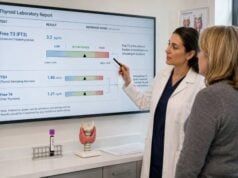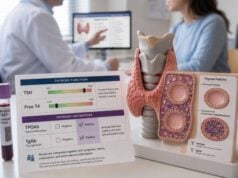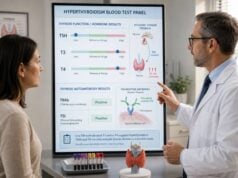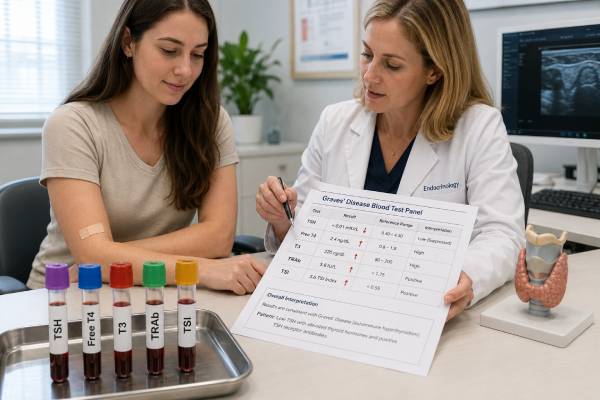
A Graves disease blood test panel usually combines thyroid function tests with antibodies that target the TSH receptor. The typical untreated pattern is a very low or undetectable TSH with high free T4, high T3, or both. A positive TSH receptor antibody, reported as TRAb, or a positive thyroid-stimulating immunoglobulin, reported as TSI, strongly supports Graves disease as the cause. No single result tells the whole story. Early disease may raise T3 before free T4, antibody results can be negative in a small minority, and medicines, pregnancy, thyroiditis, biotin, or assay interference can create similar patterns. Blood tests also serve different purposes over time: confirming the diagnosis, guiding antithyroid drug doses, estimating relapse risk, and assessing fetal or neonatal risk during pregnancy. Results should be interpreted with symptoms, examination, thyroid imaging when needed, and the timing of treatment rather than against a generic panel checklist.
- Untreated Graves disease usually causes suppressed TSH with elevated free T4, T3, or both.
- Positive TRAb or TSI supports autoimmune TSH-receptor stimulation and often removes the need for a radioactive iodine uptake scan.
- T3 may be disproportionately high or may be the only elevated hormone in early T3-predominant Graves disease.
- During early treatment, free T4 and T3 guide dosing because TSH may stay suppressed for months.
- TRAb testing is especially important in pregnancy and after prior radioiodine or thyroid surgery because antibodies can cross the placenta.
Table of Contents
- What a Graves Blood Test Panel Includes
- The Typical Graves Disease Test Pattern
- TRAb and TSI Antibody Results
- Preparation, Medicines, and Interference
- Confirming Graves and Excluding Other Causes
- Monitoring Antithyroid Treatment
- Pregnancy, Eye Disease, and Special Situations
- Next Steps and Urgent Warning Signs
What a Graves Blood Test Panel Includes
Graves disease is an autoimmune condition in which immunoglobulins bind to and stimulate the TSH receptor on thyroid cells. The gland behaves as if it is receiving a continuous TSH signal, producing excess thyroid hormone and often enlarging diffusely. The core blood tests evaluate both the hormone effect and its autoimmune cause.
TSH
Thyroid-stimulating hormone is produced by the pituitary gland. When free T4 and T3 rise, feedback suppresses pituitary TSH. In untreated overt Graves disease, TSH is usually below the assay’s lower detection limit. A mildly low TSH may occur in early disease, subclinical hyperthyroidism, pregnancy, medicine effects, or recovery from illness.
TSH is sensitive but not specific. It shows that pituitary feedback is suppressed; it does not prove Graves disease. Thyroiditis, toxic nodules, excess thyroid hormone medication, and high-dose biotin can all produce low TSH.
Free T4
Free T4 estimates unbound thyroxine. It helps establish whether hyperthyroidism is overt and indicates severity. A high free T4 with suppressed TSH is a common Graves pattern. Free T4 may be normal in early or T3-predominant disease, which is why T3 is sometimes needed.
Total or free T3
T3 is the more active thyroid hormone. Graves disease can produce a disproportionately high T3 relative to T4. Some people have suppressed TSH, normal free T4, and elevated total or free T3—T3 thyrotoxicosis. Many laboratories prefer total T3 because free T3 assays can be less reliable, particularly at concentration extremes.
TRAb
TRAb is a broad term for antibodies that bind the TSH receptor. Most routine TRAb assays are competitive binding tests. They detect receptor-binding immunoglobulins but do not directly show whether those antibodies stimulate or block the receptor. In the setting of hyperthyroidism, a positive result usually reflects stimulating activity and strongly supports Graves disease.
TSI
TSI assays are designed to identify stimulating immunoglobulins more specifically. Some are cell-based bioassays that measure receptor activation; others use bridge immunoassay designs intended to favor stimulating antibodies. A positive TSI supports Graves disease, but numeric values from different manufacturers are not interchangeable.
Additional tests may include TPO antibodies, thyroglobulin antibodies, complete blood count, liver tests, pregnancy testing, and markers selected for complications. TPO antibodies are common in Graves disease but do not distinguish it reliably from Hashimoto thyroiditis. The thyroid antibody panel should be tailored rather than ordered indiscriminately.
The Typical Graves Disease Test Pattern
The classic untreated biochemical pattern is:
- TSH: low or undetectable
- Free T4: high
- Total or free T3: high, sometimes more prominently than T4
- TRAb or TSI: positive
This combination is highly persuasive when symptoms and examination fit. Common symptoms include palpitations, tremor, heat intolerance, sweating, anxiety, muscle weakness, frequent bowel movements, menstrual changes, and unintentional weight loss despite normal or increased appetite. A smooth enlarged thyroid, thyroid bruit, eye signs, or pretibial skin changes add clinical support.
Not every patient shows the full pattern.
| TSH | Free T4 | T3 | TRAb/TSI | Possible interpretation |
|---|---|---|---|---|
| Suppressed | High | High | Positive | Typical overt Graves disease |
| Suppressed | Normal | High | Positive | T3-predominant Graves disease |
| Low | Normal | Normal | Positive | Early or subclinical Graves disease; repeat and assess context |
| Suppressed | High | High | Negative | Graves still possible, but thyroiditis, nodular disease, iodine exposure, and assay issues require consideration |
| Suppressed | High | Low or normal | Variable | Severe illness, amiodarone effect, assay differences, or non-Graves causes may alter the pattern |
| Normal | High | High | Variable | Interference, thyroid hormone resistance, or a TSH-secreting pituitary tumor rather than ordinary Graves disease |
Subclinical hyperthyroidism means low TSH with free T4 and T3 within their reference intervals. A positive TRAb can identify Graves disease before hormone levels become overtly high. The decision to treat depends on TSH suppression, age, heart and bone risk, symptoms, and persistence.
In established Graves disease, the T3-to-T4 relationship can help but is not diagnostic alone. Graves often drives active hormone synthesis and T4-to-T3 conversion, while destructive thyroiditis releases stored hormone with relatively more T4. However, assays, iodine intake, medicines, and illness create overlap.
Reference intervals matter. Pregnancy changes TSH and hormone ranges, children have age-specific ranges, and laboratories use different antibody cutoffs. A result labeled “positive” should include the method and upper reference limit, especially when trends will guide treatment.
TRAb and TSI Antibody Results
TRAb and TSI answer a different question from TSH, T4, and T3. Hormone tests show whether thyrotoxicosis is present. Receptor antibody tests identify the autoimmune mechanism that characterizes Graves disease.
What a positive result means
In a person with suppressed TSH and elevated thyroid hormones, positive TRAb or TSI has high diagnostic value for Graves disease. It can avoid a radioactive iodine uptake scan, which is useful when imaging is unavailable, contraindicated, or unnecessary.
A strongly positive result may also correlate with more active disease, a larger goiter, eye disease, or higher relapse risk, but no single antibody concentration predicts an individual outcome perfectly. Cutoffs and units vary widely. One laboratory may report IU/L; another may report a percentage of specimen-to-reference signal or a TSI index.
What a negative result means
Modern assays detect most untreated Graves cases, but a negative test does not exclude every case. Antibody concentrations may be below the method’s detection threshold in mild or early disease. Treatment can lower antibodies. Rarely, antibodies are concentrated within thyroid tissue more than in blood.
When clinical suspicion remains high, clinicians may repeat the antibody test, use an alternative assay, order radioactive iodine uptake, or assess thyroid blood flow with Doppler ultrasound. A diffuse high uptake pattern supports Graves disease, while low uptake suggests thyroiditis or exogenous hormone.
TRAb compared with TSI
Binding TRAb assays are widely available, standardized to international reference materials, and highly sensitive. They detect stimulating, blocking, and neutral receptor-binding antibodies. TSI-oriented tests aim to identify stimulating activity, which may align more directly with hyperthyroidism.
The tests often agree but are not identical. A patient can have positive TRAb and negative TSI or the reverse, especially near the cutoff or during treatment. Co-ordering both routinely may add little when one validated test provides a clear answer. Using the same method for trends is more useful than comparing raw numbers across assays.
Antibody trends and remission
TRAb is often measured near the end of a planned antithyroid drug course. A normal or low value increases the chance of remission, while a persistently elevated value signals greater relapse risk. It does not dictate a single choice. Continuing low-dose medication, radioactive iodine, or surgery may each be reasonable depending on symptoms, goiter, eye disease, pregnancy plans, adverse effects, and patient preference.
A TSH receptor antibody test can remain positive after thyroidectomy or radioiodine because removing or destroying thyroid tissue does not immediately stop antibody production. This persistence matters most in pregnancy.
Preparation, Medicines, and Interference
The panel uses one or more venous blood samples. Fasting is usually unnecessary. Collection timing and medication history can still affect interpretation.
Tell the clinician and laboratory about:
- Biotin supplements, particularly doses of 5 mg or more
- Methimazole, carbimazole, or propylthiouracil
- Levothyroxine, liothyronine, desiccated thyroid, or nonprescription thyroid products
- Amiodarone, lithium, glucocorticoids, dopamine, iodine, and recent iodinated contrast
- Pregnancy, fertility treatment, or recent childbirth
- Severe infection, hospitalization, surgery, or major weight loss
- Prior radioactive iodine or thyroid surgery
- Immune checkpoint inhibitors and other medicines associated with thyroiditis
High-dose biotin can produce falsely low TSH and falsely high free T4 or T3 on susceptible platforms. This artificial pattern can look exactly like Graves disease. Antibody assays may also be affected depending on their design. The laboratory can advise how long nonessential biotin should be withheld.
Antithyroid drugs reduce hormone synthesis and eventually lower free T4 and T3. They may also reduce antibody levels over time. A normal panel while taking methimazole means treatment is controlling hormone production; it does not prove the autoimmune process has disappeared.
Glucocorticoids and severe illness reduce conversion of T4 to T3. A patient with severe Graves disease receiving steroids may have improving T3 before T4. Amiodarone can raise free T4 and lower T3 through conversion blockade while also causing true hyperthyroidism or hypothyroidism.
Heterophile antibodies, anti-thyroid-hormone antibodies, and other immunoassay interference can cause incompatible results. Suspicion rises when laboratory values do not match symptoms—for example, extremely high free T4 with a normal heart rate, normal TSH, and no clinical features. Repeat testing on a different platform can prevent inappropriate treatment.
For serial monitoring, use the same laboratory when possible. Antibody units and free hormone results can differ among methods. Record whether the sample was taken before or after medication and whether the dose had recently changed.
Confirming Graves and Excluding Other Causes
A positive receptor antibody in a patient with biochemical hyperthyroidism often confirms Graves disease. When antibodies are negative or the presentation is unusual, the clinician may need to distinguish Graves from several alternatives.
Destructive thyroiditis
Painless, postpartum, and subacute thyroiditis release stored hormone from damaged cells. TSH is low and free T4 may be high, but TRAb is usually negative. Radioactive iodine uptake is low because the inflamed gland is not actively trapping iodine. Subacute thyroiditis often causes neck pain and elevated inflammatory markers.
Antithyroid drugs do not stop the release of stored hormone and are usually not helpful for destructive thyroiditis. Beta-blockers may control symptoms while the condition runs its course.
Toxic nodules
A toxic adenoma or toxic multinodular goiter produces hormone without TSH control. TRAb and TSI are generally negative. Examination or ultrasound may show nodules, and uptake scanning shows one or more focal “hot” areas rather than diffuse uptake.
Exogenous thyroid hormone
Excess levothyroxine, liothyronine, desiccated thyroid, or contaminated supplements can suppress TSH and raise hormones. Thyroglobulin may be low, and radioactive iodine uptake is low. A detailed product and medication review is essential.
Iodine and drug-related thyrotoxicosis
Iodinated contrast, amiodarone, and iodine-rich products can trigger hormone overproduction or destructive thyroiditis. Uptake may be low because the gland is saturated with iodine, so interpretation requires exposure history and sometimes Doppler imaging.
Gestational transient thyrotoxicosis
High human chorionic gonadotropin in early pregnancy can stimulate the TSH receptor. TSH falls and free T4 may rise, especially with hyperemesis or multiple pregnancy. TRAb is negative, there is no prior Graves history, and the condition often improves by mid-pregnancy.
Rare discordant states
High free T4 and T3 with nonsuppressed TSH suggests assay interference, thyroid hormone resistance, or a TSH-secreting pituitary tumor rather than Graves disease. These require specialist testing and should not be treated as routine hyperthyroidism until confirmed.
The hyperthyroidism blood test panel establishes the biochemical state, while antibody and imaging results identify the source. Diagnosis is strongest when both layers agree.
Monitoring Antithyroid Treatment
Methimazole or carbimazole is preferred for most nonpregnant adults who choose antithyroid medication. Propylthiouracil is used in selected situations, including the first trimester of pregnancy and thyroid storm. Blood tests guide dose reduction and help avoid treatment-induced hypothyroidism.
During the first months, free T4 and total or free T3 are usually checked every two to six weeks, depending on severity and dose changes. TSH may remain suppressed after hormone levels normalize, so increasing the drug simply because TSH is low can cause hypothyroidism.
A common sequence is:
- Free T4 begins to fall.
- T3 may normalize at the same time or remain elevated longer.
- The antithyroid drug dose is reduced as hormones approach target.
- TSH gradually recovers over weeks to months.
- Once stable, testing intervals lengthen.
Both free T4 and T3 matter. A normal free T4 with persistently high T3 indicates continued thyrotoxicosis. A low free T4 with normal T3 may signal overtreatment even if TSH is still suppressed.
Before starting an antithyroid drug, many clinicians obtain a baseline complete blood count and liver profile. Routine repeated counts do not reliably predict rare agranulocytosis, but sudden fever, sore throat, mouth ulcers, or infection symptoms require immediate drug interruption and urgent blood count according to the prescriber’s instructions. Jaundice, dark urine, pale stools, severe itching, or right-upper-abdominal pain requires prompt liver assessment.
TRAb is not needed at every visit. It may be useful at diagnosis, during pregnancy, and before deciding whether to stop medication after a treatment course. Persistently high TRAb suggests greater relapse risk, while normalization makes remission more likely.
After radioactive iodine, thyroid hormone levels may initially fluctuate, and hypothyroidism can develop over weeks or months. After total thyroidectomy, levothyroxine replacement begins and TSH becomes the principal long-term hormone target. Receptor antibodies can decline slowly in either setting.
Pregnancy, Eye Disease, and Special Situations
Pregnancy changes both the urgency and interpretation of Graves testing. Uncontrolled overt hyperthyroidism increases risks for the pregnant patient and fetus, while excessive antithyroid medication can suppress the fetal thyroid.
TSH should be interpreted with trimester-specific ranges. Free T4 assays vary in pregnancy, so a locally validated free T4 or adjusted total T4 approach may be used. Treatment generally aims to keep maternal free T4 at or just above the upper pregnancy-specific limit using the lowest effective antithyroid drug dose.
TRAb crosses the placenta. Testing is recommended for people with active Graves disease and for those previously treated with radioactive iodine or surgery, because antibodies may persist even when the mother is hypothyroid on levothyroxine. Clearly elevated values later in pregnancy can lead to fetal heart-rate and growth monitoring and coordination with maternal-fetal medicine and neonatal teams.
TSI may also help assess fetal risk, but guideline thresholds and laboratory cutoffs differ. Results should be expressed relative to the assay’s upper limit rather than compared as raw numbers from different laboratories.
Thyroid eye disease can occur before, during, or after biochemical hyperthyroidism and can occasionally occur with normal thyroid tests. TRAb or TSI often remains positive. Smoking strongly increases risk and worsens outcomes. Eye pain, reduced color vision, double vision, inability to close the eyelids, or visual loss requires urgent ophthalmic evaluation.
Children with Graves disease need age-specific ranges and often longer antithyroid drug courses than adults. Older adults may have fewer classic symptoms and present with atrial fibrillation, weight loss, or weakness. People with heart disease need prompt control because even moderate hormone excess can destabilize rhythm or angina.
Next Steps and Urgent Warning Signs
After a Graves panel, the next step depends on whether the biochemical state and antibody findings agree.
- Suppressed TSH, high hormones, positive TRAb/TSI: Graves disease is likely; discuss treatment options and symptom control.
- Suppressed TSH, normal free T4, high T3: assess T3-predominant Graves disease and other causes of T3 thyrotoxicosis.
- Suppressed TSH, high hormones, negative antibodies: consider uptake scanning, Doppler ultrasound, thyroiditis, toxic nodules, iodine, and exogenous hormone.
- Positive antibodies with normal hormones: repeat thyroid function over time; this may represent early disease, remission, or persistent antibodies after treatment.
- Unexpectedly discordant tests: review biotin, medicines, illness, pregnancy, and assay interference before rare diagnoses are pursued.
Treatment choices include antithyroid medication, radioactive iodine, and surgery. The best choice depends on age, goiter size, nodules, eye disease, pregnancy plans, antibody level, treatment preference, access to expertise, and the likelihood of remission.
Seek urgent care for severe shortness of breath, chest pain, fainting, confusion, high fever, marked agitation, vomiting or diarrhea with dehydration, or a very rapid or irregular heartbeat. These symptoms may indicate a serious cardiac complication or thyroid storm. Thyroid storm is a clinical emergency; it is not diagnosed from a hormone level alone.
Questions for the clinician can include:
- Do my TRAb or TSI results confirm Graves disease on this assay?
- Is my T3 higher relative to free T4, and does that affect monitoring?
- How often should free T4 and T3 be checked before TSH recovers?
- What symptoms require stopping my antithyroid drug and obtaining urgent tests?
- How do eye symptoms, smoking, pregnancy, or future pregnancy change treatment?
- When should receptor antibodies be repeated to estimate remission or fetal risk?
A well-interpreted panel separates three tasks: proving hormone excess, identifying Graves autoimmunity, and monitoring the response safely. Combining those tasks into one undifferentiated “thyroid panel” can obscure the meaning of each test.
References
- 2022 Update on Clinical Management of Graves’ Disease and Thyroid Eye Disease 2022 (Review)
- 2022 European Thyroid Association Guideline for the management of pediatric Graves’ disease 2022 (Guideline)
- A 2023 International Survey of Clinical Practice Patterns in the Management of Graves Disease 2024
- Best practices in the laboratory diagnosis, prognostication, and monitoring of Graves’ disease: role of TRAbs 2024 (Review)
- Comparison between thyroid stimulating immunoglobulin and TSH-receptor antibodies in the management of Graves’ disease 2024
- 2025 Korean Thyroid Association Management Guidelines for Patients with Graves’ Disease 2025 (Guideline)
Disclaimer
Graves disease testing requires interpretation with symptoms, medicines, pregnancy status, examination, and the specific laboratory methods used. Do not change antithyroid or thyroid hormone medication without the prescribing clinician’s guidance. Fever or sore throat while taking an antithyroid drug and severe hyperthyroid symptoms need prompt medical attention.