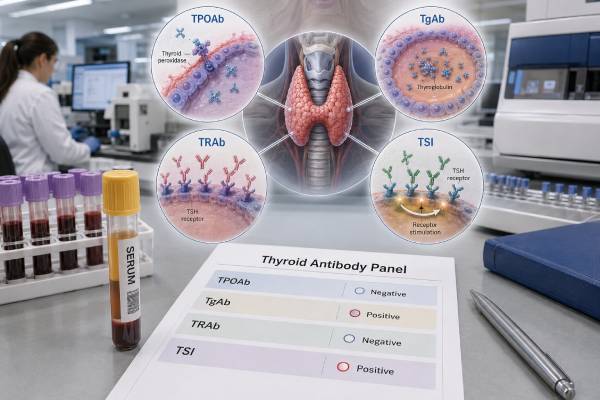
A thyroid antibody panel looks for immune proteins that react with the thyroid gland or its hormone-making machinery. The four names most often seen are thyroid peroxidase antibodies (TPOAb), thyroglobulin antibodies (TgAb), TSH receptor antibodies (TRAb), and thyroid-stimulating immunoglobulin (TSI). These tests can help identify Hashimoto thyroiditis, Graves disease, or another autoimmune thyroid process, but they do not show by themselves whether thyroid hormone levels are currently high, low, or normal. That requires thyroid function tests such as TSH, free T4, and sometimes T3. A positive antibody result may explain an abnormal hormone pattern, estimate future risk, guide pregnancy monitoring, or clarify thyroid cancer follow-up. It may also occur in a person whose thyroid function remains normal. Results therefore need to be read as a pattern, using the exact assay and reference range on the laboratory report rather than a universal cutoff.
- TPOAb and TgAb mainly support autoimmune thyroiditis, especially Hashimoto thyroiditis, while TRAb and TSI mainly support Graves disease.
- Positive antibodies do not automatically mean treatment is needed; treatment usually depends on TSH, free T4, symptoms, pregnancy status, and the clinical diagnosis.
- Reference limits vary by laboratory and method, so a result should be compared only with the range printed on that report.
- TRAb and TSI overlap but are not identical tests; many situations require one well-chosen receptor-antibody assay rather than both.
- TgAb can interfere with thyroglobulin measurement, which is important during follow-up after differentiated thyroid cancer.
Table of Contents
- What a Thyroid Antibody Panel Measures
- TPOAb, TgAb, TRAb, and TSI Compared
- How to Interpret Common Result Patterns
- Positive Antibodies With Normal Thyroid Function
- Special Uses in Pregnancy and Thyroid Cancer Follow-Up
- Preparation, Assay Differences, and Interference
- Follow-Up After an Abnormal Panel
What a Thyroid Antibody Panel Measures
Thyroid antibodies are autoantibodies: immune proteins that recognize a structure belonging to the body rather than a germ. Their presence can show that the immune system has targeted the thyroid, but each antibody points to a different target and has a different clinical use.
A “thyroid antibody panel” is not one standardized package. One laboratory may bundle TPOAb and TgAb. Another may add TRAb, TSI, or both. A clinician may instead order only the antibody that answers the current question. For example, TPOAb is often the first antibody checked when TSH is high, while a TSH receptor antibody test is more relevant when TSH is suppressed and Graves disease is suspected.
The panel answers a cause-related question. It does not replace a thyroid function test panel, which shows the current relationship among pituitary TSH and circulating thyroid hormones. This distinction prevents several common errors:
- A person can have strongly positive TPOAb with normal TSH and free T4.
- A person can have hypothyroidism with negative antibodies because of surgery, radiation, medication, congenital disease, pituitary disease, or antibody-negative autoimmune thyroiditis.
- A person can have low TSH for reasons other than Graves disease, including thyroiditis, autonomous nodules, excessive thyroid hormone medication, severe illness, or assay interference.
- Antibody concentration does not reliably measure symptom severity.
Clinicians usually choose antibodies after reviewing symptoms, examination findings, medication use, pregnancy status, and initial hormone results. A high TSH with low free T4 suggests primary hypothyroidism; positive TPOAb then supports autoimmune thyroid destruction. A low TSH with high free T4 or T3 suggests thyrotoxicosis; positive TRAb or TSI supports Graves disease. The same antibody value has less meaning when separated from this hormone pattern.
Antibodies can remain detectable for years. Some rise and fall without a matching change in thyroid function. That is why repeated antibody panels are rarely the main way to monitor levothyroxine treatment or day-to-day control of Graves hyperthyroidism. TSH, free T4, T3 when appropriate, and the clinical course usually provide more actionable information.
TPOAb, TgAb, TRAb, and TSI Compared
The four tests differ in target, disease association, and reason for ordering.
| Test | Target or action | Most common association | Typical use |
|---|---|---|---|
| TPOAb | Thyroid peroxidase, an enzyme used to make thyroid hormone | Hashimoto thyroiditis; can also occur in Graves disease | Support autoimmune thyroiditis and estimate risk of future hypothyroidism |
| TgAb | Thyroglobulin, the protein scaffold used to make thyroid hormone | Hashimoto thyroiditis and other autoimmune thyroid disease | Supplement autoimmune testing; detect interference with thyroglobulin cancer monitoring |
| TRAb | TSH receptor; many assays detect receptor-binding antibodies regardless of their biologic effect | Graves disease | Confirm Graves disease, assess relapse probability, and evaluate fetal or neonatal risk |
| TSI | Stimulating activity at the TSH receptor | Graves disease | Support Graves diagnosis and, in selected cases, follow disease activity or pregnancy risk |
Thyroid peroxidase antibodies
Thyroid peroxidase helps attach iodine to thyroglobulin during thyroid hormone production. TPOAb is the most sensitive commonly used antibody marker for Hashimoto thyroiditis. It may be reported as anti-TPO, TPO antibody, thyroid microsomal antibody, or antimicrosomal antibody.
Positive TPOAb supports an autoimmune cause when a person has a high TSH, low free T4, a firm or enlarged thyroid, or ultrasound features of thyroiditis. TPOAb can also appear in Graves disease, postpartum thyroiditis, and people who never develop clinically important thyroid dysfunction. Therefore, it is evidence of thyroid autoimmunity rather than a stand-alone diagnosis of hypothyroidism.
Thyroglobulin antibodies
Thyroglobulin is produced by normal thyroid tissue and most differentiated thyroid cancers. TgAb is less sensitive than TPOAb for routine identification of Hashimoto thyroiditis, but it can add evidence when TPOAb is negative or the clinical picture is uncertain. The separate TgAb test also has a critical laboratory role: it can make a thyroglobulin result falsely low or otherwise unreliable, depending on the measurement method.
TgAb should not be confused with thyroglobulin itself. One is an antibody; the other is a thyroid-produced protein used in selected cancer surveillance. A report may show both on the same order because the laboratory needs TgAb to judge whether the thyroglobulin number can be trusted.
TSH receptor antibodies
The TSH receptor sits on thyroid cells and normally responds to pituitary TSH. TRAb is an umbrella term for autoantibodies that bind this receptor. Some stimulate it, producing excess hormone. Some block it, reducing stimulation. Others may have little measurable biologic effect. Many modern TRAb assays are binding tests, sometimes called TSH-binding inhibitory immunoglobulin or TBII assays. They show that receptor-binding antibodies are present but do not always distinguish stimulating from blocking action.
A positive TRAb result in someone with biochemical hyperthyroidism strongly supports Graves disease. TRAb is particularly useful when the diagnosis is unclear, when a radioactive iodine uptake test is unsuitable, or when pregnancy changes the choice of diagnostic tools.
Thyroid-stimulating immunoglobulin
TSI refers to antibodies with stimulating effects at the TSH receptor. Depending on the laboratory, the test may use a cell-based bioassay that measures stimulation or an automated immunoassay designed to preferentially detect stimulating antibodies. A positive result usually supports Graves disease, especially alongside suppressed TSH and elevated free T4 or T3.
TSI and TRAb are related, and their names are sometimes used loosely. They should not be assumed to be interchangeable across laboratories. When both appear on a report, review the method, units, and interpretation supplied by that laboratory. Ordering both routinely often adds cost without adding much diagnostic value; one validated receptor-antibody test is commonly enough.
How to Interpret Common Result Patterns
A result is usually marked positive or negative, or reported as a number with a reference limit. There is no single normal range that applies to all laboratories. Units may include IU/mL, IU/L, U/L, a percentage, or a specimen-to-reference ratio. Borderline results deserve particular caution because method differences can move the same sample across a cutoff.
The most useful interpretation combines antibodies with TSH and thyroid hormones.
| Pattern | Common interpretation | Usual next step |
|---|---|---|
| High TSH, low free T4, positive TPOAb | Overt primary hypothyroidism due to Hashimoto thyroiditis is likely | Clinical assessment and thyroid hormone treatment planning |
| Mildly high TSH, normal free T4, positive TPOAb | Subclinical hypothyroidism with autoimmune thyroiditis | Repeat thyroid function testing; treatment depends on TSH level, symptoms, age, pregnancy, and risk factors |
| Normal TSH and free T4, positive TPOAb or TgAb | Thyroid autoimmunity without current hormone failure | Periodic TSH monitoring rather than treatment based on antibodies alone |
| Low TSH, high free T4 or T3, positive TRAb or TSI | Graves hyperthyroidism is likely | Assess severity, complications, and treatment options |
| Low TSH, high hormones, negative TRAb or TSI | Graves disease is less likely but not excluded; thyroiditis, nodules, medication, iodine exposure, or assay interference may be responsible | Review medications and consider imaging or repeat testing as clinically appropriate |
| Positive TPOAb plus positive TRAb or TSI | Overlapping thyroid autoimmunity; the current hormone pattern determines whether the gland is overactive, underactive, or normal | Follow TSH, free T4, and T3 rather than choosing a diagnosis from antibodies alone |
The Hashimoto thyroiditis blood test pattern usually centers on TSH and free T4, with TPOAb supporting the cause. TgAb may also be positive, but its absence does not rule out Hashimoto thyroiditis. Likewise, a positive TPOAb result does not prove that every symptom—such as fatigue, weight change, hair loss, or brain fog—comes from thyroid hormone deficiency. Those symptoms have many causes, and thyroid function results show whether hormone production is actually impaired.
For Graves disease, a Graves blood test panel typically shows suppressed TSH and elevated free T4, total T3, or both, accompanied by positive TRAb or TSI. T3 can rise disproportionately, so a normal free T4 does not end the evaluation when TSH is low and symptoms strongly suggest hyperthyroidism.
A negative antibody panel does not guarantee that thyroid disease is absent. Antibody levels may be below the assay cutoff, an autoimmune process may be limited to the thyroid, or the cause may not be autoimmune. Ultrasound, radioactive iodine uptake, medication review, repeat hormone testing, pituitary evaluation, or other tests may be needed depending on the pattern.
Avoid interpreting the numerical height of an antibody as a direct severity scale. A value ten times the upper limit does not automatically mean ten times more thyroid damage, more severe symptoms, or a larger medication dose. Assay signals, antibody mixtures, disease stage, and individual biology all affect the number.
Positive Antibodies With Normal Thyroid Function
Positive TPOAb or TgAb with normal TSH and free T4 usually indicates thyroid autoimmunity without current hypothyroidism. It is a risk marker, not proof that the gland is failing now. Many people remain euthyroid, meaning thyroid hormone production stays normal, for years or indefinitely.
The chance of future dysfunction depends on more than the antibody result. A TSH near the upper end of the laboratory range, a family history of autoimmune thyroid disease, a goiter, another autoimmune condition, prior postpartum thyroiditis, certain medications, or pregnancy plans can increase the reason for closer observation. Age and iodine exposure also affect risk.
For a nonpregnant adult with normal thyroid function, clinicians often repeat TSH periodically rather than repeating antibody titers. The interval may be around every 6 to 12 months when risk is higher or symptoms change, and less frequently when risk is low and results remain stable. The exact schedule should be individualized.
Treatment with levothyroxine is generally directed at hypothyroidism, not at antibody positivity alone. Starting medication solely to “lower antibodies” can expose a person with normal hormone production to excess thyroid hormone, causing palpitations, tremor, anxiety, sleep disruption, bone loss, or atrial fibrillation. Dietary supplements marketed to eliminate antibodies also deserve caution. Large iodine doses can worsen autoimmune thyroid dysfunction, and selenium supplements can cause toxicity when total intake is excessive.
Normal thyroid tests also mean that symptoms need a broader evaluation. Fatigue may relate to anemia, sleep apnea, depression, medication effects, infection, nutrient deficiency, or chronic illness. Hair loss may follow pregnancy, stress, iron deficiency, androgen changes, or scalp disease. A positive antibody result should not stop the search for another treatable cause.
Positive TRAb or TSI with normal thyroid function requires a different context. It can occur during remission after Graves treatment, before hormone abnormalities emerge, or when stimulating and blocking antibodies partly balance each other. A clinician may repeat TSH and free T4 sooner if symptoms appear, during pregnancy, or after a change in antithyroid therapy. The antibody result alone still does not establish active hyperthyroidism.
Special Uses in Pregnancy and Thyroid Cancer Follow-Up
Thyroid antibodies have uses beyond naming Hashimoto or Graves disease. Pregnancy and differentiated thyroid cancer follow-up are two situations in which the result can change monitoring.
Pregnancy and fetal risk
TPOAb positivity is associated with a greater chance of developing hypothyroidism during pregnancy and thyroid dysfunction after delivery. Pregnancy increases thyroid hormone requirements, so someone with limited thyroid reserve may develop an elevated TSH even if levels were normal before conception. Pregnant patients with known TPOAb positivity often need TSH checks earlier and more frequently than those without thyroid autoimmunity. Treatment decisions use pregnancy-specific TSH goals, free T4 interpretation, obstetric history, and current guidelines—not the antibody level by itself.
TRAb and stimulating receptor antibodies can cross the placenta. A person previously treated for Graves disease with surgery or radioactive iodine may no longer have a thyroid capable of becoming overactive, yet circulating antibodies can persist and affect the fetal thyroid. High maternal receptor-antibody levels can cause fetal or neonatal hyperthyroidism; blocking antibodies can occasionally contribute to hypothyroidism.
This is why a history of Graves disease matters in pregnancy even after definitive treatment. Receptor-antibody testing may be performed early and repeated at guideline-specified points when elevated. Markedly elevated results can prompt coordinated maternal-fetal medicine care, fetal heart-rate and growth monitoring, and neonatal planning. The laboratory’s assay and threshold must be used; a generic internet cutoff is unsafe.
Thyroid cancer surveillance
After treatment for papillary or follicular thyroid cancer, serum thyroglobulin can act as a marker of remaining thyroid tissue. TgAb complicates that measurement. In immunometric thyroglobulin assays, TgAb commonly causes a falsely low value, potentially hiding detectable thyroglobulin. Other methods have different vulnerabilities.
For this reason, every thyroglobulin blood test used for cancer follow-up is commonly paired with TgAb. Clinicians follow both over time, ideally using the same laboratory and assay. A falling TgAb trend after treatment can be reassuring, while persistent or rising TgAb may justify closer review, but TgAb is an indirect marker. It cannot by itself prove recurrence or identify where disease is located. Neck ultrasound, examination, pathology, imaging, TSH level, and the person’s original cancer risk remain essential.
TPOAb, TRAb, and TSI generally do not serve as differentiated thyroid cancer markers. A broad antibody panel is therefore unnecessary for routine cancer surveillance unless another thyroid question exists.
Preparation, Assay Differences, and Interference
Most thyroid antibody tests require a routine blood draw and no fasting. Water is usually allowed, and the sample can often be collected at any time of day. Follow the ordering clinician’s instructions when the blood draw includes other tests that require fasting or timed medication levels.
Bring a complete list of prescription medicines, over-the-counter products, energy supplements, hair-and-nail products, and vitamins. Biotin is especially important because high doses can interfere with several immunoassays. The direction and size of error depend on the assay design. Some thyroid tests can appear falsely high while others appear falsely low, creating a pattern that resembles Graves disease. Many laboratories recommend stopping biotin for a defined period before testing, often at least 48 hours, but higher pharmacologic doses may require longer. Do not stop prescribed high-dose biotin without guidance.
Antibody methods are not fully interchangeable. A TgAb value from one manufacturer may differ substantially from a value measured by another. TRAb may be reported by a receptor-binding assay, while TSI may use a functional bioassay or a bridge immunoassay. Cutoffs, units, calibration, and sensitivity differ. Use these rules when comparing results:
- Compare the value with the reference interval on the same report.
- Use the same laboratory and assay when following a trend, especially for TgAb in cancer surveillance.
- Do not convert one laboratory’s unit to another with an unofficial online formula.
- Treat a borderline result as context-dependent rather than unquestionably positive or negative.
- Ask whether a test labeled “TSH receptor antibody” detects total binding antibodies or specifically stimulating activity.
Other sources of misleading results include heterophile antibodies, rheumatoid factor, human anti-animal antibodies, monoclonal antibody treatments, and rare macro-complexes. These are uncommon, but they matter when the laboratory pattern conflicts sharply with symptoms or with prior results. The clinician can contact the laboratory to repeat the sample on a different platform, perform dilution studies, use blocking reagents,.
Acute illness, pregnancy, immune therapy, amiodarone, lithium, iodine exposure, and recent thyroid treatment may change the clinical picture even without analytic interference. Documenting the timing of medication and treatment changes helps distinguish a real biologic shift from a test problem.
Follow-Up After an Abnormal Panel
Follow-up should answer three separate questions: Is thyroid function abnormal now? Which disease process is most likely? Does the result create a special risk that needs monitoring?
A practical review often includes the following steps:
- Confirm the thyroid function pattern. Check TSH and free T4, and add total or free T3 when hyperthyroidism is suspected. Antibodies cannot show hormone status by themselves.
- Match the antibody to the suspected condition. TPOAb and TgAb support autoimmune thyroiditis. TRAb or TSI supports Graves disease. An isolated result outside that context may be incidental or require confirmation.
- Review symptoms and examination findings. Goiter, thyroid tenderness, eye changes, tremor, heart rate, weight change, skin findings, and neck nodules can alter the differential diagnosis.
- Check pregnancy, cancer, and treatment history. These contexts change the significance of TRAb, TSI, and TgAb even when hormone tests look stable.
- Repeat only what can change management. TSH and free T4 commonly guide treatment. Serial TPOAb or TgAb levels usually do not guide levothyroxine dosing. TRAb or TSI may be repeated for selected Graves, pregnancy, or relapse decisions.
A person with a mildly abnormal TSH and positive TPOAb may need repeat testing before treatment, unless pregnancy, a very high TSH, clear symptoms, or another clinical factor makes earlier action appropriate. Someone with suppressed TSH, elevated T4 or T3, and positive TRAb or TSI needs evaluation for complications such as rapid heart rhythm, osteoporosis risk, eye disease, and medication safety. A hyperthyroidism blood test panel helps establish severity and provides a baseline for treatment.
Seek prompt medical care for a sustained fast or irregular heartbeat, chest pain, fainting, marked shortness of breath, severe weakness, confusion, fever with worsening hyperthyroid symptoms, or new eye pain and vision changes. During pregnancy, contact the obstetric or endocrine team promptly for concerning symptoms or an elevated receptor-antibody result that has not yet been reviewed.
Do not adjust levothyroxine, antithyroid medication, iodine, or supplements from the antibody number alone. Hormone levels change on a different timeline, and overtreatment can be harmful. A well-interpreted panel narrows the cause of thyroid disease; safe treatment follows the person’s thyroid function, symptoms, age, pregnancy status, heart and bone risks, and response over time.
References
- Comparison between thyroid stimulating immunoglobulin and TSH-receptor antibodies in the diagnosis and management of Graves’ disease 2024 (Review)
- Best practices in the laboratory diagnosis, prognostication, prediction, and monitoring of Graves’ disease: role of TRAbs 2024 (Review)
- Thyroid autoantibodies 2023 (Review)
- TSH Receptor Antibody Test Utilization Patterns From a Large Academic Medical Center 2025
- The Usefulness of Thyroid Antibodies in the Diagnostic Approach to Autoimmune Thyroid Disease 2023 (Review)
- Thyroid Function Tests 2023
Disclaimer
Thyroid antibody results require interpretation with thyroid hormone tests, symptoms, medications, pregnancy status, and medical history. Do not start, stop, or change thyroid medication or supplements based only on an antibody value. Seek individualized advice from a qualified healthcare professional.