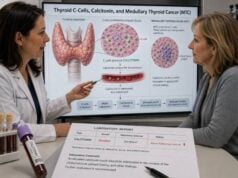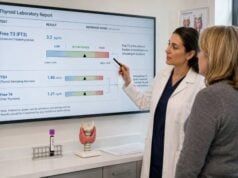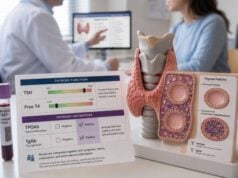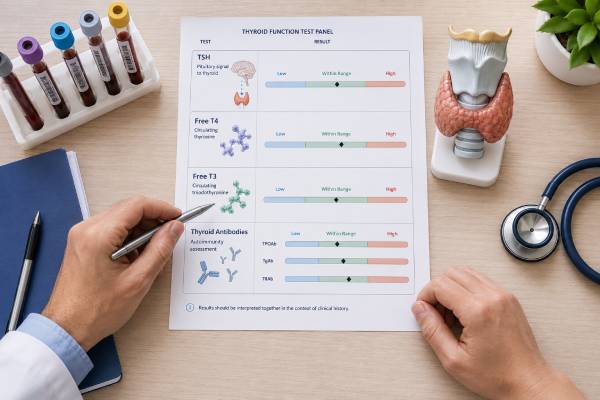
A thyroid function test panel combines blood tests that show how the pituitary gland and thyroid are communicating. TSH is usually the starting test, free T4 shows the available level of the thyroid’s main circulating hormone, and free T3 may help when hyperthyroidism is suspected. Thyroid antibodies answer a different question: whether an autoimmune condition such as Hashimoto thyroiditis or Graves disease is likely to be causing the abnormal hormone pattern. A panel is most useful when its parts are interpreted together, with the laboratory’s own reference ranges, symptoms, medicines, pregnancy status, and recent illness. More testing is not always better. Many people need only TSH first, with free T4, free T3, or antibodies added according to the result. A complete panel can be appropriate when the pattern is complex, pituitary disease is possible, treatment is being monitored, or an autoimmune diagnosis needs confirmation.
- High TSH with low free T4 usually indicates primary hypothyroidism, while high TSH with normal free T4 is called subclinical hypothyroidism.
- Low TSH with high free T4 or free T3 usually indicates hyperthyroidism; a normal free T4 does not exclude T3-predominant disease.
- Low or normal TSH with low free T4 can suggest central hypothyroidism, severe illness, medication effects, or assay problems.
- Thyroid antibodies identify a likely autoimmune cause, but they do not measure current thyroid function or determine medication dose.
- Reference ranges vary by assay, age, pregnancy, and laboratory, so results should not be compared with a generic online “optimal” range.
Table of Contents
- Tests Included in a Thyroid Function Panel
- How TSH, Free T4, and Free T3 Work Together
- Common Thyroid Panel Result Patterns
- When Thyroid Antibodies Add Useful Information
- Reference Ranges and Special Situations
- Preparation, Medicines, and Test Interference
- Follow-Up and Next Steps
Tests Included in a Thyroid Function Panel
There is no universal thyroid panel. Laboratories and clinicians may use the term for different combinations. A basic panel often contains TSH and free T4. A broader panel may add free or total T3 and one or more antibodies. Some health systems use “reflex” testing: the laboratory measures TSH first and automatically adds another test only when TSH falls outside a defined range.
TSH
Thyroid-stimulating hormone is made by the pituitary gland. It tells the thyroid how much hormone to produce. Because the pituitary responds strongly to small changes in circulating thyroid hormone, TSH is a sensitive first test for primary thyroid disease. It is usually reported in mIU/L or µIU/mL; these units are numerically equivalent.
A high TSH means the pituitary is asking for more thyroid hormone. In most people, that points toward an underactive thyroid. A low TSH means the pituitary is reducing stimulation, most often because thyroid hormone is excessive. TSH alone becomes less reliable when the pituitary or hypothalamus is diseased, during rapid changes in treatment, in some severe illnesses, and with certain drugs.
Free T4
Thyroxine, or T4, is the main hormone released by the thyroid. Most T4 travels attached to proteins. The free T4 test estimates the small unbound fraction available to tissues. It is especially useful when TSH is abnormal, central hypothyroidism is possible, or treatment needs assessment.
Free T4 helps separate overt from subclinical disease. High TSH plus low free T4 indicates overt primary hypothyroidism. High TSH plus normal free T4 indicates subclinical hypothyroidism. Low TSH plus high free T4 supports overt hyperthyroidism.
Free T3
Triiodothyronine, or T3, is the more active hormone at many tissues. The thyroid makes some T3, but much comes from conversion of T4 outside the thyroid. Free T3 can help evaluate suspected hyperthyroidism when TSH is low and free T4 is normal. Some people have T3-predominant thyrotoxicosis.
Free T3 is usually less useful for diagnosing hypothyroidism. The body can preserve serum T3 until later in thyroid failure, and illness can lower T3 without true thyroid gland failure. Many laboratories also have greater method-related variation for free T3 than for TSH.
Thyroid antibodies
A thyroid antibody panel may include TPOAb, TgAb, TRAb, or TSI. TPOAb and TgAb support autoimmune thyroiditis, especially Hashimoto thyroiditis. TRAb or TSI supports Graves disease. Antibodies identify etiology; they do not replace hormone tests.
Other tests may appear on a broad order, including total T4, total T3, T3 uptake, free thyroxine index, thyroglobulin, or calcitonin. These are not routine components for every patient. Total hormone tests are affected by binding proteins, thyroglobulin is mainly used after differentiated thyroid cancer, and calcitonin addresses medullary thyroid cancer rather than ordinary thyroid function.
How TSH, Free T4, and Free T3 Work Together
The hypothalamus, pituitary, and thyroid form a feedback loop. The hypothalamus releases thyrotropin-releasing hormone, which signals the pituitary to release TSH. TSH then stimulates the thyroid to make T4 and T3. As circulating thyroid hormone rises, the pituitary lowers TSH. When thyroid hormone falls, TSH rises.
This inverse relationship explains why TSH can change before free T4 leaves its reference range. Early primary hypothyroidism may produce a mildly high TSH while free T4 remains normal. Early or mild hyperthyroidism may suppress TSH while free T4 and T3 are still within range. These states are called subclinical because the hormone level is not overtly abnormal, not because symptoms are impossible.
The timing of change also matters. TSH reacts more slowly than free T4 during treatment. After starting or changing levothyroxine, clinicians commonly wait about six weeks before using TSH to judge the new steady state. During treatment of severe hyperthyroidism, free T4 and T3 may improve while TSH remains suppressed for weeks or months. Adjusting medication from TSH alone in that phase can lead to overtreatment.
The feedback loop behaves differently in central thyroid disease. If the pituitary cannot produce an appropriate TSH signal, free T4 can be low while TSH is low, normal, or only slightly high. A “normal” TSH is inappropriate when free T4 is low. This pattern can occur with pituitary tumors, surgery, radiation, head injury, infiltrative disease, or multiple pituitary hormone deficiencies. Central hypothyroidism is monitored mainly with free T4 and clinical status, not a conventional TSH target.
T3 adds information mainly on the hyperthyroid side. Graves disease and autonomous thyroid nodules may produce proportionally more T3. In contrast, severe non-thyroid illness often lowers T3 because conversion changes. A low T3 in a hospitalized patient may reflect illness physiology rather than primary hypothyroidism. The entire clinical setting determines whether the panel represents gland disease, pituitary disease, recovery from illness, or an analytic problem.
Common Thyroid Panel Result Patterns
The following patterns are starting points, not diagnoses by themselves. Results must be interpreted using the laboratory’s reference interval and the person’s clinical circumstances.
| TSH | Free T4 | Free T3 | Common interpretation |
|---|---|---|---|
| High | Low | Low or normal | Overt primary hypothyroidism |
| High | Normal | Usually normal | Subclinical hypothyroidism; repeat testing may be needed |
| Low | High | High or normal | Overt hyperthyroidism or excess thyroid hormone medication |
| Low | Normal | High | T3-predominant hyperthyroidism |
| Low | Normal | Normal | Subclinical hyperthyroidism, medication effect, illness, or recovery phase |
| Low or normal | Low | Low or normal | Central hypothyroidism, severe illness, drug effect, or assay interference |
| Normal or high | High | High or normal | Assay interference, medication timing, thyroid hormone resistance, or a rare TSH-secreting pituitary tumor |
High TSH patterns
A persistently high TSH is most often caused by primary hypothyroidism. Common causes include Hashimoto thyroiditis, thyroid surgery, radioactive iodine treatment, neck radiation, iodine imbalance, and drugs such as lithium or amiodarone. The hypothyroidism panel pattern becomes overt when free T4 is low.
A single mildly high TSH should often be confirmed. TSH varies biologically, may rise during recovery from illness, and can be affected by time of day, medication adherence, and laboratory interference. Treatment decisions for subclinical hypothyroidism depend on the degree and persistence of elevation, age, symptoms, cardiovascular risk, TPOAb status, pregnancy, and fertility plans.
Low TSH patterns
Low TSH with high free T4 or T3 indicates thyrotoxicosis, meaning excessive thyroid hormone action or availability. Graves disease, toxic nodules, thyroiditis, iodine exposure, and excessive replacement are common causes. The hyperthyroidism panel may include TRAb or TSI to distinguish Graves disease from other causes.
A low TSH with normal hormones may be temporary. It can occur in early pregnancy, with glucocorticoids or dopamine, during severe illness, after treatment for hyperthyroidism, or from autonomous thyroid activity. Persistent suppression is more concerning in older adults and people at risk for atrial fibrillation or bone loss.
Discordant patterns
Discordant means the tests do not fit the expected feedback relationship. Examples include high free T4 with nonsuppressed TSH, or low free T4 with normal TSH. Before pursuing rare diagnoses, clinicians review medication timing, biotin, acute illness, pregnancy, binding-protein changes, and assay interference. Repeating tests on another platform can be more useful than ordering many new hormones from the same sample.
Levothyroxine taken shortly before blood collection can temporarily raise free T4 while TSH still reflects longer-term exposure. Irregular dosing—missing tablets and taking extra doses before testing—can create a similar mismatch. A careful history often explains more than the isolated number.
When Thyroid Antibodies Add Useful Information
Antibody tests are selective additions, not a required part of every screening panel.
TPOAb is most helpful when TSH is mildly elevated, autoimmune thyroiditis is suspected, or future hypothyroidism risk would change monitoring. A positive result supports Hashimoto thyroiditis, but treatment is based mainly on thyroid function. Once TPOAb positivity is established, repeating the level usually does not guide levothyroxine dose or show whether symptoms are controlled.
TgAb can support autoimmune thyroid disease, although it is generally less sensitive than TPOAb for Hashimoto thyroiditis. Its most important separate role is identifying possible interference with thyroglobulin during thyroid cancer follow-up. TgAb should not be ordered as a general cancer screening test.
TRAb and TSI are receptor-antibody tests used when Graves disease is suspected. They can help confirm the cause of hyperthyroidism without radioactive iodine uptake, assess the chance of remission or relapse in selected patients, and estimate fetal risk during pregnancy. TSI focuses on stimulating activity; many TRAb assays detect receptor-binding antibodies with stimulating or blocking effects. One well-selected assay is often sufficient.
Antibodies are unnecessary when the cause is already clear and the result would not alter management. For example, a patient who developed hypothyroidism immediately after complete thyroid removal does not need TPOAb to explain the low hormone production. Likewise, broad antibody screening in a person with normal TSH and no risk factors may find incidental positivity that creates anxiety without changing care.
Reference Ranges and Special Situations
A reference range describes the central distribution of results in a selected population tested with a particular method. It is not a universal boundary between health and disease. TSH ranges often fall roughly around 0.4 to 4.0 mIU/L in nonpregnant adults, but laboratories use different limits. Free T4 and free T3 ranges vary substantially by assay and units. The printed range on the report takes priority.
Age can shift interpretation. TSH tends to rise in older adults, and applying a single young-adult limit may label normal aging as disease. Children require age-specific intervals because thyroid physiology changes from the newborn period through adolescence.
Pregnancy changes thyroid physiology from the first trimester. Human chorionic gonadotropin can lower TSH, and estrogen raises thyroxine-binding globulin. Trimester- and method-specific ranges are preferred. A nonpregnant free T4 range or a generic TSH cutoff can misclassify a healthy pregnancy. The separate thyroid tests in pregnancy approach also considers TPOAb and a history of Graves disease.
Severe illness can produce low T3, low or normal TSH, and sometimes low free T4 without primary thyroid failure. Testing during acute illness should be limited to situations where thyroid disease is clinically suspected, because transient non-thyroidal illness patterns can confuse interpretation. Repeat testing after recovery may clarify the picture.
Binding-protein changes primarily affect total T4 and total T3. Pregnancy, estrogen therapy, and some liver conditions increase thyroid-binding proteins, raising total hormone levels while free hormone and TSH may remain normal. Androgens, nephrotic syndrome, severe liver disease, and inherited protein variants can lower or alter total hormone results. Free hormone assays reduce but do not eliminate these issues.
People taking thyroid medication require context-specific targets. Primary hypothyroidism on levothyroxine is generally monitored with TSH after steady state. Central hypothyroidism is monitored with free T4. Early Graves treatment relies more on free T4 and T3 because TSH can remain suppressed. Thyroid cancer treatment may intentionally use a lower TSH target based on recurrence risk, but that is not an appropriate target for routine hypothyroidism.
Preparation, Medicines, and Test Interference
Most outpatient thyroid blood tests do not require fasting unless another ordered test does. Consistency improves comparison. When monitoring replacement therapy, many clinicians prefer blood collection before the morning thyroid dose or at the same interval after dosing each time, especially when free T4 is measured. Follow the specific instructions from the clinician and laboratory.
Report all medicines and supplements. Important examples include:
- Biotin: can interfere with common immunoassays and create a false hyperthyroid pattern, often low TSH with high free T4 or T3.
- Levothyroxine or liothyronine: timing can change measured hormone levels; T3 rises sharply after liothyronine dosing.
- Amiodarone: contains iodine and changes thyroid hormone metabolism as well as thyroid function.
- Lithium: can impair hormone release and contribute to hypothyroidism.
- Glucocorticoids, dopamine, and some critical-care drugs: can suppress TSH.
- Estrogen: raises binding proteins and affects total hormone results.
- Calcium, iron, antacids, bile-acid binders, and some foods: can reduce levothyroxine absorption when taken too close to the dose.
Biotin withholding recommendations differ by dose and assay. A common minimum is 48 hours, but high-dose therapy may require longer. Do not stop a prescribed treatment without medical advice.
Analytic interference should be suspected when results change dramatically without matching symptoms, conflict across repeated tests, or violate normal feedback physiology. Heterophile antibodies, anti-reagent antibodies, macro-TSH, thyroid hormone autoantibodies, abnormal binding proteins, and assay-specific effects can all produce misleading values. The laboratory may repeat the sample using a different method, perform dilution or blocking studies, or use a reference technique.
Changing laboratories can also produce an apparent shift because platforms use different calibrators and antibody reagents. For long-term monitoring, using the same laboratory is helpful when practical. A small numerical difference within the range may represent ordinary biologic and analytic variation rather than a meaningful change in thyroid status.
Follow-Up and Next Steps
Follow-up depends on the pattern, severity, symptoms, and reason for testing.
For a mildly abnormal result in a stable outpatient, repeating TSH and free T4 after an appropriate interval may confirm persistence before treatment. Tests should not be repeated too quickly after a dose change because TSH has not reached steady state. About six weeks is common after starting or adjusting levothyroxine; once stable, monitoring is often yearly unless symptoms, pregnancy, major weight change, interacting medicines, or adherence problems arise.
For suspected hyperthyroidism, free T4 and T3 help assess severity. TRAb or TSI can identify Graves disease. Marked symptoms, a very fast or irregular pulse, chest pain, shortness of breath, fever, confusion, severe weakness, or new vision changes require prompt evaluation. Older adults may have fewer classic symptoms and present with atrial fibrillation, weight loss, or fatigue.
For possible central hypothyroidism, evaluation should not stop at a normal TSH. Other pituitary hormones, pituitary imaging, and specialist assessment may be needed. Adrenal insufficiency must be considered before starting thyroid hormone in a person with suspected pituitary disease because untreated cortisol deficiency can become dangerous.
A normal panel does not prove that every symptom is unrelated to health. It does make clinically important primary thyroid dysfunction less likely in most stable adults. Persistent fatigue, weight change, palpitations, hair loss, or temperature intolerance may require evaluation for anemia, sleep disorders, heart rhythm problems, medication effects, menopause, infection, mood disorders, or other endocrine conditions.
Use the panel as a coordinated set of signals rather than a collection of isolated “optimal” numbers. TSH shows the pituitary response, free T4 and free T3 show circulating hormone, and antibodies may identify cause. The safest interpretation follows the pattern over time and changes treatment only when the clinical and laboratory evidence agree.
References
- Thyroid-Stimulating Hormone and Thyroid Hormones (T3 and T4): An American Thyroid Association-Commissioned Review of Current Clinical and Laboratory Status 2023 (Review)
- Thyroid disease: assessment and management 2023 (Guideline)
- National recommendations of the Croatian society of medical biochemistry and laboratory medicine: Thyroid function tests from the laboratory point of view 2025 (Guideline)
- [154] Thyroid testing in primary hypothyroidism 2025 (Review)
- WHO/BS/2023.2454 WHO 4th International Standards for TSH (human, pituitary) 2023
- Thyroid Function Tests 2023
Disclaimer
Thyroid panel results must be interpreted with symptoms, medicines, medical history, pregnancy status, and the laboratory’s method-specific ranges. Do not change thyroid medication or supplements from an isolated result without clinical guidance. Urgent symptoms such as chest pain, fainting, severe shortness of breath, confusion, or a sustained rapid heartbeat need prompt care.