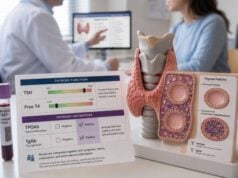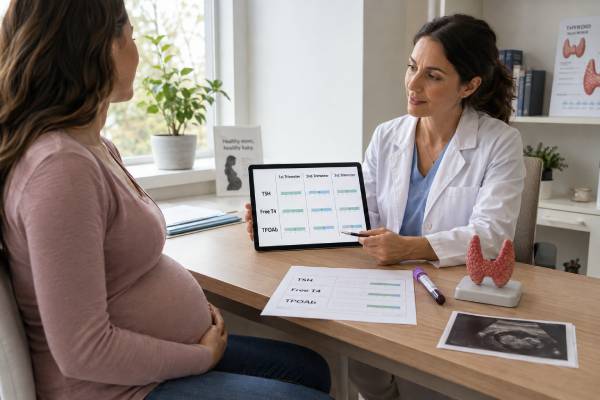
Thyroid testing in pregnancy usually begins with TSH and adds free T4 when TSH is outside the pregnancy-appropriate range or thyroid disease is strongly suspected. TPO antibodies can identify autoimmune thyroiditis and a greater risk of developing hypothyroidism as pregnancy progresses. TRAb is a separate antibody used for current or previous Graves disease because it can cross the placenta and affect the fetal thyroid. Pregnancy changes normal physiology: human chorionic gonadotropin can lower TSH early, estrogen raises thyroid-binding proteins, and thyroid hormone needs increase. For these reasons, nonpregnant reference ranges can misclassify results. The best interpretation uses trimester-, population-, and assay-specific intervals from the testing laboratory. Treatment and monitoring also depend on whether hypothyroidism is overt or mild, whether hyperthyroidism is caused by Graves disease or gestational changes, whether thyroid medication was used before conception, and how far the pregnancy has progressed.
- TSH is the usual first test in pregnancy, but it must be interpreted with a pregnancy-specific reference range.
- Free T4 helps classify an abnormal TSH, although pregnancy can make some free T4 immunoassays less reliable.
- TPOAb supports autoimmune thyroiditis and higher future hypothyroidism risk; it does not measure current hormone sufficiency.
- TRAb, not TPOAb, assesses fetal risk from Graves antibodies, including after prior surgery or radioactive iodine.
- People already taking levothyroxine often need an early dose increase and closer testing after pregnancy is confirmed.
Table of Contents
- Why Pregnancy Changes Thyroid Test Results
- TSH, Free T4, TPOAb, and Other Tests
- Trimester-Specific Reference Ranges
- High TSH and Hypothyroid Patterns
- Low TSH and Hyperthyroid Patterns
- Monitoring Thyroid Treatment During Pregnancy
- Postpartum Testing and Next Steps
Why Pregnancy Changes Thyroid Test Results
Pregnancy alters the thyroid system from the first weeks after conception. The developing fetus depends on maternal thyroid hormone, especially early, and the maternal thyroid must respond to greater demand.
Human chorionic gonadotropin, or hCG, can weakly stimulate the TSH receptor. hCG peaks near the end of the first trimester, so TSH often falls during this period. A low or even temporarily suppressed TSH can occur without Graves disease when free T4 is appropriate and symptoms are mild. Multiple pregnancy and severe vomiting can produce higher hCG exposure and a more pronounced change.
Estrogen raises thyroxine-binding globulin, the main transport protein for T4 and T3. Total T4 and total T3 therefore rise during pregnancy even when the free hormone supply is normal. A nonpregnant total T4 range will make many healthy pregnant patients appear hyperthyroid.
Plasma volume expands, iodine is cleared more rapidly by the kidneys, some iodine is transferred to the fetus, and placental enzymes metabolize thyroid hormones. These changes increase iodine and hormone requirements. People with adequate thyroid reserve can usually adapt. Those with Hashimoto thyroiditis, prior thyroid surgery, radioactive iodine treatment, or iodine deficiency may not.
The feedback relationship between TSH and free T4 remains useful, but the expected values shift by gestational age and assay. The same TSH result can have a different meaning at 8 weeks and 30 weeks. A single universal “pregnancy normal range” cannot capture differences in population iodine intake, ethnicity, body mass, antibody status, hCG, and laboratory method.
Pregnancy also changes the consequences of missed disease. Overt hypothyroidism and uncontrolled overt hyperthyroidism can affect maternal health and pregnancy outcomes. At the same time, unnecessary treatment can expose the fetus to too little or too much thyroid hormone. Accurate classification matters more than chasing an isolated borderline number.
TSH, Free T4, TPOAb, and Other Tests
Pregnancy testing strategies differ between health systems. Some programs use universal TSH screening, while others use targeted testing based on symptoms and risk factors. The local policy reflects disease prevalence, laboratory resources, and interpretation of evidence about treating mild abnormalities. Regardless of the strategy, testing should not be delayed when a pregnant person has known thyroid disease or a strong clinical concern.
Reasons for early testing commonly include:
- Previous hypothyroidism, hyperthyroidism, postpartum thyroiditis, thyroid surgery, or radioactive iodine
- Current levothyroxine, antithyroid medicine, lithium, amiodarone, or immune therapy
- Goiter, thyroid nodule, or symptoms suggesting thyroid dysfunction
- TPOAb positivity or another autoimmune disease such as type 1 diabetes
- A family history of autoimmune thyroid disease
- Prior head or neck radiation
- Infertility treatment, recurrent pregnancy loss, or selected obstetric risk factors
- A history of an infant affected by maternal thyroid antibodies
Symptoms alone are unreliable because normal pregnancy can cause fatigue, heat intolerance, constipation, palpitations, sleep changes, and weight change. Examination and history refine the reason for testing. A resting pulse that remains unusually high, a new goiter, eye signs of Graves disease, severe vomiting, or symptoms that are disproportionate to gestational age increase concern.
When a result is only mildly abnormal, confirmation can be important. TSH changes rapidly in early pregnancy as hCG rises and falls, and assay variation can move a borderline result across a cutoff. Current guidance may recommend repeating selected mild abnormalities within a short interval before labeling disease or starting treatment, provided overt disease and urgent risk have been excluded. The repeat should use the same assay when possible and should not postpone treatment of clear overt hypothyroidism or significant Graves hyperthyroidism.
Testing the pregnant person is different from testing the fetus. Maternal TSH does not cross the placenta in meaningful amounts, but maternal T4 and receptor antibodies do. Fetal assessment may include ultrasound, heart-rate monitoring, growth evaluation, and neonatal testing when maternal Graves antibodies or antithyroid treatment creates risk. These decisions belong to a coordinated obstetric, endocrine, and pediatric team.
TSH
TSH remains the main screening and monitoring signal for primary thyroid disease. A high TSH suggests insufficient thyroid hormone for the current pregnancy, while a low TSH may reflect normal hCG effects, Graves disease, gestational transient thyrotoxicosis, a toxic nodule, thyroiditis, or excess medication.
TSH alone is not enough when it is abnormal. Free T4 helps determine whether the pattern is overt or subclinical. TSH is also unreliable for central hypothyroidism caused by pituitary disease, where free T4 guides care.
Free T4 and total T4
Free T4 estimates unbound thyroxine. It is commonly used with TSH, but pregnancy challenges many routine immunoassays because binding proteins and albumin change. Method-specific trimester ranges are essential. When the free T4 result conflicts with the clinical picture, a laboratory may use another method, free thyroxine index, or pregnancy-adjusted total T4 interpretation.
Total T4 can be useful when interpreted with a pregnancy adjustment after binding proteins have risen. The exact approach should follow the laboratory and current guideline rather than a self-calculated online correction.
Free T3 or total T3 is not a routine screening test. It may help when TSH is low and free T4 is normal, Graves disease is suspected, or T3-predominant hyperthyroidism needs assessment. T3 is not used to diagnose ordinary hypothyroidism because it may remain normal despite low T4.
TPO antibodies
TPOAb identifies autoimmune thyroiditis and reduced thyroid reserve. A positive TPOAb result does not by itself establish hypothyroidism or prove that levothyroxine is needed. It changes how a borderline TSH is interpreted and supports closer monitoring because TSH may rise later in pregnancy.
TPOAb positivity is also associated with postpartum thyroiditis. Routine repeated antibody titers are generally less useful than repeated TSH and free T4.
TRAb or TSI
TSH receptor antibodies are different from TPOAb. TRAb or TSI is measured in pregnant people with current Graves disease, a prior affected infant, or a history of Graves treated with radioactive iodine or surgery. Definitive treatment removes or disables the maternal thyroid but does not immediately remove circulating antibodies.
Stimulating receptor antibodies can cross the placenta and cause fetal or neonatal hyperthyroidism. Blocking antibodies can occasionally cause hypothyroidism. Elevated results may lead to repeat testing and fetal surveillance. A TRAb test must be interpreted using the assay-specific multiple of the upper reference limit.
Trimester-Specific Reference Ranges
The preferred reference interval comes from healthy pregnant people in the local population, tested with the same assay and separated by trimester or narrower gestational periods. This approach accounts for laboratory and population differences.
Typical physiology follows this pattern:
| Test | Early pregnancy | Later pregnancy | Interpretive caution |
|---|---|---|---|
| TSH | Often lower because of hCG | Usually rises toward the nonpregnant range | Use trimester- and assay-specific limits |
| Free T4 | May be slightly higher | Often trends lower by routine immunoassay | Method bias increases as binding proteins change |
| Total T4 | Rises as TBG increases | Remains above nonpregnant values | Do not use a nonpregnant range |
| TPOAb | May be positive or negative | Titers may decline with immune modulation | Function is determined by TSH and free T4 |
Published trimester ranges vary markedly. First-trimester upper TSH limits around 3 to 4 mIU/L appear in many modern populations, but values can be lower or higher. Some assays and populations show upper limits above 4. Using a fixed 2.5 mIU/L cutoff for every first-trimester patient can overdiagnose mild dysfunction.
When a laboratory lacks a pregnancy-specific interval, clinicians use current guideline fallback approaches. These have changed over time and may differ among professional organizations. The treating obstetric and endocrine team should apply the current local standard rather than an outdated chart.
Free T4 needs equal caution. A value marked low by a nonpregnant range late in pregnancy may reflect the assay and normal physiology. Conversely, a clearly low value with an inappropriately normal or high TSH requires assessment. Repeating a borderline result within a short guideline-directed interval may prevent treatment of a transient hCG-related or analytic change.
Ranges also differ in twin or higher-order pregnancy, iodine deficiency or excess, TPOAb positivity, obesity, and certain ethnic groups. Reference intervals describe populations; they do not replace review of trends and symptoms in the individual.
High TSH and Hypothyroid Patterns
Overt primary hypothyroidism generally means TSH is above the pregnancy-specific range and free T4 is low, or TSH is markedly elevated regardless of free T4 under the applicable guideline. It requires prompt treatment with levothyroxine because maternal T4 supports fetal development and maternal cardiovascular and metabolic function.
Subclinical hypothyroidism means TSH is elevated while free T4 remains within the pregnancy range. Management is more nuanced. The degree and persistence of TSH elevation, TPOAb status, gestational age, previous hypothyroidism, infertility treatment, symptoms, and obstetric history all influence whether levothyroxine is started.
Common causes include:
- Hashimoto thyroiditis
- Inadequate levothyroxine dose in a person already treated
- Prior thyroid surgery or radioactive iodine
- Missed tablets or reduced absorption from iron, calcium, vomiting, or gastrointestinal disease
- Iodine deficiency or excess
- Medicines that affect thyroid function
- Rare pituitary or congenital disorders
Positive TPOAb supports Hashimoto thyroiditis and predicts less reserve, but treatment does not aim to lower the antibody. A hypothyroid blood test pattern must be confirmed with pregnancy-appropriate ranges.
Levothyroxine is the replacement treatment used in pregnancy. T3-only therapy and desiccated thyroid extract are not appropriate substitutes because the fetus depends on maternal T4, especially early. Supplements marketed as “thyroid support” may contain iodine, animal thyroid hormone, or unlisted ingredients and can be unsafe.
Iron and calcium in prenatal vitamins can reduce levothyroxine absorption. They are commonly separated from the thyroid dose by at least four hours. Severe vomiting can also disrupt dosing and requires a practical medication plan.
Symptoms are difficult to distinguish from normal pregnancy. Fatigue, constipation, weight change, dry skin, and cold sensitivity can occur in either. Laboratory testing is therefore more reliable than symptoms alone, while still requiring clinical interpretation.
Low TSH and Hyperthyroid Patterns
A low TSH in the first trimester is not automatically hyperthyroidism. If free T4 is appropriate and symptoms are mild, hCG stimulation may explain the result. Subclinical hyperthyroidism—low TSH with normal thyroid hormones—often does not require antithyroid medication.
Overt hyperthyroidism means thyroid hormone exceeds the pregnancy-specific range. Graves disease is the most common persistent cause. Gestational transient thyrotoxicosis is associated with high hCG, often severe nausea and vomiting, no previous Graves history, no Graves eye signs, and negative TRAb. It usually improves as hCG falls.
Features favoring Graves disease include:
- Hyperthyroidism before pregnancy
- Diffuse goiter or increased thyroid blood flow
- Graves eye disease
- Positive TRAb or TSI
- Persistent or marked T3 elevation
- Symptoms continuing beyond the hCG peak
Radioactive iodine uptake and radioactive iodine treatment are contraindicated during pregnancy. Diagnosis therefore relies on history, examination, blood tests, and ultrasound when useful.
Uncontrolled overt Graves hyperthyroidism can cause maternal arrhythmia, heart failure, preeclampsia, poor fetal growth, preterm birth, and thyroid storm. Antithyroid medication crosses the placenta, so treatment uses the lowest effective dose to keep maternal hormone appropriately controlled without making the fetal thyroid underactive. Drug choice can change by trimester because propylthiouracil and methimazole have different maternal and fetal risks. This requires specialist management rather than self-adjustment.
TRAb may remain high even after maternal thyroid hormone is controlled. Elevated receptor antibodies can affect the fetus independently of the mother’s free T4. Fetal tachycardia, growth problems, goiter, advanced bone maturation, or hydrops may prompt coordinated maternal-fetal assessment.
Urgent evaluation is needed for fever, severe agitation or confusion, vomiting with inability to keep medicines down, chest pain, shortness of breath, or a sustained rapid heartbeat. Thyroid storm is rare but life-threatening.
Monitoring Thyroid Treatment During Pregnancy
People taking levothyroxine before conception should have a preconception TSH review when possible. Hormone needs often rise very early, so contact the prescribing team promptly after a positive pregnancy test. Many patients require an immediate planned increase, but the exact amount depends on their diagnosis, baseline TSH, remaining thyroid tissue, and clinician instructions.
TSH is commonly checked about every four weeks through the first half of pregnancy and after dose changes, then at least once later when stable. Current guidelines may tailor intervals more closely to baseline risk and results. Free T4 may be added when TSH is abnormal, central disease is present, or the dose response is unclear.
Take levothyroxine consistently with water and separate it from iron and calcium. Record whether the tablet was taken before the blood draw, especially when free T4 is measured. Do not skip prenatal iodine without advice, but avoid stacking multiple iodine supplements. People taking levothyroxine still need adequate iodine for the fetal thyroid, although local recommendations and diet matter.
Graves disease requires more frequent free T4 and often total T3 monitoring during active treatment. TSH can remain suppressed after hormones improve, so increasing antithyroid medication solely because TSH is low can cause fetal hypothyroidism. TRAb testing follows a separate schedule based on history and the initial result.
After thyroidectomy or radioactive iodine for Graves disease, levothyroxine monitoring addresses maternal hormone replacement, while TRAb monitoring addresses fetal antibody risk. Both are needed because they measure different processes.
Testing should also be repeated after major changes: persistent vomiting, hospitalization, new interacting medication, missed doses, rapid weight change, or a formulation switch. Small isolated shifts may reflect assay and biologic variation; large or persistent shifts deserve action.
Postpartum Testing and Next Steps
Thyroid requirements change quickly after delivery. A levothyroxine dose increased during pregnancy is often reduced toward the pre-pregnancy dose, followed by TSH testing several weeks later. The exact plan should be set before hospital discharge.
Postpartum thyroiditis can occur during the first year, especially with positive TPOAb, type 1 diabetes, or a prior episode. It may cause a thyrotoxic phase, a hypothyroid phase, both, or only one. The hyperthyroid phase often begins in the first few months and results from hormone leakage, so antithyroid drugs are generally not useful. Graves disease can also recur postpartum and is distinguished with TRAb, clinical findings, and other tests.
Symptoms overlap with normal postpartum recovery and mood disorders. Palpitations, tremor, unexplained weight loss, severe anxiety, persistent fatigue, constipation, cold intolerance, low mood, or difficulty with milk supply justify testing. Postpartum depression should never be attributed to the thyroid without appropriate mental health assessment and support.
The TSH test is commonly repeated after dose reduction, when symptoms appear, and after a thyroiditis phase. Some people recover completely; others develop permanent hypothyroidism and need long-term levothyroxine. Annual TSH and early testing before a future pregnancy are often appropriate after postpartum thyroiditis.
Breastfeeding is compatible with levothyroxine and with carefully selected antithyroid treatment. Radioactive iodine testing or therapy requires specific breastfeeding restrictions and should never be arranged without nuclear medicine and endocrine guidance.
Pregnancy thyroid results should be read as a timeline rather than a single number. Preconception status, gestational week, assay, antibodies, medication, and postpartum changes all shape the correct interpretation.
References
- American Thyroid Association 2026 Guidelines for Diagnosis and Management of Thyroid Disease During Preconception, Pregnancy, and the Postpartum 2026 (Guideline)
- Management of Thyroid Disorders in Pregnancy (Green-top Guideline No. 76) 2025 (Guideline)
- Overview of thyroid disorders in pregnancy 2025 (Review)
- Trimester-Specific Reference Range for Thyroid Function Tests in Pregnant Women: A Prospective Study 2025
- Defining Trimester-Specific Reference Intervals for Thyroid Hormones: Insights from a Bulgarian Monocenter Study 2024
- Hyperthyroidism in Pregnancy 2023
Disclaimer
Thyroid testing and treatment in pregnancy require pregnancy-specific ranges and individualized obstetric and endocrine care. Do not start, stop, or change levothyroxine, antithyroid medicine, iodine, or supplements from an isolated result. Urgent symptoms such as chest pain, severe shortness of breath, confusion, fever with marked hyperthyroid symptoms, or a sustained rapid heartbeat need immediate evaluation.