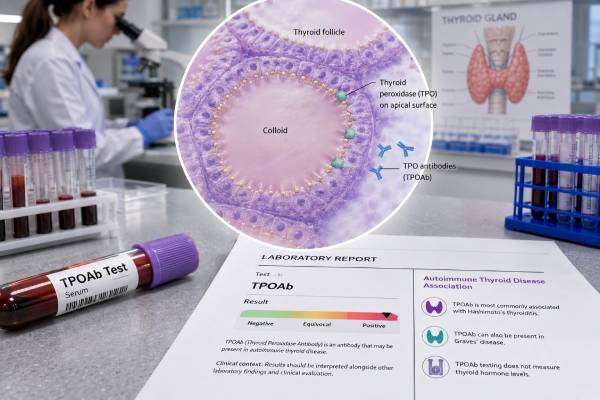
The thyroid peroxidase antibody test detects immune proteins directed against thyroid peroxidase, an enzyme the thyroid uses to make T4 and T3. A positive TPOAb result most often supports Hashimoto thyroiditis, the leading autoimmune cause of hypothyroidism, but TPOAb can also be present in Graves disease, postpartum thyroiditis, other autoimmune conditions, and people whose thyroid function remains normal. The test identifies thyroid autoimmunity; it does not show whether hormone production is currently low, normal, or high. TSH and free T4 provide that information. TPOAb values are method-specific, so the laboratory’s own cutoff matters more than a generic internet range. Once positivity has established an autoimmune cause, repeating the antibody level usually does not guide levothyroxine treatment. Pregnancy, a mildly high TSH, goiter, another autoimmune disease, or medicines that affect the thyroid may make a positive result more important for future monitoring.
- Positive TPOAb strongly supports autoimmune thyroid disease, especially Hashimoto thyroiditis, but it does not prove current hypothyroidism.
- TSH and free T4 determine thyroid function; antibody concentration does not set a levothyroxine dose.
- Normal TSH with positive TPOAb usually calls for monitoring, not automatic treatment, unless pregnancy or another clinical factor changes the plan.
- TPOAb can be positive in Graves disease, but TRAb or TSI is more specific for the cause of Graves hyperthyroidism.
- Reference limits vary by assay, and small differences between laboratories should not be interpreted as disease progression.
Table of Contents
- What the TPOAb Test Measures
- When TPOAb Testing Is Useful
- TPOAb Results in Hashimoto Thyroiditis
- TPOAb in Graves Disease and Other Conditions
- Positive TPOAb With Normal TSH and Free T4
- TPOAb Before, During, and After Pregnancy
- Preparation, Repeat Testing, and Next Steps
What the TPOAb Test Measures
Thyroid peroxidase, abbreviated TPO, sits in thyroid follicular cells. It helps oxidize iodide and attach iodine to tyrosine residues on thyroglobulin, steps needed to produce thyroxine (T4) and triiodothyronine (T3). In autoimmune thyroid disease, the immune system recognizes TPO as a target and produces TPO antibodies.
Laboratory reports may use several names:
- Thyroid peroxidase antibody
- TPO antibody or TPOAb
- Anti-TPO
- Antimicrosomal antibody
- Thyroid microsomal antibody
Modern testing usually reports a numeric result in IU/mL, kIU/L, or another assay-specific unit and marks it negative, borderline, or positive. A cutoff such as 9, 34, or another value may be normal for one platform and inappropriate for another. Interpretation must use the reference interval printed on the report.
TPOAb is a marker of autoimmunity, not a direct measurement of tissue damage. A high concentration can occur while TSH and free T4 are normal. Conversely, a person can have clear autoimmune thyroiditis with a negative result because antibody levels are below the detection limit or the immune process is concentrated in the thyroid.
The TPOAb number also does not measure symptom intensity. Someone with a modestly positive result may have overt hypothyroidism, while another person with a very high value may remain euthyroid. The hormone pattern, gland appearance, symptoms, and clinical history determine the current state.
TPOAb differs from the other tests in a thyroid antibody panel. TgAb targets thyroglobulin and can interfere with thyroglobulin cancer monitoring. TRAb and TSI target the TSH receptor and are more closely linked to Graves disease. These antibodies can overlap, but they answer different questions.
What high, low, and negative values mean
A negative TPOAb result means the measured concentration is below that assay’s positivity threshold. It lowers the likelihood of classic autoimmune thyroiditis but does not reduce it to zero. “Low” usually means negative or detectable below the positive cutoff; it is not evidence that thyroid hormone is low. Likewise, “high” describes antibody concentration, not T4 or T3 concentration.
A weakly positive or borderline result deserves context. Small amounts of thyroid autoantibodies occur in some healthy adults, and prevalence increases with age. The finding becomes more clinically persuasive when TSH is persistently abnormal, the gland is enlarged or has a typical ultrasound appearance, or autoimmune thyroid disease runs in the family. Repeating a borderline result may be reasonable when the first sample conflicts with the clinical picture, but routine serial measurement after a clear diagnosis rarely helps.
Very high values can strengthen confidence that autoimmunity is present, yet they do not create a separate stage of disease. Laboratories may cap reports at “greater than” a maximum measurable value. A result above 1,000 IU/mL cannot be used to calculate how quickly the thyroid will fail, how severe symptoms should be, or how much levothyroxine is needed. The TSH response and free T4 concentration answer those questions more directly.
Changes in assay method can make the number appear to rise or fall. Different manufacturers use different TPO preparations, calibrators, signal systems, and cutoffs. A value of 100 on one platform may not equal 100 on another. This is another reason to avoid using antibody trends as a treatment target. When a repeat is clinically justified, using the same laboratory improves comparability.
TPOAb can also decline naturally or after the thyroid has become extensively damaged. A falling level does not prove immune tolerance has returned, and a negative result years later does not mean established hypothyroidism has resolved. People with permanent loss of thyroid function still need replacement according to TSH and free T4, regardless of the current antibody concentration.
When TPOAb Testing Is Useful
TPOAb is most useful when knowing whether thyroid dysfunction is autoimmune will change diagnosis, monitoring, or counseling.
Common reasons to order it include:
- A high or borderline-high TSH, especially when free T4 is normal
- Suspected Hashimoto thyroiditis based on goiter, a firm thyroid, family history, or ultrasound appearance
- Unexplained primary hypothyroidism
- Pregnancy or pregnancy planning in a person with thyroid risk factors
- Postpartum thyroid dysfunction
- Another autoimmune disease, such as type 1 diabetes or celiac disease, when thyroid abnormalities are present
- Treatment with lithium, amiodarone, interferon, or immune checkpoint inhibitors when autoimmune thyroid disease is a concern
- A need to estimate the likelihood that subclinical hypothyroidism will progress
TPOAb is often unnecessary when the cause of hypothyroidism is already obvious. A person who has had complete thyroid removal does not need an antibody test to explain the need for replacement. It may also add little after Hashimoto thyroiditis has already been documented.
Testing may still be useful when old records are unavailable and confirming autoimmune disease would affect counseling, family risk discussions, or pregnancy monitoring. The result should answer a defined clinical question rather than be added automatically to every annual thyroid blood draw.
Screening every person with a broad antibody panel is not generally useful. Antibody positivity is common enough that testing people with normal TSH and no relevant history can identify incidental findings. This may lead to repeated blood draws, unproven supplements, or treatment despite normal hormone production.
A sensible sequence is often TSH first. If TSH is high, free T4 distinguishes overt from subclinical hypothyroidism, and TPOAb can clarify the cause. The thyroid function panel therefore supplies the functional information that TPOAb lacks.
TPOAb is not a thyroid cancer screening test. It cannot determine whether a nodule is benign or malignant. Nodules are evaluated with examination, ultrasound risk features, and fine-needle aspiration when indicated. Autoimmune thyroiditis and nodules can coexist, but a positive antibody result does not replace structural evaluation.
TPOAb Results in Hashimoto Thyroiditis
Hashimoto thyroiditis is a chronic autoimmune process in which lymphocytes and antibodies target thyroid tissue. TPOAb is detectable in most people with classic Hashimoto thyroiditis, making it the most useful common antibody marker for the condition.
The result becomes most convincing when it fits the thyroid function pattern:
| TSH | Free T4 | TPOAb | Likely interpretation |
|---|---|---|---|
| High | Low | Positive | Overt primary hypothyroidism due to Hashimoto thyroiditis is likely |
| High | Normal | Positive | Subclinical hypothyroidism with autoimmune thyroiditis |
| Normal | Normal | Positive | Thyroid autoimmunity without current hormone failure |
| Low | High | Positive | Possible transient Hashimoto-related thyrotoxicosis, Graves disease, or another hyperthyroid cause; receptor antibodies may help |
In early Hashimoto thyroiditis, the gland may enlarge and hormone production may remain normal. Over time, progressive loss of functioning tissue can raise TSH and eventually lower free T4. The rate is unpredictable. Some people progress within months or years; others never develop overt hypothyroidism.
A brief hyperthyroid phase, sometimes called hashitoxicosis, can occur when inflammation releases stored hormone. It usually differs from Graves disease because the gland is leaking hormone rather than continually producing excess. TSH is low and free T4 or T3 may be high, but radioactive iodine uptake is typically low and TRAb or TSI is usually negative. Treatment focuses on symptoms while the phase resolves; antithyroid medicines do not stop passive hormone leakage.
A negative TPOAb does not completely exclude Hashimoto thyroiditis. TgAb may be positive instead, or ultrasound may show a heterogeneous, hypoechoic gland consistent with autoimmune thyroiditis. Other causes of high TSH must also be considered, including medication effects, iodine imbalance, prior treatment, and laboratory interference.
The Hashimoto blood test pattern should drive treatment. Levothyroxine replaces deficient hormone. It is not prescribed to eliminate TPOAb, and the dose should not be increased because the antibody remains high.
TPOAb in Graves Disease and Other Conditions
TPOAb is not exclusive to Hashimoto thyroiditis. Many people with Graves disease also have it because both conditions arise from thyroid autoimmunity. In Graves disease, however, the antibodies that directly stimulate the TSH receptor—TRAb or TSI—are more specific to the cause of hyperthyroidism.
A person with low TSH, high free T4 or T3, and positive TPOAb should not automatically be labeled with Hashimoto thyroiditis. The pattern may represent Graves disease, transient thyroiditis, autonomous nodules, medication excess, or another cause. TRAb or TSI, examination findings, thyroid blood flow on ultrasound, or radioactive iodine uptake may distinguish them.
TPOAb can also occur in:
- Postpartum thyroiditis
- Painless or silent autoimmune thyroiditis
- Type 1 diabetes, celiac disease, rheumatoid arthritis, lupus, and other autoimmune conditions
- Turner syndrome and Down syndrome
- People taking certain immune-modifying medicines
- Some individuals without known thyroid disease
Autoimmune conditions cluster within families and individuals. A positive result may therefore prompt awareness of symptoms rather than broad testing for every autoimmune disorder. Additional evaluation should be guided by history and signs.
TPOAb has been reported in a minority of people with thyroid nodules or cancer, but it is not a tumor marker. The association between autoimmune thyroiditis and papillary thyroid cancer has been studied extensively, yet antibody status alone cannot estimate an individual nodule’s malignancy risk or determine treatment.
Antibody concentrations may fluctuate with immune activity, iodine exposure, pregnancy, and assay variation. A decrease after treatment or supplementation does not necessarily mean the autoimmune condition has resolved. A rise does not prove that thyroid function is worsening. TSH and free T4 remain the actionable measures.
Positive TPOAb With Normal TSH and Free T4
Positive TPOAb with normal thyroid function means autoimmune risk is present but hormone production is currently adequate. This state is often called euthyroid autoimmune thyroiditis.
Treatment is usually not needed solely for the antibody result. Levothyroxine in a person whose TSH and free T4 are appropriate can suppress TSH and create iatrogenic hyperthyroidism. Potential harms include palpitations, anxiety, sleep disturbance, atrial fibrillation, and accelerated bone loss.
Monitoring frequency depends on risk. TSH may be checked every 6 to 12 months when risk is higher, or less often in a stable low-risk person. Testing should occur sooner if symptoms develop, pregnancy begins, a goiter enlarges, or a medicine known to affect the thyroid is started.
Factors that make future hypothyroidism more likely include:
- TSH near or above the upper reference limit
- Strong family history of autoimmune thyroid disease
- Goiter or ultrasound evidence of thyroiditis
- Another autoimmune disease
- Prior postpartum thyroiditis
- Lithium, amiodarone, or certain cancer immunotherapies
- Pregnancy or plans for pregnancy
Symptoms such as fatigue, weight change, dry skin, hair loss, constipation, low mood, and poor concentration are nonspecific. A positive antibody result may appear to explain them, but normal TSH and free T4 make substantial primary hormone deficiency less likely. Iron deficiency, sleep disorders, menopause, depression, medication effects, and other conditions deserve evaluation.
Some people seek dietary or supplement strategies to lower TPOAb. Adequate iodine and selenium are necessary for thyroid biology, but both can be harmful in excess. High-dose iodine can trigger thyroid dysfunction. Selenium trials and meta-analyses show that supplementation can lower antibody concentrations in some Hashimoto populations, but the clinical importance is uncertain, and benefits for symptoms, progression, or medication need are inconsistent. Chronic excessive selenium can cause hair and nail changes, gastrointestinal symptoms, nerve problems, and toxicity. Supplement decisions should consider dietary intake, local deficiency risk, pregnancy, kidney function, and total dose.
Gluten-free diets are medically necessary for celiac disease. Without celiac disease or another clear indication, evidence that gluten avoidance prevents Hashimoto progression is limited. Restrictive diets can add cost and nutrient deficiencies. The focus should remain on a balanced diet, adequate—not excessive—iodine, and management of actual thyroid dysfunction.
TPOAb Before, During, and After Pregnancy
Pregnancy increases thyroid hormone demand and changes normal test ranges. TPOAb-positive people have less thyroid reserve on average and are more likely to develop an elevated TSH during pregnancy or thyroid dysfunction after delivery.
Preconception assessment may include TSH in someone with known TPOAb positivity, prior thyroid disease, infertility, recurrent pregnancy loss, type 1 diabetes, or another risk factor. A positive antibody does not by itself prove that levothyroxine will improve fertility or prevent miscarriage when TSH is normal. Treatment recommendations depend on current TSH, prior hypothyroidism, fertility treatment, obstetric history, and the applicable guideline.
During pregnancy, TSH should be interpreted with trimester- and method-specific ranges. A TPOAb-positive person with normal TSH may need repeat testing through pregnancy because hormone needs can change rapidly. Someone already taking levothyroxine often requires an early dose increase and frequent monitoring.
The dedicated pregnancy thyroid tests also distinguish TPOAb from TRAb. TPOAb estimates autoimmune hypothyroidism risk. TRAb can cross the placenta and directly affect the fetal thyroid in a person with current or previous Graves disease. TPOAb is not used to predict fetal Graves hyperthyroidism.
After delivery, immune rebound can produce postpartum thyroiditis. A hyperthyroid phase may occur one to four months postpartum, followed by hypothyroidism later in the first year. Some people experience only one phase. TPOAb positivity raises the risk, but symptoms can resemble ordinary postpartum changes. Palpitations, anxiety, fatigue, depression, heat or cold intolerance, and unexpected weight change justify thyroid function testing.
Postpartum thyroiditis may resolve, but some people develop permanent hypothyroidism. TSH follow-up after recovery is important, especially before another pregnancy.
Preparation, Repeat Testing, and Next Steps
The TPOAb test requires a routine blood sample. Fasting is usually unnecessary unless other ordered tests require it. It can generally be drawn at any time of day.
Tell the clinician and laboratory about biotin, high-dose supplements, immune therapies, and recent thyroid treatment. Biotin can interfere with some immunoassays, although the size and direction of error depend on the platform. A common instruction is to stop nonprescription biotin for at least 48 hours, but high-dose prescribed therapy may require a different plan.
When results are positive, the next steps depend on TSH and free T4:
- Normal TSH and free T4: monitor thyroid function according to risk; do not treat the antibody alone.
- High TSH and normal free T4: confirm persistence and assess subclinical hypothyroidism. Age, symptoms, TSH degree, pregnancy, and cardiovascular factors influence treatment.
- High TSH and low free T4: primary hypothyroidism is present; positive TPOAb supports Hashimoto thyroiditis and levothyroxine is commonly indicated.
- Low TSH with high free T4 or T3: investigate Graves disease, thyroiditis, nodules, medication, and assay interference rather than assuming Hashimoto thyroiditis.
- Discordant or surprising values: repeat testing, verify supplements and medicines, and consider another assay or laboratory consultation.
Routine serial TPOAb testing is usually unnecessary. Antibody titers do not reliably track treatment response, symptom burden, or the amount of functioning thyroid tissue. Repeat TSH, not TPOAb, commonly guides levothyroxine monitoring in primary hypothyroidism.
Seek prompt care for a sustained fast or irregular heartbeat, chest pain, fainting, severe weakness, confusion, or major breathing difficulty. Severe hypothyroid or hyperthyroid emergencies are rare, and they are diagnosed from clinical illness and hormone tests—not from the TPOAb level.
A positive TPOAb result is most useful as a cause marker and a sign to watch thyroid function over time. It should lead to proportionate monitoring, not fear of the antibody number or treatment aimed at making the value disappear.
References
- American Thyroid Association 2026 Guidelines for Diagnosis and Management of Thyroid Disease During Preconception, Pregnancy, and the Postpartum 2026 (Guideline)
- Selenium Supplementation in Patients with Hashimoto Thyroiditis: A Systematic Review and Meta-Analysis of Randomized Clinical Trials 2024 (Systematic Review)
- Thyroid autoantibodies 2023 (Review)
- Thyroid antibodies in Hashimoto’s thyroiditis patients are positively associated with inflammation and multiple symptoms 2024
- Thyroid peroxidase antibody test: What is it? 2024
- Hashimoto’s Thyroiditis 2023
Disclaimer
TPOAb results must be interpreted with TSH, free T4, symptoms, medications, pregnancy status, and the laboratory’s assay-specific range. Do not start thyroid hormone, iodine, selenium, or other supplements based only on an antibody value. A qualified healthcare professional can determine the appropriate monitoring and treatment plan.