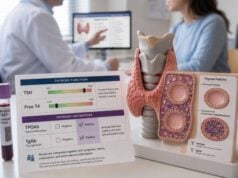
A TSH receptor antibody test detects autoantibodies that attach to the thyroid’s TSH receptor. It is most often used to confirm Graves disease, the autoimmune form of hyperthyroidism, when TSH is low and free T4 or T3 is high. TRAb is a broad term: receptor antibodies may stimulate the thyroid, block stimulation, or bind without a clearly measured functional effect. Most routine laboratory TRAb assays are competitive binding tests and do not directly separate those actions. A positive result in untreated thyrotoxicosis strongly supports Graves disease, while a negative result makes it less likely but does not rule it out completely. TRAb can also help estimate relapse risk before stopping antithyroid medicine and assess fetal or newborn thyroid risk during pregnancy because the antibodies cross the placenta. Results are assay-specific and must be interpreted with the laboratory cutoff, thyroid hormone levels, treatment history, pregnancy status, and clinical findings rather than used as a stand-alone severity score.
- Positive TRAb with suppressed TSH and elevated free T4 or T3 strongly supports Graves disease.
- TRAb includes stimulating, blocking, and neutral receptor antibodies; many routine assays measure binding rather than biological action.
- A negative result lowers the likelihood of Graves disease but can occur in mild, early, or treated disease.
- High or persistent TRAb near the end of antithyroid therapy is associated with a greater relapse risk.
- TRAb can remain elevated after thyroid surgery or radioactive iodine and may still matter during pregnancy.
- Reference limits and units differ by assay, so results from different laboratories cannot be directly converted.
Table of Contents
- What the TRAb Test Measures
- Why TRAb Is Ordered
- Positive, Negative, and Borderline Results
- TRAb Assays, TSI, and Discordant Tests
- Treatment, Remission, and Relapse
- Pregnancy, Fetal, and Newborn Risk
- Preparation, Limitations, and Next Steps
What the TRAb Test Measures
The TSH receptor sits on thyroid follicular cells. Under normal conditions, pituitary TSH binds to this receptor and signals the gland to take up iodine, make thyroglobulin, and release T4 and T3. In autoimmune thyroid disease, the immune system can produce antibodies directed at the same receptor.
TRAb is an umbrella term for these antibodies. Their functional effects include:
- Stimulating antibodies, which imitate TSH and drive excess hormone production
- Blocking antibodies, which prevent TSH signaling and can reduce thyroid function
- Neutral or cleavage-region antibodies, which bind without a clearly demonstrated stimulating or blocking effect in routine testing
Stimulating activity dominates in classic Graves hyperthyroidism. Blocking activity is less common but can contribute to hypothyroidism, including rare fetal or neonatal hypothyroidism. Some people produce a mixture, and the balance may shift over time or after treatment. This helps explain why thyroid status can occasionally change despite persistent receptor-antibody positivity.
Most routine TRAb tests are TSH-binding inhibitory immunoglobulin assays, often abbreviated TBI or historically TBII. They measure how strongly antibodies in the sample compete with a labeled reagent for receptor binding. The assay detects receptor-directed antibodies well, but it generally cannot tell whether an individual antibody stimulates or blocks the receptor.
Functional cell-based bioassays instead expose engineered cells to the patient sample and measure receptor signaling. These can distinguish stimulating from blocking activity more directly, but they are less widely available and may take longer. Some automated tests marketed as TSI use bridge designs intended to favor stimulating antibodies. The exact method name on the report matters.
TRAb is not TSH. TSH is a pituitary hormone measured in mIU/L, while TRAb is an autoantibody reported in assay-specific units such as IU/L or as an index. TRAb is also not a thyroid hormone level. It can identify the autoimmune cause, but free T4 and T3 show whether the thyroid is overactive now.
Why TRAb Is Ordered
The most common reason for TRAb testing is to determine whether thyrotoxicosis is caused by Graves disease. Several conditions can produce low TSH and elevated thyroid hormone, but their treatment differs. Graves disease reflects ongoing receptor stimulation. Thyroiditis releases stored hormone from injured tissue. Toxic nodules make hormone independently. Excess thyroid medication introduces hormone from outside the gland.
TRAb is especially useful when:
- Hyperthyroidism is biochemically confirmed but the cause is uncertain
- There is no obvious goiter or thyroid eye disease
- A radioactive iodine uptake scan is unavailable or contraindicated
- Pregnancy or breastfeeding makes radioactive iodine inappropriate
- The person recently received iodine contrast or takes amiodarone
- Graves disease must be distinguished from gestational transient thyrotoxicosis
- A clinician is considering stopping antithyroid medication
- Current or previous Graves disease creates pregnancy-related fetal risk
A typical Graves disease blood test pattern combines suppressed TSH, elevated free T4 or total T3, and positive TRAb or TSI. A positive receptor-antibody result can avoid nuclear imaging when the biochemical picture is compatible.
TRAb testing is not a routine screen for fatigue, weight change, or a normal-TSH thyroid panel. It is also not the preferred test for Hashimoto thyroiditis; TPOAb and TgAb are more commonly associated with that condition. Ordering every thyroid antibody at once can increase cost and create incidental findings without improving the diagnosis.
When imaging is still needed
A positive TRAb result may establish Graves disease, but imaging may still be appropriate when a palpable nodule, asymmetric gland, compressive symptoms, or a separate cancer concern is present. Ultrasound evaluates structure, not hormone production. Radioactive iodine uptake shows functional distribution and can distinguish diffuse Graves uptake from one or more autonomous nodules when antibody results are negative or unclear.
A negative TRAb result should not automatically lead to ultrasound if the thyroid is not enlarged or nodular. The next test depends on the biochemical pattern, examination, pregnancy status, iodine exposure, and likelihood of thyroiditis.
Positive, Negative, and Borderline Results
A positive TRAb result means receptor-binding antibodies exceed that assay’s cutoff. The probability of Graves disease rises sharply when the result accompanies untreated overt hyperthyroidism. The same positive value has a different meaning after treatment or when thyroid hormone levels are normal.
| TRAb | TSH and thyroid hormones | Common interpretation |
|---|---|---|
| Positive | Low TSH; high free T4 or T3 | Active Graves disease is likely |
| Positive | Low TSH; normal free T4 and T3 | Early or treated Graves disease, subclinical hyperthyroidism, or persistent TSH suppression |
| Positive | Normal TSH and hormones | Remission, persistent autoimmunity, early recurrence, or mixed antibody activity |
| Positive | High TSH; low free T4 | Consider blocking antibodies, coexisting Hashimoto disease, treatment effect, or thyroid destruction |
| Negative | Low TSH; high hormones | Consider toxic nodules, thyroiditis, iodine or medication effects, assay issues, or antibody-negative Graves disease |
| Borderline | Any pattern | Interpret with the assay, repeat testing, and an alternative diagnostic method when necessary |
A positive result is not a direct measure of symptom intensity. A person with a modest TRAb elevation may have severe tachycardia, while someone with a much higher result may have fewer symptoms. Thyroid hormone concentrations, age, cardiac status, goiter size, eye disease, and duration of excess determine clinical severity.
A negative result reduces the probability of Graves disease because modern assays are highly sensitive in untreated, typical disease. False-negative or low-negative results can occur in mild disease, early disease, localized antibody production, or after antithyroid therapy. When the presentation still strongly suggests Graves disease, clinicians may repeat the test, use a different receptor-antibody method, or obtain uptake imaging when safe.
Borderline results deserve restraint. A small difference around the cutoff can reflect analytical variation. The result becomes more convincing when TSH is suppressed, hormones are elevated, and the examination fits Graves disease. It becomes less convincing when thyroid tests are normal and there are no Graves features.
Reference limits are platform-specific. One laboratory may define positivity above 1.75 IU/L, another may use a different concentration or an index. A result should be compared with the limit on the same report, not with a cutoff found elsewhere.
The distance above the cutoff can still add context, particularly in untreated disease and pregnancy, but it should be expressed relative to that assay’s upper limit rather than treated as a universal concentration. For example, “four times the upper limit” can be more portable than quoting an isolated IU/L value. Even then, clinical protocols may define risk differently, and a repeat result should ideally use the same platform.
A falling value usually reflects reduced autoimmune activity, but antibody concentrations fluctuate and do not decline at a fixed rate. Small differences between nearby measurements may represent analytical and biological variation. Large decisions are better supported by a sustained trend, the current hormone pattern, and the purpose of testing.
Positive TRAb without hyperthyroidism
Receptor antibodies can persist during remission or after definitive treatment. They can also appear in some people with autoimmune hypothyroidism. A positive result with normal thyroid function does not automatically require antithyroid medication. Follow-up depends on symptoms, prior Graves disease, pregnancy, and changes in TSH and free T4.
After thyroidectomy, little thyroid tissue remains to respond, yet antibody-producing immune cells may continue to circulate. After radioactive iodine, TRAb can transiently rise and remain detectable for years. This distinction is particularly important during pregnancy because the placenta transfers antibody even when the mother no longer has an intact or overactive thyroid.
TRAb Assays, TSI, and Discordant Tests
TRAb and TSI are closely related but not synonymous laboratory labels. TRAb usually refers to all antibodies that bind the receptor. TSI testing aims to identify stimulating antibodies more specifically. The TSI test may be a functional bioassay or an automated bridge immunoassay, depending on the laboratory.
Both tests perform well for diagnosing Graves disease. In a person with overt hyperthyroidism, ordering both at the same time is often redundant. The most appropriate test is usually the validated receptor-antibody assay available locally, interpreted with its own cutoff.
Discordance can occur for several reasons:
- A binding TRAb assay detects blocking antibodies that a stimulation-focused test does not
- A TSI assay detects low stimulating activity while a broader binding result remains below cutoff
- Assays use different receptor constructs, reagents, calibrators, and decision limits
- Treatment changes the antibody mixture over time
- The sample contains interfering antibodies
- Results were drawn months apart during a changing disease course
When one test is positive and the other negative, clinicians should not simply choose the result that supports a preferred diagnosis. The thyroid hormone pattern, treatment stage, pregnancy status, assay design, and imaging findings must reconcile the difference.
TPOAb and TgAb answer different questions. They indicate thyroid autoimmunity but are not specific for receptor stimulation. A person with Graves disease may have all three types of antibodies. A positive TPOAb does not replace TRAb when confirming Graves disease or estimating fetal receptor-antibody exposure.
Assay standardization remains incomplete. Even when two reports use IU/L, their numerical values and cutoffs may not be interchangeable. Longitudinal monitoring is clearest when the same assay is used.
Treatment, Remission, and Relapse
Antithyroid drugs such as methimazole and propylthiouracil reduce thyroid hormone synthesis. They do not neutralize every circulating receptor antibody immediately. Free T4 and T3 often improve before TRAb falls, and TSH may stay suppressed after both hormones normalize.
Early dose adjustment should therefore rely on free T4, T3 when appropriate, symptoms, and safety monitoring rather than TRAb alone. Increasing an antithyroid dose merely because TRAb remains positive can cause hypothyroidism.
TRAb becomes more useful near a decision about stopping medication. Persistent positivity or a high titer after an adequate treatment course is associated with a greater chance of relapse. A low or negative result improves the likelihood of remission but does not guarantee it. Relapse risk also depends on age, smoking, goiter size, initial hormone severity, adherence, treatment duration, and prior relapse.
A clinician may continue low-dose medication, stop with close surveillance, or discuss radioactive iodine or surgery based on the whole picture. There is no universal TRAb number that mandates one treatment. Study cutoffs cannot be transferred automatically to every assay.
After medication is stopped, TSH, free T4, and T3 are monitored for recurrence. A rising TRAb may precede biochemical relapse in some people, but routine frequent antibody measurement is not always necessary. Symptoms and hormone tests remain the primary evidence of current thyroid status.
Radioactive iodine can increase receptor-antibody levels for months and may worsen thyroid eye disease risk in susceptible patients, especially smokers. Surgery often leads to a gradual decline, but antibodies can persist. The choice among therapies should not be based on TRAb alone.
TRAb and thyroid eye disease
TRAb levels are often higher in people with active or severe thyroid eye disease, but the association is imperfect. The antibody result cannot grade eye activity, predict vision loss in an individual, or replace an eye examination. Pain with eye movement, new double vision, reduced color vision, inability to close the eyelids, or declining vision requires prompt assessment.
Smoking is a major modifiable risk factor for Graves orbitopathy. Maintaining stable thyroid hormone levels and coordinating endocrine and eye care are more actionable than trying to reach a specific antibody number.
Pregnancy, Fetal, and Newborn Risk
TRAb has a special role in pregnancy because immunoglobulin G crosses the placenta. Stimulating antibodies can activate the fetal thyroid and cause fetal or neonatal hyperthyroidism. Blocking antibodies can rarely cause fetal or neonatal hypothyroidism. Maternal thyroid status alone does not show this risk.
Testing is particularly important for a pregnant person with:
- Current Graves hyperthyroidism
- A history of Graves disease treated with radioactive iodine or thyroidectomy
- A previous infant or fetus affected by thyroid dysfunction from receptor antibodies
- Persistently elevated antibodies or uncertain Graves history
- Antithyroid medication use during pregnancy
Current guidelines use timed antibody testing and recommend enhanced fetal surveillance when the level is substantially above the assay’s upper reference limit, often described as more than three times that limit. The exact schedule and threshold should follow the current obstetric-endocrine protocol and the laboratory method.
High maternal TRAb can prompt ultrasound monitoring for fetal tachycardia, poor growth, goiter, abnormal bone maturation, heart failure, or hydrops. These findings require specialist interpretation because maternal antithyroid medication crosses the placenta too. The treatment must balance maternal control with fetal thyroid function.
TRAb can remain high after definitive maternal treatment. A pregnant person taking levothyroxine after thyroidectomy may have normal TSH and free T4 yet still transfer stimulating antibodies. Historical treatment details are therefore essential.
Newborn effects may not be obvious immediately if maternal antithyroid medicine is still present in the infant. Hyperthyroidism can emerge after the drug clears, while antibodies persist longer. The neonatal team should know the maternal diagnosis, antibody level, medication, and fetal findings before delivery so that the newborn can be monitored appropriately.
Preparation, Limitations, and Next Steps
TRAb testing requires a standard blood sample. Fasting is usually unnecessary. Antithyroid medicine does not need to be stopped for the draw, and doing so without advice can be dangerous. Provide the laboratory and clinician with the current medication list, supplement use, pregnancy status, previous radioactive iodine or surgery, and the timing of prior Graves treatment.
Biotin interferes with some immunoassays, although the direction and size depend on the platform. Hair, skin, and nail products may contain milligram doses. Follow the laboratory’s recommended pause rather than assuming one interval fits every assay. Do not stop prescribed high-dose biotin without medical guidance.
Other analytical problems include heterophile antibodies, anti-reagent antibodies, and rare nonspecific binding. A result should be questioned when it conflicts sharply with TSH, free T4, T3, symptoms, and the disease course. Repeating the test on another platform or using a functional bioassay may resolve the discrepancy.
A practical diagnostic sequence after an abnormal TRAb result is:
- Confirm whether the assay is a binding TRAb, TSI bridge assay, or functional bioassay.
- Compare the value with the laboratory’s own cutoff and units.
- Review TSH, free T4, and total T3 from the same period.
- Consider treatment stage, pregnancy, iodine exposure, and prior definitive therapy.
- Use imaging or another antibody method when the diagnosis remains uncertain.
- Base treatment on current thyroid function and clinical risk, not antibody concentration alone.
Seek urgent care for chest pain, fainting, a very rapid or irregular heartbeat, high fever, severe agitation, confusion, persistent vomiting, or marked shortness of breath. These can signal a serious thyrotoxic complication. During pregnancy, reduced fetal movement or urgent obstetric concerns require immediate contact with the maternity team.
TRAb is most powerful when it answers a defined clinical question: Is Graves disease causing the hyperthyroidism, is relapse risk still substantial, or could receptor antibodies affect a fetus or newborn? Used that way, it can replace unnecessary imaging, clarify prognosis, and direct monitoring without being mistaken for a stand-alone treatment target.
References
- Best practices in the laboratory diagnosis, prognostication, prediction, and monitoring of Graves’ disease: role of TRAbs 2024 (Review)
- A TRAb-First Diagnostic Strategy for Overt Hyperthyroidism 2026 (Clinical Study)
- TSH Receptor Antibody Test Utilization Patterns From a Large Academic Medical Center 2025 (Clinical Study)
- Comparison between thyroid stimulating immunoglobulin and TSH-receptor antibodies in the diagnosis and management of Graves’ disease 2024 (Clinical Study)
- American Thyroid Association 2026 Guidelines for Thyroid Disease in Preconception, Pregnancy, and Postpartum 2026 (Guideline)
- High TRAb Titer at Diagnosis Predicts Persistent Positivity and Relapse in Graves’ Disease after Prolonged Antithyroid Drug Therapy 2025 (Clinical Study)
Disclaimer
This article provides general education and does not diagnose Graves disease or determine an individual treatment plan. TRAb results must be interpreted with the specific assay, thyroid hormone levels, symptoms, treatment history, and pregnancy status. Do not start, stop, or change antithyroid or thyroid hormone medication based on an antibody result alone.