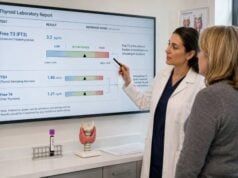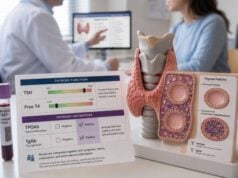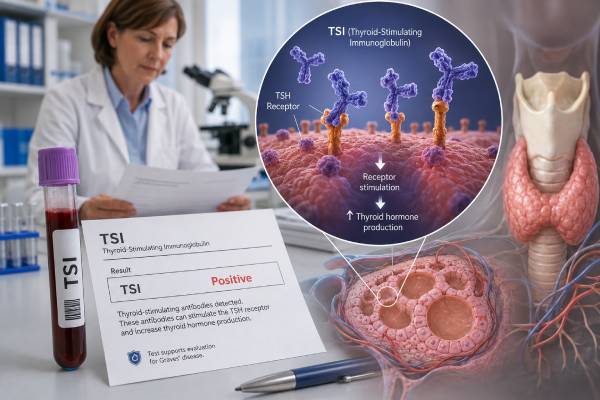
The thyroid-stimulating immunoglobulin test looks for antibodies that activate the thyroid’s TSH receptor. These stimulating antibodies can make the gland produce excessive T4 and T3, which is the central mechanism of Graves disease. A positive TSI result strongly supports Graves disease when TSH is low and free T4 or T3 is high. The test does not measure thyroid hormone itself, and a positive value does not show how severe symptoms are or set an antithyroid medication dose. TSI may also help when the cause of hyperthyroidism is unclear, when radioactive iodine testing is unsuitable, before stopping antithyroid medicine in selected patients, and during pregnancy because stimulating antibodies can cross the placenta. Laboratories use different assay designs, units, and positive cutoffs. Results must be compared with the reference limit on the same report and interpreted alongside TSH, free T4, T3, treatment history, and pregnancy status.
- Positive TSI with low TSH and high free T4 or T3 strongly supports Graves disease.
- A negative TSI makes Graves disease less likely but does not completely exclude it, especially in mild or treated disease.
- TSI and TRAb overlap but are not identical labels or assays; one well-chosen receptor-antibody test is often enough.
- The TSI level is not a direct severity scale and does not determine medication dose; thyroid hormone levels guide treatment.
- During pregnancy, elevated TSI can indicate fetal or neonatal thyroid risk, even after maternal surgery or radioactive iodine.
Table of Contents
- What the TSI Test Measures
- Why TSI Testing Is Ordered
- Positive, Negative, and Borderline TSI Results
- TSI Versus TRAb
- TSI During Treatment and Relapse Assessment
- Pregnancy and Thyroid Eye Disease
- Preparation, Interference, and Next Steps
What the TSI Test Measures
The thyroid has TSH receptors on the surface of its hormone-producing cells. Pituitary TSH normally attaches to these receptors and signals the gland to make and release thyroid hormone. In Graves disease, the immune system produces antibodies that stimulate the same receptor even when the pituitary has reduced TSH to nearly zero.
TSI stands for thyroid-stimulating immunoglobulin. It belongs to the broader family of TSH receptor antibodies. The antibody’s action increases iodine uptake, hormone synthesis, hormone release, and often thyroid growth and blood flow. The result can be diffuse hyperthyroidism and a goiter.
A TSI assay may use one of two broad approaches. A functional bioassay exposes cells containing the human TSH receptor to the patient’s serum and measures the cell response. An automated bridge immunoassay is designed to preferentially identify stimulating receptor antibodies through binding. Both may be called TSI, but their units and cutoffs are not interchangeable.
Results may be reported in IU/L, IU/mL, a percentage, or a specimen-to-reference index. Some laboratories define positivity above a fixed number; others report a percentage above a baseline. The report’s method-specific reference limit is the only appropriate comparison.
How stimulating antibodies affect the receptor
The TSH receptor normally receives signals from pituitary TSH. When TSH binds, thyroid cells take up iodine, make thyroglobulin, and release T4 and T3. TSI can imitate that signal even when the pituitary has already reduced TSH to nearly undetectable levels. This explains why Graves disease can show the apparently contradictory combination of very low TSH and high thyroid hormone: the gland is being driven by antibody stimulation rather than by the pituitary.
The immune response is not always biologically uniform. One person may produce mostly stimulating antibodies, while another has a mixture of stimulating, blocking, and functionally neutral receptor antibodies. The balance can change with time, treatment, pregnancy, or immune-modifying therapy. In unusual cases, a person can move between hyperthyroidism and hypothyroidism as the dominant antibody activity changes. A TSI result is therefore a measurement made at one point in a changing immune process, not a permanent label for the thyroid’s future behavior.
Assay design also matters. Functional cell-based bioassays assess receptor activation after a patient sample is added to engineered cells. Automated bridge immunoassays detect antibody binding configured to favor stimulating antibodies and are faster for routine laboratories. The report may express results as an index, a percentage of specimen-to-reference activity, or an instrument-specific concentration. These numbers are not interchangeable. A value should be interpreted only with that laboratory’s cutoff and method.
TSI is not the same as TSH. TSH is a pituitary hormone, while TSI is an autoantibody. TSI is also not free T4 or T3. A high antibody signal explains why the thyroid may be overactive, but the hormone tests show whether it is overactive now.
Because TSI is an immune marker, it can remain positive after thyroid hormone has normalized. It can also be measurable after radioactive iodine or surgery, when the thyroid can no longer respond fully. These features become especially important in pregnancy and relapse assessment.
Why TSI Testing Is Ordered
TSI is most often ordered to confirm that thyrotoxicosis is caused by Graves disease. Thyrotoxicosis means excessive thyroid hormone action, but several conditions can produce it. Graves disease increases hormone production throughout the gland. Thyroiditis releases stored hormone from damaged tissue. Toxic nodules produce hormone autonomously. Excess thyroid medication introduces hormone from outside the gland. These causes require different management.
The test is particularly useful when:
- TSH is suppressed and free T4 or T3 is elevated
- The examination does not clearly distinguish Graves disease from another cause
- A radioactive iodine uptake scan is contraindicated, unavailable, or undesirable
- Pregnancy makes radioactive iodine testing unsafe
- The patient has no obvious goiter or eye findings
- Hyperthyroidism follows immune therapy, amiodarone, or another complex exposure
- A clinician is considering stopping antithyroid medication
- Current or past Graves disease creates fetal antibody risk
The classic Graves disease blood test pattern includes low TSH, elevated free T4 or T3, and positive TSI or TRAb. Some people have T3-predominant disease, so free T4 may still be within range.
TSI is not a general screening test for fatigue, weight gain, or ordinary hypothyroidism. TPOAb is more relevant when Hashimoto thyroiditis is suspected. Ordering every thyroid antibody can create confusing incidental positives and duplicate information.
TSI also does not diagnose thyroid eye disease by itself. Eye disease is assessed clinically through symptoms, examination, activity, severity, and imaging when needed. TSI supports the autoimmune context and may correlate with risk or activity in groups, but an individual’s eye treatment cannot be chosen from one antibody number.
A positive result can occasionally precede overt hyperthyroidism. In a person with normal TSH and hormones, it may represent early autoimmune activity, remission, or a balance between stimulating and blocking antibodies. Follow-up depends on symptoms, pregnancy, and clinical risk rather than immediate antithyroid treatment.
Positive, Negative, and Borderline TSI Results
A positive result means the assay detected stimulating TSH receptor antibodies above its cutoff. The meaning depends on the thyroid hormone pattern.
| TSI | TSH and hormones | Common interpretation |
|---|---|---|
| Positive | Low TSH; high free T4 or T3 | Active Graves hyperthyroidism is likely |
| Positive | Low TSH; normal free T4 and T3 | Subclinical or early Graves disease, treatment effect, or persistent suppression |
| Positive | Normal TSH and hormones | Remission, early autoimmunity, mixed antibody activity, or persistent antibodies after treatment |
| Negative | Low TSH; high hormones | Consider thyroiditis, toxic nodules, medication, iodine exposure, assay issues, or less commonly antibody-negative Graves disease |
| Borderline | Any pattern | Interpret with assay, clinical findings, repeat testing, or another diagnostic method |
The numerical height does not translate directly into disease severity. A value five times the upper limit does not mean symptoms will be five times worse or that five times more medication is needed. Free T4, T3, heart rate, weight change, age, cardiac risk, and clinical findings guide treatment intensity.
A negative result lowers the probability of Graves disease. Sensitivity is high in untreated classic Graves disease, but false-negative or genuinely low results occur in mild disease, early disease, localized antibody production, and after treatment. If the clinical picture remains convincing, clinicians may repeat the assay, use a TRAb method, obtain Doppler ultrasound, or perform radioactive iodine uptake when safe.
Borderline results are vulnerable to assay differences. A specimen slightly above one manufacturer’s cutoff could be below another’s. The result becomes more persuasive when the biochemical pattern and examination agree. It becomes less persuasive when TSH and hormones are normal and there are no Graves features.
False-positive signals are uncommon but possible. Other autoimmune thyroid conditions can involve receptor antibodies, and analytic interference can affect immunoassays. A surprising result should be verified before committing someone to long-term Graves treatment.
Why the same TSI value can mean different things
A positive TSI result in untreated thyrotoxicosis carries different weight from the same result after treatment. Before therapy, a concordant low TSH and high free T4 or T3 pattern makes Graves disease highly likely. During methimazole treatment, the hormones may be normal even though antibody production continues. After radioactive iodine or thyroidectomy, TSI can remain elevated because the immune system still recognizes the receptor, despite there being little functioning thyroid tissue left to stimulate.
The cutoff is designed for a particular clinical and analytical purpose; it is not a universal dividing line between disease and health. Results close to the upper reference limit are more sensitive to ordinary laboratory variation than strongly positive values. When a borderline value would change a major decision, such as starting long-term therapy, stopping antithyroid medication, or increasing fetal surveillance, repeating the test with the same method can be more informative than comparing it with a result from a different platform.
Discordance should trigger review rather than automatic dismissal. A positive TSI with normal thyroid tests may reflect treated disease, remission, early recurrence, or pregnancy-related immune change. A negative TSI with convincing hyperthyroidism may reflect a low antibody concentration, an assay that does not capture the person’s antibody characteristics, or a non-Graves cause. Recent iodine exposure, thyroid medication, biotin use, and the timing of treatment should be checked alongside imaging and examination findings.
Longitudinal interpretation is strongest when the same laboratory and assay are used. A trend can still be clinically meaningful, but a percentage fall is not itself a treatment target. The purpose of repeat testing must be clear: confirming etiology, estimating relapse risk, or assessing fetal exposure risk. Routine frequent TSI measurements add little when thyroid hormone levels and the treatment plan are already stable.
TSI Versus TRAb
TSI and TRAb are related tests aimed at TSH receptor antibodies, but the terminology can be confusing.
TRAb is the broad term for antibodies that bind the TSH receptor. They can stimulate the receptor, block it, or have little measurable effect. Many routine TRAb tests are competitive binding assays, historically called TBII tests. They report receptor binding but may not identify the antibody’s biologic action.
TSI is intended to identify stimulating activity more specifically. Functional bioassays measure cell activation. Some automated TSI bridge assays are designed to favor stimulating antibodies through their binding geometry. The exact selectivity depends on the platform.
The practical differences are:
- Both can support a Graves disease diagnosis.
- A binding TRAb assay may detect blocking antibodies as well as stimulating antibodies.
- A TSI assay may align more closely with active hyperthyroidism, but it can still remain positive in remission.
- Cutoffs and units cannot be converted across methods.
- Pregnancy guidance may refer to TRAb, TSI, or receptor antibodies collectively, so the laboratory assay must be identified.
Ordering both tests at the same visit is often redundant. Discordant results can occur because the assays detect different antibody properties. When both are ordered, the clinician should not simply choose the positive one; the hormone pattern, treatment status, and assay characteristics must explain the difference.
The separate TRAb test may be preferred in health systems where validated binding assays and guideline thresholds are established. TSI may be preferred when stimulating activity is the specific clinical question. Availability, turnaround time, laboratory expertise, and pregnancy protocols influence the choice.
TPOAb and TgAb are not substitutes. They are common in autoimmune thyroid disease but do not specifically demonstrate receptor stimulation. A person with Graves disease may have positive TPOAb as well as TSI, and the current hormone pattern still determines whether the gland is overactive.
TSI During Treatment and Relapse Assessment
Antithyroid medicines such as methimazole or propylthiouracil reduce hormone synthesis. Free T4 and T3 usually improve before TSH recovers, and TSI may decline more slowly than either. Early dose adjustment should therefore use hormone levels and symptoms rather than antibody concentration alone.
During a course of antithyroid medication, a falling TSI can be encouraging, but it does not guarantee permanent remission. A persistently elevated result near the planned end of therapy suggests a higher relapse risk in many studies. A negative or low result improves the chance of remission but does not eliminate relapse.
Relapse prediction also depends on:
- Age and sex
- Smoking
- Goiter size
- Initial hormone severity
- Duration and dose of treatment
- Previous relapse
- Thyroid eye disease
- Adherence and iodine exposure
- The specific TSI assay and cutoff
A clinician may use TSI as one part of the decision to continue medication, stop it with close follow-up, choose radioactive iodine, or consider surgery. No single study cutoff should be copied across laboratories.
After radioactive iodine, receptor antibodies can rise temporarily before declining. Hyperthyroidism may take months to resolve. After thyroidectomy, TSI can persist even though most thyroid tissue is gone. In both settings, TSH and free T4 guide hormone status, while TSI may retain relevance for pregnancy or eye disease.
TSI is not usually checked at every visit. Repeated testing is most useful when the result will change a specific decision: confirming diagnosis, assessing remission before medication withdrawal, evaluating pregnancy risk, or investigating recurrent symptoms.
After treatment stops, relapse commonly appears through falling TSH and rising free T4 or T3. Symptoms such as palpitations, tremor, heat intolerance, unexplained weight loss, or eye changes justify prompt testing. Waiting for a scheduled antibody test is not appropriate when clinical hyperthyroidism returns.
Pregnancy and Thyroid Eye Disease
TSI has special importance during pregnancy because immunoglobulin G antibodies cross the placenta. A pregnant person can have no thyroid, normal maternal free T4 on levothyroxine, and still have circulating stimulating antibodies from previous Graves disease.
Current or prior Graves disease should be reported at the first prenatal visit. TSI or TRAb is generally measured early, with repeat testing later when elevated or when antithyroid medication is used. The timing and threshold follow current pregnancy guidelines and the laboratory’s assay.
Markedly elevated stimulating antibodies can cause fetal hyperthyroidism. Possible signs include persistent fetal tachycardia, poor growth, fetal goiter, advanced bone maturation, heart failure, or hydrops. Maternal antithyroid medication also crosses the placenta and can cause fetal hypothyroidism if the dose is excessive. Management requires endocrinology, maternal-fetal medicine, and neonatal coordination.
A positive TSI does not mean the fetus is definitely affected. The level, trend, maternal treatment, gestational age, and fetal findings determine risk. The pregnancy thyroid testing plan separates maternal hormone targets from antibody monitoring.
TSI is also associated with thyroid eye disease because the TSH receptor participates in orbital autoimmunity. Higher levels occur more often in active or severe disease at the group level. Yet eye disease can worsen while thyroid hormone is normal, and antibody values overlap widely among individuals.
Eye pain, redness, swelling, light sensitivity, double vision, color-vision change, or reduced vision requires clinical assessment. Smoking is a major modifiable risk factor for thyroid eye disease. Achieving stable thyroid hormone levels and avoiding uncontrolled hypothyroidism or hyperthyroidism are important, but TSI reduction is not a stand-alone treatment goal.
Preparation, Interference, and Next Steps
TSI testing uses a routine venous blood draw. Fasting is generally unnecessary unless other tests require it. The sample can usually be collected at any time of day.
Tell the clinician about biotin, immune therapies, recent radioactive iodine, thyroid surgery, antithyroid medication, levothyroxine, pregnancy, and severe illness. Biotin can interfere with some immunoassays, although the direction depends on the platform. Laboratories often recommend withholding nonprescription biotin for at least 48 hours; prescribed high-dose therapy needs individualized instructions.
When TSI is positive, the usual next steps are to:
- Confirm current thyroid status with TSH, free T4, and T3 when appropriate.
- Assess symptoms, pulse, goiter, eye findings, weight change, heart and bone risks.
- Review pregnancy or pregnancy plans.
- Discuss Graves treatment options: antithyroid medicine, radioactive iodine, or surgery.
- Establish a hormone-monitoring schedule; do not use TSI alone to titrate medication.
When TSI is negative but hyperthyroidism is present, review medication and iodine exposure, consider thyroiditis or autonomous nodules, and choose imaging or another antibody method when appropriate. The broader hyperthyroidism panel helps establish severity and differential diagnosis.
Seek urgent care for chest pain, fainting, severe shortness of breath, confusion, fever with severe hyperthyroid symptoms, or a sustained fast or irregular heartbeat. New vision loss, color-vision change, or inability to close the eyelids also needs urgent assessment.
TSI is most useful when it answers a defined question about Graves disease. Its strength lies in identifying the autoimmune driver; safe decisions still depend on hormone levels, clinical status, treatment history, and the assay used.
References
- Comparison between thyroid stimulating immunoglobulin and TSH-receptor antibodies in the diagnosis and management of Graves’ disease 2024
- Thyroid-stimulating immunoglobulins as a reliable predictive marker for Graves’ disease remission 2025
- TSH Receptor Antibody Test Utilization Patterns From a Large Academic Medical Center 2026
- Thyroid-stimulating immunoglobulin levels during low-dose antithyroid drug therapy predict Graves’ disease relapse 2025
- Assessing the Quality of Care of Pregnant Patients with Graves’ Disease 2024
- Graves’ Disease 2023
Disclaimer
TSI results must be interpreted with TSH, free T4, T3, symptoms, treatment history, pregnancy status, and the laboratory’s assay-specific cutoff. Do not start, stop, or change antithyroid medicine or thyroid hormone from an antibody value alone. Urgent heart, breathing, neurologic, or vision symptoms require prompt medical care.