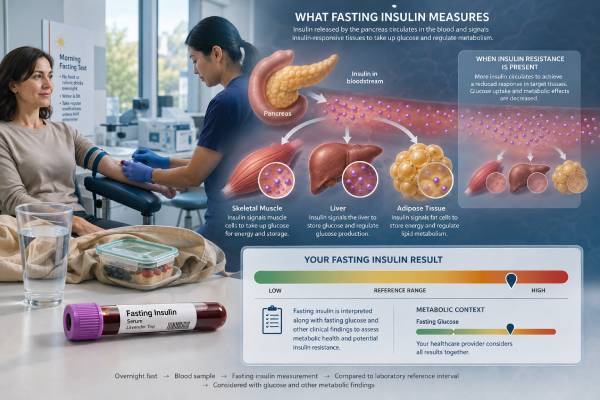
A fasting insulin test measures the insulin circulating after a period without calories, usually 8 to 12 hours. It can show how hard the pancreas is working to keep fasting glucose stable. When fasting glucose is still normal but insulin is elevated, the pattern may suggest compensation for insulin resistance. When both glucose and insulin are high, insulin resistance is more likely, although no single fasting insulin cutoff can diagnose it.
The test is not standardized well enough to define one universal “optimal” value. Insulin assays differ, reference intervals vary by population and laboratory, and results change with recent food, medicines, illness, sleep, exercise, and body composition. A low result may be normal during a true fast, or it may reflect reduced beta-cell function if glucose is elevated. A high result can occur with obesity, prediabetes, polycystic ovary syndrome, medications, or rare causes of excessive insulin secretion. Interpretation should always include the fasting glucose drawn at the same time and usually hemoglobin A1c, lipids, kidney and liver information, symptoms, and medication history.
- Fasting insulin is most useful when measured with fasting glucose after 8–12 hours without calories.
- A high level with normal glucose can indicate compensatory hyperinsulinemia before diabetes develops.
- There is no universal optimal range; one laboratory may use about 2.6–24.9 µIU/mL while another uses a narrower interval.
- Insulin resistance cannot be diagnosed from fasting insulin alone because assays and cutoffs are not standardized.
- Low fasting insulin is concerning mainly when glucose is high or other evidence suggests poor pancreatic insulin production.
- Severe symptoms of low or high glucose need immediate assessment regardless of the insulin result.
Table of Contents
- What Fasting Insulin Shows
- When the Test Is Useful
- Preparation and Collection
- Normal Ranges and “Optimal” Values
- Causes of High Fasting Insulin
- Causes of Low Fasting Insulin
- Interpreting Insulin With Glucose
- Follow-Up for Metabolic Health
What Fasting Insulin Shows
Insulin is a peptide hormone made by pancreatic beta cells. Its main job is to coordinate fuel use after food and between meals. It helps muscle and fat cells take up glucose, reduces liver glucose production, promotes energy storage, and limits the breakdown of fat when energy is available.
During an overnight fast, insulin should fall from its post-meal peak but remain high enough to restrain excessive glucose release from the liver. A fasting insulin test captures that basal level. It does not directly measure how strongly muscle, liver, or fat respond to insulin, but the amount needed to maintain a given glucose offers indirect information.
Consider two people with a fasting glucose of 92 mg/dL. One has insulin of 4 µIU/mL and the other 20 µIU/mL. The second pancreas appears to be releasing much more insulin to achieve the same glucose. That pattern can be consistent with reduced insulin sensitivity, but it is not proof. Genetics, medications, recent diet, sleep, puberty, pregnancy, assay differences, and other factors can produce variation.
Fasting insulin also reflects beta-cell capacity. If fasting glucose is 220 mg/dL but insulin is low, the pancreas may not be producing enough for the level of glucose present. This can occur in type 1 diabetes, advanced type 2 diabetes, or pancreatic disease.
The test differs from C-peptide. Insulin in blood can come from the pancreas or from an injection, depending on whether the assay detects the specific insulin medicine. C-peptide is released only with endogenous insulin. A C-peptide blood test is therefore usually better for estimating how much insulin the pancreas makes in a person using insulin therapy.
Insulin is cleared rapidly, largely by the liver and then the kidneys. Its circulating half-life is only several minutes. That short half-life makes the result sensitive to timing and short-term physiology.
When the Test Is Useful
Fasting insulin is not a standard diagnostic test for diabetes. Diabetes and prediabetes are diagnosed with fasting plasma glucose, hemoglobin A1c, a two-hour oral glucose tolerance test, or a random glucose in the setting of classic symptoms. Fasting insulin may add information in selected situations.
Common reasons include:
- Exploring possible insulin resistance when glucose and A1c are still normal or borderline
- Calculating HOMA-IR or another fasting index in clinical research or specialist care
- Evaluating metabolic features in polycystic ovary syndrome
- Studying obesity, metabolic syndrome, or fatty liver risk
- Investigating fasting hypoglycemia as part of a supervised critical sample
- Comparing insulin secretion before and after a defined intervention
- Reviewing an unusual glucose pattern when beta-cell compensation is a concern
The test can be helpful in a person with abdominal weight gain, high triglycerides, low HDL cholesterol, acanthosis nigricans, a strong family history of type 2 diabetes, or prior gestational diabetes. Even then, established screening tests remain the foundation.
It may be less useful when the result will not change management. Many people with metabolic risk already qualify for lifestyle support, blood pressure treatment, lipid management, or diabetes screening based on standard measures. A fasting insulin number may confirm a suspected pattern without altering the next step.
In suspected hypoglycemia, fasting insulin has a completely different purpose. The important question is whether insulin is appropriately suppressed when plasma glucose is low. An insulin value that looks “normal” on a routine reference interval can be abnormally high during hypoglycemia. Testing must occur at the time of low glucose and include C-peptide, proinsulin, beta-hydroxybutyrate, and a screen for insulin-releasing drugs.
Routine home testing for insulin is not established. Consumer panels may provide a fasting value, but interpretation should not rely on nonvalidated “optimal” charts or wellness scores.
Preparation and Collection
Most fasting insulin orders require 8 to 12 hours without food or caloric drinks. The laboratory or clinician should specify the duration. Plain water is generally allowed and can make the blood draw easier.
During the fast, avoid:
- Food, including small snacks
- Coffee or tea with milk, cream, sugar, or sweetened additives
- Juice, soda, alcohol, and sports drinks
- Gum, candy, or supplements containing calories
- Smoking or nicotine close to collection when possible, because it can affect metabolic physiology
- Strenuous exercise immediately before the draw
Do not stop medication on your own. Insulin, sulfonylureas, meglitinides, glucocorticoids, hormonal medicines, and weight-management treatments can change results. The ordering clinician may give specific instructions about diabetes medicines to prevent hypoglycemia during the fast.
Aim for a routine morning under stable conditions. A night of very poor sleep, acute infection, major stress, recent intense exercise, or an unusually large late meal can affect fasting glucose and insulin. If the goal is to track change over time, use the same laboratory, similar fasting duration, and similar collection time.
The blood sample is usually serum. The laboratory may separate it from cells and refrigerate or freeze it according to the method. Insulin is commonly measured by an immunoassay. These assays use antibodies that recognize the hormone, but they do not all recognize insulin analogs or interference in the same way.
Tell the clinician or laboratory about:
- Every insulin type, dose, and last injection time
- Sulfonylureas or meglitinides
- GLP-1 receptor agonists, tirzepatide, metformin, and other metabolic medicines
- Biotin supplements, especially high doses
- Pregnancy
- Kidney or liver disease
- Recent bariatric surgery
- Insulin antibodies or autoimmune disease
The usual blood-draw risks are brief discomfort, bruising, and occasional lightheadedness. The greater safety concern is fasting while using glucose-lowering medicine. Symptoms such as shaking, sweating, confusion, weakness, or palpitations should be treated according to the person’s hypoglycemia plan rather than ignored to complete the test.
Normal Ranges and “Optimal” Values
Fasting insulin reference intervals vary widely. One major laboratory reports 2.6 to 24.9 µIU/mL for serum insulin. A 2024 study in a selected reference population proposed approximately 2.52 to 13.14 µU/mL. Another population may produce a different interval because of age, ancestry, body composition, assay calibration, and inclusion criteria.
The units µIU/mL, mIU/L, and often µU/mL are numerically equivalent for many insulin reports. Some studies use pmol/L. A commonly used laboratory conversion is:
- Insulin in µIU/mL × about 6.0 to 6.945 = insulin in pmol/L
The exact conversion can depend on the insulin standard used, which is another sign that methods are not perfectly harmonized.
A laboratory reference interval is not the same as a disease threshold. It usually describes the middle range observed in a reference group. If the group includes people with unrecognized insulin resistance or higher body weight, the upper limit may not represent an ideal metabolic target. On the other hand, using a very low “optimal” cutoff can wrongly label healthy people.
The following broad framework is more useful than a universal target:
| Fasting insulin | Fasting glucose | Possible meaning |
|---|---|---|
| Low-normal | Normal | Often normal insulin sensitivity and basal secretion |
| High | Normal | Possible compensatory hyperinsulinemia or assay/medication influence |
| High | Prediabetes range | Insulin resistance with partial compensation is likely |
| High | Diabetes range | Marked insulin resistance may be present, but beta-cell output remains substantial |
| Low | High | Insulin deficiency or advanced beta-cell dysfunction should be considered |
| Detectable during significant hypoglycemia | Low | May be inappropriately high and requires a critical-sample workup |
One result near a cutoff should not drive a diagnosis. Insulin can vary from day to day, and laboratory imprecision can move a borderline result. Trends may be informative if testing conditions remain consistent, but repeated insulin testing is not always necessary.
There is no universally accepted therapeutic target for fasting insulin. Treatment goals are usually based on glucose, A1c, blood pressure, lipids, weight-related health, liver disease, symptoms, and cardiovascular or kidney risk.
Causes of High Fasting Insulin
High fasting insulin most commonly reflects compensation for insulin resistance. The pancreas releases extra hormone because target tissues are less responsive.
Visceral fat and metabolic syndrome
Visceral fat releases fatty acids and inflammatory signals that interfere with insulin pathways in liver and muscle. The liver may continue releasing glucose despite insulin, so beta cells increase output. This often appears with increased waist circumference, high triglycerides, low HDL cholesterol, elevated blood pressure, and fatty liver.
Body mass index does not tell the whole story. A person with a lower BMI can have substantial visceral fat or genetically driven insulin resistance, while some people at a higher BMI remain relatively insulin sensitive for a time.
Prediabetes and early type 2 diabetes
Fasting insulin may rise years before fasting glucose crosses a diagnostic threshold. At first, beta-cell compensation keeps glucose normal. Later, glucose increases as insulin resistance worsens or beta cells can no longer maintain output.
High insulin does not mean the pancreas is “strong” in a way that prevents diabetes. It can be a sign that the system is under increased demand.
Polycystic ovary syndrome
Insulin resistance is common in polycystic ovary syndrome and can increase ovarian androgen production. Fasting insulin may be elevated, but there is no single insulin cutoff that diagnoses PCOS. Diagnosis depends on ovulatory function, androgen excess, and ovarian findings after excluding other causes.
Pregnancy and puberty
Insulin sensitivity normally decreases during later pregnancy, and puberty also causes a temporary physiological reduction in sensitivity. Age-specific and pregnancy-specific context is needed. Routine gestational diabetes screening uses glucose-based tests rather than fasting insulin.
Medicines and endocrine conditions
Glucocorticoids, some antipsychotics, certain HIV medicines, and other drugs can increase insulin resistance. Cushing syndrome, acromegaly, and severe sleep apnea may also raise insulin through counter-regulatory or stress pathways.
Kidney or liver effects
Kidney disease can alter insulin clearance, while advanced liver disease changes both clearance and glucose regulation. A high circulating concentration may therefore reflect impaired removal as well as increased secretion.
Endogenous hyperinsulinism
Insulinoma is rare. A high fasting insulin during normal glucose does not diagnose it. The diagnosis requires inappropriate insulin secretion during verified hypoglycemia, usually through supervised testing. Accidental or intentional use of an insulin-releasing medicine can create a similar pattern.
Causes of Low Fasting Insulin
Low fasting insulin can be entirely normal if glucose is low-normal and the person is insulin sensitive. During a true fast, the body should reduce insulin so stored fat can be used and the liver can maintain glucose.
Concern rises when insulin is low despite high glucose. Possible causes include:
- Type 1 diabetes or another form of autoimmune beta-cell loss
- Longstanding type 2 diabetes with beta-cell failure
- Chronic pancreatitis or pancreatic surgery
- Pancreatogenic diabetes from pancreatic disease
- Severe illness affecting pancreatic function
- Rare genetic disorders of insulin production
A low insulin result in a person injecting insulin is difficult to interpret because some assays detect certain insulin analogs poorly. A low measured value may not mean that no injected insulin is present. C-peptide and the specific assay’s cross-reactivity are more informative.
Low insulin during hypoglycemia is usually appropriate. If both insulin and C-peptide are suppressed, clinicians consider non-insulin causes such as prolonged fasting, alcohol-related hypoglycemia, adrenal insufficiency, severe liver disease, critical illness, or a non-islet-cell tumor. The full clinical setting guides the workup.
Laboratory interference can also create a falsely low result. Hemolysis may degrade insulin in some specimens. Insulin antibodies can alter free and total concentrations, and a standard assay may not capture the biologically active fraction. A general insulin blood test interpretation should account for whether total insulin, free insulin, or a routine immunoreactive value was measured.
There is no treatment for a low fasting insulin number by itself. Treatment depends on glucose, symptoms, and the cause. Insulin deficiency with hyperglycemia may require insulin replacement, while a low value in a healthy, insulin-sensitive person needs no correction.
Interpreting Insulin With Glucose
The matching glucose is essential because glucose is the main stimulus for insulin secretion. Interpretation can be organized in three steps.
1. Confirm the test conditions
Verify the fasting duration, time of collection, recent food, exercise, illness, and medicines. A result after six hours is not equivalent to one after a standardized overnight fast. A sample collected after treating nocturnal hypoglycemia is not truly fasting.
2. Compare insulin with glucose and A1c
Fasting glucose shows the immediate state. A1c estimates average glucose over roughly two to three months but can be distorted by anemia, altered red-cell lifespan, kidney disease, pregnancy, and hemoglobin variants.
Common patterns include:
- Normal glucose and low-to-midrange insulin: often compatible with adequate insulin sensitivity.
- Normal glucose and high insulin: possible early compensation; review waist, triglycerides, HDL, blood pressure, and family history.
- High glucose and high insulin: insulin resistance is likely, though diabetes diagnosis uses glucose or A1c criteria.
- High glucose and low insulin: beta-cell failure or insulin deficiency becomes more concerning.
- Low glucose with insulin not suppressed: evaluate endogenous or exogenous hyperinsulinism urgently under medical supervision.
3. Use calculated indices cautiously
The original HOMA-IR formula commonly used with glucose in mg/dL is:
HOMA-IR = fasting insulin (µIU/mL) × fasting glucose (mg/dL) ÷ 405
When glucose is in mmol/L, the denominator is 22.5. A separate HOMA-IR test interpretation should consider the formula version, assay, and population cutoff. HOMA-IR is useful for group comparisons and trends but is not a universal diagnostic test for one person.
Other markers can add context. Triglyceride-to-HDL ratio, waist circumference, blood pressure, liver enzymes, and imaging for fatty liver may reveal metabolic risk. An oral glucose tolerance test can uncover abnormal post-meal handling even when fasting values appear normal.
Fasting insulin should not replace clinical risk assessment. A person can have normal insulin but still need treatment for hypertension, high LDL cholesterol, smoking, or elevated glucose.
Follow-Up for Metabolic Health
A high fasting insulin result usually prompts a review of the broader cardiometabolic profile rather than medication aimed specifically at the insulin number.
Useful follow-up may include:
- Confirm glucose status. Review fasting glucose, A1c, and an oral glucose tolerance test when indicated.
- Assess cardiovascular risk. Check blood pressure, triglycerides, HDL, LDL, non-HDL cholesterol, smoking, and family history.
- Evaluate liver health. Insulin resistance is strongly linked with MASLD; liver enzymes and noninvasive fibrosis assessment may be appropriate.
- Review sleep and medicines. Sleep apnea, glucocorticoids, and some psychiatric medicines can worsen insulin resistance.
- Choose sustainable treatment. Regular activity, resistance training, adequate sleep, nutrient-dense eating, and weight reduction when appropriate can lower insulin demand.
- Use medicines for established indications. Metformin, GLP-1-based treatment, SGLT2 inhibitors, and other therapies are chosen based on diabetes, obesity, cardiovascular, kidney, liver, reproductive, and safety considerations—not solely a fasting insulin target.
Improvements may appear as lower fasting insulin, lower glucose, reduced triglycerides, smaller waist size, or better blood pressure. Insulin does not need to be rechecked frequently if established clinical markers show progress.
A low result with elevated glucose deserves timely medical review. Additional testing may include C-peptide, diabetes autoantibodies, ketones, and assessment for pancreatic disease. Do not delay insulin treatment when symptoms and glucose indicate deficiency.
Fasting insulin is rarely an emergency result on its own. Urgent evaluation is needed for confusion, seizure, fainting, severe weakness, repeated glucose below the person’s safe range, vomiting with high glucose, deep breathing, dehydration, or suspected ketoacidosis.
Used carefully, fasting insulin can reveal the amount of compensation behind a glucose value. Its limits are equally important: it has no universal optimal cutoff, assays differ, and the complete metabolic picture determines the action.
Why Repeatability Matters
Fasting insulin varies within the same person. Sleep loss, a late meal, unusual exercise, alcohol, acute stress, menstrual-cycle timing, and minor illness can change the next morning’s value even when long-term metabolic health has not changed. A repeat measurement is most useful when the fasting duration, collection time, laboratory method, recent activity, and medication routine are kept as similar as practical.
Trend interpretation should focus on a coordinated change rather than insulin alone. A lower value is reassuring when fasting glucose is stable or improved and A1c, triglycerides, waist circumference, blood pressure, and liver markers move in the same direction. A falling insulin result accompanied by rising glucose may instead signal declining beta-cell reserve. That pattern requires clinical review rather than celebration of a lower number.
References
- Proposal for fasting insulin and HOMA-IR reference intervals based on an extensive Brazilian laboratory database 2024 (Research Study)
- Reference intervals for fasting insulin and insulin-related indices in healthy adults: a cross-sectional study in Gandaki Province, Nepal 2026 (Research Study)
- 2. Diagnosis and Classification of Diabetes: Standards of Care in Diabetes—2026 2026 (Guideline)
- The role of short-chain fatty acids on insulin sensitivity: a systematic review and meta-analysis 2024 (Systematic Review)
- INS – Overview: Insulin, Serum 2026 (Official Test Catalog)
Disclaimer
A fasting insulin test cannot diagnose insulin resistance, prediabetes, diabetes, or an insulin-secreting disorder by itself. A qualified healthcare professional should interpret the result with the simultaneous glucose, performing laboratory’s range, medicines, kidney and liver function, symptoms, and overall metabolic risk. Do not change diabetes medicine or fasting routines based only on this value.