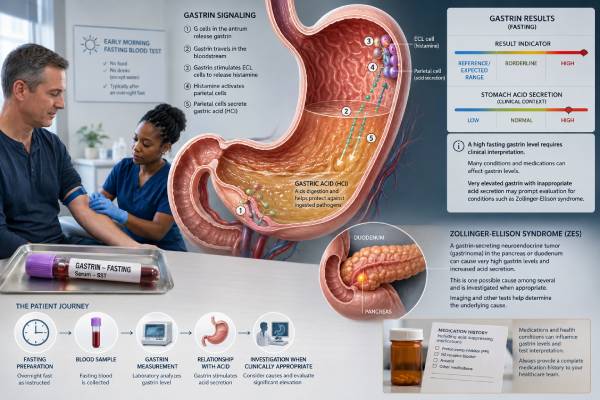
A gastrin blood test measures a hormone that tells the stomach to produce acid. It is mainly ordered when doctors suspect Zollinger-Ellison syndrome, a gastrin-secreting tumor, or when they are evaluating very low stomach acid, autoimmune atrophic gastritis, or pernicious anemia. The result cannot be interpreted without knowing whether stomach acid is high, normal, or suppressed.
High gastrin is common in people taking proton pump inhibitors because these medicines reduce acid and remove the stomach’s normal feedback signal. The same compensatory rise can occur when acid-producing cells have been damaged. Zollinger-Ellison syndrome is different: gastrin remains high even though the stomach is already strongly acidic. A fasting value above 1,000 pg/mL together with gastric pH below 2 is highly concerning in the right clinical setting, but many patients have lower values and need further testing. Stopping acid-suppressing treatment can be dangerous in suspected Zollinger-Ellison syndrome, so medication changes must be medically supervised.
- Gastrin should usually be measured after a 12-hour fast because nonfasting results are difficult to interpret.
- Proton pump inhibitors are the most common reason for a high gastrin result and should not be stopped without a clinician’s plan.
- One major laboratory uses a fasting reference value below 100 pg/mL, but intervals vary by assay.
- High gastrin with gastric pH below 2 suggests inappropriate acid-producing hypergastrinemia; high gastrin with a higher pH usually reflects low stomach acid.
- A result above 1,000 pg/mL plus marked gastric acidity can support Zollinger-Ellison syndrome, while lesser elevations may require a secretin test.
- Severe ulcer pain, vomiting blood, black stools, dehydration, or persistent diarrhea needs prompt medical care.
Table of Contents
- What Gastrin Does
- Why the Test Is Ordered
- Preparation and Medication Safety
- Normal Ranges and Gastric pH
- Common Causes of High Gastrin
- Zollinger-Ellison Syndrome and Gastrinoma
- Low Gastrin and Unusual Results
- Follow-Up Tests and Next Steps
What Gastrin Does
Gastrin is a peptide hormone produced mainly by G cells in the antrum, the lower part of the stomach. Smaller amounts are made in the upper small intestine. Food, stomach stretching, protein fragments, calcium, and nerve signals can stimulate its release.
Gastrin increases stomach acid through two connected routes. It can act directly on acid-producing parietal cells, but much of its effect comes from stimulating enterochromaffin-like cells to release histamine. Histamine then strongly activates parietal cells. Gastrin also supports growth of the acid-producing stomach lining and influences motility, pepsin release, and intrinsic-factor secretion.
The system normally regulates itself through acidity. As stomach pH falls and the contents become more acidic, somatostatin from nearby D cells suppresses gastrin. When acid is low, that brake weakens and gastrin rises in an attempt to restore acid production.
This feedback loop explains the two broad types of hypergastrinemia:
- Appropriate hypergastrinemia: Gastrin is high because stomach acid is low or absent. The hormone is responding normally to reduced acidity.
- Inappropriate hypergastrinemia: Gastrin is high even though the stomach remains strongly acidic. A gastrinoma is the classic concern.
A number alone cannot reliably distinguish them. Gastric pH, medication use, stomach history, vitamin B12 status, and symptoms provide the missing context.
Several molecular forms circulate, including gastrin-17 and gastrin-34. Assays may recognize these forms to different degrees. The hormone also has a short half-life, and kidney clearance contributes to circulating levels. Those factors help explain why methods and clinical thresholds need careful use.
Why the Test Is Ordered
The test is usually ordered for a focused gastrointestinal or endocrine question rather than routine screening.
Suspected Zollinger-Ellison syndrome
Zollinger-Ellison syndrome occurs when one or more gastrin-secreting neuroendocrine tumors, called gastrinomas, drive excessive acid production. Symptoms may include recurrent or treatment-resistant peptic ulcers, severe reflux, abdominal pain, chronic watery diarrhea, and unexplained complications of acid disease.
Gastrinomas are most often found in the duodenum or pancreas. Some occur as part of multiple endocrine neoplasia type 1, or MEN1, an inherited syndrome that can also cause parathyroid and pituitary tumors.
Autoimmune atrophic gastritis and pernicious anemia
Autoimmune damage to stomach parietal cells reduces acid and intrinsic factor. Low acid causes gastrin to rise, while loss of intrinsic factor can lead to vitamin B12 deficiency and pernicious anemia. A high gastrin result can support this picture when combined with B12, methylmalonic acid, blood counts, intrinsic-factor antibodies, parietal-cell antibodies, and endoscopic findings.
Unexplained hypergastrinemia
A high value found during another workup may lead to assessment of acid-suppressing medicine, kidney function, prior stomach surgery, Helicobacter pylori-related changes, gastric outlet obstruction, and other causes.
Monitoring a known gastrinoma
After treatment, gastrin may be followed with imaging and clinical assessment. A change is meaningful only when collection conditions and acid-suppressing medicines are comparable. Normalization can support a response, but imaging and long-term surveillance remain important.
The test should not be used as a general screen for stomach cancer or as a stand-alone explanation for common reflux. Most people with gastroesophageal reflux disease do not need gastrin measurement.
Preparation and Medication Safety
Fasting is essential. A major reference laboratory requires 12 hours without food. Water is generally permitted unless the testing center says otherwise. Food, especially protein, can stimulate gastrin and make a random result uninterpretable.
A typical preparation checklist includes:
- Follow the exact fasting period on the order.
- Avoid food, caloric drinks, gum, and candy during the fast.
- Ask about biotin-containing supplements; some laboratories request that they be withheld for at least 12 hours.
- Tell the clinician about proton pump inhibitors, H2 blockers, antacids, potassium-competitive acid blockers, opioids, and medicines that affect stomach motility.
- Report kidney disease, previous stomach surgery, bariatric surgery, vagotomy, and recent endoscopy.
Why proton pump inhibitors complicate testing
Proton pump inhibitors, or PPIs, such as omeprazole, pantoprazole, esomeprazole, lansoprazole, rabeprazole, and dexlansoprazole suppress acid strongly. Gastrin then rises through normal feedback. Values can become substantially elevated and overlap with those seen in gastrinoma.
Some laboratories advise withholding PPIs for at least one week, while clinical algorithms may use a longer period. That instruction is not safe for everyone. In a person with possible Zollinger-Ellison syndrome, stopping a PPI abruptly can cause a rapid return of extreme acid secretion, ulcer bleeding, perforation, or severe diarrhea.
Medication withdrawal should therefore be planned by a gastroenterologist or endocrinologist. The plan may involve temporary substitution, close monitoring, gastric pH measurement, or testing while treatment continues with cautious interpretation.
H2-receptor blockers can also affect acid and gastrin. Opioids and other drugs that slow gastrointestinal movement may influence results. Never change them solely because an online preparation list says to do so.
Recent gastroscopy can temporarily alter gastrin through stomach distention or motility changes. When possible, collect the baseline sample before procedures or after an appropriate interval specified by the clinician.
Normal Ranges and Gastric pH
One major laboratory uses a fasting serum gastrin reference value below 100 pg/mL. Other laboratories may report a different upper limit because assays recognize gastrin forms differently. The report’s own interval takes priority.
A fasting result can be grouped broadly, but these categories do not replace clinical interpretation:
| Fasting gastrin result | Possible meaning | Critical context |
|---|---|---|
| Within laboratory range | Gastrinoma is less likely if untreated and anatomy is intact | Symptoms, medicine use, and timing still matter |
| Mildly elevated | PPI use, low acid, kidney disease, or gastrinoma are possible | Measure or assess gastric pH and review medicines |
| Above about 400 pg/mL | Significant hypergastrinemia; many causes remain possible | Acid status separates appropriate from inappropriate elevation |
| Above 1,000 pg/mL | Can occur with profound acid suppression or atrophic gastritis as well as gastrinoma | Gastric pH below 2 and compatible clinical setting are crucial |
Gastric pH is a logarithmic measure of acidity. A pH below 2 indicates strong acidity. In suspected Zollinger-Ellison syndrome, the combination of markedly elevated fasting gastrin and gastric pH below 2 is far more specific than gastrin alone.
A very high gastrin level with a higher gastric pH points toward reduced or absent acid. Common explanations include PPI treatment and autoimmune atrophic gastritis. In that setting, the stomach is not responding to gastrin because acid-producing cells are suppressed or damaged.
Gastric pH may be measured from stomach fluid obtained during endoscopy or by another specialist method. Basal acid output is used less often but can provide direct evidence of excessive secretion.
Kidney failure can increase gastrin by reducing clearance. A result that appears disproportionate should be interpreted with creatinine and estimated glomerular filtration rate.
Biological and analytical variation also matter. If a borderline result would trigger invasive testing, repeating it under controlled fasting conditions and with a clear medication plan may be appropriate.
Common Causes of High Gastrin
High gastrin is much more often caused by low stomach acid or medication than by a gastrinoma.
Acid-suppressing medicines
PPIs are the leading cause encountered in practice. Potassium-competitive acid blockers can also cause marked hypergastrinemia. H2 blockers usually have a smaller effect but can still raise the value.
The degree of elevation varies with dose, duration, individual metabolism, baseline acid output, and the timing of the sample. A high result during treatment should not be dismissed automatically, but it should not be labeled a tumor marker without further assessment.
Autoimmune atrophic gastritis
Immune destruction of the stomach body and fundus reduces parietal cells. Acid and intrinsic factor fall, gastrin rises, and enterochromaffin-like cells receive chronic stimulation. Patients may develop iron deficiency before vitamin B12 deficiency becomes obvious. Long-term surveillance may be needed because autoimmune gastritis changes gastric tumor risk.
Pernicious anemia is a late manifestation of autoimmune gastritis. Findings can include low B12, high methylmalonic acid, macrocytosis, neurologic symptoms, and intrinsic-factor antibodies.
Other forms of reduced acid
Chronic atrophic gastritis from other causes, extensive gastric disease, or certain surgical changes can reduce acid and raise gastrin. Some Helicobacter pylori patterns affect gastrin and acid regulation, although the direction and degree vary with where inflammation is concentrated.
Kidney impairment
Renal failure can prolong the half-life of gastrin and increase circulating concentrations. Acid status and medications still need review because kidney disease often coexists with PPI use.
Gastric outlet obstruction and altered anatomy
Obstruction can cause stomach distention and retained food, both of which stimulate gastrin. A retained or excluded gastric antrum after surgery can also create persistent stimulation. A detailed surgical history is important.
Less common associations
Diabetes with autonomic dysfunction, gastroparesis, hypercalcemia, and several systemic or endocrine disorders have been associated with elevations. These usually produce modest values and should not be assumed to be the cause until common explanations are addressed.
Zollinger-Ellison Syndrome and Gastrinoma
Zollinger-Ellison syndrome is uncommon but clinically important because uncontrolled acid can cause severe complications. Gastrinomas may be small and difficult to locate. Many arise in the “gastrinoma triangle,” an area that includes the duodenum and pancreatic head region.
Symptoms can include:
- Multiple, recurrent, or unusually located peptic ulcers
- Ulcers that return despite standard treatment
- Severe reflux or esophagitis
- Upper abdominal pain
- Chronic watery diarrhea that improves with acid suppression
- Unexplained weight loss
- Gastrointestinal bleeding
Diarrhea occurs because excessive acid can damage the small-intestinal lining, inactivate pancreatic enzymes, and interfere with fat digestion.
Biochemical confirmation
The first step is a properly collected fasting gastrin result with assessment of gastric acidity. A fasting gastrin above 1,000 pg/mL and gastric pH below 2 in a patient with compatible symptoms and no confounding anatomy is strongly supportive.
Many gastrinoma patients have values below that level. If gastrin is elevated but not diagnostic and the stomach is acidic, a secretin stimulation test may be used. Paradoxically, gastrinoma cells often release more gastrin after intravenous secretin, while normal G cells do not show the same response.
Protocols and decision thresholds vary. A current ARUP algorithm uses an increase of at least 120 pg/mL over baseline, while other validated protocols have used greater than 200 pg/mL. The test belongs in an experienced center because medicine effects, acid status, and sampling times matter.
Imaging after biochemical evidence
Imaging is generally used to locate and stage a tumor after biochemical findings support the diagnosis. Options can include contrast-enhanced CT or MRI, endoscopic ultrasound, and somatostatin-receptor imaging. A negative scan does not exclude a small duodenal gastrinoma.
A pancreatic hormone test panel is not a substitute for focused gastrin testing. Neuroendocrine tumors secrete different hormones, and broad testing can create incidental abnormal results.
MEN1 assessment
About one-quarter of gastrinomas occur with MEN1. Confirmed cases should prompt assessment for hyperparathyroidism, pituitary disease, family history, and genetic counseling when appropriate. Calcium and parathyroid hormone are especially relevant because hypercalcemia can worsen gastrin secretion and acid output.
Low Gastrin and Unusual Results
Low gastrin is usually less clinically important than high gastrin. Strong stomach acidity can suppress G-cell release, and a low fasting result may simply reflect normal feedback.
Possible contexts include:
- High acid output without a gastrinoma
- Surgical removal of the gastric antrum, where most G cells reside
- Medicines or conditions that enhance acid signaling
- Assay limitations or sample problems
A low value does not diagnose excessive stomach acid. Symptoms, endoscopy, pH testing, and ulcer history are more informative.
An apparently normal gastrin can also be misleading. A patient taking a PPI would usually be expected to have some rise; a normal value in that setting does not prove normal acid physiology. Conversely, an untreated person with classic symptoms can occasionally require repeat testing if the first sample was not properly fasting or was mishandled.
Immunoassay interference from heterophile antibodies can produce a result that does not fit the clinical picture. Different laboratories may recognize different gastrin fragments, so confirmation with another method can help when values are persistently extreme without a plausible cause.
The result should be questioned when:
- It changes dramatically without a medication or clinical change.
- It is extremely high but gastric acid is not assessed.
- It conflicts with endoscopy, B12 status, and symptoms.
- The sample was nonfasting.
- It was drawn shortly after gastroscopy.
- Kidney function is severely reduced.
Follow-Up Tests and Next Steps
Follow-up depends on whether the stomach is acidic or hypoacidic and whether symptoms suggest a functional neuroendocrine tumor.
For high gastrin, clinicians may use:
- Medication review. Document every acid-suppressing drug, dose, and duration.
- Repeat fasting gastrin. Use controlled conditions when safe and clinically useful.
- Gastric pH or acid assessment. Distinguish low-acid compensation from acid-producing hypergastrinemia.
- Vitamin and autoimmune testing. Check B12, methylmalonic acid, blood count, iron studies, intrinsic-factor antibodies, and parietal-cell antibodies when autoimmune gastritis is suspected.
- Kidney function. Review creatinine and estimated GFR.
- Secretin stimulation. Consider when gastrin is elevated, gastric pH is low, and the diagnosis remains uncertain.
- Imaging and MEN1 evaluation. Proceed after biochemical evidence supports gastrinoma.
Treatment addresses the cause. PPI-related elevation may be accepted when the medicine is necessary. Autoimmune gastritis requires treatment of B12 or iron deficiency and appropriate endoscopic care. Zollinger-Ellison syndrome usually requires potent acid suppression plus tumor localization, staging, and multidisciplinary management.
Do not try to lower gastrin through diet or supplements without knowing why it is high. The hormone may be appropriately compensating for absent acid, and adding acid products can be harmful in ulcer disease or an undiagnosed tumor.
Seek urgent medical care for vomiting blood, black tarry stool, sudden severe abdominal pain, fainting, signs of shock, persistent vomiting, or severe diarrhea with dehydration. These symptoms can indicate ulcer bleeding, perforation, or dangerous fluid and electrolyte loss.
A gastrin test becomes clinically meaningful only when fasting status, acid suppression, and gastric pH are considered together. That framework prevents a common medication effect from being mistaken for a tumor and helps identify the smaller group who need specialized testing.
Putting Gastrin and Acid Results Together
The most useful interpretation starts with two questions: how high is gastrin, and is the stomach still strongly acidic? Four common patterns illustrate why both are needed.
High gastrin with reduced acid is an appropriate feedback response. Proton pump inhibitors, potassium-competitive acid blockers, autoimmune atrophic gastritis, and loss of acid-producing stomach tissue remove the normal acid brake on G cells. The gastrin may be strikingly elevated, yet the mechanism is fundamentally different from Zollinger-Ellison syndrome. Endoscopy, gastric biopsies, vitamin B12, iron studies, and autoimmune markers may be more informative than tumor imaging.
High gastrin with gastric pH below 2 is inappropriate hypergastrinemia because gastrin remains elevated despite abundant acid. This pattern raises concern for gastrinoma, especially with recurrent ulcers, severe reflux, diarrhea, thickened gastric folds, or a personal or family history suggesting MEN1. Borderline elevations still require careful medication review and confirmation because no single concentration proves the diagnosis in every patient.
Normal gastrin with persistent ulcer symptoms does not rule out ordinary acid-peptic disease. Helicobacter pylori infection, nonsteroidal anti-inflammatory drugs, smoking, and other causes can produce ulcers without hypergastrinemia. The test should not replace endoscopy or appropriate infection testing when alarm symptoms are present.
Changing gastrin values during medication adjustment must be interpreted against the treatment timeline. Gastrin may remain elevated for a period after long-term acid suppression, and abrupt withdrawal can cause rebound acid secretion. The safest diagnostic plan balances biochemical clarity against the risk of bleeding, pain, or perforation.
Secretin stimulation is reserved for selected cases in which fasting gastrin is elevated, gastric pH confirms acid secretion, and uncertainty remains. A paradoxical rise supports gastrinoma, but the protocol, assay, acid status, and medication exposure still matter. Results should be interpreted by clinicians experienced in acid-hypersecretory disorders.
References
- GAST – Overview: Gastrin, Serum 2026 (Official Test Catalog)
- Zollinger-Ellison Syndrome Testing Algorithm 2026 (Clinical Algorithm)
- Neuroendocrine Tumors 2026 (Clinical Guidance)
- Predictors for the Development of Hypergastrinemia in Users of Proton Pump Inhibitors 2025 (Research Study)
- Long-Term Proton Pump Inhibitor–Acid Suppressive Treatment Can Cause Vitamin B12 Deficiency in Zollinger–Ellison Syndrome Patients 2024 (Research Study)
- Potassium-Competitive Acid Blockers and Hypergastrinemia 2026 (Review)
Disclaimer
A gastrin result cannot diagnose Zollinger-Ellison syndrome, autoimmune gastritis, pernicious anemia, or a neuroendocrine tumor by itself. Proton pump inhibitors and other acid-suppressing medicines can strongly affect the result and should never be stopped without medical supervision, especially when severe acid disease is possible. Interpretation belongs with a qualified gastroenterology or endocrine professional using fasting status, gastric pH, symptoms, medicines, and follow-up testing.