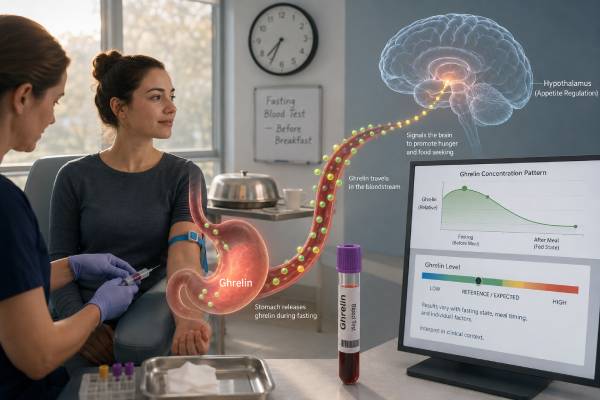
A ghrelin blood test measures a stomach-derived hormone involved in hunger, meal timing, growth hormone release, glucose regulation, and energy balance. Ghrelin usually rises before meals and during fasting, then falls after food. That daily movement makes one result difficult to interpret unless fasting duration, collection time, meal timing, body weight, medicines, and the exact form measured are known.
Ghrelin testing is specialized rather than a routine obesity or appetite test. Laboratories may measure total ghrelin, acyl ghrelin, or des-acyl ghrelin. Acyl ghrelin is the form that activates the main ghrelin receptor, but it is unstable unless blood is collected and processed with special precautions. Total ghrelin is easier to measure but combines forms with different actions. Higher fasting values can occur after weight loss, prolonged calorie restriction, or in undernutrition, while lower values are often seen with obesity and after some bariatric procedures. Neither a high nor low result explains appetite by itself, and there is no universal treatment target.
- Ghrelin normally rises before meals and falls after eating, so fasting duration and collection time are essential.
- Total, acyl, and des-acyl ghrelin are different tests and should not be compared using the same range.
- A specialized total-ghrelin test may require a 10–12-hour fast, preservative tube, rapid refrigerated processing, and frozen transport.
- Obesity often accompanies lower fasting ghrelin, while weight loss and calorie restriction often raise it.
- High ghrelin does not prove excessive hunger, and low ghrelin does not guarantee good appetite control.
- An abnormal result is rarely urgent; concerning weight loss, dehydration, severe vomiting, or endocrine symptoms require clinical evaluation.
Table of Contents
- What Ghrelin Does
- When Ghrelin Is Tested
- Test Types and Sample Handling
- Ranges and Normal Daily Variation
- Causes of High Ghrelin
- Causes of Low Ghrelin
- How to Interpret Results
- Follow-Up and Appetite Health
What Ghrelin Does
Ghrelin is a 28-amino-acid peptide made mainly by endocrine cells in the stomach. Smaller amounts arise in the intestine, pancreas, brain, and other tissues. It was first identified as a natural signal that activates the growth hormone secretagogue receptor, now commonly called GHSR1a.
Before ghrelin can strongly activate this receptor, an enzyme called ghrelin O-acyltransferase attaches a fatty-acid group, usually octanoate. The resulting molecule is acyl ghrelin. Without that modification, it is called des-acyl or unacylated ghrelin. Des-acyl ghrelin does not activate GHSR1a in the same way and may have separate biological effects that remain under study.
Ghrelin participates in several systems:
- Meal initiation and hunger. Levels often rise before an expected meal and fall after nutrient intake.
- Growth hormone release. Ghrelin works with hypothalamic signals to stimulate pituitary growth hormone secretion.
- Gastrointestinal movement. It can promote stomach emptying and motility under some conditions.
- Glucose regulation. Ghrelin can influence insulin release, glucagon, liver glucose production, and insulin sensitivity.
- Reward and food preference. Brain pathways responding to ghrelin interact with motivation and the rewarding qualities of food.
- Adaptation to energy shortage. Levels tend to rise when weight or energy availability falls, helping defend against continued loss.
Calling ghrelin the “hunger hormone” is convenient but incomplete. Hunger also depends on leptin, insulin, GLP-1, peptide YY, cholecystokinin, amylin, sleep, stress, sensory cues, stomach volume, habits, and the brain’s reward system. A person can feel very hungry with a normal ghrelin result or have a high result without severe hunger.
Ghrelin’s action is also balanced by liver-expressed antimicrobial peptide 2, or LEAP2, which can oppose GHSR signaling. The ratio or interaction between these molecules may matter more than either concentration alone, but this remains largely a research area.
When Ghrelin Is Tested
Most people with appetite, weight, or metabolic concerns do not need a ghrelin blood test. Routine care relies on history, weight trend, dietary assessment, medications, sleep, glucose, thyroid testing when indicated, and evaluation for gastrointestinal or systemic disease.
Ghrelin may be measured in:
- Research on appetite, obesity, fasting, and weight loss
- Studies before and after bariatric or metabolic surgery
- Investigations of anorexia nervosa, cachexia, or severe undernutrition
- Growth hormone physiology research
- Studies of Prader-Willi syndrome and other rare appetite disorders
- Drug trials targeting ghrelin signaling or gastrointestinal motility
- Specialized evaluation of neuroendocrine or gastric physiology
A single fasting value generally cannot establish why a person is gaining weight or struggling with appetite. In obesity, fasting ghrelin is often lower than in lean comparison groups, yet hunger and food intake may still be high. This pattern shows that circulating concentration is only one part of signaling.
Prader-Willi syndrome is a notable research context because many affected people have hyperphagia and unusually high ghrelin levels. Even there, diagnosis depends on genetic testing, not ghrelin.
Ghrelin has also been studied in gastroparesis, functional gastrointestinal disorders, chronic illness, and cancer-related weight loss. These uses are investigational or adjunctive. The test does not replace gastric-emptying studies, nutritional evaluation, or cancer assessment.
A leptin blood test may be paired with ghrelin in research because leptin reflects longer-term energy stores while ghrelin changes around meals. Neither is a stand-alone clinical measure of willpower, appetite control, or metabolic health.
Before ordering the test, clinicians should decide whether they need total ghrelin, acyl ghrelin, des-acyl ghrelin, a fasting baseline, or a meal-response curve. Those are different questions.
Test Types and Sample Handling
Ghrelin measurement is highly sensitive to how the sample is collected. The report should identify the molecular form and specimen protocol.
Total ghrelin
Total ghrelin assays measure acyl and des-acyl forms together, sometimes with additional fragments depending on antibody specificity. A current referral test offered through a major laboratory uses plasma collected in a gastrointestinal preservative tube, a 10- to 12-hour fast, rapid refrigerated centrifugation, freezing, and frozen shipment.
Total ghrelin is more stable than acyl ghrelin but cannot show how much receptor-active hormone was present.
Acyl ghrelin
Acyl ghrelin loses its fatty-acid group rapidly after blood collection. Accurate measurement often requires:
- A chilled collection tube
- A protease inhibitor or specialized preservative
- Immediate cooling
- Rapid plasma separation
- Acidification according to the assay protocol
- Prompt freezing with minimal freeze-thaw cycles
A routine serum tube left at room temperature can produce a falsely low active-ghrelin result because acyl ghrelin converts to des-acyl ghrelin.
Des-acyl ghrelin
Des-acyl ghrelin is more abundant and stable. It may be measured separately or calculated from total and acyl results. Its physiology is complex, and it should not be dismissed as inactive simply because it does not strongly activate the classical receptor.
Fasting and meal-stimulated testing
Fasting measurement provides a standardized baseline. Meal studies collect blood before food and at timed intervals afterward. The meal’s calories, protein, fat, carbohydrate, fiber, texture, and route of delivery can all alter the response.
The following table summarizes common differences:
| Test | Main use | Major limitation |
|---|---|---|
| Total ghrelin | Broad fasting or research assessment | Mixes biologically different forms |
| Acyl ghrelin | Estimates receptor-active hormone | Very unstable before processing |
| Des-acyl ghrelin | Research on metabolism and signaling | Clinical cutoffs are not standardized |
| Meal-response curve | Shows dynamic suppression after food | Requires a fixed protocol and multiple samples |
Medicines that affect glucose, insulin, growth hormone, somatostatin, stomach emptying, or appetite can change results. Some laboratories request withdrawal when medically possible, but no medicine should be stopped without the prescriber’s direction.
Ranges and Normal Daily Variation
There is no universal normal ghrelin range. Values differ by assay, molecular form, body weight, age, sex, fasting duration, time of day, and sample handling. Results may be reported in picograms per milliliter (pg/mL), picomoles per liter, or assay-specific units.
One specialized total-ghrelin method lists example values of about 520–700 pg/mL for normal-weight control subjects and lower ranges in obesity, with separate time-of-day and post-weight-loss information. Those figures belong only to that method and preservative system. They should not be applied to an acyl-ghrelin assay or a different laboratory.
Normal physiology creates several sources of variation:
- Ghrelin rises during fasting.
- Anticipated mealtimes can produce pre-meal peaks.
- Food usually suppresses ghrelin, but the size and timing of suppression vary.
- Protein, fat, and carbohydrate can produce different response curves.
- Sleep, exercise, stress, and circadian rhythm can alter secretion.
- Recent weight loss tends to raise fasting concentrations.
A result near a reference boundary may reflect ordinary day-to-day change. Repeat testing is most useful when the same assay, collection time, fasting period, and processing method are reproduced.
The ratio of acyl to total ghrelin is sometimes used in research, but it is highly dependent on preanalytical stability. A low ratio may simply mean active ghrelin degraded after collection.
“Optimal ghrelin” targets promoted for weight loss are not supported by clinical standards. Lower is not automatically better. Ghrelin supports adaptation to fasting, gastrointestinal movement, growth hormone physiology, and protection during energy shortage. Excessive suppression could have unwanted effects.
Children, pregnant people, older adults, and individuals with severe illness may have different expected patterns. Use a population-specific comparator when available.
Causes of High Ghrelin
High ghrelin most often reflects energy deficit or a physiological attempt to restore weight. The exact meaning depends on whether total or acyl hormone was measured.
Fasting and calorie restriction
Ghrelin rises as the fast continues. A sample collected after 16 hours cannot be compared directly with one collected after 10 hours. Very-low-calorie diets and sustained energy restriction may increase fasting values and pre-meal hunger.
Weight loss
After diet-induced weight loss, appetite-related hormones can shift in a direction that favors regain. Ghrelin often rises, while leptin falls. This response is biological rather than a failure of discipline. It can persist and make weight maintenance harder.
Low body weight and eating disorders
People with anorexia nervosa or chronic undernutrition often have elevated total or acyl ghrelin. High levels do not necessarily produce normal eating because brain response, anxiety, gastrointestinal symptoms, and other hormonal adaptations can oppose the signal. The concentration may represent ghrelin resistance or a compensatory response.
Prader-Willi syndrome
Marked hyperghrelinemia has been repeatedly observed in Prader-Willi syndrome, a genetic disorder associated with hypotonia, developmental differences, endocrine abnormalities, and hyperphagia. Ghrelin testing is not diagnostic and cannot replace molecular genetic confirmation.
Chronic illness and cachexia
Some people with cancer, heart failure, lung disease, or other catabolic illness have increased ghrelin as the body attempts to stimulate intake and preserve tissue. Others do not. Weight loss in chronic disease requires a full medical and nutritional evaluation.
Gastrectomy and altered anatomy
Because the stomach is the main source, major gastric surgery often lowers ghrelin, but responses depend on which area is removed or bypassed. Some procedures and later adaptations can produce mixed or time-dependent results.
Rare tumors or endocrine states
Ghrelin can be expressed by certain neuroendocrine tumors, but an isolated high blood value is not a validated tumor diagnosis. Growth hormone disorders, thyroid status, and insulin dynamics may influence secretion indirectly.
A high result should first trigger confirmation of fasting duration, assay type, body-weight trend, and sample handling rather than a search for a rare tumor.
Causes of Low Ghrelin
Lower fasting ghrelin is commonly associated with obesity. This may seem contradictory because ghrelin stimulates food intake. The body may reduce secretion in response to abundant energy stores, while altered receptor sensitivity, reward pathways, meal suppression, and other hormones continue to influence appetite.
Obesity and insulin resistance
Many studies find lower total fasting ghrelin in people with obesity, especially when insulin resistance is present. Post-meal suppression may also be blunted. A low baseline does not mean that appetite signaling is inactive.
Insulin can suppress ghrelin, so hyperinsulinemia may contribute. A fasting insulin test and glucose can provide metabolic context, although neither proves the cause of the ghrelin result.
After bariatric surgery
Roux-en-Y gastric bypass and sleeve gastrectomy can change ghrelin through altered stomach anatomy, vagal signaling, meal flow, weight loss, and assay timing. Sleeve gastrectomy removes much of the ghrelin-producing fundus and often lowers levels early. Long-term patterns vary.
Recent food intake
A random sample after a meal is expected to be lower than a fasting sample. Without meal timing, a low result may have no abnormal meaning.
Hyperglycemia and hormonal influences
Glucose and insulin can suppress ghrelin. Somatostatin pathways, some gastrointestinal medicines, and acute nutrient infusions can also lower it. Severe inflammation and critical illness produce variable effects.
Sample degradation
A low acyl-ghrelin result may be false if the sample was not chilled, preserved, acidified, separated, and frozen as required. This is one of the most common technical concerns. Total ghrelin may appear acceptable while active ghrelin is artifactually low.
There is no recognized “ghrelin deficiency syndrome” diagnosed from one low value in ordinary practice. Treatment is directed at the underlying nutritional, metabolic, surgical, or gastrointestinal condition.
How to Interpret Results
Interpretation begins with the laboratory details, not the number alone.
Ask:
- Was total, acyl, or des-acyl ghrelin measured?
- Was the sample collected after the specified fast?
- What time of day was it drawn?
- Was a special preservative and rapid cold processing used?
- What was the person’s recent weight trend?
- Which medicines or supplements could affect appetite, glucose, growth hormone, or motility?
Common patterns include:
| Pattern | Possible explanation | Useful context |
|---|---|---|
| High fasting total ghrelin after weight loss | Physiological defense against energy loss | Leptin, weight trend, dietary intake, symptoms |
| High ghrelin with very low weight | Undernutrition or compensatory signaling | Eating-disorder and medical assessment |
| Low fasting total ghrelin with obesity | Common obesity-associated pattern | Glucose, insulin, sleep, medications, waist size |
| Low acyl ghrelin with normal total ghrelin | True low acyl fraction or sample deacylation | Collection and processing protocol |
| Low post-meal result | Normal meal suppression | Timing and meal composition |
| Extreme result that conflicts with symptoms | Assay interference or handling problem | Repeat with a validated method |
Ghrelin should not be interpreted as a direct score of hunger. Subjective appetite should be assessed separately, including timing, triggers, binge episodes, early satiety, nausea, pain, and medication effects.
A ghrelin result also cannot distinguish emotional eating from physiological hunger or diagnose an eating disorder. Those assessments require skilled clinical evaluation.
Growth hormone is pulsatile, so a ghrelin value does not diagnose growth hormone deficiency or excess. IGF-1 and formal stimulation or suppression tests are used for those conditions.
Follow-Up and Appetite Health
An abnormal ghrelin result rarely leads to treatment aimed at the number. Follow-up addresses the reason for testing.
For high ghrelin with weight loss, clinicians may review:
- Calorie and protein intake
- Gastrointestinal symptoms and malabsorption
- Thyroid, adrenal, inflammatory, infectious, and malignant causes when indicated
- Eating-disorder symptoms and psychological health
- Medication effects
- Body composition and muscle loss
For low ghrelin with obesity or insulin resistance, care focuses on established metabolic measures: glucose, A1c, lipids, blood pressure, sleep apnea, liver health, physical activity, eating pattern, and medicines. Lowering or raising ghrelin is not a standard goal.
Weight-management treatment can affect ghrelin indirectly. Sustained calorie restriction may raise it; higher-protein meals and some eating patterns may improve satiety despite the rise. Bariatric surgery and medications change multiple appetite signals at once, so outcomes cannot be attributed to ghrelin alone.
Repeat testing is reasonable mainly in research protocols, after a preanalytical error, or when a specialist needs a standardized trend. Use the same assay and exact collection conditions.
Seek prompt medical attention for rapid unexplained weight loss, inability to eat, persistent vomiting, severe dehydration, black or bloody stool, progressive weakness, or signs of an endocrine crisis. These symptoms matter far more than an isolated ghrelin concentration.
Ghrelin is a dynamic signal that helps the body anticipate meals and defend energy stores. Its biology is useful for understanding appetite, but current blood testing remains specialized. The result becomes meaningful only when the molecular form, handling, fasting status, and clinical setting are known.
Recognizing a Preanalytical Ghrelin Problem
Unexpected active-ghrelin results should be reviewed from collection onward. The laboratory should confirm the tube type, preservative, time to centrifugation, temperature, acidification step when required, storage duration, and number of freeze-thaw cycles. A low acyl value with a plausible total concentration may reflect deacylation after collection rather than low secretion in the body. Repeating the test with a validated protocol is usually more informative than building a diagnosis around a compromised specimen.
Meal timing also changes interpretation. Ghrelin commonly rises before an anticipated meal and falls after eating, but the size and timing of suppression differ across individuals and meal compositions. A sample drawn at 7 a.m. after a 12-hour fast cannot be compared directly with one drawn after a shorter fast, overnight shift work, or a late high-fat meal. Sleep deprivation and circadian disruption may alter appetite and hormone patterns independently of body weight.
The acyl-to-total relationship can add research detail, yet it is not a standardized clinical ratio. Assays may recognize different molecular fragments, and subtraction of results from separate methods can magnify error. The laboratory’s own specimen and calibration information is therefore part of the result, not a technical footnote.
When a result appears extreme, first ask whether it fits weight trajectory, nutritional status, gastrointestinal symptoms, and the expected direction after meals. Discordance should prompt protocol review, not an attempt to manipulate ghrelin with supplements or restrictive eating.
References
- FGHTP – Overview: Ghrelin Total (Plasma) 2026 (Official Test Catalog)
- Ghrelin and LEAP2: Their Interaction Effect on Appetite and Metabolic Regulation 2025 (Review)
- To eat or not to eat: A role for ghrelin and LEAP2 in eating disorders? 2024 (Review)
- Appetite-related Gut Hormone Responses to Feeding Across the Life Course 2025 (Review)
- Effects of Ramadan intermittent fasting on hormones regulating appetite and energy metabolism: a systematic review and meta-analysis 2025 (Systematic Review)
- Short-term changes in des-acyl ghrelin following bariatric surgery 2026 (Research Study)
Disclaimer
Ghrelin testing is specialized and cannot diagnose obesity, an eating disorder, growth hormone disease, gastrointestinal disease, or a cause of appetite change by itself. A qualified healthcare professional should interpret the exact ghrelin form and laboratory method with fasting status, sample handling, weight trend, medicines, symptoms, and other relevant tests.