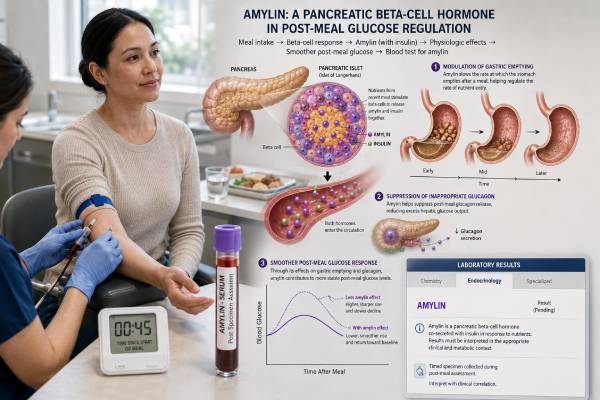
An amylin blood test measures a pancreatic hormone released from beta cells alongside insulin. Amylin helps limit the rise in blood glucose after eating by slowing stomach emptying, reducing meal-related glucagon release, and signaling fullness to the brain. Its other name is islet amyloid polypeptide, or IAPP.
Despite amylin’s important role, blood testing is not part of routine diabetes care. The hormone circulates at low concentrations, rises after food, and can form aggregates that make measurement technically difficult. Laboratories may measure intact amylin, total amylin, proamylin, or specialized molecular forms, so results from different assays are not interchangeable. A low concentration can accompany loss of pancreatic beta-cell function, while a high fasting or meal-stimulated result may occur with insulin resistance and increased beta-cell secretion. Neither pattern diagnoses diabetes on its own. Interpretation requires the exact assay, collection timing, glucose, insulin or C-peptide, kidney function, medication use, and the clinical reason for testing.
- Amylin is co-secreted with insulin and helps control post-meal glucose, stomach emptying, glucagon, and satiety.
- Amylin blood testing is specialized and has no universal normal range or standard diagnostic cutoff.
- Fasting and post-meal values answer different questions, so collection timing must be documented.
- Low amylin may reflect reduced beta-cell function; high amylin may accompany hyperinsulinemia or impaired kidney clearance.
- Pramlintide and investigational amylin drugs can interfere with interpretation depending on assay cross-reactivity.
- An abnormal result should be reviewed with glucose, C-peptide, insulin, and clinical symptoms rather than treated by itself.
Table of Contents
- What Amylin Does
- Why Amylin Is Measured
- Test Types and Sample Timing
- Ranges and Laboratory Limitations
- Low Amylin Results
- High Amylin Results
- Interpreting Amylin With Other Tests
- Follow-Up and Treatment Context
What Amylin Does
Amylin is a 37-amino-acid peptide made primarily by pancreatic beta cells. Those are the same cells that produce insulin. When glucose and nutrients stimulate a healthy beta cell, insulin and amylin enter the circulation together. Insulin helps move glucose into cells and suppresses liver glucose output. Amylin coordinates several other responses that prevent nutrients from reaching the bloodstream too quickly.
Its major physiological actions include:
- Slowing gastric emptying. Food leaves the stomach more gradually, so carbohydrate reaches the small intestine and bloodstream at a slower rate.
- Reducing inappropriate glucagon after meals. Glucagon normally tells the liver to release glucose. Suppressing it when nutrients are arriving helps limit a post-meal glucose surge.
- Promoting satiation. Amylin acts on brainstem and hypothalamic pathways involved in meal size and the sense that enough food has been consumed.
- Coordinating energy balance. Its signaling interacts with leptin, insulin, GLP-1, and other hormones that regulate appetite and metabolism.
Amylin receptors are formed from a calcitonin receptor combined with receptor activity-modifying proteins. Different receptor combinations help explain why amylin can affect several tissues and neural circuits.
The hormone has a second, less helpful characteristic: human amylin can misfold and aggregate. Islet amyloid deposits are common in the pancreas of people with type 2 diabetes. Researchers continue to study whether toxic intermediate forms contribute directly to beta-cell stress and loss or arise mainly as a consequence of prolonged overproduction and impaired processing. A blood amylin measurement does not show how much amyloid is deposited in the pancreas.
Amylin should not be confused with amyloid-beta, the peptide associated with Alzheimer disease. The names sound similar because both can form amyloid structures, but they are distinct molecules produced from different precursor proteins. Specialized research explores possible interactions between them, yet a standard amylin test is not an Alzheimer diagnostic test.
Why Amylin Is Measured
Clinicians rarely order amylin as a first-line test. Standard evaluation of glucose regulation relies on fasting glucose, hemoglobin A1c, an oral glucose tolerance test when appropriate, and sometimes insulin or C-peptide. Amylin testing is used mostly in research, specialist metabolic assessment, drug development, and selected questions about beta-cell biology.
Potential reasons include:
- Measuring fasting or meal-stimulated beta-cell peptide release
- Studying early hypersecretion in obesity or insulin resistance
- Characterizing beta-cell failure in type 1 or type 2 diabetes
- Evaluating hormone patterns after pancreatic surgery
- Monitoring research interventions that alter appetite or islet function
- Investigating amylin processing, proamylin, or oligomer formation
- Supporting pharmacokinetic studies of amylin analogs
A result should have a defined purpose before blood is drawn. For example, a fasting value may be intended to assess baseline secretion, while serial values after a mixed meal may be intended to show the shape and size of the response. Those tests cannot be interpreted with the same expectations.
The measurement is not a substitute for a C-peptide blood test. C-peptide is released in equal molar amounts with endogenous insulin and has a longer half-life, making it much more practical for estimating pancreatic insulin production. Amylin is biologically informative but technically less standardized and less widely available.
Testing may also be considered when a research team wants to distinguish intact biologically active amylin from precursor or aggregated forms. This distinction matters because a high “total” signal does not necessarily mean that a person has a high concentration of active hormone. Some assays detect epitopes shared by intact amylin, partially processed molecules, or aggregates.
Amylin testing does not confirm an insulinoma, diagnose type 1 diabetes, classify type 2 diabetes, or determine whether a person needs insulin. Those decisions depend on established clinical and laboratory criteria.
Test Types and Sample Timing
The words “amylin test” can describe several different laboratory measurements. The report or research protocol should specify what was measured.
Fasting amylin
A fasting sample estimates baseline secretion after an overnight period without calories. The usual fasting interval is 8 to 12 hours when amylin is collected with glucose, insulin, lipids, or C-peptide. Plain water is generally permitted unless the laboratory says otherwise.
A fasting value is easier to standardize than a random value, but it may be very low and close to the assay’s detection limit. It also misses the hormone’s normal meal-related rise.
Meal-stimulated amylin
A mixed-meal tolerance test measures the response to a standardized drink or meal. Blood may be collected before intake and at several later points, such as 30, 60, 90, or 120 minutes. Protocols vary, and the entire response curve may matter more than any one sample.
Stimulated testing can show whether beta cells release amylin as nutrients arrive. However, stomach emptying, the meal’s composition, glucose level, recent exercise, and medicines all affect the response.
Total, intact, and specialized assays
Common research categories include:
| Measurement | What it may detect | Main interpretation problem |
|---|---|---|
| Intact or mature amylin | Fully processed 37-amino-acid peptide | Concentrations are low and the peptide can be unstable |
| Total amylin | A broader group of immunoreactive forms | Assays differ in cross-reactivity with precursors or aggregates |
| Proamylin or processing intermediates | Molecules made before mature amylin | Mostly a research measurement without routine cutoffs |
| Oligomeric amylin | Aggregated molecular assemblies | Methods remain investigational and are not standardized clinically |
| Drug-specific amylin analog | A therapeutic or investigational compound | Requires an assay designed to separate drug from native hormone |
Sample handling can strongly influence results. Laboratories may require chilled tubes, a protease inhibitor, rapid plasma separation, and immediate freezing. Delayed processing can allow peptide degradation or adsorption to collection surfaces. Hemolysis or repeated freeze-thaw cycles may also affect some methods.
Before testing, report all diabetes and weight-management medicines. Pramlintide is an approved amylin analog, while several longer-acting amylin receptor agonists have been studied or developed for obesity. An immunoassay may detect the drug, native amylin, both, or neither accurately. The manufacturer’s cross-reactivity data are essential.
Ranges and Laboratory Limitations
There is no universal normal range for circulating amylin. Values depend on whether serum or plasma is used, fasting status, meal timing, assay design, sample processing, and the molecular form detected. Laboratories may report picomoles per liter (pmol/L), picograms per milliliter (pg/mL), or another unit.
Research studies often find fasting intact amylin in the low-picomolar range in people without diabetes, followed by a several-fold rise after food. The spread between individuals is wide. Because published assays do not always recognize the same forms, copying a cutoff from a paper or another laboratory can be misleading.
The report should answer four questions:
- Was the sample fasting, random, or meal-stimulated?
- Did the assay measure intact, total, proamylin, or oligomeric amylin?
- What specimen and handling procedure were required?
- What reference interval or research comparator applies to that exact method?
A number marked “normal” does not prove that amylin signaling is normal. Receptor sensitivity, gastric emptying, glucagon response, and neural signaling are not measured by the concentration alone. Similarly, an abnormal concentration may reflect a preanalytical problem rather than disease.
Sex, age, body composition, kidney function, and glucose tolerance can shift results. Amylin is cleared partly through the kidneys, so reduced kidney function may increase circulating concentrations. A person with chronic kidney disease should not be compared casually with a healthy research control group.
Biological variation is another limitation. Beta-cell secretion changes with glucose at the moment of collection. A mildly elevated fasting glucose can stimulate more amylin than a lower glucose, even in the same person. For that reason, amylin should be interpreted beside the matching glucose value.
When repeat testing is necessary, use the same laboratory, assay, fasting duration, and meal protocol. Switching methods can create an apparent change that is analytical rather than biological.
Low Amylin Results
Low amylin usually suggests reduced secretion from pancreatic beta cells, but the meaning depends on glucose and collection timing. A low fasting value in a person with low-normal glucose may be expected. A weak stimulated response despite rising glucose may provide more evidence of limited beta-cell reserve.
Type 1 diabetes
In type 1 diabetes, immune destruction of beta cells causes loss of both insulin and amylin secretion. People with little or no endogenous insulin production generally have very low native amylin. Injected insulin replaces insulin’s action but does not replace amylin, which is one reason post-meal glucagon, gastric emptying, and glucose patterns may differ from those of a person without diabetes.
Pramlintide can be prescribed for selected people who use mealtime insulin. It acts as an amylin analog and may reduce post-meal glucose and food intake, but it also increases the risk of hypoglycemia unless mealtime insulin is adjusted appropriately.
Advanced type 2 diabetes
Early in type 2 diabetes, beta cells may release more insulin and amylin to compensate for insulin resistance. As beta-cell function declines, secretion may fall. A low amylin response can therefore occur later in the disease, especially when C-peptide is also low relative to glucose.
This progression is not uniform. Some people retain substantial secretion for many years, while others lose it more quickly. An insulin blood test and amylin can both be affected by the current glucose level and by medications, so clinicians usually rely more heavily on C-peptide for practical assessment.
Pancreatic surgery or pancreatic disease
Removal of part or all of the pancreas reduces the beta-cell mass available to release amylin. Chronic pancreatitis, pancreatic injury, and some forms of pancreatogenic diabetes can also lower secretion. The clinical evaluation includes digestive symptoms, pancreatic imaging or history, glucose, and exocrine pancreatic function rather than amylin alone.
Other explanations
A falsely low result may come from delayed processing, peptide degradation, an assay that detects only one form, or collection during low glucose. Severe calorie restriction and major weight loss can reduce meal-related pancreatic peptide secretion. Medications that reduce glucose or insulin demand may also lower the concentration without causing beta-cell failure.
Low amylin itself is not treated as a laboratory deficiency in most patients. Care focuses on glucose control, nutrition, insulin dosing when needed, and the underlying pancreatic disorder.
High Amylin Results
High amylin can reflect increased beta-cell secretion, reduced clearance, drug exposure, or assay detection of precursor and aggregated forms. The glucose and insulin context separates these possibilities.
Insulin resistance and compensatory secretion
When muscle, liver, and fat respond poorly to insulin, beta cells often compensate by releasing more insulin. Because amylin is co-secreted, fasting or meal-stimulated amylin may also rise. This can occur before glucose reaches the diabetes range.
A pattern of high amylin, high insulin or C-peptide, high triglycerides, and increased waist size may fit insulin resistance. It still does not establish a diagnosis. A HOMA-IR calculation uses fasting glucose and insulin, not amylin, and even that score has assay- and population-related limitations.
Early type 2 diabetes and islet stress
Some people with early type 2 diabetes have increased total amylin output because beta cells are working harder. At the same time, abnormal processing and aggregation may increase. A high circulating result cannot show whether amyloid is forming inside the pancreas, and a low result does not rule it out.
The distinction between active monomeric amylin and oligomeric forms is important. A total assay may show a high signal while biologically active secretion is impaired. Research assays that target oligomers are not yet routine diagnostic tools.
Kidney impairment
Reduced renal clearance can raise amylin concentrations. Creatinine and estimated glomerular filtration rate should be reviewed whenever an unexpected high result appears, particularly in a person with diabetes or hypertension.
Medication or assay interference
Pramlintide or an investigational amylin analog may cross-react with the assay. The timing of the last dose, the drug’s half-life, and the laboratory method must be known. Heterophile antibodies and other immunoassay interferences can also produce an implausible result.
A very high amylin value is not known to diagnose a specific tumor in routine practice. Pancreatic neuroendocrine tumors are evaluated according to symptoms and with validated hormone markers, imaging, and specialist assessment. Amylin-producing tumors are exceedingly rare, and an isolated immunoassay result would require confirmation.
Interpreting Amylin With Other Tests
Amylin is best viewed as one part of a coordinated beta-cell and metabolic response. The most useful companion measurements depend on the question being asked.
| Clinical question | Helpful companion tests | Reason |
|---|---|---|
| Is endogenous beta-cell secretion preserved? | C-peptide and matching glucose | C-peptide is more stable and clinically standardized |
| Is insulin resistance likely? | Fasting glucose, fasting insulin, A1c, triglycerides, HDL cholesterol | Shows compensation and the broader metabolic pattern |
| Is post-meal control abnormal? | Timed glucose, insulin or C-peptide, sometimes glucagon | Aligns hormone changes with nutrient exposure |
| Is kidney clearance affecting the result? | Creatinine and estimated GFR | Amylin concentrations may rise as filtration falls |
| Could an amylin drug affect the result? | Medication record and dose timing | Assay cross-reactivity may mimic endogenous hormone |
| Is pancreatic disease present? | Pancreatic history, imaging, digestive testing | Amylin alone cannot locate or classify pancreatic damage |
Several patterns illustrate why matching samples matter:
- High glucose with low amylin and low C-peptide supports marked beta-cell failure.
- Normal glucose with high amylin and high insulin may reflect compensation for insulin resistance.
- High amylin with reduced kidney function may reflect impaired clearance.
- Low fasting amylin with a strong meal response may be physiologically normal.
- An isolated extreme value with otherwise normal findings raises concern for assay or sample-handling error.
Glucagon adds another layer. Amylin normally suppresses glucagon after a meal. A glucagon blood test is itself technically demanding, and routine care rarely uses paired amylin-glucagon testing. Research protocols may do so to understand why liver glucose output remains high after eating.
The result should not be used to estimate appetite in a simple way. Hunger and fullness reflect many signals, including ghrelin, leptin, GLP-1, meal composition, sleep, medications, stress, and learned behavior. A low amylin concentration does not prove that it caused overeating.
Follow-Up and Treatment Context
Follow-up starts by confirming what the laboratory measured. Ask for the assay name, specimen requirements, detection limit, reference information, and cross-reactivity with amylin medicines. If the result is unexpected, repeat testing under a standardized protocol may be more appropriate than drawing conclusions from one sample.
For a low result, clinicians may focus on:
- Confirming endogenous insulin production with C-peptide
- Reviewing glucose patterns and hypoglycemia risk
- Assessing for type 1 diabetes, advanced type 2 diabetes, or pancreatic disease when clinically indicated
- Adjusting insulin therapy based on glucose data rather than amylin alone
- Considering pramlintide only when it has a clear approved indication and can be used safely
For a high result, follow-up may include:
- Checking fasting status and the matching glucose
- Reviewing insulin, C-peptide, A1c, lipids, and waist-related risk
- Measuring kidney function
- Checking medication and research-drug exposure
- Confirming an implausible result with a validated alternative method
There is no standard treatment aimed at normalizing a native amylin blood level. Lifestyle and medical treatment address insulin resistance, diabetes, obesity, kidney disease, or pancreatic disease according to established outcomes. A falling amylin level is not automatically an improvement, and a rising level is not automatically harmful.
Amylin-based medicines are an active area of metabolic treatment. Pramlintide is a short-acting analog used with mealtime insulin in selected patients. Longer-acting receptor agonists and combinations with GLP-1-based treatment have been studied for obesity because their appetite and gastric effects can complement incretin pathways. Drug effects should not be confused with the interpretation of a native hormone test.
An amylin result is rarely an emergency. Urgent care is warranted for severe hypoglycemia, persistent vomiting with dehydration, diabetic ketoacidosis symptoms, confusion, fainting, or very high glucose with illness. Those conditions are managed using symptoms and established glucose and acid-base testing, not the amylin number.
The test is most informative when collection is carefully timed and the laboratory method is known. Low and high values can each have several explanations, and the combination of glucose, C-peptide, kidney function, and clinical history determines which one fits.
References
- Mediators of Amylin Action in Metabolic Control 2022 (Review)
- Amylin: From Mode of Action to Future Clinical Potential in Diabetes and Obesity 2025 (Review)
- The role of amylin, a gut–brain axis hormone, in metabolic and neurological disorders 2025 (Review)
- Amylin, Another Important Neuroendocrine Hormone for the Treatment of Diabesity 2024 (Review)
- IAPP – oligomerisation levels in plasma of people with type 2 diabetes 2024 (Research Study)
- Amylin Revisited: A 5-Year Perspective on Its Emerging Role in the Treatment of Diabesity 2026 (Review)
Disclaimer
Amylin measurement is a specialized or research-oriented test and cannot diagnose diabetes, insulin resistance, pancreatic disease, or an amyloid disorder by itself. A qualified healthcare professional should interpret the result using the exact assay and sample timing together with glucose, C-peptide or insulin, kidney function, medicines, symptoms, and medical history.