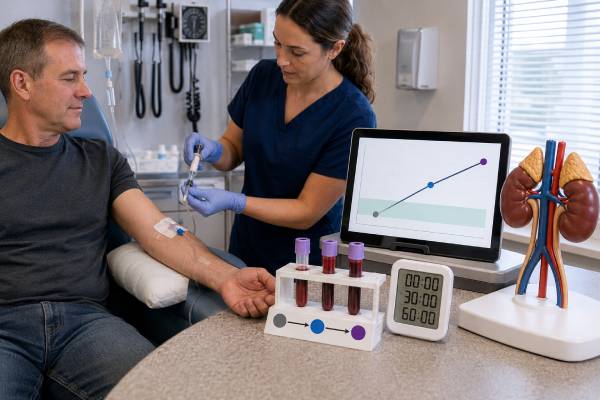
The ACTH stimulation test checks whether the adrenal cortex can produce enough cortisol after an injection of synthetic adrenocorticotropic hormone. The medicine is called cosyntropin or tetracosactide. Blood is drawn before the injection and again at timed intervals, commonly 30 and 60 minutes later. A healthy adrenal gland should respond with a clear cortisol rise.
This test is widely used when a morning cortisol result is indeterminate or symptoms suggest adrenal insufficiency. It performs especially well for established primary adrenal failure, where the adrenal glands themselves are damaged. It can miss very recent secondary or tertiary adrenal insufficiency because adrenal tissue may still respond to a strong synthetic signal shortly after pituitary or hypothalamic ACTH has fallen. Interpretation also depends on the cortisol assay. The historical pass cutoff of 18–20 mcg/dL came from older assays; many modern, more specific methods use lower thresholds near 14–15 mcg/dL. The correct cutoff is the one validated for the laboratory’s method and the protocol’s sampling time.
- A normal response means cortisol reaches the laboratory’s assay-specific threshold after cosyntropin; the absolute peak is usually more important than the size of the rise.
- The standard adult test usually uses 250 mcg of cosyntropin with cortisol measured at baseline and 30 and/or 60 minutes.
- Modern assays often use peak cutoffs around 14–15 mcg/dL, while some laboratories still use the historical 18 mcg/dL threshold.
- A normal test can miss recent central adrenal insufficiency after new pituitary injury, surgery, or glucocorticoid suppression.
- Suspected adrenal crisis should be treated immediately; testing must not delay emergency glucocorticoid and fluid therapy.
Table of Contents
- What the Test Assesses
- Who Needs ACTH Stimulation Testing
- Preparing for the Test
- Procedure and Protocols
- Cortisol Cutoffs and Results
- Limitations and Special Cases
- After the Test and Next Steps
What the Test Assesses
The hypothalamic-pituitary-adrenal, or HPA, axis controls cortisol production. The hypothalamus releases corticotropin-releasing hormone, the pituitary releases ACTH, and ACTH stimulates the adrenal cortex. Cortisol supports blood pressure, glucose availability, immune regulation, and the response to illness or injury. Rising cortisol normally feeds back to reduce hypothalamic and pituitary signaling.
Cosyntropin contains the first 24 amino acids of natural ACTH, the portion that activates the adrenal ACTH receptor. A standard pharmacologic dose provides a strong, short stimulus. If the adrenal cortex has adequate functional capacity, cortisol increases within 30 to 60 minutes.
The result answers a focused question: can the adrenal glands respond to ACTH at the time of testing? It does not directly test the hypothalamus or pituitary. This distinction explains both the strength and the main limitation of the procedure.
In primary adrenal insufficiency, adrenal tissue has been damaged or cortisol synthesis is impaired. The response is usually clearly subnormal. In long-standing central adrenal insufficiency, chronic lack of ACTH causes adrenal atrophy, so the response also becomes subnormal. In newly developed central disease, however, the glands may still respond normally to synthetic ACTH even though the person cannot generate an appropriate signal during everyday stress.
A baseline plasma ACTH measurement collected before cosyntropin helps locate the problem. Low cortisol with high ACTH supports primary adrenal insufficiency; low cortisol with low or inappropriately normal ACTH supports a central cause. ACTH requires a separate chilled EDTA tube and rapid processing.
The test is sometimes called a short Synacthen test, Cortrosyn test, cosyntropin test, or adrenal stimulation test. These names usually describe the same principle, but dose and sampling times may differ. The report should specify the exact protocol.
Who Needs ACTH Stimulation Testing
Clinicians often begin with an early-morning cortisol. A clearly high morning value can make adrenal insufficiency unlikely, while a very low value with compatible symptoms may be strongly suggestive. Intermediate values need dynamic testing because cortisol pulses, binding proteins, and assay differences create a broad gray zone.
Symptoms that may prompt evaluation include:
- persistent fatigue and muscle weakness;
- loss of appetite or unintentional weight loss;
- nausea, abdominal pain, vomiting, or diarrhea;
- dizziness when standing or low blood pressure;
- low sodium, high potassium, or recurrent low glucose;
- salt craving or increasing skin pigmentation;
- prolonged recovery after illness; and
- symptoms during or after glucocorticoid tapering.
Primary adrenal insufficiency can follow autoimmune adrenalitis, bilateral adrenal hemorrhage, infection, infiltrative disease, metastatic cancer, adrenal surgery, or inherited disorders. Central adrenal insufficiency can follow pituitary or hypothalamic tumors, surgery, radiation, trauma, apoplexy, or prolonged external glucocorticoid exposure.
Testing is also used to evaluate HPA-axis recovery after glucocorticoid treatment, although a 2024 guideline generally favors morning cortisol as the first test during tapering and recommends against routine dynamic testing for every patient. The choice depends on the dose, duration, symptoms, and need to prove recovery.
The test is not a wellness screen and does not diagnose “adrenal fatigue,” which is not a recognized medical disorder. People with nonspecific fatigue require evaluation for sleep, mood, anemia, thyroid, cardiopulmonary, medication, and other causes according to their history.
Some people do not need stimulation testing because the clinical situation is already decisive. A person in adrenal crisis needs treatment. At the other end, a robust morning cortisol obtained under suitable conditions may make deficiency unlikely. Testing adds most value in the intermediate zone, when symptoms and risk are meaningful but baseline blood work does not settle the question. Repeating random cortisol samples without a plan is less informative because normal pulses can move the value across a broad range.
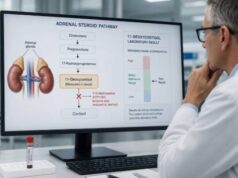
An ACTH stimulation test may also be adapted to evaluate congenital adrenal hyperplasia by measuring precursor steroids such as 17-hydroxyprogesterone before and after cosyntropin. That protocol answers a different question from cortisol reserve and uses different interpretive cutoffs.
Preparing for the Test
Testing is usually scheduled in the morning, although the strong standard cosyntropin dose reduces some time-of-day dependence. Morning testing allows a baseline ACTH and cortisol to be judged against their usual peak and standardizes comparisons.
The most important preparation is a complete glucocorticoid history. Report tablets, injections, inhalers, skin creams, nasal sprays, eye drops, and rectal preparations. Include the exact drug, dose, route, and time of the last dose. Hydrocortisone is chemically identical to cortisol and will be measured as cortisol. Prednisolone can cross-react with some cortisol immunoassays. Dexamethasone usually has little cross-reactivity but suppresses the HPA axis.
Do not skip or stop steroid treatment without explicit instructions. The clinician may arrange a safe interval after a short-acting dose, temporarily use dexamethasone, or interpret the test around treatment. People with established adrenal insufficiency should never risk a crisis merely to obtain an unconfounded sample.
Also report:
- estrogen-containing contraception, hormone therapy, or pregnancy;
- medicines that induce or inhibit steroid metabolism;
- opioid use;
- supplements containing biotin or hormone ingredients;
- critical illness, fever, surgery, severe pain, or recent hospitalization;
- low albumin, liver disease, nephrotic syndrome, or other binding-protein problems; and
- shift work or major sleep disruption.
Estrogen raises cortisol-binding globulin, which can raise total serum cortisol without increasing free cortisol. Low albumin or cortisol-binding globulin can make total cortisol appear low even when biologically active cortisol is adequate. In selected cases, free serum cortisol or salivary cortisol may help, but protocol-specific cutoffs are required.
Fasting rules differ. The test itself does not always require fasting, yet the center may request no food for several hours. Water is usually allowed. Avoid vigorous exercise and arrive early enough to rest. Acute stress from illness or a difficult procedure can raise baseline cortisol, but an unstable patient needs immediate care rather than ideal outpatient conditions.
Procedure and Protocols
For the standard-dose test, an intravenous line is often placed so timed samples can be drawn without repeated needle sticks. Some centers inject cosyntropin into a muscle. The process typically follows these steps:
- Rest and baseline sampling: Blood is collected at time 0 for cortisol and often ACTH. Additional tests may include sodium, potassium, glucose, renin, or aldosterone.
- Cosyntropin administration: A standard adult dose of 250 mcg is given intravenously or intramuscularly according to protocol.
- Timed cortisol samples: Blood is drawn at 30 minutes, 60 minutes, or both. Exact timing matters; tubes must be labeled with the true collection time.
- Observation: Staff monitor for brief flushing, nausea, dizziness, or an allergic reaction. Serious reactions are rare.
The visit often lasts about an hour to 90 minutes. Normal activities usually resume afterward unless the person is ill or received other medicines.
Correct timestamps are as important as correct tubes. A “30-minute” sample taken at 20 minutes may not have reached the expected response, while a late sample compared with a 30-minute cutoff can appear misleadingly reassuring. If an intravenous line fails, staff should document any delay rather than relabeling the sample. The cosyntropin route should also be recorded, because intramuscular absorption may be less predictable in severe circulatory compromise.
Standard-dose and low-dose tests
The 250-mcg test gives a supraphysiologic stimulus and is well standardized for primary adrenal insufficiency. A 1-mcg low-dose test was designed to detect subtler central deficiency. Research results vary, and preparing such a tiny dose requires precise dilution. Adsorption to tubing or dilution error can deliver less than intended and create a false abnormal result.
Some centers use the low-dose protocol for recent pituitary disease, while others prefer the insulin tolerance test, metyrapone test, or a carefully interpreted standard test. A low-dose result should be interpreted only with a locally validated procedure.
Children require weight- or age-adjusted dosing in many protocols. Infants and children younger than 2 years may receive less than 250 mcg. Pediatric cortisol ranges and clinical context also differ, so adult internet cutoffs should not be applied.
The insulin tolerance test evaluates the full HPA axis by inducing controlled hypoglycemia and remains a reference test for central reserve in selected patients. It carries seizure and cardiovascular risks and requires close supervision. It is not appropriate for everyone. Metyrapone tests the integrated axis by blocking cortisol synthesis and measuring the resulting ACTH and 11-deoxycortisol response.
Cortisol Cutoffs and Results
The peak cortisol value is generally the main endpoint. Older guidelines commonly defined a normal response as at least 18–20 mcg/dL, or about 500–550 nmol/L, at 30 or 60 minutes. Those thresholds were derived from older polyclonal immunoassays that measured cortisol plus some related steroids.
Newer monoclonal immunoassays and LC-MS/MS are more specific and often report lower cortisol values from the same sample. Studies support assay-specific cutoffs around 14–15 mcg/dL for several modern methods. Applying 18 mcg/dL indiscriminately can falsely diagnose adrenal insufficiency and expose a person to unnecessary lifelong steroid treatment.
| Result pattern | Possible meaning | Important check |
|---|---|---|
| Peak reaches the method-specific cutoff | Adequate adrenal response | Could recent central disease still be present? |
| Peak remains below cutoff | Adrenal insufficiency is possible | Were steroid exposure, binding proteins, dose, and timing valid? |
| Borderline peak | Assay and clinical context determine classification | Confirm the exact platform and cutoff |
| Low baseline but adequate peak | Reserve may be intact | Recent central deficiency can still be missed |
The increment from baseline is less reliable than the peak because a high baseline leaves less room to rise. Some laboratories consider both, but an arbitrary required increase should not override a validated peak threshold.
For example, a baseline of 13 mcg/dL that rises to 16 mcg/dL may pass a modern assay’s peak rule despite increasing by only 3 mcg/dL. A baseline of 2 mcg/dL that rises to 12 mcg/dL shows a large increment but may still fail the same peak criterion. This is why “it doubled” is not enough. The laboratory’s validated absolute endpoint, timing, and assay determine classification.
The 30-minute and 60-minute values are not interchangeable. Some healthy people cross the cutoff only at 60 minutes. Using only a 30-minute sample may therefore create false failures, depending on protocol and assay. Other centers have validated a 30-minute endpoint. The report must be judged against the matching time-specific criterion.
A failed response confirms inadequate adrenal cortisol reserve but does not by itself distinguish primary from long-standing central disease. Baseline ACTH provides that separation. High ACTH favors primary failure; low or normal ACTH favors pituitary, hypothalamic, or glucocorticoid-related suppression.
Limitations and Special Cases
Recent central adrenal insufficiency
After new pituitary surgery, apoplexy, trauma, or abrupt ACTH suppression, the adrenal cortex may retain enough stored capacity to pass a 250-mcg test. Atrophy develops over time. If clinical suspicion remains high, the endocrinologist may repeat testing later or choose an integrated HPA-axis test. A normal result should not overrule emergency symptoms or a compelling recent history.
Glucocorticoid exposure
Steroids can both suppress the axis and distort cortisol measurement. The duration of suppression varies with dose, potency, timing, route, repeated injections, and individual metabolism. Recovery is not predicted accurately from the calendar alone. The morning cortisol test is often used to track recovery before dynamic testing is considered.
Pregnancy and binding proteins
Pregnancy and oral estrogen raise cortisol-binding globulin and total cortisol. Higher trimester-specific stimulated thresholds may be needed. Low albumin or binding globulin in cirrhosis, nephrotic syndrome, or critical illness can lower total cortisol. Free cortisol testing may help when available, but validated ranges are limited and laboratory consultation is useful.
Critical illness
The standard outpatient test does not cleanly diagnose critical illness-related corticosteroid insufficiency. Critical illness changes binding proteins, cortisol metabolism, distribution, and tissue sensitivity. In shock that does not respond to fluids and vasopressors, treatment decisions rely on critical-care guidance rather than a routine outpatient cutoff.
Cosyntropin is generally safe, but brief flushing, nausea, altered taste, abdominal discomfort, or lightheadedness can occur. Severe allergy is rare. Tell staff about prior reactions to cosyntropin or excipients.
Obesity, age, and ordinary stress do not justify inventing a personal cutoff. Conversely, severe malnutrition, liver disease, nephrotic protein loss, and intensive-care illness can alter binding proteins enough that total cortisol becomes difficult to interpret. When the total result conflicts with the clinical picture, the answer is method-aware reassessment, not automatically starting or withholding long-term steroids.
After the Test and Next Steps
If the response is adequate and no high-risk exception applies, adrenal insufficiency becomes less likely. The clinician can investigate other causes of fatigue, dizziness, weight loss, or electrolyte abnormalities. A normal result after very recent pituitary injury may require planned reassessment.
If the response is subnormal, the paired ACTH guides the next branch. Primary adrenal insufficiency evaluation may include 21-hydroxylase antibodies, renin, aldosterone, electrolytes, adrenal imaging, and testing for infection, bleeding, infiltration, or genetic disease. Central evaluation may include TSH and free T4, prolactin, gonadotropins, sex hormones, IGF-1, and pituitary MRI.
Treatment for confirmed adrenal insufficiency uses physiologic glucocorticoid replacement and education. Primary disease often also requires fludrocortisone and attention to salt intake. Dose selection is clinical; more steroid is not necessarily better. Excess replacement can cause weight gain, diabetes, high blood pressure, bone loss, and Cushing-like features.
Every person with established adrenal insufficiency should receive sick-day rules, medical identification, and training in emergency injectable hydrocortisone when prescribed. Fever, surgery, injury, or significant illness increases cortisol requirements. Vomiting may prevent oral medicine absorption.
Ask these questions when reviewing the report:
- Was this a 250-mcg or 1-mcg protocol?
- Were samples drawn at 30 minutes, 60 minutes, or both?
- Which cortisol assay was used, and what cutoff is validated for each time point?
- Could estrogen, low albumin, or recent glucocorticoid exposure change total cortisol?
- Was baseline ACTH obtained and handled correctly?
- Is recent central insufficiency still possible despite an apparently normal peak?
- Do I need replacement now, repeat testing, or another dynamic test?
If adrenal crisis is suspected, clinicians may draw baseline cortisol and ACTH immediately if that does not delay care, then give hydrocortisone and intravenous saline. Dexamethasone may be used in selected circumstances when future cortisol measurement must remain interpretable, but emergency regimens are clinician-directed.
Repeated vomiting, severe weakness, abdominal pain, dehydration, confusion, fainting, low blood pressure, or shock warrants emergency care. The ACTH stimulation test is a planned diagnostic tool, not a gatekeeper for lifesaving treatment.
Long-term follow-up should revisit whether replacement is still required when the original cause can recover, such as glucocorticoid suppression or some postoperative pituitary states. An abnormal test during early recovery does not always mean lifelong disease. Retesting intervals depend on the cause and current dose. Patients should continue their prescribed protection until a clinician documents adequate recovery; feeling better for a few days does not prove that stress reserve is normal.
Keep the full report, including baseline, 30-minute and 60-minute values, units, drug dose, and assay name. A note that merely says “passed” or “failed” may be impossible to reassess when the laboratory later changes its cortisol method. Complete records also prevent a historical cutoff from being applied to a newer assay.
The report should also document whether cosyntropin was given intravenously or intramuscularly and whether any sample was delayed. These details explain borderline timing patterns.
Situations That Need Individual Interpretation
Recent glucocorticoid exposure is one of the most important reasons an ACTH stimulation result may be difficult to interpret. Tablets, injections, inhalers, creams, and joint injections can suppress the body’s ACTH signal, sometimes for longer than patients expect. Some steroid medicines also cross-react with particular cortisol assays. The prescribing clinician and laboratory should decide whether a dose needs to be timed differently or temporarily withheld; stopping long-term glucocorticoids suddenly can provoke adrenal crisis and should never be improvised.
Pregnancy and oral estrogen increase cortisol-binding globulin, which can raise total serum cortisol. Critical illness, low albumin, kidney or liver disease, and severe inflammation may lower binding proteins or disrupt usual cortisol physiology. These states can make a standard cutoff less dependable. Newer cortisol assays also tend to read lower than older methods, so the laboratory’s validated, assay-specific threshold matters more than a single cutoff copied from another report or website.
Test timing and clinical history remain essential. Early central adrenal insufficiency can produce an apparently adequate response because the adrenal glands have not yet atrophied despite deficient pituitary ACTH. Conversely, a marginal peak in a stable person may need confirmation rather than an immediate lifelong diagnosis. Clinicians may review a paired morning cortisol and ACTH, repeat testing after an appropriate interval, or use a specialist dynamic test when uncertainty would change treatment. Anyone with vomiting, severe weakness, low blood pressure, confusion, or collapse should receive urgent assessment; dynamic testing must not delay treatment when adrenal crisis is suspected.
References
- Glucocorticoid-Induced Adrenal Insufficiency 2024 (Guideline)
- Adrenocorticotropic Hormone (Cosyntropin) Stimulation Test 2023 (Review)
- New Cutoffs for the Biochemical Diagnosis of Adrenal Insufficiency after ACTH Stimulation using Specific Cortisol Assays 2021
- Adrenal Insufficiency 2022 (Review)
- Addison Disease 2024 (Review)
Disclaimer
This information is educational and does not diagnose adrenal insufficiency or set a personal cortisol cutoff. Protocols and thresholds vary by dose, sampling time, and assay. Suspected adrenal crisis requires immediate medical treatment, not delayed outpatient testing.