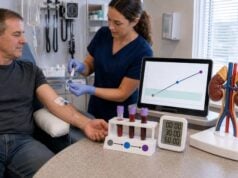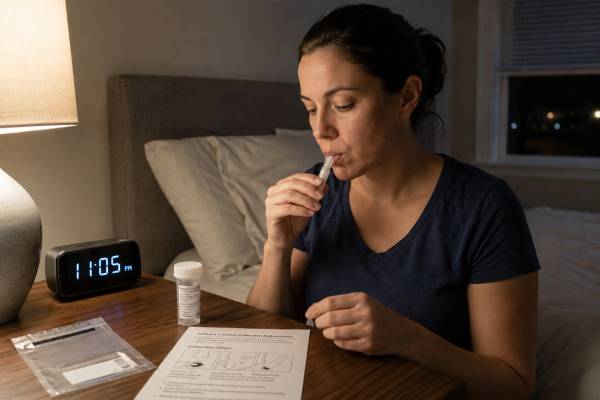
A late-night cortisol test checks whether cortisol falls to its normal low point near bedtime. Healthy cortisol production follows a daily rhythm: levels rise before waking, peak in the morning, and decline toward midnight. Loss of that nighttime low is one of the earliest and most consistent biochemical features of Cushing syndrome. The test is most often performed with saliva collected at home on two separate nights, although some centers use a carefully timed midnight blood sample. A high result does not prove Cushing syndrome. Shift work, irregular sleep, acute stress, depression, alcohol use, smoking, oral bleeding, steroid contamination, and several medical conditions can raise or distort the measurement. The collection must match the person’s usual sleep schedule, and the laboratory’s assay-specific cutoff must be used. Repeated abnormal results in someone with compatible symptoms usually lead to another first-line cortisol test and endocrine evaluation rather than immediate imaging.
- Late-night cortisol should be low during the usual sleep period; repeated elevation can signal loss of the normal cortisol rhythm.
- Late-night salivary cortisol is a recommended first-line screening test for Cushing syndrome, usually collected on two nights.
- One high result is not diagnostic, especially after poor sleep, stress, smoking, alcohol, or sample contamination.
- Shift workers and people with highly irregular sleep may need a different test, because clock time may not reflect their biological night.
- Steroid creams, inhalers, and oral gels can contaminate saliva, so collection instructions and medication review matter.
Table of Contents
- Why Cortisol Is Tested Late at Night
- Who Should Have Cushing Screening
- Saliva and Blood Testing Methods
- How to Collect a Saliva Sample
- Normal and High Late-Night Results
- False-High and Misleading Results
- How Results Fit With Other Cortisol Tests
- Next Steps After an Abnormal Test
Why Cortisol Is Tested Late at Night
Cortisol is made by the adrenal cortex under control of pituitary ACTH. Its secretion is pulsatile and strongly tied to the sleep-wake cycle. In a person with a conventional daytime schedule, cortisol begins rising during the final hours of sleep, reaches its highest average level after waking, then declines through the day. Near midnight, secretion normally reaches a nadir, or low point.
Cushing syndrome disrupts this rhythm. Cortisol may remain elevated late at night even when a morning value still falls within the broad laboratory range. Testing at the expected nadir therefore looks for a loss of normal timing rather than simply an excessive morning concentration.
Late-night salivary cortisol is especially useful because unbound cortisol diffuses from blood into saliva. The sample reflects free, biologically available cortisol and is not directly increased by cortisol-binding globulin. This matters in people taking oral estrogen or during pregnancy, when total serum cortisol can rise because binding protein increases.
The test is a screening tool, not a localization test. It can support the presence of endogenous hypercortisolism but cannot show whether the source is pituitary, adrenal, or ectopic ACTH production. Source testing begins only after cortisol excess is convincingly established.
The biological night matters more than a rigid clock time. A sample collected at 11 p.m. is appropriate only when that is close to the person’s normal bedtime. Someone who routinely sleeps from 6 a.m. to 2 p.m. has a shifted rhythm, and the standard late-night reference interval may not apply. In such cases, an endocrinologist may select a 24-hour urine free cortisol test or dexamethasone suppression test instead.
Late-night cortisol is not a validated measure of ordinary daily stress, burnout, or “adrenal fatigue.” A temporary stressful evening can change a sample, but the test’s clinical purpose is to detect pathological loss of circadian suppression in a carefully selected patient.
Who Should Have Cushing Screening
Cushing syndrome is uncommon, so testing everyone with weight gain, fatigue, high blood pressure, or diabetes would create many false-positive results. Screening is most appropriate when several progressive or unusually specific features occur together.
Features that raise concern include wide purple stretch marks, easy bruising, facial redness, proximal muscle weakness, unexplained osteoporosis, thin skin, slow wound healing, new severe hypertension, difficult diabetes, recurrent infections, menstrual disruption, and rapid changes in body fat distribution. In children, weight gain accompanied by slowed height growth is especially concerning.
Testing may also be appropriate for an adrenal incidentaloma, unusual osteoporosis or hypertension at a young age, or multiple conditions that are unexpectedly severe for age. The decision depends on the entire pattern rather than one symptom.
Before testing for endogenous disease, clinicians ask about exposure to glucocorticoids. Prescription or nonprescription steroids can cause Cushing features and suppress the body’s own cortisol. Sources include tablets, injections, inhalers, nasal sprays, skin creams, scalp solutions, rectal products, and some unregulated supplements. A person may not recognize these products as steroids.
Late-night testing is less reliable in people whose sleep schedule is unstable, those working rotating night shifts, and people with acute severe illness. Pregnancy, uncontrolled psychiatric illness, active alcohol use disorder, and poorly controlled diabetes can also alter the cortisol axis and may require specialist selection of tests.
The Cushing syndrome test panel generally uses one or more of three established approaches: late-night salivary cortisol, 24-hour urine free cortisol, and low-dose dexamethasone suppression. Because cortisol secretion varies, guidelines commonly recommend at least two late-night saliva samples rather than relying on a single night.
Testing should not begin with pituitary or adrenal imaging. Incidental lesions are common and can mislead the evaluation. Biochemical confirmation comes first unless an urgent clinical situation requires a different sequence.
Saliva and Blood Testing Methods
Late-night salivary cortisol is the most convenient method. The patient collects saliva at home, often by chewing or holding a small absorbent device in the mouth or by drooling into a tube. The exact device matters because laboratories validate specific collection materials. Cotton swabs and flavored products can interfere with some assays.
Laboratories measure salivary cortisol by immunoassay or LC-MS/MS. Some also measure salivary cortisone. Cortisone may help identify contamination with hydrocortisone, because topical or oral hydrocortisone can produce a disproportionately high cortisol result. LC-MS/MS can distinguish cortisol from related compounds more specifically, although each method needs its own reference limit.
Midnight serum cortisol is another option. It usually requires admission or a controlled setting because the person must be asleep or resting before blood is drawn without provoking a stress response. An indwelling catheter may be placed earlier so that the draw causes minimal disturbance. A blood sample taken after waking, walking to a laboratory, or experiencing a difficult venipuncture no longer represents an undisturbed midnight nadir.
Serum and saliva results are not interchangeable. Serum cortisol is reported in units such as mcg/dL or nmol/L, while salivary cortisol uses much lower concentrations, often ng/dL, nmol/L, or micrograms per liter. A cutoff from one specimen type or assay should never be applied to another.
Saliva is usually unsuitable when there is active oral bleeding, immediately after dental work, or when a person cannot produce enough specimen. Blood testing may be chosen in those circumstances, although a different screening method is often easier.
A late-night test captures one point in a fluctuating system. Two collections improve reliability, and more may be needed when cyclic Cushing syndrome is suspected. In cyclic disease, periods of high cortisol alternate with normal or low periods, so timing tests during active symptoms can be important.
How to Collect a Saliva Sample
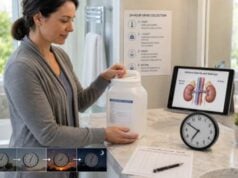
Follow the kit instructions exactly because collection times, devices, storage, and shipping rules vary. A common plan is to collect between 11 p.m. and midnight on two ordinary evenings close to the usual bedtime. The person should remain awake until the sample is obtained unless the laboratory gives different instructions.
For at least 30 minutes before collection, most laboratories advise avoiding food, drinks other than water, smoking, vaping, chewing gum, and toothbrushing. Vigorous brushing or flossing can cause small amounts of blood to enter the sample. Some centers recommend a longer period without tobacco, alcohol, or caffeine.
A practical collection sequence is:
- Choose a typical evening rather than one involving overnight travel, an acute crisis, or unusually strenuous exercise.
- Wash and dry the hands, especially if any household member uses hydrocortisone cream.
- Avoid touching the absorbent portion of the collection device.
- Place the swab as directed or allow saliva to collect in the tube without forceful spitting.
- Record the exact collection time and any unusual event, such as bleeding gums or a missed bedtime.
- Cap the tube securely and store it as instructed, often refrigerated or frozen.
- Return all samples with the completed collection information.
Topical steroid contamination can produce extremely high results. Hydrocortisone cream on fingers is a classic source, but steroid lip balm, oral ulcer preparations, inhaled steroid residue, and a partner’s topical product may also contaminate the specimen. Wash hands thoroughly and discuss the timing of prescribed inhalers or oral steroid products with the ordering clinician.
Do not stop prescribed therapy without instruction. The team may adjust collection timing, document the exposure, or choose another test. Rinsing the mouth immediately before collection is not always recommended because it can dilute the sample; follow the kit rather than improvising.
A sample with insufficient volume, visible blood, an incorrect device, or missing collection time may be rejected. Recollection is preferable to generating a number from a poor specimen.
Normal and High Late-Night Results
A normal result shows that cortisol reached an appropriately low level near the person’s biological bedtime. This makes sustained Cushing syndrome less likely, especially when two correctly collected samples are normal and clinical suspicion is modest. It does not completely exclude mild or cyclic disease.
There is no universal cutoff. Laboratories establish upper limits based on specimen device, assay, units, and collection time. Common LC-MS/MS cutoffs are often around 0.09 to 0.12 mcg/dL, or roughly 2.5 to 3.3 nmol/L, but values vary. The laboratory’s own reference limit should always be used.
| Result pattern | General meaning | Typical response |
|---|---|---|
| Two normal samples | Normal nighttime suppression documented | Reassess clinical probability; further testing may not be needed |
| One high and one normal | Possible variability or collection problem | Review conditions and repeat or use another test |
| Repeated mild elevation | Possible hypercortisolism or persistent confounding | Endocrine review and independent confirmation |
| Repeated marked elevation | Stronger evidence of lost circadian nadir | Prompt confirmation and source workup after diagnosis |
The distance above the upper limit matters. A result just above the cutoff after a poor night’s sleep carries less weight than a value several times the limit on repeated, well-collected samples. Laboratories may also flag a result because it exceeds a population limit even when the clinical significance remains uncertain.
A low late-night cortisol result is usually expected and is not used to diagnose adrenal insufficiency. The test is designed around nighttime suppression, not morning adrenal reserve. Suspected adrenal insufficiency is evaluated with an early-morning cortisol test, ACTH, and often stimulation testing.
Normal late-night saliva can be misleading in cyclic Cushing syndrome if samples are collected during an inactive phase. Repeating saliva across symptomatic and asymptomatic periods may reveal a pattern, but this should be coordinated by an endocrinologist to avoid indiscriminate testing and false alarms.
False-High and Misleading Results
The test is sensitive to disturbances that keep the body alert at the expected nadir. Staying awake far beyond the usual bedtime, working a night shift, exercising intensely, experiencing acute pain, or having a stressful event can elevate cortisol. The effect may be modest or substantial depending on the person and timing.
Smoking and nicotine can raise salivary cortisol. Alcohol use can disturb the cortisol rhythm, and active alcohol dependence can produce a biochemical picture sometimes called non-neoplastic hypercortisolism. Major depression, severe anxiety, poorly controlled diabetes, obstructive sleep apnea, and severe obesity may also increase false-positive rates, although these conditions do not make testing useless in every case.
Oral contamination is particularly important. Blood from gingivitis, a mouth ulcer, or aggressive toothbrushing can introduce serum cortisol. Hydrocortisone contamination can cause an extreme result that bears little relation to internal production. Measuring salivary cortisone or repeating under controlled conditions can help identify this issue.
Other misleading situations include:
- Rotating or irregular sleep schedules.
- Recent travel across time zones.
- Acute infection or hospitalization.
- Pregnancy, especially later trimesters.
- Use of glucocorticoids or products containing hidden steroids.
- Sample collection at the wrong time.
- Inadequate storage or delayed shipment outside laboratory limits.
- Assay interference or a cutoff borrowed from another method.
A false-normal result can occur if cyclic disease is inactive, if the sample is collected too early in the evening, or if saliva is diluted. A person with a very low saliva flow may also produce an unreliable specimen.
The phrase “pseudo-Cushing” has been used for reversible cortisol activation from depression, alcohol use, severe obesity, or uncontrolled metabolic disease. Many specialists now prefer “non-neoplastic hypercortisolism” because the hormone changes are real even though no autonomous tumor is present. Treating the underlying condition and repeating testing can clarify the distinction.
How Results Fit With Other Cortisol Tests
Cushing screening tests examine different features of cortisol physiology. Late-night salivary cortisol tests the daily rhythm. A 24-hour urine free cortisol test estimates integrated free cortisol production over a full day. The low-dose dexamethasone suppression test examines whether synthetic glucocorticoid feedback can suppress morning cortisol.
Agreement between independent tests is more persuasive than repeated copies of the same mistake. For example, two high late-night saliva samples plus failure to suppress after dexamethasone strongly support hypercortisolism when confounders have been addressed. One borderline saliva result with normal urine and normal suppression is less convincing.
Urine testing can be difficult in kidney disease or when collection is incomplete. Dexamethasone testing is affected by estrogen and medicines that alter dexamethasone metabolism. Late-night saliva is less affected by binding proteins but depends on sleep timing and clean collection. The clinician selects tests that fit the patient rather than following a fixed one-size sequence.
After endogenous hypercortisolism is confirmed, plasma ACTH helps determine whether the process is ACTH-dependent. Low ACTH directs attention to the adrenal glands. Normal or high ACTH leads to evaluation for pituitary Cushing disease or ectopic ACTH production. Late-night cortisol itself cannot make that distinction.
Imaging comes after biochemical confirmation because adrenal nodules and small pituitary lesions are common. Finding one before proving cortisol excess can create a false narrative around an incidental lesion.
Next Steps After an Abnormal Test
After a high result, the first step is usually to review collection quality, sleep timing, steroid exposure, oral bleeding, smoking, alcohol, acute illness, and medications. A technically questionable sample is repeated. A valid abnormal result is generally confirmed with another late-night sample or a different first-line test.
When repeated testing supports endogenous Cushing syndrome, referral to endocrinology is appropriate. ACTH measurement, adrenal or pituitary evaluation, and source-specific testing follow. The sequence depends on the ACTH result and severity of cortisol excess.
People with severe hypercortisolism may need treatment before localization is complete. Urgent concerns include serious infection, very low potassium, uncontrolled diabetes, blood clots, heart failure, severe muscle weakness, and psychosis. These complications require prompt medical care.
A normal result may end the workup when clinical suspicion is low. If highly specific symptoms continue to progress, the clinician may repeat testing later or use a different method. Repeated daily testing without a plan can produce random borderline values and unnecessary anxiety.
Useful questions for the follow-up visit include:
- Was the collection time appropriate for my usual sleep schedule?
- Which assay and upper limit did the laboratory use?
- Were both samples abnormal, and by how much?
- Could any steroid product, oral bleeding, or medicine explain the result?
- Which independent cortisol test should confirm it?
- At what point would ACTH testing and imaging become appropriate?
A late-night cortisol result is most valuable when the sample is clean, the timing reflects the biological night, and the result is interpreted as part of a deliberate Cushing evaluation.
Results also need context after treatment for known Cushing syndrome. Endocrinologists may use repeated late-night salivary cortisol during long-term follow-up because reappearance of an elevated nighttime value can precede more obvious recurrence. Post-treatment interpretation is specialized: replacement glucocorticoids, altered sleep, recent surgery, and the expected recovery of the cortisol axis can all affect timing and meaning. A surveillance value should be compared with prior results and the center’s protocol rather than treated like a first screening sample.
Children require pediatric reference intervals and careful attention to bedtime. A sample collected at an adult clock time after a child has already fallen asleep or been awakened may not represent normal conditions. Parents should receive device-specific instructions and should record bedtime, collection time, medicines, and any difficulty obtaining the specimen. Growth charts are central to pediatric assessment because Cushing syndrome commonly slows height gain while weight increases.
People using continuous positive airway pressure for sleep apnea should follow their usual treatment on collection nights unless instructed otherwise. Untreated sleep disruption can activate the stress axis and may contribute to inconsistent results. Similarly, a person with active dental disease may be better served by another screening method until oral bleeding is controlled.
The laboratory report may include both cortisol and cortisone. These values have different ranges and should not be added together. A pattern of very high cortisol with relatively little cortisone can suggest direct hydrocortisone contamination, while concordant elevations are more consistent with internal cortisol production; the laboratory and endocrinologist must make that judgment.
When repeated normal results are reassuring
Two well-collected normal samples substantially lower the likelihood of sustained Cushing syndrome in a patient with modest clinical suspicion. Continued testing is usually reserved for progressive, highly specific features or a suspected cyclic pattern rather than nonspecific symptoms alone.
References
- Consensus on diagnosis and management of Cushing’s disease: a guideline update 2021 (Guideline)
- Late-night salivary cortisol and cortisone should be the initial screening test for Cushing’s syndrome 2022
- Cushing Syndrome: A Review 2023 (Review)
- Pitfalls in the Diagnosis and Management of Hypercortisolism (Cushing Syndrome) in Humans; A Review of the Laboratory Medicine Perspective 2023 (Review)
- Development of diagnostic algorithm for Cushing’s syndrome: a tertiary centre experience 2024
Disclaimer
This information is educational and does not diagnose Cushing syndrome or another cortisol disorder. Late-night cortisol cutoffs depend on the specimen, assay, collection time, and sleep schedule, and abnormal results require clinical confirmation. Do not stop prescribed steroid medicines without medical supervision.