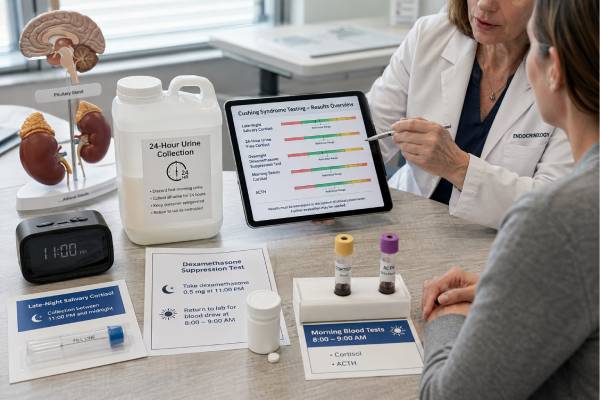
A Cushing syndrome test panel does not mean drawing several random hormones at once. Diagnosis follows a sequence: first exclude external glucocorticoid exposure, then confirm persistent endogenous cortisol excess with validated screening tests, and only afterward use ACTH and imaging to find the source. The main first-line options are two late-night salivary cortisol samples, at least two 24-hour urine free cortisol collections, and a 1-mg overnight dexamethasone suppression test.
Each test examines a different failure of cortisol regulation. Late-night saliva detects loss of the normal bedtime low point. Urine measures free cortisol excreted across a day. Dexamethasone tests whether external feedback can suppress ACTH and cortisol. No method is perfect, and mild or cyclic disease may produce normal and abnormal results on different days. Stress, shift work, depression, alcohol use, uncontrolled diabetes, sleep apnea, kidney function, pregnancy, estrogen, fluid intake, collection errors, and drug interactions can cause misleading findings. ACTH is not used to prove cortisol excess; it is measured after hypercortisolism is established to separate adrenal from pituitary or ectopic causes.
- Confirm Cushing syndrome with late-night salivary cortisol, 24-hour urine free cortisol, or low-dose dexamethasone suppression—not random morning cortisol.
- Collect at least two saliva or urine samples because cortisol secretion varies from day to day and may be cyclic.
- After 1 mg dexamethasone, a morning serum cortisol above 1.8 mcg/dL suggests inadequate suppression but requires context and confirmation.
- Confirmed high cortisol with suppressed ACTH suggests an adrenal source; measurable or high ACTH suggests pituitary or ectopic production.
- Severe infection, low potassium, blood clots, uncontrolled blood pressure or glucose, acute psychiatric change, or rapid decline needs urgent care.
Table of Contents
- Who Should Be Tested
- Late-Night Cortisol Testing
- 24-Hour Urine Free Cortisol
- Dexamethasone Suppression Testing
- ACTH and Source Testing
- Discordant and False Results
- Next Steps and Follow-Up
Who Should Be Tested
Cushing syndrome is the clinical state caused by prolonged excessive glucocorticoid exposure. Cushing disease is one subtype caused by a pituitary ACTH-secreting tumor. Other endogenous causes include adrenal cortisol-producing tumors or nodular disease and ectopic ACTH production from a nonpituitary tumor.
Prescription glucocorticoids are the most common cause overall. Before biochemical testing, review tablets, injections, inhalers, creams, nasal sprays, eye drops, rectal products, and supplements. Some exposures produce Cushingoid features while suppressing the body’s own cortisol, so endogenous screening can be normal or low.
Testing is most useful when several progressive features cluster or a high-discrimination sign is present:
- wide purple or reddish striae, especially wider than 1 cm;
- easy bruising, thin skin, or slow wound healing;
- progressive proximal muscle weakness, such as difficulty rising from a chair;
- facial plethora and increasing supraclavicular or dorsocervical fat;
- osteoporosis or fracture at an unexpectedly young age;
- difficult-to-control hypertension or diabetes;
- menstrual disturbance, hirsutism, low libido, or infertility with other features;
- recurrent infection, low potassium, or unexplained blood clots;
- slowing height gain with continued weight gain in a child; or
- an adrenal incidentaloma requiring cortisol-autonomy assessment.
Common obesity, fatigue, depression, diabetes, or hypertension alone has low specificity. Screening very-low-risk patients produces more false positives than true cases. A clinician should document why the pretest probability is high enough to test.
The best first test depends on sleep schedule, kidney function, medication, pregnancy, ability to collect urine, and whether disease may be mild or cyclic. Often two different abnormal first-line tests are used to confirm the diagnosis.
Children require a different threshold for concern. Simple obesity usually preserves or accelerates height growth, while endogenous Cushing syndrome commonly slows linear growth as weight rises. Pubertal delay, headaches, hypertension, acne, or mood change may accompany it. Pediatric endocrinology selects age-appropriate saliva, urine, and dexamethasone protocols.
An adrenal incidentaloma creates another distinct pathway. Mild autonomous cortisol secretion may lack classic Cushing features and often leaves UFC within range. The 1-mg dexamethasone test is usually the most sensitive starting assessment, followed by ACTH, comorbidity review, and individualized decisions about surgery or monitoring.
Late-Night Cortisol Testing
Healthy cortisol reaches a low point around habitual bedtime. Many people with Cushing syndrome lose this circadian nadir before daily cortisol becomes dramatically high. Late-night salivary cortisol measures the free hormone that diffuses into saliva and can be collected at home without venipuncture stress.
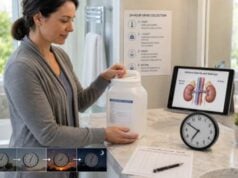
Most protocols request two samples on separate nights around 11 p.m. or the person’s specified bedtime. Use only the supplied swab or tube. Follow local instructions, which commonly include:
- avoid eating, drinking, smoking, vaping, or brushing teeth for at least 15–30 minutes;
- rinse the mouth earlier if instructed, then allow it to clear;
- collect at the exact clock time without touching the swab with steroid-contaminated hands;
- record bedtime, sample time, medicines, and unusual stress; and
- store and return samples as directed.
Blood from gum disease, dental work, or vigorous brushing can contaminate saliva. Topical hydrocortisone on the hands or face can cause a striking false elevation. Licorice, tobacco, and some collection devices or assays may also affect results.
Shift workers and people with irregular sleep schedules need individualized timing. Collecting at 11 p.m. is not meaningful if that is the middle of the person’s active day. Acute illness, severe sleep disruption, depression, and poorly controlled diabetes can raise late-night values.
The cutoff is assay-specific. Many U.S. laboratories use an upper limit near 0.1–0.15 mcg/dL, but the report’s range takes priority. Two normal, correctly collected results make persistent ACTH-dependent Cushing syndrome less likely, yet mild adrenal cortisol autonomy or cyclic disease may still require another test.
Salivary cortisone may be reported with cortisol by some LC-MS/MS laboratories. Cortisone can help detect contamination or improve collection assessment in selected protocols, but decision limits are method-specific. A result from one laboratory should not be interpreted with another laboratory’s published cutoff.
If a sample is insufficient, visibly bloody, or collected at the wrong time, it should be repeated rather than averaged with a valid sample. The collection log is part of the test, not optional paperwork.
Midnight serum cortisol is a specialized alternative that may require an acclimatized inpatient setting. A blood draw performed immediately after waking or distress can create a stress rise. Saliva is generally more practical for repeated outpatient assessment.
24-Hour Urine Free Cortisol
Urine free cortisol, or UFC, measures unbound cortisol filtered across an entire day. It is not influenced by cortisol-binding globulin in the same way as total serum cortisol. At least two complete 24-hour collections are recommended because output varies.
For each collection, discard the first morning void and record the start time. Collect every subsequent void for 24 hours, including the final urine exactly at the end time. Keep the container chilled or preserved as instructed. If one void is missed or spilled, the collection usually needs to be restarted.
Urine creatinine helps assess completeness. A low value can indicate missed urine; a high value may reflect overcollection, high muscle mass, or other factors. Total volume and exact start and end times should accompany the result.
UFC may be falsely high with very high fluid intake, physiologic stress, severe depression, alcohol-related states, poorly controlled diabetes, or collection longer than 24 hours. It can be falsely low with incomplete collection or reduced kidney filtration. An estimated GFR below about 60 mL/min/1.73 m² reduces reliability.
The upper limit varies by assay, often around 40–60 mcg/24 h in adults. A value more than three times the upper limit is strongly suggestive when exogenous steroids and collection problems are excluded. Mild elevation needs confirmation. Mild Cushing syndrome can have normal UFC because free cortisol may not exceed the renal threshold enough to raise daily excretion.
The 24-hour urine free cortisol collection is particularly useful for quantifying substantial hypercortisolism and monitoring selected treatments. It does not identify the source.
Urine cortisol should be compared as a multiple of the laboratory’s upper limit, not against a fixed internet value. LC-MS/MS and immunoassay intervals differ. A person collecting two jugs for the same 24-hour period must return both with one total volume; submitting only one makes the result falsely low.
For children, daily excretion may be adjusted for body surface area. For pregnancy, physiologic UFC rises, especially after the first trimester, so nonpregnant limits can overdiagnose disease. Kidney impairment shifts the choice toward tests that do not depend on filtration.
Dexamethasone Suppression Testing
Dexamethasone is a potent synthetic glucocorticoid that should suppress pituitary ACTH and endogenous cortisol in people without autonomous cortisol production. It has little cross-reactivity with most cortisol assays.
In the common overnight protocol, the patient takes 1 mg dexamethasone around 11 p.m. and has serum cortisol drawn between about 8 and 9 a.m. the next morning. Exact dose and times must be followed. A cortisol at or below 1.8 mcg/dL, or 50 nmol/L, generally indicates adequate suppression for sensitive screening. A value above that threshold is abnormal but not diagnostic by itself.
False nonsuppression can occur when:
- dexamethasone was taken late, missed, or vomited;
- phenytoin, carbamazepine, rifampin, or another inducer increases dexamethasone clearance;
- absorption is impaired;
- estrogen raises cortisol-binding globulin and total cortisol;
- severe stress, alcohol use, depression, or another non-neoplastic state activates the HPA axis; or
- the cortisol assay has interference.
Medicines that inhibit dexamethasone metabolism can increase exposure and potentially cause more suppression. Measuring serum dexamethasone alongside cortisol can verify adequate drug concentration when the result is questionable.
Oral estrogen commonly causes false-positive total-cortisol results. A clinician may arrange a safe pause for about six weeks or choose urine or salivary testing. Pregnancy needs specialist testing because normal cortisol physiology and dexamethasone considerations differ.
The 48-hour low-dose test gives 0.5 mg every six hours for two days in a supervised schedule. It may be used when the overnight result is equivocal or non-neoplastic hypercortisolism is difficult to separate. The low-dose dexamethasone test confirms impaired suppression; high-dose dexamethasone is a different, less definitive source test and should not be used as the first proof of Cushing syndrome.
Obesity alone does not invalidate dexamethasone testing, but severe depression, alcohol use, and uncontrolled metabolic disease can produce nonsuppression. Measuring dexamethasone, repeating after stabilization, or using an independent rhythm or urine test can distinguish inadequate drug exposure from persistent cortisol autonomy.
Do not take extra dexamethasone if a dose was forgotten. Contact the testing center and reschedule. An improvised dose changes the protocol and can suppress cortisol beyond the intended window.
ACTH and Source Testing
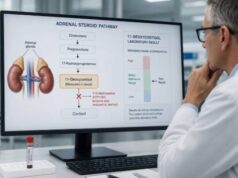
ACTH comes after endogenous hypercortisolism is confirmed. It divides the causes into ACTH-independent and ACTH-dependent groups.
| ACTH pattern | Likely category | Next direction |
|---|---|---|
| Suppressed, often below about 5–10 pg/mL | ACTH-independent adrenal cortisol production | Adrenal imaging and subtype assessment |
| Clearly measurable or high, often above about 20 pg/mL | ACTH-dependent disease | Pituitary versus ectopic evaluation |
| Intermediate | Indeterminate | Repeat correctly handled ACTH and integrate other findings |
Thresholds vary by assay. ACTH is fragile and requires a chilled EDTA tube with rapid processing; degradation can falsely suggest an adrenal source. Repeat an incongruent result.
With suppressed ACTH, adrenal CT evaluates adenoma, carcinoma, or bilateral nodular disease. For an adrenal incidentaloma, the 1-mg dexamethasone test is commonly used to assess mild autonomous cortisol secretion, which may not elevate UFC or late-night saliva strongly.
With measurable or high ACTH, pituitary MRI is performed. A pituitary lesion does not automatically prove Cushing disease because small incidental lesions are common and some true corticotroph tumors are invisible. CRH or desmopressin stimulation may add evidence, but responses overlap.
Bilateral inferior petrosal sinus sampling, or BIPSS, compares ACTH in venous drainage from the pituitary with peripheral blood. It is the reference method for distinguishing pituitary from ectopic ACTH when biochemical and MRI findings do not align. Hypercortisolism must be active and confirmed before the procedure; BIPSS does not diagnose Cushing syndrome by itself.
Ectopic ACTH evaluation may include chest and abdominal imaging and functional imaging tailored to suspected neuroendocrine tumors. Severe rapid cortisol excess, low potassium, infection, and muscle weakness can suggest an ectopic source, but no single feature is definitive.
High-dose dexamethasone, CRH, or desmopressin tests can support pituitary versus ectopic classification, but none has perfect accuracy. A pituitary tumor may fail to respond, and an ectopic tumor may show a misleading response. BIPSS remains decisive when noninvasive results are discordant and surgery is contemplated.
ACTH-independent disease also has subtypes. Unilateral adenoma, adrenocortical carcinoma, primary bilateral macronodular adrenal hyperplasia, and primary pigmented nodular adrenocortical disease differ in imaging, age, genetics, and treatment. Suppressed ACTH identifies the category but not the exact subtype.
Discordant and False Results
Discordance is common in mild disease. One abnormal and one normal test should trigger review, not averaging. Confirm specimen quality, timing, assay, medicines, kidney function, sleep, estrogen, alcohol use, mood, diabetes, and the evolution of physical features.
Non-neoplastic hypercortisolism, sometimes called pseudo-Cushing syndrome, can accompany severe depression, alcohol use disorder, poorly controlled diabetes, eating disorders, extreme obesity, or obstructive sleep apnea. These conditions can alter rhythm and suppression. Treating the underlying driver and retesting may normalize results.
Cyclic Cushing syndrome produces alternating periods of excess and remission. A symptom diary with dated photos, blood pressure, glucose, sleep, and clinical changes can help time repeated late-night saliva or UFC. Dexamethasone testing during a quiet phase can be normal. Multiple results over time are more useful than one random cortisol.
Different first-line tests answer different questions:
| Test | Strength | Main limitation |
|---|---|---|
| Late-night saliva | Home collection; detects rhythm loss | Shift work, contamination, and sleep disruption |
| 24-hour UFC | Integrated free cortisol output | Collection burden and low kidney function |
| 1-mg DST | Convenient and sensitive for adrenal autonomy | Drug interactions and estrogen-related binding effects |
Pregnancy raises total and free cortisol, particularly later in gestation. UFC with pregnancy-aware thresholds is often preferred; dexamethasone and late-night values require expert interpretation. Children need pediatric ranges and often show growth deceleration as a distinctive clue.
No panel should be ordered during uncontrolled acute stress without recognizing the false-positive risk, unless the severity of suspected hypercortisolism makes immediate assessment necessary. In severe disease, treatment of complications may begin while source testing continues.
Laboratory disagreement can also be analytical. Immunoassays may cross-react with related steroids, while LC-MS/MS results depend on extraction and calibration. A dramatic result inconsistent with every other finding deserves laboratory consultation, repeat collection, and review for synthetic glucocorticoids rather than an immediate scan.
Exogenous Cushing syndrome can coexist with suppressed endogenous results. A patient using potent topical steroid under occlusion or an inhaled steroid with a metabolism-inhibiting drug may have Cushingoid features, low ACTH, and low cortisol. That pattern is not an adrenal tumor and requires a supervised medication plan to avoid withdrawal crisis.
Next Steps and Follow-Up
The diagnostic sequence protects against incidental findings:
- Exclude external glucocorticoids. Review every route, supplement, and drug interaction.
- Confirm endogenous cortisol excess. Use repeated, validated first-line tests suited to the patient.
- Measure ACTH. Classify adrenal versus ACTH-dependent disease.
- Localize the source. Use adrenal imaging, pituitary MRI, BIPSS, or ectopic-tumor imaging as indicated.
- Assess and treat complications. Check blood pressure, potassium, glucose, infection, thrombosis, bone, and psychiatric risk.
Surgery to remove the source is generally first-line when feasible. Medical therapy can reduce cortisol production, lower ACTH in selected pituitary disease, or block the glucocorticoid receptor. Radiation or bilateral adrenalectomy is used in selected cases. Treatment belongs in an experienced multidisciplinary center.
After successful treatment, cortisol may be low because the normal HPA axis was suppressed. Temporary glucocorticoid replacement and sick-day education are often needed until recovery. Recurrence can occur years later, particularly after pituitary surgery, so long-term monitoring is essential. Late-night salivary cortisol may detect recurrence early in some patients.
Recovery of muscle strength, skin, blood pressure, glucose, bone, mood, and body composition takes different amounts of time. Biochemical remission is the first milestone, not the end of care. Thrombosis risk, infection, fractures, cardiovascular disease, and mental health may require continued treatment after cortisol normalizes.
People treated with cortisol-lowering medicines need surveillance for adrenal insufficiency. Nausea, vomiting, weakness, dizziness, or low pressure may indicate overtreatment or rapid cortisol decline. Drug-specific monitoring can include liver tests, potassium, blood pressure, ECG, or interactions. Dose changes belong with the endocrine team.
Ask the endocrinologist:
- Which first-line test best fits my sleep, kidney function, medicines, and pregnancy status?
- Were two saliva or urine measurements obtained?
- Could estrogen, dexamethasone metabolism, fluid intake, or collection error explain the result?
- Is cortisol excess confirmed strongly enough to interpret ACTH?
- Does the ACTH sample meet handling requirements?
- Is imaging finding the source or merely an incidental lesion?
- Do I need urgent treatment for potassium, infection, clot risk, glucose, blood pressure, or psychiatric symptoms?
Seek urgent care for chest pain, breathing difficulty, one-sided weakness, severe infection, confusion, acute psychosis, extreme blood pressure or glucose, or symptoms of a blood clot. Severe Cushing syndrome can become medically urgent even though the diagnostic workup usually occurs in stages.
A reliable Cushing panel is a sequence of independent physiologic tests, not a single bundle. Repeated confirmation before source imaging and careful handling of discordant results prevent both missed disease and unnecessary tumor treatment.
When Screening Tests Disagree
Different Cushing syndrome tests examine different parts of cortisol physiology, so disagreement is not unusual. Late-night salivary cortisol tests whether the normal nighttime low point has been lost. Urine free cortisol estimates unbound cortisol production over a full day. Dexamethasone suppression tests whether an external glucocorticoid signal can turn cortisol production down. A mild abnormality in one pathway may appear before the others, while poor collection, sleep disruption, medication effects, alcohol use, depression, acute illness, or assay interference may create a misleading result.
The response should match the strength of the evidence. A clinician may repeat the same test under better-controlled conditions or choose another validated first-line method. Cyclic Cushing syndrome requires particular patience because cortisol production can alternate between active and quiet periods; testing during a symptomatic phase and documenting changes in weight, bruising, blood pressure, glucose, menstrual pattern, or muscle strength can help. Hair cortisol and other emerging approaches are not routine substitutes for established testing.
ACTH measurement and imaging belong after endogenous cortisol excess has been supported. Finding a pituitary or adrenal lesion first can misdirect the evaluation because incidental abnormalities are common. Once the biochemical pattern is convincing, ACTH helps divide ACTH-dependent from ACTH-independent disease and guides targeted imaging or specialized procedures. Severe infection, uncontrolled diabetes, dangerous hypertension, blood clots, psychosis, profound weakness, or rapidly worsening symptoms may require expedited specialist or hospital care while the source evaluation proceeds.
References
- Consensus on Diagnosis and Management of Cushing’s Disease: A Guideline Update 2021 (Consensus Guideline)
- Cushing’s Syndrome 2024 (Review)
- Consensus on the Diagnosis of Cushing’s Disease: A Guideline Update 2026 (Consensus Guideline)
- Approach to the Patient: Diagnosis of Cushing Syndrome 2022 (Review)
- Diagnosis of Cushing’s Syndrome Guideline Resources 2008 (Guideline)
Disclaimer
This article is educational and cannot diagnose Cushing syndrome or identify a tumor source. Test cutoffs and preparation vary by assay, medicine, sleep schedule, kidney function, and pregnancy. Severe complications or rapid deterioration require urgent medical care.