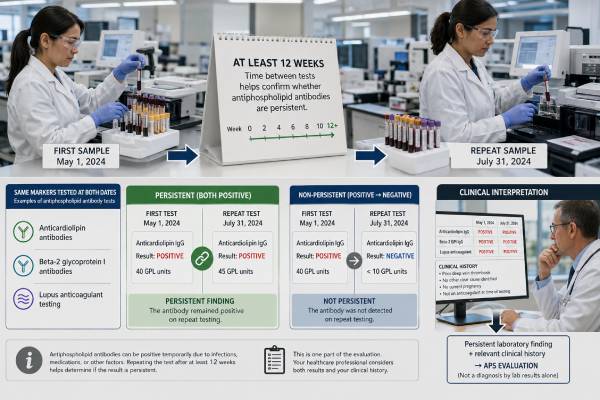
Antiphospholipid antibody repeat testing is used to determine whether an abnormal result is persistent rather than temporary. For antiphospholipid syndrome assessment, a criteria antibody is generally confirmed on a second blood sample collected at least 12 weeks after the first positive sample. The interval matters because infections, inflammatory illnesses, medications, pregnancy-related changes, and normal laboratory variation can produce short-lived or misleading results.
Repeat testing is not simply a duplicate order. The clinician should repeat the correct antibody group, use a comparable assay, account for anticoagulant interference, and connect the laboratory findings to a documented clinical event. Lupus anticoagulant requires especially careful timing because warfarin, heparin, and direct oral anticoagulants can create false-positive or false-negative patterns. Anticardiolipin and anti-beta-2 glycoprotein I immunoassays are less directly affected by anticoagulants but still need consistent methods. Two positive tests do not diagnose APS unless the clinical history also fits.
- A second positive criteria antibody test should usually be collected at least 12 weeks after the first.
- Testing sooner than 12 weeks may confirm a technical result but does not establish required persistence.
- The repeat panel should include lupus anticoagulant, anticardiolipin IgG/IgM, and anti-beta-2 glycoprotein I IgG/IgM when appropriate.
- Anticoagulants can strongly distort lupus anticoagulant assays and require laboratory or specialist planning.
- Use the same laboratory and method when possible so values and categories remain comparable.
- Persistent antibodies without thrombosis or qualifying pregnancy morbidity do not automatically mean APS.
Table of Contents
- Why Repeat Testing Is Required
- How to Count the 12-Week Interval
- Which Antiphospholipid Tests to Repeat
- Anticoagulants and Lupus Anticoagulant Interference
- Comparing the First and Second Results
- Pregnancy, Infection, and Other Timing Situations
- APS Diagnosis After Repeat Testing
- A Practical Repeat-Testing Plan
Why Repeat Testing Is Required
Antiphospholipid antibodies can be persistent autoimmune markers or temporary immune responses. A single abnormal result cannot reliably separate those possibilities. The repeat requirement reduces false diagnoses and prevents patients from being labeled with a chronic thrombotic disorder because of a short-lived antibody.
Transient positivity can occur with:
- viral or bacterial infection;
- acute inflammation;
- some medications;
- recent hospitalization or surgery;
- pregnancy and postpartum immune changes;
- laboratory interference or sample problems;
- low-level background autoantibodies.
Persistence is especially important because an APS diagnosis can influence long-term anticoagulation, pregnancy treatment, surgery planning, contraception, and the interpretation of future clots. Those decisions carry bleeding and other risks.
The 12-week concept applies to the accepted criteria antibodies: lupus anticoagulant, anticardiolipin IgG/IgM, and anti-beta-2 glycoprotein I IgG/IgM. A repeat result from a non-criteria marker may add context, but it does not substitute for persistent criteria testing.
A negative first panel usually does not need automatic repetition. Retesting may be appropriate when the sample was drawn under technically difficult conditions, when clinical suspicion remains high, or when the event and testing timing were poorly aligned. Repeating broad panels without a clinical reason increases borderline findings and confusion.
Repeat testing is confirmation, not screening by persistence
The repeat rule is sometimes misunderstood as a requirement to test everyone twice. It is not. A second sample is mainly needed after a relevant first positive result or when the first test may have been unreliable. Repeating a clearly negative, technically sound panel in a person with low clinical suspicion is unlikely to improve care.
The rule is also not permission to keep testing until one sample becomes positive. Every assay has normal variation, and repeated low-probability testing eventually produces incidental abnormalities. The clinician should define the clinical question before ordering another panel: confirm persistence, resolve interference, complete an incomplete first evaluation, or reassess after a new event.
Once APS is well established, routine annual reconfirmation is often unnecessary. A later negative antibody does not erase a prior qualifying persistent profile or automatically justify stopping anticoagulation. Retesting may still be useful for a specific treatment or diagnostic question, but it should not become a substitute for clinical follow-up.
How to Count the 12-Week Interval
The second sample should be collected at least 12 full weeks after the first positive sample. Twelve weeks is 84 days. The interval is measured from blood-draw date to blood-draw date, not from the date the result was viewed or the follow-up appointment was scheduled.
For example, if the first sample was drawn on January 2, the earliest qualifying repeat date is generally March 27, assuming 84 days have passed. A sample taken at 10 or 11 weeks may be clinically informative but does not meet the usual persistence interval.
There is no requirement to draw the repeat test exactly on day 84. Testing at 13, 16, or more weeks can still establish persistence. Delays may be reasonable when a patient is recovering from infection, changing anticoagulation, or waiting until postpartum.
| Interval | What it can show | What it cannot show |
|---|---|---|
| A few days to 4 weeks | Possible confirmation of an unexpected technical result | Persistent APS antibody positivity |
| 8 to 11 weeks | Whether the result is still present | The standard minimum 12-week persistence interval |
| 12 weeks or more | Persistence when the same criteria antibody remains appropriately positive | APS diagnosis without a compatible clinical event |
| Years later | Long-term antibody status | Automatic proof that all intervening events were caused by APS |
If the first result was collected during acute infection, waiting until recovery and at least 12 weeks may provide a cleaner answer. When treatment decisions are urgent, clinicians may act on the clinical event while confirmation is pending rather than delay necessary care.
Which Antiphospholipid Tests to Repeat
A complete criteria panel is often preferable to repeating only the initially abnormal marker. Antibody profiles can be single, double, or triple positive, and the complete pattern influences risk assessment.
The standard groups are:
- Lupus anticoagulant: a functional assessment using phospholipid-dependent clotting tests, commonly including dilute Russell viper venom time and an activated partial thromboplastin time–based method.
- Anticardiolipin IgG and IgM: solid-phase antibody assays.
- Anti-beta-2 glycoprotein I IgG and IgM: solid-phase antibody assays against a major phospholipid-binding protein.
Repeating only anticardiolipin may miss a persistent lupus anticoagulant or anti-beta-2 glycoprotein I result. Conversely, repeating lupus anticoagulant without considering anticoagulants may produce an uninterpretable panel.
A complete APS blood test panel makes the second time point easier to compare with the first. The clinician may omit a component for a documented reason, but the reason should be clear.
Non-criteria markers such as aPS/PT, anti-phosphatidylserine, anti-prothrombin, or anti-phosphatidylethanolamine do not have the same established repeat requirement. A specialist may repeat them to assess reproducibility, ideally with the same laboratory, but persistence does not turn them into criteria antibodies.
Anticoagulants and Lupus Anticoagulant Interference
Lupus anticoagulant testing is the most technically vulnerable part of repeat evaluation. The test relies on clotting times, and anticoagulant drugs also prolong or alter clotting times.
Direct oral anticoagulants
Apixaban, rivaroxaban, edoxaban, and dabigatran can create false-positive or false-negative lupus anticoagulant patterns. The effect varies by drug, concentration, reagent, and testing algorithm. A sample drawn at a trough level is not guaranteed to be reliable.
Some laboratories use drug-removal products or measure drug levels, but these approaches have limitations. The ordering clinician should discuss the plan with the coagulation laboratory or a hematologist.
Heparin
Unfractionated heparin and low-molecular-weight heparin can interfere with clotting assays. Some reagents contain heparin neutralizers effective up to a stated level, but protection is not unlimited. Timing relative to the last dose and the assay design matter.
Warfarin
Warfarin lowers vitamin K–dependent clotting factors and can make lupus anticoagulant interpretation difficult. Mixing patient plasma with normal plasma, alternative assays, or testing during a medically supervised change in anticoagulation may be considered. None should be attempted without a safe clinical plan.
Never stop an anticoagulant solely to repeat APS testing without instructions from the prescriber. A temporary interruption can cause recurrent thrombosis. In some cases, the safest choice is to defer lupus anticoagulant confirmation while repeating solid-phase antibodies, or to use a specialist laboratory strategy.
Anticardiolipin and anti-beta-2 glycoprotein I immunoassays are generally less directly distorted by anticoagulants. They can often be measured while treatment continues, although the overall clinical interpretation still needs context.
Why the laboratory needs the medication list
A coagulation laboratory cannot interpret lupus anticoagulant testing safely if it does not know that an anticoagulant is present. The request should name the drug, dose, last administration time, and reason for therapy. Kidney impairment can prolong exposure to some direct oral anticoagulants, making a nominal trough sample less reliable.
Heparin-neutralizing reagents have maximum capacities. If the heparin concentration exceeds that capacity, a false lupus anticoagulant pattern may remain. Drug-removal products can reduce direct oral anticoagulant interference, but incomplete removal and changes to the sample are possible. Results should state whether a mitigation method was used and whether residual drug was assessed.
When no safe and validated strategy is available, “unable to interpret while anticoagulated” is better than a confident but incorrect positive or negative report.
The lupus anticoagulant reflex panel should be reviewed as a sequence of screening, mixing, and phospholipid-confirmation evidence rather than as one isolated number.
Comparing the First and Second Results
A repeat test is useful only if the two time points are comparable. The same antibody class, assay, unit, cutoff, and laboratory should be used when possible.
| First result | Repeat result at 12+ weeks | Typical interpretation |
|---|---|---|
| Low-positive anticardiolipin | Negative | Transient or nonpersistent result; does not establish criteria persistence |
| Moderate/high anticardiolipin IgG | Moderate/high on same assay | Persistent criteria antibody finding |
| Positive lupus anticoagulant while on a DOAC | Negative with reliable drug-free or mitigated testing | Initial result may have reflected medication interference |
| Positive anticardiolipin IgM | Positive anti-beta-2 glycoprotein I IgG only | Profile changed; each result needs individual review rather than assuming persistence of the first marker |
| Triple positive | Triple positive | Persistent high-risk laboratory profile when testing is technically valid |
Persistence usually means the same criteria antibody remains positive. A first positive anticardiolipin IgM followed only by a positive beta-2 glycoprotein I IgG does not prove persistence of the original IgM, although the second result may have its own significance.
Small numerical changes are less important than category and persistence. A value changing from 48 to 43 units may represent normal variation. Switching laboratories can create a larger apparent change because methods are not fully interchangeable.
Keep both complete reports. Screenshots that omit units, cutoffs, or anticoagulant notes are insufficient for specialist interpretation.
What counts as a meaningful change
For anticardiolipin and anti-beta-2 glycoprotein I, a shift from clearly moderate or high to negative is more meaningful than a movement near the cutoff. For lupus anticoagulant, the entire interpretation matters: screening ratios, mixing behavior, confirmation, anticoagulant status, and laboratory conclusion. One raw dRVVT number does not establish persistence.
A changed profile is not unusual. Antibody classes may rise or fall, and one component may disappear while another remains. The clinician should state which marker persisted rather than simply writing “APS panel still positive.” This precision affects classification, risk stratification, and future comparison.
Pregnancy, Infection, and Other Timing Situations
Pregnancy and postpartum testing
Pregnancy creates practical challenges. A patient with a high-risk obstetric history may need treatment before repeat confirmation is complete. Clinicians may make a provisional plan based on the history and first result, then confirm persistence later.
Lupus anticoagulant testing during pregnancy can be influenced by physiologic changes and anticoagulation. Low-molecular-weight heparin timing needs coordination. When feasible, postpartum confirmation may provide a more stable setting, but postponing testing should not postpone necessary obstetric care.
Acute thrombosis
Testing during an acute clot can be complicated by inflammation, factor changes, and immediate anticoagulant treatment. Solid-phase antibodies may still be informative, but lupus anticoagulant results require caution. A reliable repeat after recovery may be essential.
Infection
Infection can cause temporary anticardiolipin or other antiphospholipid antibodies. When the result is low and the clinical setting does not require immediate classification, waiting until recovery and repeating at 12 weeks or later helps avoid mislabeling.
Autoimmune flares
Lupus activity can change immune markers, but APS antibodies are not simply disease-activity tests. A flare may be recorded as context; repeat testing still focuses on persistence and assay validity.
Transfusion or plasma exchange
Recent plasma products or plasma exchange can alter measured antibodies. The treating specialist and laboratory should determine when a later sample will reflect the patient’s own steady state.
APS Diagnosis After Repeat Testing
Persistent antibody positivity is necessary for accepted APS laboratory classification, but it is not sufficient by itself. APS combines laboratory evidence with a clinical syndrome.
Clinical manifestations include documented venous, arterial, or microvascular thrombosis and defined pregnancy morbidity. The 2023 ACR/EULAR classification system also considers cardiac valve, hematologic, and other weighted domains. Classification criteria are primarily designed for research; clinical diagnosis still requires judgment.
After repeat testing, several outcomes are possible:
- Persistent criteria antibodies plus a qualifying event: supports APS assessment and may fulfill classification depending on the full criteria.
- Persistent antibodies without a clinical event: antibody positivity or an asymptomatic aPL profile, not automatically APS.
- Clinical event with nonpersistent antibodies: APS becomes less likely; other causes should be evaluated.
- Strong clinical history with negative criteria antibodies: may prompt review of test validity, timing, and selected non-criteria antibodies, but “seronegative APS” remains a specialist and debated concept.
- Technically invalid lupus anticoagulant testing: the diagnosis may remain unresolved until reliable testing is possible.
The repeat result should not be read in isolation from the event date. The 2023 criteria use a defined relationship between laboratory and clinical findings for classification. Even outside research, very remote or poorly documented events require careful review.
Persistent positivity also affects risk differently according to profile. Lupus anticoagulant and triple positivity usually indicate greater thrombotic risk than an isolated low-titer solid-phase antibody.
A Practical Repeat-Testing Plan
A clear plan prevents missed intervals, unsafe medication changes, and incomparable assays.
- Record the first draw date. Count 84 days to identify the earliest qualifying repeat date.
- Save the full first report. Include units, cutoffs, method, and all panel components.
- List current anticoagulants. Note drug, dose, last dose time, kidney function, and why treatment is required.
- Ask the laboratory about lupus anticoagulant validity. Do this before collection, not after an uninterpretable result.
- Repeat the appropriate complete panel. Use the same laboratory when possible.
- Avoid acute infection when clinically reasonable. Do not delay urgent care merely to improve testing conditions.
- Document the clinical event. Bring clot imaging, obstetric records, and dates.
- Schedule interpretation, not just collection. A clinician should compare both time points and explain what changed.
Do not repeatedly test every few weeks while waiting for the 12-week mark. Those results do not establish persistence and can create confusing fluctuations.
Do not stop anticoagulation on your own. If reliable lupus anticoagulant testing requires a medication change, the prescriber must balance thrombosis risk, bridging options, and laboratory timing.
After the second result, ask whether the same antibody persisted, whether the assay was valid, and whether the clinical event meets APS definitions. Also ask how the result changes medication, pregnancy planning, surgery precautions, hormone use, or follow-up. A diagnosis should lead to a coherent care plan, not merely a permanent label in the chart.
Patients can prepare by bringing both laboratory reports, a medication list, and a dated event timeline. For thrombosis, include the imaging report and whether the event followed surgery, immobility, estrogen, pregnancy, or cancer. For obstetric evaluation, include gestational ages, ultrasound findings, placental pathology, and blood-pressure complications. These details determine whether laboratory persistence has diagnostic meaning.
If the repeat is negative, ask whether any part of the first test could still be clinically relevant and whether further testing is truly needed. If the repeat remains positive, ask whether the result is isolated, double positive, or triple positive and what that implies for risk. Clear answers reduce both unnecessary anticoagulation and missed prevention.
References
- An update on laboratory detection and interpretation of antiphospholipid antibodies for diagnosis of antiphospholipid syndrome: guidance from the ISTH-SSC Subcommittee on Lupus Anticoagulant/Antiphospholipid Antibodies 2025 (Guidance)
- Guidelines on the investigation and management of antiphospholipid syndrome 2024 (Guideline)
- The 2023 ACR/EULAR Antiphospholipid Syndrome Classification Criteria 2023 (Classification Criteria)
- Lupus Anticoagulant Testing for Diagnosis of Antiphospholipid Syndrome: A Perspective Informed by Local Practice 2025 (Review)
- Testing for the lupus anticoagulant: the good, the bad, and the ugly 2024 (Review)
- Lupus anticoagulant testing during anticoagulation, including direct oral anticoagulants 2022 (Review)
Disclaimer
This article provides general information about APS repeat testing and does not replace individualized laboratory or medical advice. Never interrupt anticoagulation to improve lupus anticoagulant testing unless the prescribing clinician has created a safe plan. Persistent antibodies must be interpreted with a documented clinical history before APS is diagnosed.